a model is an abstraction often represented using mathematics that describe some pattern and that pattern can be static like a snapshot or dynamic like a movie models are used everywhere in our lives most commonly to predict the weather and are invaluable tools in the study of infectious disease Biology one of the goals of modeling when trying to describe a complex process like an epidemic is to pair down the number of processes that you represent to only those that are necessary to adequately represent the pattern of course how far to pair down that list and what
constitutes an adequate representation of the pattern isn't necessarily objective the golden rule for developing models was best stated by Albert Einstein when he said that everything should be made as simple as possible but not simpler there are an infinite number of possible ways to develop models of epidemic processes but we can come up with some broad dichotomies one of the major dichotomies in infectious disease modeling is whether to represent the population as many individuals or as broad compartments that describe groups of individuals perhaps the most famous class of models in epidemiology are of this latter
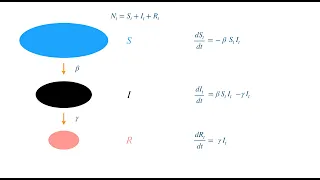
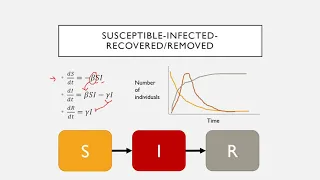
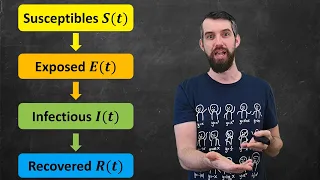
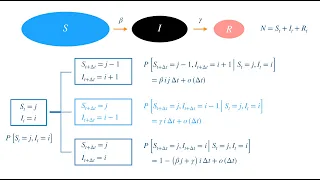
type the so-called suceptible infectious recovered or sir class of compartment models here we divide the population into three classes of individuals those that are susceptible to infection represented by the Box s those that are infectious represented by the box I and those that are recovered and immune to infection represented by the Box R though each of these boxes contains many individuals we can still represent the change in infection through time as the way the number of individuals in each compartment changes susceptible individuals move to the Infectious class when transmission occurs and infectious individuals move to
the recovered class when they cease to be infectious thus taking a large population and simplifying it down to only three components which can be represented by only three equations though very simple this allows us to calculate simple analytical summaries of how such models will behave such as calculating the basic reproductive number or not or the vaccination threshold necessary to achieve herd immunity the downside to this is that we must treat each individual in each compartment as though they are the same which is something times too simple in that case we can still subdivide the population
into any arbitrary number of compartments that represent the set of Divisions that we think are relevant to the process for example perhaps we think that children transmit at a different rate than adults so each class of s i and r should be subdivided based on age so long as the number of subdivisions isn't too great we can still calculate all the simple analytical summaries albeit using some more complicated mathematics of course if you subdivide the population into enough compartments such that each contains only one person then you're in the realm of so-called individual-based models representing
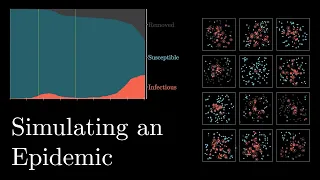
each individual in a population is computationally intensive but allows us to move away from the simplifying assumption that all individuals do the same thing and represent the kind of individual variability that we know exists in real populations in general these models are too complex to solve analytically and we often need to use computers to simulate epidemics in these models in order to see the patterns that emerge from the set of rules that we put in another important dichotomy in infectious disease modeling is whether or not the outcomes are deterministic that is predetermined by the rules
of the model or stochastic that is variable each time the model is evaluated the simplest way to think of this is in accounting for the change of infectious individuals through transmission if I have 100 susceptible individuals and they each get infected at a rate of 10% per day then if I constrain my model to be deterministic I know that after one day I'll have 90 susceptible individuals and 10 infected individuals and the next day I'll know that there are 10 individuals that can subsequently infect others and so on so even at the start I know
what will happen in the future however if I say that the probability of any individual getting infected after one day is 0.1 then it's like each of those 100 individuals flipping a coin that comes up heads 10% of the time on average 10 of them will get infected but sometimes only seven will and sometimes 13 will this has important consequences for what would then happen the following day if only seven got infected then there are fewer individuals to be sources of infection the next day and the outbreak might grow slow if 13 got infected the
outbreak might grow faster the coin flipping analogy makes sense for the way we see the world work lots of things whether they are up to chance or not behave as though they are however interpreting the outcomes of models that are stochastic is difficult if I run the model forward and only seven people get infected the first day I might think that the epidemic would always tend to grow slower it's only if I evaluate many outcomes of the model model that I would see that there is a range of outcomes that might happen on the next
day and a range of outcomes that might happen the day after that and the farther I go out the harder it is to predict deterministic models can be useful because they can characterize what the average outcome might be in a very simple and interpretable way stochastic models though more challenging to interpret are useful when we want to represent the uncertainty in potential outcomes where the prediction at any time is a range rather than a point this is important when we consider how to evaluate models the observation of an epidemic through time might follow a generic
shape but with lots of fluctuation in the number of infections from time to time a deterministic model might get the average shape of the pattern well but never accurately predict any one outbreak a stochastic model might provide a range at each time that captures all the observed points but only provides a fuzz the answer there are two major uses of models models are often used to describe the patterns that we've already observed in the past and models are commonly used to try to forecast patterns that might occur in the future in the best case scenario
models are developed and evaluated based on their ability to replicate the patterns of the past then used to try to predict the future and we can express our confidence in the prediction of the future based on their ability to replicate the past we can then use these models to project things like how fast might an epidemic spread in a new population or which vaccination strategy would limit cases the most invariably the projections of a model are likely to be wrong the future is inherently challenging to predict but the utility of models lies in their ability
to help us pair down a complicated world to a relatively simple and tractable set of explanations and in the extent to which they can at least provide some picture however hazy of what the future may hold