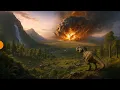
There was a time when the Earth breathed in silence. A time when no man called it home. The forests were seas of green, and the seas.
. . oceans of light.
Life flourished everywhere, free, wild, ancient. It was the Cretaceous. A time of colossi, of creatures so large they seemed sculpted by the gods.
On land, Triceratops roamed in herds under a sun that knew no winter. In the skies, enormous Pterosaurs cut the air like living sails. In the seas, monsters with fins and teeth reigned over silent abysses.
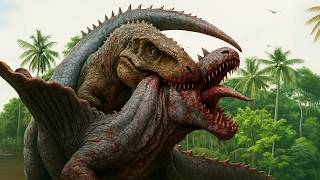
And among them, on land, the undisputed king: the Tyrannosaurus rex. Two tons of muscle, claws, fangs, and an instinct as old as the Earth. It was a world perfect in its ferocity.
Every creature had a role, every heartbeat a meaning. Herbivores fed on the immense ferns and conifers that covered entire continents. The carnivores hunted at dawn, when the light colored blood and dew.
It was balance, it was life, it was pure power. Yet, even in that harmony, fate was unfolding. None of those beings knew that every step, every breath, every glance would be the last in a world.
Above them, far away, in the darkness of space, something was changing. A fragment of rock, born from the collision of ancient celestial bodies, had begun a journey. A journey that lasted millions of years.
It crossed the asteroid belt between Mars and Jupiter, silent, invisible, inevitable. And the Earth, unaware, continued to rotate, cradled by its blue sky. The seasons passed slowly, the mountains grew, the oceans shifted.
It was a living planet, but vulnerable. And in that immensity, a single grain of space was enough to change everything. That grain was coming.
And no one could stop it. Under that blue sky, the Earth seethed with energy. Volcanoes erupted in chains of fire, rivers of lava carved out new continents.
Every tremor, every explosion was a breath from the planet. A world in constant flux, where life adapted, grew, and multiplied. Across the great plains of the North and in the broad valleys at the foot of the mountains, herds of Ankylosaurs advanced slowly and heavily, their bone armor glinting in the sunlight like living shields.
Further south, herds of Hadrosaurs crossed the rivers, their calls echoing through the valleys like ancient songs. In the swamps, small Compsognaths moved in groups, swift and curious, while among the ferns, more agile predators hid, waiting. In the forests, new plant species flourished as never before.
Insects carried pollen among ancient flowers, and the sky echoed with the beats of wings that had not yet known fear. Among the branches, primitive birds experimented with flight. The Microraptor, its dark, shiny feathers, glided among the trees as the sun filtered through the foliage like liquid light.
And beneath the roots, tiny mammals lived in the shadows, alert, wary, but already ready for a future they didn't yet know they possessed. It was a world full of movement and voice, of birth and death. A fragile balance, suspended above an invisible abyss.
Everything worked, everything lived. That world was so perfect that only an apocalyptic end could match it. The asteroid, after millions of kilometers, had entered Earth's neighborhood.
It entered its gravitational field and accelerated. It exceeded the Moon's orbit. Its course tilted toward the atmosphere.
Ahead of it, the air began to compress and heat up; the surface became incandescent. From the ground, a continuous trail appeared, ever brighter. Only moments remained until it entered the densest layers.
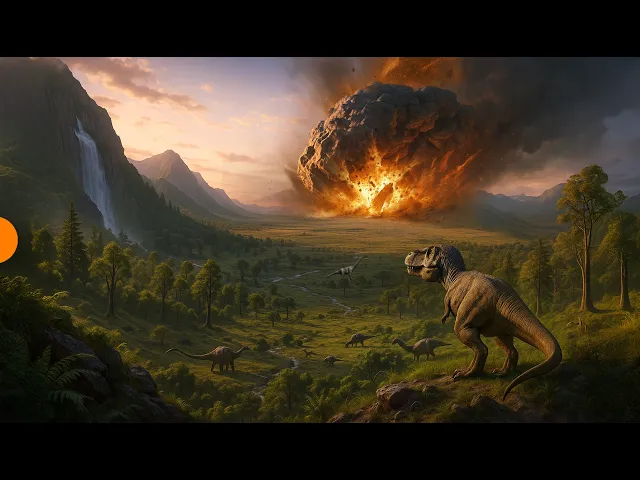
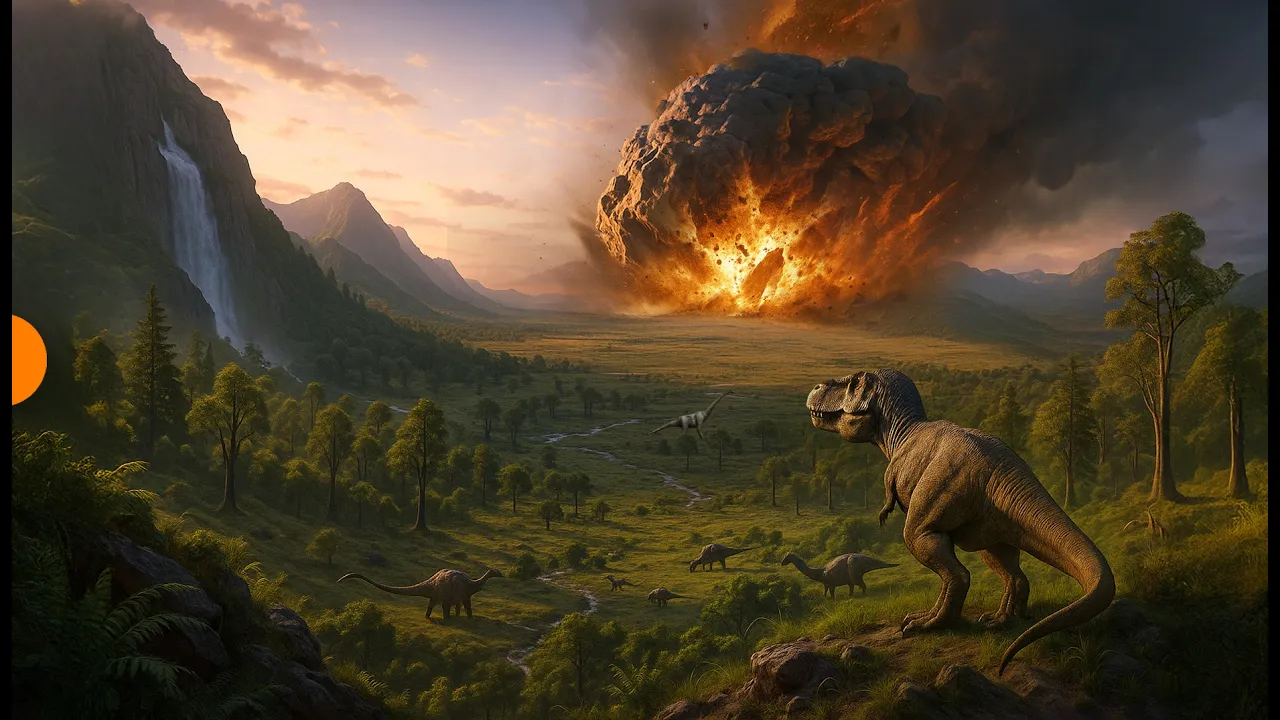
Then it became a fire. A fiery orb that grew by the minute, hurtling at over 70,000 kilometers per hour. A body ten kilometers across, but with a force beyond any weapon man could ever have imagined.
Its target: the Yucatán Peninsula, in present-day Mexico. There, where the sea bends in a perfect arc, fate was about to strike. Beneath it, the dinosaurs were experiencing their last dawn.
No one looked up. No one could understand what was happening. The sky began to change color.
The birds stopped singing. The animals froze, as if the Earth itself were holding its breath. Then came light.
A flash that blotted out the sun. A roar that had no echo, because it surpassed sound itself. Time stood still.
The asteroid crossed the last few kilometers of sky in less than a breath. Its wake ignited the atmosphere, lighting up the day like a thousand suns. And then, it struck.
The sea exploded upward, vaporizing in an instant. The impact released energy equal to more than 100 million megatons. The Earth's crust folded like a veil of sand, the rock melted, the sky ignited.
In a radius of thousands of kilometers, nothing survived. A shock wave swept across the entire planet. Trees bent and then disappeared, instantly burned.
The air itself became flame. A wave rose in the sea, more than a kilometer high. Shards of rock and metal were hurled to the edges of the world.
The tsunami swept across the oceans, sweeping coastlines thousands of kilometers away. The seas rose, then retreated, carrying everything away. The planet transformed into a howl.
But it wasn't over. Fragments of light began to fall from the sky. They were the rocks hurled by the impact, which, after circling the world , returned, incandescent.
Little stars fell by the thousands, illuminating the newborn darkness. At first they were isolated flashes, then a continuous, incessant rain. Day and night merged into a single inferno.
After the impact, the Earth was no longer the same. The sunlight no longer filtered through. The once blue sky had become a wound of smoke and flame.
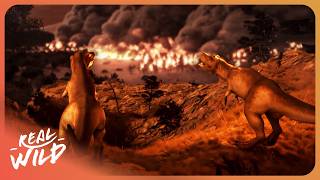
The rain of incandescent rocks continued for hours, then for days. Each falling fragment ignited new fires, new seas of flame. The forests disappeared in a single breath.
The oceans boiled, raising poisonous vapors. Animals sought refuge, but there was no refuge. The air was fire.
The ground was glass. On the surface, the temperature exceeded a thousand degrees. The entire planet turned into a furnace.
Even the rocks deformed, flowing like wax. Flames raced beyond the horizon, fueled by wind and pain. The largest dinosaurs collapsed, suffocated by the heat.
Rivers evaporated. Clouds vanished. Only the sound of earthquakes accompanied the silence of destruction.
The Earth trembled relentlessly, as if struggling to free itself from the weight of its fate. The impact had opened a wound more than 20 kilometers deep and 180 kilometers wide. The crater remained hidden beneath the sea, but the scar was now forever etched into the Earth.
The shock waves circled the globe multiple times, reflecting off oceans and mountains. Each vibration erased something: a forest, a lake, a breath. In a matter of hours, entire ecosystems disappeared.
The day turned black. And in the darkness, ash fell. A fine, dense dust that covered everything.
It settled on the seas, on the bodies, on the mountains, on the open eyes of the giants. It was the dust of the end. Yet, even as everything burned, something survived.
Underground, in the rivers, in the burrows, small lives resisted. Insects, amphibians, mammals. Forgotten creatures, that no one had ever looked at.
They hid in the mud, in the trunks, in the holes between the rocks. And in that darkness, the future began to take shape. The dust raised by the impact remained suspended in the atmosphere for months, then years.
It blocked the light of the sun. Day and night became blurred. The entire world plunged into an eternal twilight.
Temperatures plummeted. The planet's heat dispersed into space. The wind carried with it ash, sulfur, death.
Photosynthesis stopped. Plants, deprived of light, began to die one after another. The herbivores found nothing left to eat.
And when they fell, the predators followed. The Tyrannosaurus rex, which once ruled the land, roamed the charred trees, searching for something to devour. The Triceratops, once in majestic herds, were now alone, slow, and tired.
Hunger consumed them, the cold bent them. The Earth had become a frozen tomb. In the sea, the algae disappeared.
Food chains collapsed. Even the ancient sea monsters disappeared, suffocated by a liquid silence. And so, one after another, the giants vanished.
Not in a day, but in slow, merciless time. Each species took a last step, a last breath, a last look. The Earth, once full of life, now breathed only ash.
But beneath that gray blanket, something still moved. There, in the darkness, the first heart of the future beat. Years passed.
Then decades. The dust began to slowly settle. The sun filtered again, weak, through the clouds of death.
And the ice began to melt. Above the now silent Earth, the first light of the new world settled. A world without dinosaurs.
A world waiting to begin again. At first, there was only silence. Then, a breath.
A light breeze crossed the gray plains, raising the ash like gold dust. The sun, pale and distant, returned to warm the Earth. The first drops of rain washed the blackened soil.
The water penetrated the cracks in the earth and, beneath them, found forgotten seeds. And those seeds, against all logic, sprouted. Life returned.
Slowly, timidly, fragile. Moss on the rocks, ferns among the burnt trunks, small flowers opening their petals to a new light. The Earth breathed again.
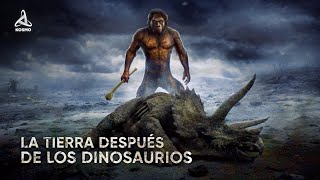
The insects reappeared first, followed by the smaller reptiles, the surviving birds, the mammals that had waited in the darkness. Those who once lived hidden now dominated the plains. Where once the giants walked, light, agile, silent creatures ran.
The world had changed forever. The ages of reptiles were over. The age of mammals had begun.
The darkness dissolved. Light filled the sky again, as if time had begun to breathe again. The planet, wounded and transformed, began to heal.
The mountains continued to grow, the oceans shifted, the winds reshaped the deserts like invisible hands recreating the world. And with them, life began to dance again. It was not the same as before.
It was new, different, more fragile but also more intelligent, more adaptable. The Earth had not forgotten what had happened; it bore it engraved in its rocks, in its fossils, in the bones buried under millions of years of silence. Every time we walk a mountain today, or pick up an ancient stone, we walk on the memory of that day.
The day the Earth stopped. The extinction of the dinosaurs was not just the end of an era. It was the spark that lit the next.
Because from that destruction the seeds of our history were born. Millions of years later, in those same lands, the first creatures capable of looking at the sky and wondering where they came from would appear. Creatures capable of remembering, of building, of dreaming.
Us. The Chicxulub impact didn't destroy life. It transformed it.
And in that instant, in that second of pure devastation, a new era began. One day, perhaps, our civilization too will end. The sky will darken again, the tides will change, the stars will burn elsewhere.
But life will find a way. Always. Because life doesn't give up.
It transforms, adapts, begins again. And so, the time that stopped one day continued to flow, right up to us. It wasn't the end of life.
It was only the beginning of us. And if you too believe that the world's memory should not be forgotten, follow Eclesso. Here, every story becomes voice.
Every silence comes back to life.