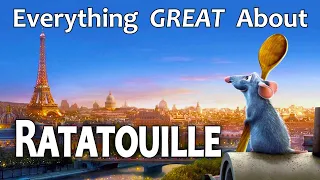
“A man can always change things. That’s what makes him different from the barnyard critters. ” Among the entire Pixar catalogue, the movie Ratatouille is arguably *the* best that the studio has to offer, and it stands as one of the most significant contributions to the medium of film as a whole.
However, many people generally dismiss the movie, praising its climax as the only good part, while ignoring its thematic structure as well as its commentary on excellence and the importance of embracing the new. Ratatouille is a movie that deserves a closer examination to better understand how it stands as a celebration of the greatness of humanity. The film is centred on Remy’s journey, a rat living in the countryside, as he discovers what it means to be human.
In the opening scenes of the movie, Remy is demonstrated as having a very sensitive palate, allowing him to identify the finer ingredients in food. However, his true defining characteristic is his deep self-respect and self-love. “This much I knew: If you are what you eat, then I only want to eat the good stuff.
” As the noble soul has reverence for itself, by loving himself and wanting the best out of life, Remy desires more to match his large soul. And this is what makes him fond of humans, whom he considers special. “I know I’m supposed to hate humans but there’s something about them.
They don’t just survive, they discover, they create; just look at what they do with food! ” Throughout the runtime of the movie, the audience observes from an outsider’s perspective the central elements that make humanity unique from all other animals. This is established by presenting several interconnected dichotomies, one of which is comparing eating finely cooked meals over garbage.
“Food is fuel. If you get picky about what you eat, your engine is going to die. " "Now shut up and eat your garbage.
" The difference between eating fine cuisine and garbage is a universal component that distinguishes humans from animals, between existing to live instead of merely to survive. In a general sense, animals interact with reality to obtain the basic necessary sustenance so that they can continue existing. They conform to their environment and never intentionally create anything new.
But in comparison, humans are different: we not only survive but we thrive; we discover, we create, and ultimately, we live. Humanity has recognized in many ways that reality is a playground for creativity, where any individual can achieve greatness if they pay attention to their surroundings. “Good food is like music you can taste.
Color you can smell. " There is excellence all around you; you only have to be aware to stop and savor it. ” It is no coincidence that, upon hearing those words, Remy not only discovered his love for food, but understood the essence of what it means to be human.
The act of cooking serves as the backbone of the movie, representing not only the collective achievements of mankind, but also as an example of all creative endeavours. At its core, cooking is a form of art in and of itself, encapsulating the fundamentals of all arts: the integration of materials within reality to convey values and potentially evoke emotional responses. By understanding the taste and flavour of every ingredient and selectively merging the right ones together, something new is created.
However, what differentiates fine cuisine from garbage is the understanding of how each element integrates. For example, when Linguini attempts to cook, he acts randomly, without any conscious effort or selective thought, creating a soup that induces vomit. If an individual does not respond and create with proper selectivity and thought, a net negative is created; something worse than the sum of its parts.
But in comparison, when Remy cooks, he smells every ingredient available to him, only choosing the proper flavour that meshes with the whole. The result is a food critic praising the soup as a revelation. This conscious effort represents the split dichotomy between cooking and garbage, between art and trash, displaying the unique power of humanity: a synergy of creativity, where every particular choice is deliberate in creating something that is elevated beyond what can be generally found in reality.
However, merely observing reality and selectively choosing is only a segment of what makes humans unique. Our ability to understand and grasp reality also permits humanity the capacity to be self-aware and to control our actions, setting personal standards that emphasize creativity. In a general sense, standards are the limiting factors you impose upon yourself and reality to achieve a higher degree of excellence.
Animals are incapable of having self-awareness for their actions; they observe and engage with reality, but only in a practically automatic capacity by reflex to survive, never striving for anything more. In comparison, at the beginning of the movie, as Remy accepts his passion for cooking, he begins to walk on his back paws so as to not contaminate his food. While humans evolved to naturally walk on two legs, Remy chooses to do so because of his intense love for food.
Upon finding a mushroom and high-quality cheese, he is overjoyed, recognizing the potential greatness that both ingredients have to offer. He feels that something special should be protected and improved upon rather than be thrown away as garbage. These principles of applied standard in regards to food selectivity is another foundation of what it means to be human, and it is done at the highest level of human functionality.
As Remy becomes more accustomed to the human world by cooking through Linguini, the audience learns from Collette the extreme expectations of cooking in a high-class restaurant. “What are you doing? ” “I’m, uh, cutting vegetables?
” “No, you waste energy and time. You think cooking is a cute job, eh? Like mommy in the kitchen?
Well, mommy never had to face the diner rush when the orders come flooding in, and every dish is different, and none are simple, and all have different cooking time, but must arrive on the customer’s table at exactly the same time, hot and perfect. " "Every second counts and you cannot be mommy! ” Concentrating your efforts with proper standards is necessary because humans desire to experience a greater quality of life as the expectation from all creative endeavours.
However, there is another element that can be emphasized to further excellence: the potentiality of nature, enhanced by other individuals that strive to provide their own excellence. “The only way to obtain the best produce is to have the first pick of the day. And there are only two ways to get the first pick: grow it yourself, or bribe a grower.
" "Voila! " "The best restaurant get first pick. ” By pursuing creative action with high standards and working with the best life has to offer, individuals can achieve a status akin to that of a god; creating an integrated sum total that evokes an experience of pure joy, making life and reality mutually shine.
Humanity does not merely create for its own sake; we do it to make life worth living. But this begs the question: what makes Remy special compared to all other rats? Why is he able to act like a human?
At the midpoint of the movie, upon reuniting with his father, Remy explains that he has been living closely with humans, and that he is no longer interested in being chained to his family. His father is displeased and shows him the practical truth: there can never be any coexistence between rats and humans. Rats will always be seen as a pest to be murdered; all that can be done is to accept the reality that this cannot be changed.
Remy’s father accepts a deterministic view of reality: everything is as it is and nothing can ever change, escaping death and surviving is the only possible future. “The world we live in belongs to the enemy. ” But Remy points out the flaw of his belief: “Dad, I don’t believe it.
You’re telling me that the future is, can only be, more of this? ” “This is the way things are. You can’t change nature.
” “Change is nature, dad. The part that we can influence. And it starts when we decide.
” Change is part of nature, and any animal with the ability of volitional choice can become the change that breaks the perceived cycle of malevolence in the world. Volition is the cognitive power of your mind to interact with reality. By focusing, adhering to and conceptually understanding the properties of reality, you can enact selective choices with life-affirming values that can improve the standard of living.
EVERY-SINGLE-HUMAN *IS* capable of volitional choice; we are not mere pawns whose life is determined absolutely by factors outside our control. Your destiny is what you create. In the setting of Ratatouille, humans generally discriminate against rats, perceiving them as disgusting creatures.
However, that does not mean that this view cannot be challenged or improved. Change is gradual, slow and at times may never be seen in hindsight, but it can only happen if we take action. By enacting your will and volition, you can change the world, and all that is required is having the courage to take the first step forward.
“Where are you going? ” “With luck, forwards. ” This scene represents the underlying strength that makes it possible to set and follow your own standards, to strive for excellence and to create something new.
And it is the soul of the movie, reminding the audience that everyone is capable of focusing on what is worthwhile in life, and that you must take responsibility for every choice you make. As Aristotle pointed out millennia ago: humans are categorized as a rational animal compared to all other species, and that humanity can be rational due to our ability to conceptualize, become self-aware of our actions, and volitionally choose. However, this categorization is not an absolute that only pertains to humans.
We only fit that classification because humanity is the only known species that is capable of these cognitive abilities. If another species were shown to display acts of conceptualization, self-awareness and volition to the same degree as humans, they would also be categorized as a rational being. Remy is special because, after interacting closely with humanity, he is the first non-human to implicitly recognize that rats are also members of that classification.
By his own efforts to cook, Remy elevated himself to the position of becoming a rational animal, regardless of his physical qualities. “Rats. All we do is take dad.
I’m tired of taking. I want to make things. " "I want to add something to this world.
" “You’re talking like a human. " However, this does not mean that Remy is unique: all other rats have these abilities as well. At the beginning of the movie, when the old lady discovers the rat colony, every rat runs away to makeshift lifeboats.
This escape proves that, within the universe of Ratatouille, rats are capable of conceptualization and being creative, but they choose not to achieve more. Rats likely all share the same mentality as Remy’s father that there can never be any coexistence between themselves and humans, thereby negating any attempt to improve their lives beyond survival. This autonomous agency becomes the secondary dichotomy that differentiates humans from animals: the recognition that we are capable of enacting volitional choice instead of resigning to the notion that it is impossible to impose your will on the world and change it.
The importance of this dichotomy ties into a binary choice in the movie: to be a cook or a thief. “You are better than that. You are a cook!
A cook makes. A thief takes. ” “But I am hungry.
” “Oh hoho. Food will come, Remy. Food always comes to those who love to cook.
” Since the ability to choose is the general cognitive function of rationality and conceptualization, to be volitional requires to focus on reality and recognize what is important in life. These become values by which individuals act to gain and keep them that give a sense of meaning and direction, and it is the principle by which morality exists: an integrated guide to living properly. And integral to that, members of the rational a animal classification must choose between two binary moral choices: to be self-sufficient by relying on your strength and creativity *or* to steal from others.
To be a cook is to live by your effort and what you create, while to be a thief is to be dependent on the strength and creativity of others to perpetuate your well-being and survival. Implicitly, this is the general ethical practice humans have among each other. “Look, it’s delicious, but don’t steal.
” Universally, all animals are incapable of volitional choice as they lack the specialized degree of conceptualization and capacity for self-awareness of their actions to be self-sufficient. But in comparison, any species that are members of the rational animal classification are forced to make this choice even an apathetic non-choice is a choice to do nothing. To ignore, negate or deny your volitional ability to choose and act on your values is to remove yourself from the classification of a rational animal.
When Remy secretly fixes the vomit-inducing soup, Skinner threatens to fire Linguini for even attempting to be creative in his restaurant. But Colette stands up for Linguini, reminding everyone of Gusteau’s motto that anyone can cook. Skinner begrudgingly caves to group pressure and does not fire Linguini, choosing to follow the standards and choice of others rather than his judgment.
This lack of integrity represents Skinner’s primary characterization in the movie: his refusal to be creative and embrace the new. He does not set any standards nor strive for excellence, only wishing to survive another day without any effort. In many ways, by lacking independent judgment, Skinner illustrates how an individual can lower themselves to the status of an animal.
Emphasizing his lack of integrity, we see Skinner readily sell-out when a marketing artist visits the restaurant to propose a new design of chef Gusteau. Despite being dead, the reputation of the restaurant, its chef, and past glory are fresh in people’s minds, and it permits Skinner to survive. He panders to the lowest common denominator by sacrificing the image and dignity of Gusteau for monetary gain, negating his choice to live by his own strength and creativity because it is easier.
“Isn’t it good to have the press? Isn’t it good to Gusteau’s name getting headlines? ” “Not if they’re over his face!
” “Gusteau already has a face and it’s fat, lovable and familiar, and it sells burritos. " "Millions and millions of burritos. ” But, by conforming to the familiar rather than attempting to seek out the new, it breeds stagnation.
Life is perpetual motion, while death is inaction. Without any continual change and growth, life dies. Because humans are self-aware, we implicitly understand the importance of the new and seek it out.
When the restaurant patrons express dissatisfaction of repeated recipes, they ask for something different and it reflects humanity's general desire for change. “What does the chef have that’s new? ” In lieu of this, Skinner cooks up a scheme to discredit Linguini by forcing him to make an old Gusteau recipe.
And every chef concedes that the meal will be terrible. “Are you sure? That recipe was a disaster.
Gusteau himself said so! ” “Just the sort of challenge a budding chef needs. ” While reading the list of ingredients, Colette acknowledges that something is wrong, yet she volitionally chooses to ignore her independent judgment: if the head chef makes a demand, they must know what they are doing, so it must be made, without question or criticism.
This mentality of clinging to the past and following authority is echoed in another scene when Collette explains the standards of chef Gusteau. “In every dish, Gusteau always does something unexpected. I will show you.
I memorized all his recipes. ” “Always do something unexpected. ” “No.
Follow the recipe. ” “But you just said…” “No, no, no. It was his job to be unexpected.
" "It is our job to follow the recipe. ” This mindset is contradictory because by acting obediently and mindlessly following the recipe, without determining whether the integration of the ingredients will create a positive-sum total, it sabotages the effort towards achieving excellence by dooming the work to repeating the failures of old. But rather than being confined to the past, Remy recognizes that this is an opportunity to prove himself by improving on the failure of Gusteau.
The ladder of success is climbed by trusting your independent judgment and skills, grasping the rungs of opportunity by creating something new. And so, refusing to be bound to follow the assigned duty, Remy shows that even if individuals were considered great, you should not blindly accept old practices and instead embrace your independent judgment to achieve excellence. “They love it!
The dinner is already asking about it. About Linguini. " "I have seven more orders!
” “That’s wonderful…” An individual must trust their independent judgment by coming up with non-contradictory conclusion, utilizing their creativity, talent and skills, as to whether making something will create a positive-sum total. Skinner’s inaction kept the restaurant in perpetual decline, and in comparison, Remy’s action increased its popularity. Clinging to the familiar may be easier or comfortable, but it induces stagnation, while acting based on your independent judgment and proving your excellence breeds life.
However, the responsibility of independentjudgment applies beyond the mere application of creative endeavours but to all choices in life as to preserve volitional choice. The principles that protect an individual’s means to choose is final dichotomy that differentiates humans from animals, and it is the most crucial separation that meta-ethically separates whether an individual is surviving or living. After Remy reunites with his brother and casually steals to give him a taste of cooking.
“Remy! You are stealing? You told Linguiny he could trust you!
” “And he can. It's for my brother. ” “But the boy could lose his job.
” “Which means I would too; it's under control, okay? ” This evasion displays how dependence compounds and can perpetually limits volition. The next day, Remy’s brother tells his friends about his charitable act and invites them to have some food as well.
Although Remy is angry at the betrayal, he nonetheless agrees to steal as to feed them. Rationalized as an obligation, Remy denies his volitional choice by telling himself that stealing food will keep the rats quiet about his position as a chef. Unfortunately, this short term bribery only creates further dependence from the rats, and the next day, even more of them show up, begging for free food.
Ultimately, when dealing with members of the rational animal classification, you cannot live for the sake of others nor expect them to live for you, as it promotes dependence and makes it harder to enact your independent judgment and volition on both ends. Remy is put in considerable pressure as to not be caught, and while it does make life easier for the other rats, they become dependent on his ability to provide food instead of finding their own garbage. All living beings capable of volitional choice must rely on their strength and creativity to live or else they give up their means to enact their volition and make independent judgement, resigning their right to live by placing their means of survival in the hands of another.
If a rational animal rejects the meta-ethics of volitional-sustainability, it leaves two possible moral options: to be a thief or survive by what you can get. Although rats do not strive to be ethical like humans, they nevertheless have standards of their own. “We’re thieves dad.
And what we’re stealing is, lets face it, garbage. ” “It isn’t stealing if no one wants it. ” “If we're going to be thieves, why not steal the good stuff in the kitchen, where nothing is poisoned?
” “First of all, we are not thieves. Secondly, stay out of the kitchen and away from the humans. ” Rats merely acquire what humans do not want and never strive for more.
And while this does not elevate rats to the level of independence of humans, rats utilize their abilities to find food and remain partially self-sufficient, never stealing what humans have obtained for themselves. In comparison, to be a thief, you must volitionally choose to exploit and steal the effort of others that you have not earned, perpetually becoming dependent on their strength and creativity rather than your own. At the beginning of the movie, Remy is willing to take from humans.
Although this boldness leads him to be more humane, his mentality on stealing never faded. Foreshadowing his continued negligence, Remy continually stole from the old lady’s house, and acquired spices from Linguini’s neighbour to show his cooking talents. Remy’s mistake is that he conceptually equatestaking what you have not earned to be the same as freely taking what no one wants.
And after Remy and Linguini get into a fight, when Remy feels that his efforts are unappreciated, he volitionally chooses to allow his entire family to steal from Gusteau’s restaurant, betraying the trust of Linguini, and losing his position as a chef. If you steal, refusing to live by your strength and creativity to preserve your ability to choose or allow others to be dependent on you to survive, you will eventually lose everything. Equally, this lack of volitional-sustainability is echoed with Skinner, and it is the reason why he is the villain of the movie.
He refuses to make choices and clings to the familiar, using the success and past glory of Gusteau to survive rather than his own efforts and creativity. Skinner was the owner of the restaurant yet led it to stagnation by never allowing anything new to occur. His only creative input was to further sell out with microwave food.
But when Linguini is ultimately found to be the son of Gusteau and becomes the rightful owner of the restaurant, all the chefs celebrate by burning the posters and microwave food, figuratively destroying the previously embraced mediocrity and stagnation. Skinner placed his means of survival on selling the prestige and dignity of Gusteau rather than his own strengths and creativity. And, as a result, he lost everything.
Further showing his dependence, after being fired, Skinner continued to linger around the restaurant rather than moving on in life, seeking vengeance on Linguini and observing his every movement. When he finds out that Remy is the talent behind Linguini’s success, he chooses to kidnap the rat and demands that he produce mediocrity. “So, I have in mind a simple arrangement: you will create a new line of Skinner frozen food.
" "And in return, I will not kill you. ” By kidnapping Remy, Skinner has chosen to be a thief, becoming dependent on the creativity and effort of others and stealing the very freedom that is required for excellence to exist. When you actively choose to not rely on your strength and creativity to live, you end up seeking to exploit others in an attempt to perpetuate your survival, forsaking your right to be a part of the rational animal classification.
So if Skinner represents the worst humanity can be, what is its highest potential? The answer is to be a cook! Throughout this video, many elements of humanity were discussed, from being selective, setting high standards, volitionally making choices, upholding your independent judgment, and relying on your strength and creativity to live rather than being dependent on others for your survival.
However, these are all isolated mental actions that contribute to what makes humanity special. Just as a cook integrates all the ingredients to create a positive-sum total, to reach the excellence possible for a rational being, to reach the excellence possible for a rational being, it is essential to recognize all these elements and combine them thoroughly with your innate talents. It is accomplished by pursuing a single homogeneous creative passionate career that concretizes your soul, conveying to the whole world: *THIS* is who I am.
This process of self-discovery is something that can only be done through introspection, volitionally and independently choosing your own path. For example, upon the recognition of Remy’s talent to detect ingredients in food, he was given the job of poison checker by his father, but this gave Remy no sense of joy. Although it should have given him purpose, Remy felt discouraged because he did not choose that job, nor did it require him to utilize his abilities to any meaningful extent.
It is when Remy cooks, a path that he has chosen for himself, which properly utilizes his innate talents, he felt proud and joyful. When an individual integrates all these elements with a productive career, they give meaning to their life and reach the apex of what is possible for rational animals. This self-actualization is what Remy came to recognize after being kidnapped.
“I’m sick of pretending. I pretend to be a rat for my father. I pretend to be a human through Linguini.
" "I know who I am. Why do I need you? Why do I need to pretend?
" “Ah, but you don’t Remy. You never did. ” He never had to pretend, he was always himself, but he had to realize it.
When you can integrate your talents with a productive career, you achieve purpose. “Where are you going? ” “Back to the restaurant; they’ll fail without me.
” “Why do you care? ” “Because I’m a cook! ” Near the end of the movie, Remy serves the critic Ego the Ratatouille dish, and it becomes the culmination of everything he stands for: a creative reimagining of an old peasant recipe, concretizing who he is as a rat by its name, achieved by pushing his abilities to their greatest extent to make life and reality mutually shine.
His reward at the end of the day is one of silent contemplations of pride and happiness. Achieving proper pride is a height all rational animals can aspire to reach. It is the feeling of justified self-love from having reached personal excellence, the reward and expression of attained success.
As Aristotle argues, pride is the crown and result of all your virtuous actions. To obtain pride is to be ambitious, seeking the best out of life and utilizing your talents to their highest potential to achieve excellence. By integrating your abilities to their maximum with standards, volition, independent judgment, rational self-sufficiency, and commitment to be creative, a sense of personal accomplishment and pride becomes your reward, and it is the height of human expression: the recognition that your life can properly coexist with reality and flourish.
However, what is important in living is not obtaining a level of fame, but utilizing the full application of innate talents, merged with creativity and skills to strive for excellence and acquire pride, which is only possible by the complete effort of the individual. This degree of achievement is echoed with the character Linguini. Throughout the story, he is shown as a bumbling guy, never the sharpest tool in the kitchen, but always well-meaning to others.
Upon his introduction, he is desperate to find any job, has no discernible talent and is unable to find a sense of direction and purpose in life. When Remy uses his body as a means to cook, Linguini feels useful, but, over time, he falls to the conceit that his contribution is of a greater value than it is in actuality. In contrast to when Remy was dissatisfied with his job of poison checker, Linguini earned much more than his position demanded of his efforts, and it bred vanity: the feeling of unjustified self-love from not having achieved any personal excellence.
During a press conference, he attributes his genius and success to being the son of Gusteau, despite talent not being passed down by genes, rather than crediting the effort and creativity of Remy. However, when Remy is thrown out for being a thief, reality forces Linguini to recognize that playing the role of a chef does not require any effort; he neglected his means to be self-sufficient and became dependent on Remy’s talents. This mounting pressure causes him to have a psychological breakdown and give up.
Yet, unlike Skinner, Linguini realizes that he must live by effort, creativity and talent, and manages to find his purpose in the direst of circumstances: “Someone needs to wait tables! ” Throughout the story, we see that Linguini is attentive to people’s well-being, and although Remy can control part of his body when cooking, Linguini has to maintain his balance. These are his innate talents, which Linguini hones in with selective choice and standards.
At its core, creativity is the integration of non-obvious relationships from the facts of reality; the standard by which a person can be creative is with continual focus, adherence to reality, and reshaping its materials to express values. No matter their level of intellect, every member of the rational animal classification is capable of being creative. And so, by merging roller blades with his ability to be observant of the well-being of others and having a strong innate sense of balance, Linguini fits the qualification for being a great waiter, and, through this, finds his passion in life and achieving his own personal excellence.
With dedication, effort and persistence, regardless of a person’s level of talent —from a genius like Remy to an average person like Linguini—every individual can recognize their innate abilities and use them to their greatest extent, honing their skills to achieve purpose and earn pride. Both characters accomplish feats only they could realize, satisfying an integrated cooperative unity between the chef that cooks and the waiter that serves food to the client, together making life and reality shine even brighter. And this is the conclusive message of the movie: anyone can strive to create and achieve excellence.
It is not that everyone can be a great chef, or that anyone should try cooking when they they lack the talent, but that through fearless passion and love, greatness can come from anywhere, and anyone can achieve personal excellence in their chosen field. Just as Remy can be the greatest chef in France, so too can Linguini be its best waiter. This lesson is what the character Anton Ego was made to learn.
Presented as the harshest critic in France, Ego is the antagonist of the movie. He disagreed with the motto that anyone can cook, and caused the death of Gusteau by negatively reviewing his food. A towering presence in the narrative, he takes pride in burying chefs, as shown by the dismissive reviews hanging next to his painting, histypewriter having the shape of a skull, and his room outlining a coffin.
At its core, a critic is an individual that judges the degree of excellence, evaluating the integrated cohesion of a creative work and pointing out flaws in any perceived disunity. Despite Ego’s actions and elevated sense of self-importance, his high expectations are not born out of an elevated desire to see people fail, but out of respect and love for food. “I don’t like food, I love it.
” However, this demand of conforming to unreasonably high expectations is a mistake nearly everyone makes in regards to excellence: they conflate it to mean perfection, and that anything that does not reach that level is bad. Gusteau represented the height of cooking in the world, yet Ego was unimpressed. When Gusteau’s restaurant becomes popular again due to Remy’s actions, we hear the negative review he gave the chef.
“I haven't reviewed Gusteau's in years. ” “I said: “Gusteau has finally found hisrightful place in history right along an equally famous chef, monsieur Boyardee. ”" By linking Gusteau to chef Boyardee—equating greatness with mediocrity —Anton ridicules any personal excellence from having been made with effort, selective action or creativity.
By dismissing creative endeavors from ever being elevated beyond the average, Ego denies the new from being recognized or considered an achievement. Ultimately, this is the worst mistake a critic can make, as all creations must be praised for their degree of integration and overall creativity rather than merely emphasizing the lack of cohesion of certain elements. Individuals can never achieve perfection, but they can pursue it and obtain excellence.
As Gusteau mentioned at the beginning of the movie, to be human, you have to stop and pay attention to the potential of life all around you and savor it. Ironically, Linguini’s observation of Anton was astute. “And you're thin for someone who likes food.
” But, after tasting Remy's cooking and learning that he is a rat, Ego obtained a new perspective: praising excellence and defending the new makes life worth living. And so, by the end of the movie, we see that Ego is chubbier, enjoying life by eating more food rather than being picky; utilizing his abilities in identifying excellence by financing new, worthwhile restaurants. Remy can cook without having to hide, and people line up to eat his meals.
Linguini is still an able waiter, helping Remy serve food to make the dining experience shine even brighter. And the rats have a home where they can eat quality food rather than garbage. The whole world has not radically improved overnight, but it has changed for the better.
We see what happens when individuals embracethe new and reach personal excellence: it increases the standard of living, and everyone becomes happier. Ratatouille is a movie about the importance of embracing the new, but, more than that, it conveys a moral blueprint of how each of us can achieve personal excellence and meaning in living. As presented through the actions of Remy, we can all strive to selectively choose, set standards, enact our volition, trust our independent judgment, and integrate it all by assuming a productive career to give meaning to our lives.
Ultimately, the reason we humans continue living is because life is enjoyable so long as there is something to enjoy about it. As a testament to the glory of humanity, we all have the power to reshape materials within reality to feel prideful of being alive, continually making life and reality mutually shine. “Perhaps maybe a little Hamlet?
” “Oh, I know Hamlet. And what he would say with irony, I say with conviction: What a piece of work is a man, how noble in reason, how infinite in faculty, in form and moving, how express and admirable, in action, how like an angel, in apprehension, how like a God! ” “Surely you don’t see your species like that, do you?
” “I see as one day becoming that. ” Picard's words echo mine. Glory to Humanity!
This video is my manifesto on how to be creative and live a proper life. After the creation of my Evangelion video, many wondered how one could achieve happiness by being creative. This video is my answer to those questions.
Strive for excellence and show the nobility of your soul to the world! Everyone can do it. Thank you for watching.