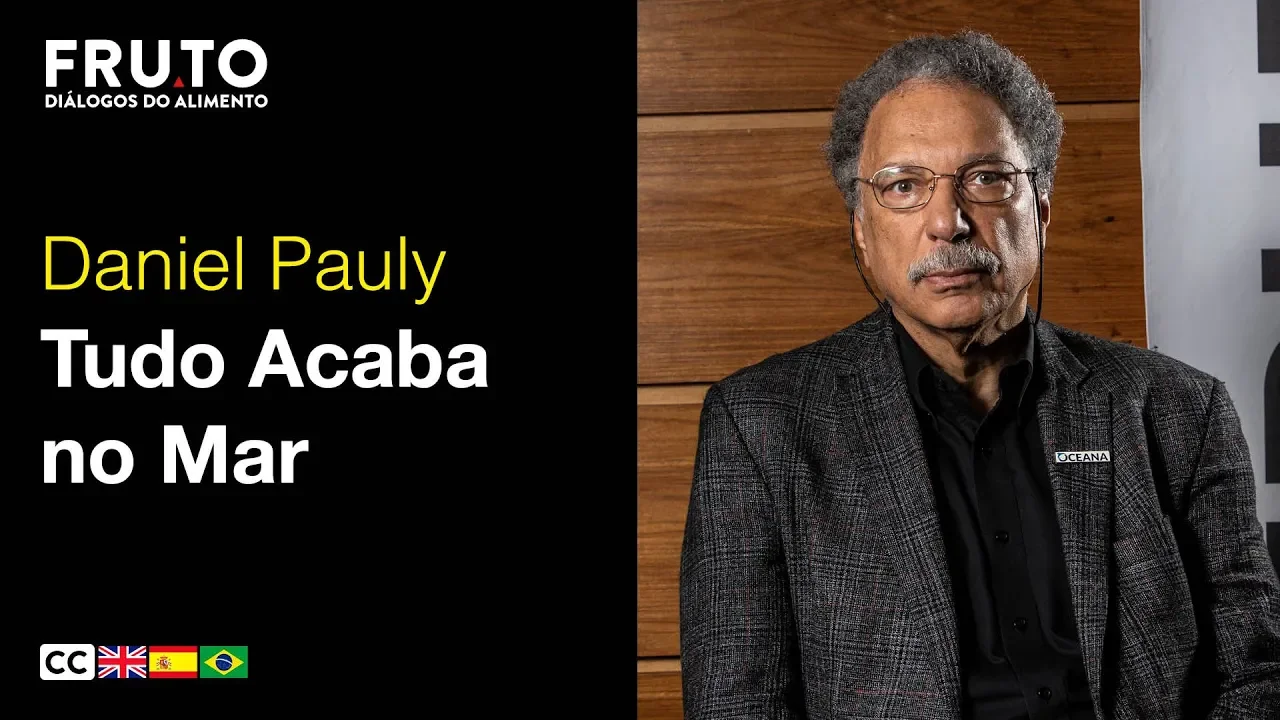
I will speak about fisheries as a food production system that is also endangered just as Amazonia is and we start by president I start by presenting to you on the effort that we do to get fish out of the sea and this effort cannot be measured in number of fishes because fishes when they fish without moto or where they fish with a motor they are not comparable official with a motor can catch ten times or a hundred times more then without a motor and so the the cumulative power of all motors is a better measure
then number of fishers a number of books and this is here the cumulative power of all motors in Asia in Europe and in other continent and you can see that we are doing a massive effort to extract fish from the sea and you will see what we do with this effort now what we do with this effort is actually modify the ecosystem and the big fish are gone mostly and what is left is lower in a food web we went from a situation where we had lots of big fish to a situation where we have
lower amounts of fish and then we catch little fish and because we use trawlers are astray we are modifying the habitats and we have at the end only mud fungal and this ecosystem is a modified ecosystem just like a divorce that amazona when you have devastated a local coastal ecosystem you need to expand and I will show you the expansion of Fisheries on a global basis our project is the only one in the world that describe fisheries as a global phenomenon you see most people study fisheries locally in a buyer the Salvador they fish they
Fisher and there is some and some motors that you use so that is the fishery but fisheries are also understandable as a coastal as a global system like the banking system or the weather system and we have to study them to understand them on a global basis so this measure of impact in the ocean is how much is how much plankton the grass of the sea is used is embodied in the fish that we catch this is this is not difficult to compute but I will not show you and I will show you only that
in in 50s in 1990 50 the 20% or so of the primary production of the grass of the sea was used in the coast of Industrialists country and in asia in north of in north europe in New England and in around Japan and China this is the the countries the places where the fish we were industrialized before world war ii now in 80s it was we had spread and now we have spread some more that's this is fisheries they they they tend not to be sustainable where they are and so they expand they go deeper
they go further offshore so now this is contract constructed with caches that are not the official patches every country in the world well every researcher who wants to study fishery fisheries can do that by consulting with the Fisheries Department in their state or in the city when you study a local fishery you can get the data from the local fisheries office but when you study international fisheries you know you cannot get the data from everywhere you you need data that have been compiled by another agency and the only agency in the world that collects global
fisheries that is ticks is the FAO Food and Agriculture Organization of the United Nations in Rome all countries except North Korea and Brazil except North Korea and Brazil send data national data National Statistics natural statistics to to Rome and Rome they the FAO they process the data to make them available for the world and I would get back to North Korea and Brazil so this data are very incomplete so that would be the reported catch but they don't report the catch by small small fishes they don't report the catch in a Pacific for example by
woman on coral reef they collect they collect fish for subsistence they don't also the subsistence fishery in Brazil is not reported they don't collect data on illegal catches catches that are made against the regulation so the catch of FAO is an underestimate and we have conducted a 15-year project 15-year project to compensate for this missing information in every country of the world and what we do is we finish the puzzle to get an to get an image of the whole catch of the world the entire catch of the world and what came out is oh
this the catch of the world as is reported by the country's NFL is this and FAO was writing the catch is stable so we are K but actually the catch of the world is declining rapidly is higher and declining rapidly so all countries tend to report more a few countries less then they really catch no all countries tend to report less then they really catch and a few country exaggerated China over over reports Vietnam and Myanmar and few country because because the political pressure these political pressure to produce a lot so the countries respond by
the Statistical Office by making catch making statistics but most countries and Brazil is no exception under report well for Brazil when Brazil was reporting and and the catch is declining sorry the touch is declining this is a very important feature that you could not tell but now we can I feel admits that this cut is also declining but this rate of decline is very rapid now you could say how come we fish more and we catch less this is the problem of Fisheries in agriculture and in man of industrial manufacturing the more you in the
more you input into the fishery the more you produce maybe it would not be polished proportional maybe it will it will flatten but the more you input the more you will have you will produce more water more fertilizer and most people from the in the ministries of Agriculture that are in charge of fisheries they are trained as agronomist or engineer and they do not understand that fisheries go up and then down why do they go down because if you you plot here what do you plot here it's not an input to the to the production
it's about the number of boats or the power of the boat on the number of fishers and that is not making fish it is just collecting fish so it is like you you have hunters and they don't have enough what what do they kill the hunters Bambi's right so the Bambi harvest is declining let's have machine guns you know we with we give the hunters machine guns so they will kill more Bambi's this is not so you because the machine gun does not make antelopes but water or fertilizer makes wheat or whatever and so when
something like that happens the reaction is always let's fish more and in fact you must fish less to get more so that is Brazil as reconstructed by us now Brazil seen since 2009 is one of two countries that do not send statistics national statistic to a few it's it's bizarre it's strange and the organization that that brought me here is Oceana because I'm in a board of Oceana in a director board of director and Oceana is trying to in the countries where it works he's trying to rebuild the stocks so that they can produce more
by fishing less and and this is due this decline is due to a succession of stocks that have been fished and collapse because too much fishing and the most the one that you will all all know is the the collapse of the sardine of southern Brazil there was a huge fishery and we fish more and more and more more and any collapse and then the minister says you didn't fish enough you don't have the so this this was done by a group of Brazilian scientists who were each in each state in each coastal state you
have 17 coastal state from whatever del Sur to whatever they'll note and is they put together the statistics that that do not exist since 2009 and they are now doing the statistic to 2016 are perhaps in the meantime Oceania is pushing for the government to do its job of reporting status fishery statistics and also our statistics show separate the different sectors of the economy so the this sector is a the industrial sector the big boat this sector is a small-scale sector and the FAO statistics do not distinguish between small-scale and large-scale and thus they ignore
large-scale a small key and sorry all the subsidies all the subsidies all the attention all the research is for industrial fishers and this is the reason why in most countries including in Brazil the fishes the artisanal fisheries are very poor because you can actually help artisanal fishes by getting the son of many of them these fishes out out of fishing that first thing good education so they can get out of fishing so there will be not so many so the one that are remaining they can get you you can provide our system that will make
the product the what they produce much more valuable in a market for example for example if you put clean table to land the fish instead of putting it on a sand in a beach becomes a good product that can be high-quality so this kind of attention perhaps even subsidies but you small-scale fisheries can enhance the situation of small-scale fishes in most of the world including in Brazil small-scale fishes are mistreated ignored and the result of this is that when they have the opportunity to come together at a conference they are very unhappy and I was
a few years ago at a conference in Brasilia where there was a National Conference of fisheries scientists and fisheries manager the small-scale fishes were there especially their wives and the screamed on stopped during two days because they never had the opportunity to make the point valid so there is some subsistence fishing we also are the only one to count for subsistence and recreational is too small but this colleague of mine she did PhD in she works in a university of Sur Gipper she works oops sorry this colleague of mine she was a student at UBC
and she she operated that team and she's a specialist now or on recreational fisheries in including in Brazil so the species that are important lots of different species and and this is a problem with Brazil compared with Peru on the other side of America you have a relatively low productivity with lots of species it makes fisheries management difficult that is an objective fact you cannot get around it but but the value of the fishery products altogether is is quite high there is two billion dollars at 2.4 billion dollars at the point of first first sale
and usually fisheries product are multiplied by four so perhaps 10 billion to addition to the GDP that situation ha now what has happened to your barrio species can be assessed we are in a process of doing an assessment of all stocks of the world and you can see the for example is a vanilla oops it caught Cod cartilage collapse that is typical and that was the biomass at the beginning and then too much fishing and it collapse and so that what what should appear here what should happen here is a low quota yet to fish
only a little bit so that this stock can come back if it comes back you can have again a big catch and rebuilding of stocks is what must be done and very few country have a few countries are rebuilding policies and oceania works for rebuilding policies in Brazil that is China they it that's the catch so so far we we know and again the biomass that is the amount of fish in the sea declined and it has to be rebuilt and now in a moment they now it's being rebuilt a little bit or it is
a management plan to rebuild it but it it this goes to 2014 before or Sienna came in Brazil all of this is possible all of this is possible because we actually don't remember how things were before we there is a thing which I formulated in 95 1995 is called shifting baselines basically when you are a young person you will oops okay when you are a young person you know you will know at the beginning of your conscious life that the world is a certain way there is so much Amazon there's so much fish there's so
much everything and you will not notice the change that has happened when you get old you see that a bit of Amazon has been cut or this and this happens but what you don't remember is what you what you don't count as a loss that's a lost what it was what your parents experienced as a loss because you cannot feel what your parent felt and they our parents our parents they don't know what their parents loss and so each of the generation looks at the loss only from the beginning of its perception of the world
and so year four year four year we kind of lose not only by diversity or Hamazon of fish but we lose the memory of it so we don't ask for it back to come back now this is a real problem but it is it is now perceived next problem so fisheries issue we should not subsidize good fishery industrial fishing because if they don't make money just collecting fish that nature makes then if they cannot make money collecting fish that nature makes then the fish should be left alone to rebuild we should have conservative Kota low
quota so that the fish can rebuild and we should have marine reserves to protect the sea the same way that we protect biodiversity on land that is almost trivial obvious then on top of this we have global warming and until recently the consequence of global warming for the ocean and Fisheries were not known and the cylinders my group and other people we have for the first time being able to fill in the blank because what the presentation that we heard just before is based on terrestrial changes but they were also will be changes in the
ocean and the change one change we can notice is that the fish are moving toward the poles they are moving toward in an autonomous fair they're moving toward the North Pole in a southern hemisphere toward the support why because the water is getting warmer so they are looking for the temperature that they are adjusted if I'm a fish that likes them 15 degree and the temperature becomes 18 and move south to about trot Argentina right and if I'm in Venezuela I move toward Brazil if I'm in Brazil I moved toward Argentina because I look for
the same if I'm a fish for the same temperature and this example is an Aussie that is the United Kingdom Norway and Holland and stuff and here's the fish moving the the center of the distribution moving toward the north and it is it is well known and there are hundreds of papers showing this now each paper has a little story but what is interesting is what is the effect of all fish together and what we did is we took all the fish that we have in our maps about 2000 of them we have them mapped
the distribution so this fish for example or is is a fish that occurs in China or it occurs you see in South Korea it doesn't occur in Japan in North Korea doesn't and in the north of Taiwan and because it has this distribution it we can tell that it likes 15 degrees centigrade so so what we have done in each of these cells in each of these cells we have a little model a little simulation model that makes a population of fish grow and then they produce eggs and larvae and they go to the neighboring
cell if the temperature is right they produce no eggs new larvae and everything if the temperature is not right they die now we got temperatures from from Princeton University our colleagues in Princeton University they have big models of that predict the temperature of the water everywhere in the world so we could put this thing together and you have the fish moving from our do it again moving from from where they were toward toward North Korea and at the end they have invaded North Korea which is difficult nobody has invaded North Korea recently remembered Brazil and
North Korea don't produce national fishery statistics they are they have invaded southern Japan and they have left Taiwan they have moved north into the Bohai sea now this we do in a computer that takes about half an hour to one hour to run one so we have six and seven computers running at the same time what for one week and and when we finish with that we get this and this is the first map that we produce of the effects of biodiversity or global warming on marine biodiversity basically you will have invasion species that were
not there that have invaded in the Tropic in in the North Pole and tactical lots of species invasion and you will have species that leave that is extinction in here because there is no more ice and so all the animals that need ice will go same thing for the Arctic but more important here in the Intertropical belt fish are leaving but they are not replaced by anything you see if you if you take if you take a landscape here for example where I live we will have fish from Mexico and fish from Southern California and
our fish will go north but and so same thing in Brazil you will have fish from some rihanna's and the or fish will go to to Argentina but if you are in the tropics in the lamb or in the Gulf of Guinea in Southeast Asia your fish are not replaced right because it's too hot and so what you have is each of these fish that moves is a potential catch so the fisheries will decline especially in the tropics now if you do this this map for agriculture you get the same thing the the agriculture in
the tropics will decline for example rice wet rice which is the most important food item in the world is at the limit of its temperature tolerance so every degree is a decline in 10% 20% of worldwide production so this is a big big problem and basically fisheries are in trouble in the tropics and more what makes it worse is that we don't know we will not know whether it is because of Fisheries of overfishing or because of climate change or because of pollution or whatever because there is in the tropics altogether very little research most
research is in temperate areas so this is one reason where we must rebuild stocks because if we rebuild stocks not only will we have a better fishery but we have more variability in the stocks and more capacity to adapt and to accommodate the changes that are coming so this summary is that in a temperate zones and subtropics you have some cold water fish they will decline and disappear in the future but there will be a change in fish whereas in inner tropics they will be they will be a decline and a disappearance of tropical fish
and that's that is forces us to think about what we're going to do about that and obviously what we're going to do about that is reduce reduce the emission reduce greenhouse gas emission rebuild stocks as much as possible because they are more resistant to change and and hope for the best and this is my group and we are they should have a oh say an eye there but I cannot have forgot to do it I'm sorry so so thank you very much [Applause]







![Hawaii / Island Oahu [4K UHD] Footage with relaxation music vol.2.](https://img.youtube.com/vi/I7EKvZkUDlQ/maxresdefault.jpg)