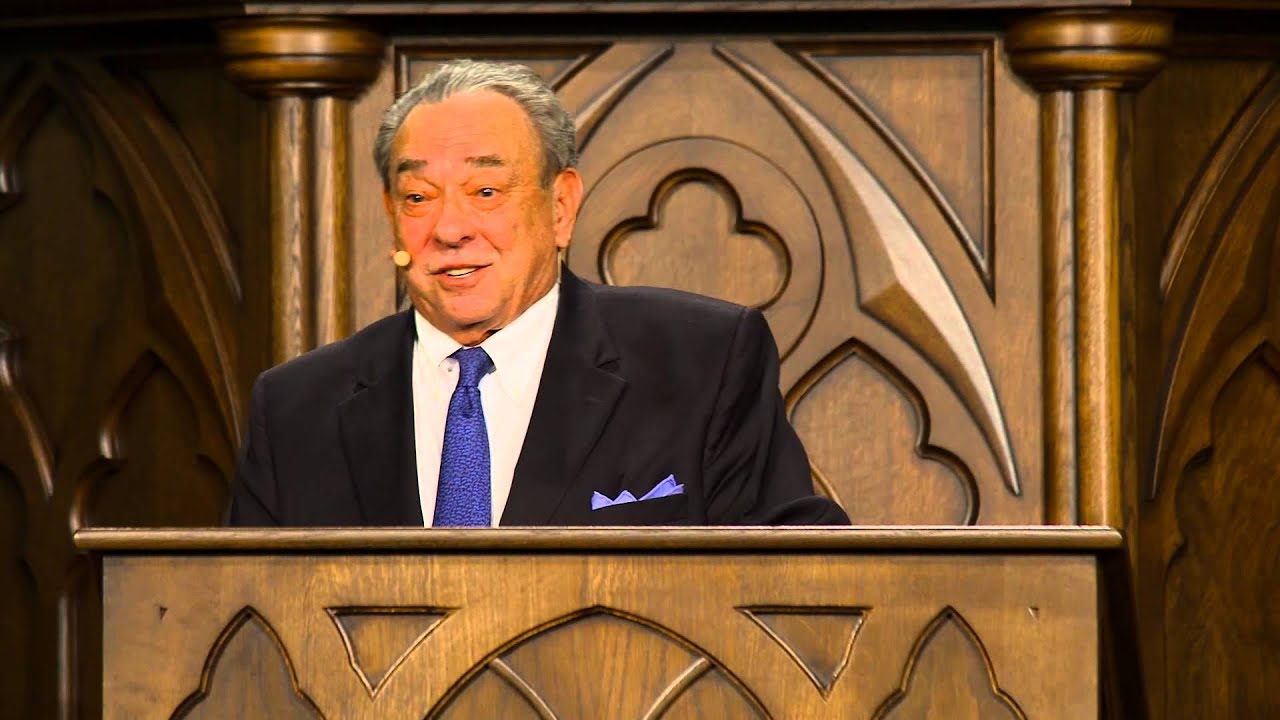
SPROUL: Today, we're going to start a new series, and we're going to focus in this series on the work of Christ. Now, in theology we make a distinction between the person of Christ and the work of Christ for various reasons. But even though that distinction is important to make, we must never let it become a separation because the person of Christ is intimately connected to His work.
And we understand His work largely in part from the perspective of who it was who was doing that work. And yet at the same time, conversely, the work of Jesus reveals to us a great deal about who He is. So His person and His work may be distinguished but never separated.
Now, when we start an examination of the work of Jesus, usually people want to start with His birth, His virgin birth, and yet we're not going to start at that point in this particular lecture series. Instead the work of Jesus, I believe, begins much earlier than His birth. In fact, it begins in eternity past in what we call in theology "the covenant of redemption.
" The people who listen to this radio program have told me many times that just like they enjoy listening to Rush Limbaugh rattling his papers on his desk, so the people enjoy the sound of the chalk scratching on the blackboard. But we hear the word covenant a lot in the Bible. We think about the covenant of creation.
We think about the covenant of works, the covenant of grace. We think about the covenant God makes with Abraham, with Noah, with David, and the even the new covenant that we call the New Testament. But many people aren't at all familiar with what we consider to be the very first covenant, or the covenant of redemption.
And that covenant is not a covenant that God makes with human beings. Rather the covenant of redemption refers to a pact or an agreement that takes place in eternity within the Godhead. We distinguish the persons of the Godhead as the Father, the Son, and the Holy Spirit, and we know when we look at the Old Testament record of creation that the entire Trinity, the whole Godhead is actively involved in bringing the universe into being.
But not only is creation a Trinitarian work, but redemption is also a Trinitarian work. The Father is the one who initiates the concept of redeeming a creation that He knows will be fallen. And so it is the Father who designs the plan of redemption.
It is the Son who is given the assignment by the Father to accomplish that redemption, and of course, it is the work of the Holy Spirit to apply that work of redemption to us. But we have to understand that this does not represent a struggle within the Godhead itself, but rather an eternal agreement. The Son is sent by the Father, and the Son is absolutely delighted to be sent and to carry out the mission that the Father has given to Him.
During His earthly sojourn, Jesus made a comment on one occasion where He said, "No one ascends into Heaven except He who has descended from Heaven. " And so with respect to the ministry of Jesus in this world, it begins with the descension, as distinguished from the ascension. The descension has to do with His leaving His situation in glory with the Father and the Spirit and coming to this world by way of incarnation.
When the Apostle Paul wrote his letter to the Romans at the very beginning of the epistle where he identifies himself as an apostle whose been called of God and set apart for the gospel of God, which he said was announced by the Old Testament prophets, and it regards Jesus who is born of the seed of David. And so when Paul announces the gospel and the work of Christ throughout the book of Romans, he begins in the very first chapter with a reference to Jesus as having been born of a woman from the seed of David, according to the flesh. And when we speak of Jesus' flesh, that brings us immediately to the concept of incarnation.
What we celebrate at Christmas is not so much the birth of a baby, as important as that is, but what's so significant about the birth of that particular baby is that in this birth we have the incarnation of God Himself. An incarnation means a coming in the flesh. We know how John begins His gospel, "In the beginning was the Word, and the Word was with God, and the Word was God.
" So in that very complicated introductory statement, he distinguishes between the Word and God, and then in the next breath identifies the two, "The Word was with God, and the Word was God. " And then at the end of the prologue, he says, "And the Word became flesh and dwelt among us. " Now in this "infleshment," if you will, of Christ appearing on this planet, it's not that God suddenly changes through a metamorphosis into a man, so that the divine nature sort of passes out of existence or comes into a new form of fleshiness.
No, the incarnation is not so much a subtraction as it is an addition, where the eternal second person of the Trinity takes upon Himself a human nature and joins His divine nature to that human nature for the purpose of redemption. Now, I'd like to direct our attention this morning to a very important passage in Paul's letter to the Philippians in the second chapter, where in chapter two of Philippians, beginning at verse 5, we have these words, "Let this mind be in you, which was also in Christ Jesus, who being in the form of God, did not consider it robbery to be equal with God, but made Himself of no reputation, taking the form of a bondservant and coming in the likeness of men. And being found in the appearance as a man, He humbled Himself and became obedient to the point of death, even the death of the cross.
Therefore, God also has highly exalted Him and given Him the name which is above every name that at the name of Jesus every knee should bow of those in heaven, and of those on earth, and of those under the earth, and that every tongue should confess that Jesus Christ is Lord to the glory of God the Father. " Now this passage that I've just read is known in Biblical circles as the kenotic hymn, the idea being that the speculation is that this particular passage out of Paul's letter to the Philippians was a passage that was not composed by the apostle while he was writing the letter to the Philippians, but rather Paul was making use of a widely used, very early Christian hymn. Now, we don't know that for sure, but it's certainly possible.
And that hymn celebrates the incarnation, and it is called the kenotic hymn because of a prominent Greek word that is found within this passage, which is the Greek word kenosis, which means literally "an emptying. " And the focal point of this passage or hymn, whichever the case may be, is on the transition that Jesus underwent by coming from His exalted state in heaven and becoming incarnate as a man in this world. And the pattern that is found here in this passage is a pattern that… uh… that we see frequently in the life of Jesus, which is a pattern of humiliation and exaltation, that is to say, he begins in exaltation in glory in heaven, but he condescends to join us in our earthly predicament in order to redeem us.
And by entering into human flesh, He undergoes a profound humiliation. And throughout His lifetime, there seems to be a progression, or regression, where the humiliation moves deeper and darker and worse and worse, as it reaches its nadir in the cross, and then following the cross comes the resurrection and the exaltation of Christ once again to glory. Now, that progression or that pattern that I've just mentioned from humiliation to exaltation is not absolute.
Several years ago, I wrote a book entitled The Glory of Christ because I was fascinated how that during certain moments of Jesus' earthly life in the very midst of the hiddenness of His eternal identity, in the very midst of the shroud of incarnation, there would be little bursts of glory that would break through as if the incarnation itself was incapable of totally submerging the glory of the second person of the Trinity. We see it, for example, in the birth narratives of Jesus, where we see so much of the literature there speaks of the arduous journey that Mary and Joseph take in order to sign up for the tax in Bethlehem. And they get there, and there's no room in the inn, and so Jesus is born in ignominious circumstances there in utter humiliation, being wrapped in swaddling cloth and so on.
But all the time we have this picture of humiliation, right outside in the fields of Bethlehem the glory of God bursts through, and the angelic chorus begins to sing, "Glory to God in the Highest, and on earth peace, good will to men. " So, that's just one example, but throughout the life of Jesus, we see these episodes of glory that come through. Nevertheless, the basic pattern is one of humiliation to exaltation.
Again, back in Romans 1, Paul speaks of his being born of the seed of David according to the flesh but made known as the Son of God through the resurrection. Now, having said that, let's look once more at this hymn and analyze some of aspects of it in Philippians 2. The way this is used is an exhortation that the apostle is making to Christians, that Christians ought to emulate the humility of their Savior.
Elsewhere, the apostle tells us unless we are willing to identify with the humiliation of Jesus, we will not be ever able to experience His exaltation. And even our very baptism has that dual sign, that in that baptism we are marked with the death of Jesus, but we're also marked with the resurrection of Jesus. Do you see that pattern?
Humiliation and exaltation. Well, the apostle using this says that Christ, who being in the form of God, did not consider it robbery to be equal with God. That's strange language.
There other translators render it differently. They will say that He did not consider His equality with God a thing to be grasped. In other words, that Jesus did not consider the glory that He enjoyed with the Father and the Spirit from all eternity as something to be tenaciously held onto, jealously guarded, but rather He was willing to lay it aside.
He was willing to empty Himself and make Himself of no reputation. In the 19th century, liberal scholars propounded a doctrine called the kenotic theory of the incarnation, and you may have heard it, the idea being that when Jesus came to this earth, He laid aside His divine attributes so that the God-man at least touching His deity no longer had the divine attributes of omniscience, omnipotence, and all the rest. But of course, that would totally deny the very nature of God, who is immutable.
Even in the incarnation, the divine nature does not lose His divine attributes. He doesn't communicate them to the human side. He doesn't deify the human nature, but in the mystery of the union between the divine and the human natures of Jesus, the human nature is truly human.
It's not omniscient. It's not omnipotent. It's none of those things.
But at the same time, the divine nature remains fully and completely divine. B. B.
Warfield, the great scholar at Princeton, in remarking on the kenotic theory of his day said, "The only kenosis that that theory proves is the kenosis of the brains of the theologians who are propagating it" -- that they've emptied themselves of their common sense. But in any case, what is emptied is glory, privilege, exaltation. Jesus in the incarnation makes Himself of no reputation.
He allows His own divine exalted standing to be subjected to human hostility and human criticism and denial. He took the form of a bondservant and coming in the likeness of men. This is an amazing thing that He doesn't just come as a man, He comes as a slave.
He comes in a station that carries with it no exaltation, no dignity, only indignity. And being found in appearance as a man, He humbled Himself and became obedient even to the point of death, the shameful death of the cross. Now, having given us that brief summary of the humiliation of Jesus in the incarnation, the next word that follows from it is vitally important to us.
Therefore or wherefore hath God highly exalted Him. Do you remember when Jesus was in the upper room the night before His execution, the night that He established the Lord's Supper? And He went through that lengthy prayer, the high priestly prayer it is called.
Do you remember one of the things that Jesus asked for in that prayer? He asked the Father to restore to Him the glory that He had with the Father from the beginning. He said, I've -- I've done my mission.
I've been obedient. Now, Father, glorify Your Son with the glory that He had with You from the foundation of the world. And this is exactly what God does with Jesus at the completion of His work.
There is an endpoint to His indignity. There is a completion to His humiliation that starts so starkly with His birth. Therefore hath God highly exalted Him and given to Him a name that is above every name.
Now, in other series that we've done, we've looked carefully at the names and titles that are used for Jesus in the New Testament, which are rich indeed and inspiring to us. But so often when Christians read this passage, they assume that what is being said here is that the name that is above every name is the name Jesus. But that's not what the text is saying.
What the text is saying is that God has highly exalted Him to such a degree that at the name of Jesus -- when you hear the name of Jesus -- every knee should bow and every tongue should confess what? That He is Lord to the glory of God the Father. The name that is above every name is that title that belongs only to God, that title Adonai that refers to God as the sovereign one.
That is the title that is revealed that belongs to Christ because of His humiliation. Because of His perfect obedience in the role of a slave, God moves heaven and earth to exalt His Son, gives Him the name that is above every name, so that when you hear the name of Jesus, your impulse should be to be on your knees and confess that He is Lord to the glory of God the Father, that at this point by exalting Christ you are also exalting the Father. And so it comes full circle.
Humiliation, first exaltation, humiliation, back to exaltation. But this is where it starts. And the work of Christ is given to Him not to come down to die on Good Friday and then return to heaven, but through His entire lifetime, He is occupied with the mission that He agreed to perform with the Father and the Spirit from all eternity.