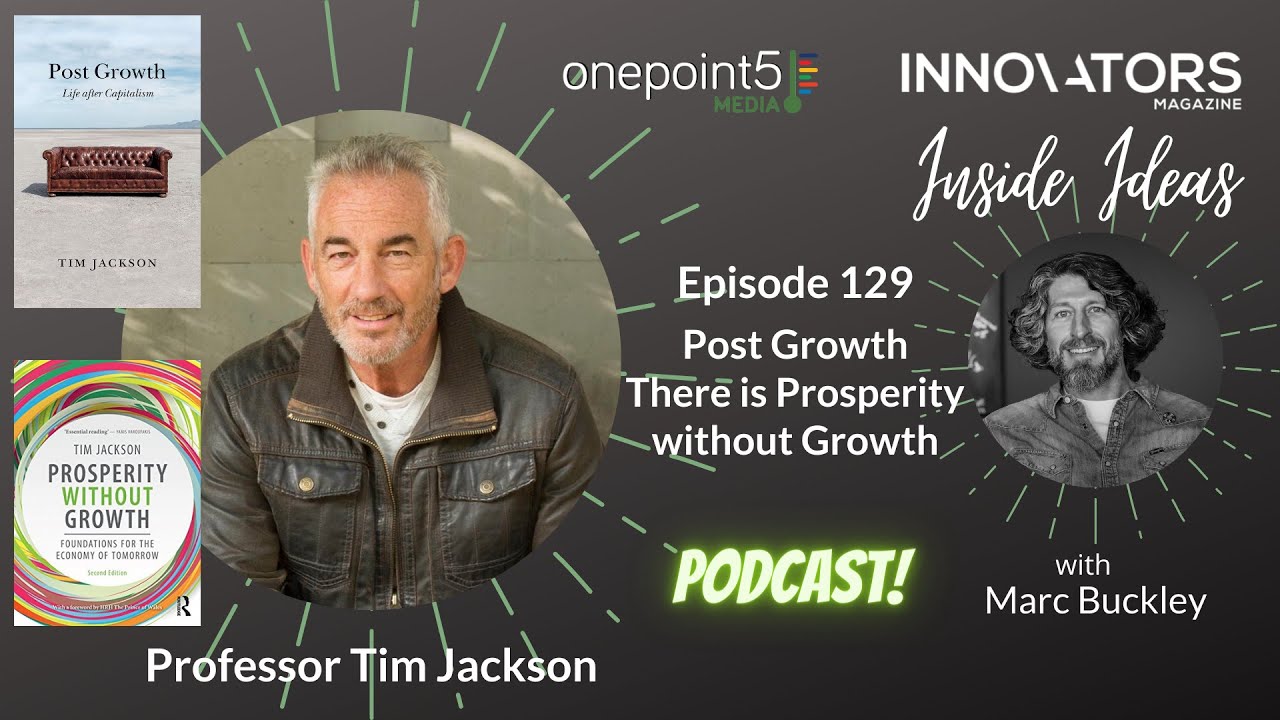
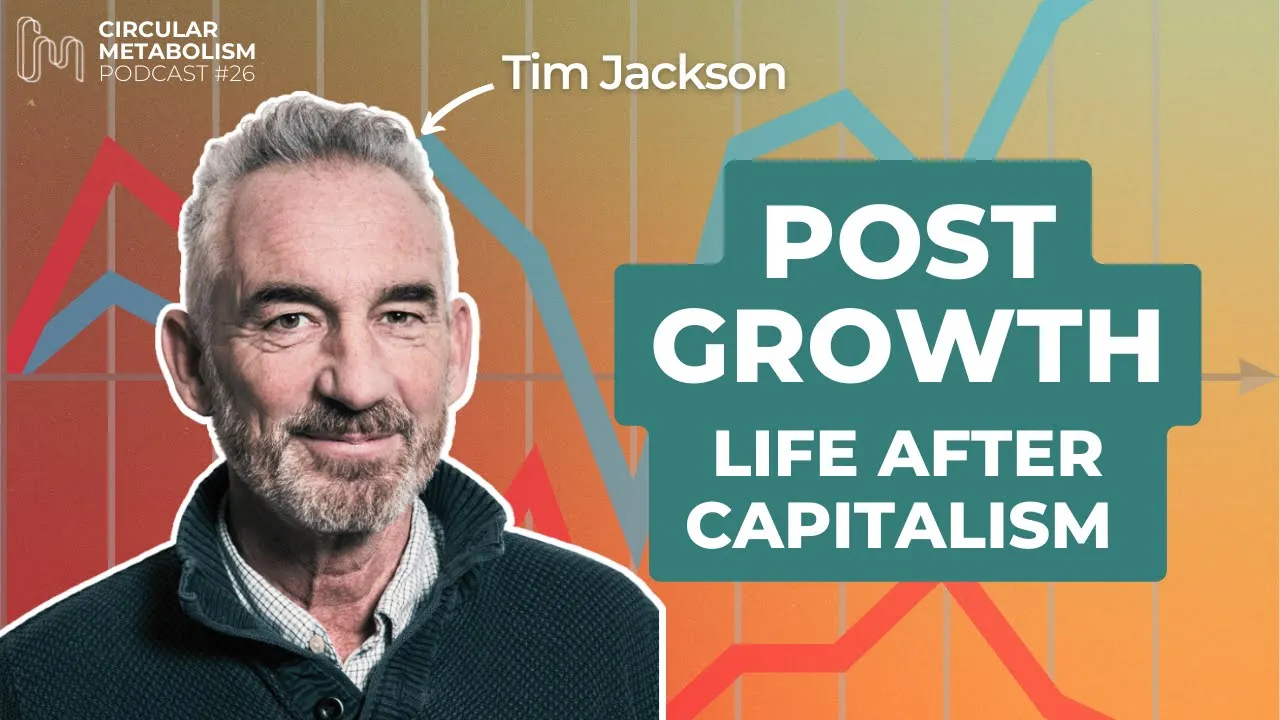
[Music] hello everyone and welcome to the circular metabolism podcast i'm your host aristide from metabolism of cities in this podcast we interview researchers thinkers policy makers and practitioners to better understand the metabolism of our cities and how to reduce their environmental impact in a socially just and context-specific way in the last episodes we explored some alternative societal and economic models such as the growth living well within limits perma-circularity and we continue our quests by looking into post-growth today is a special day i have the pleasure to talk with tim jackson about his new book post
growth life after capitalism which i had the opportunity to receive from polity press and i wanted to introduce tim because you are of course a a very versatile uh person you are an ecological economist but you also are a writer and a play writer uh since 2016 you have been the director of the center of um in understanding sustainable prosperity so cusp and you have degrees in mathematics and philosophy in physics so quite a happy mix that i'm very curious to talk about later on i'm glad i'm glad you think that's a happy mix it's
perhaps a rather strange mix for an economist well i think this tells a lot about how you write as well and you are the author of course of prosperity without growth which is a book that has influenced a lot of people including me so i read it 10 years ago back when it was a report before it was a book and it helped me kind of explore with the relationship between material flows gdp prosperity and how they're interlinked and so i had the pleasure to read this book which is a his it it's a mix
between history of economy capitalism science philosophy and a manifesto of how to build the next economy uh so it's a really inspiring book and you can find quotes of the beatles of boltzmann of aristotle shakespeare stuart mill and many others in order to better understand what the good life is and what motivates us so with all that being said thank you very much team for being part of this podcast and congratulations of your on your inspiring book um thank you perhaps just give a short introduction of yourself tell us a bit more about the rationale
behind this book uh yeah i i guess uh you know in a way in a way i'm i started out with with circular economy and writing about secular economy um i guess kind of back in the late 1980s early 1990s and i read a book uh in the mid 1990s called material concerns which really tried to draw together a lot of the technological understanding of a circular economy um and situated it in our sort of search for the good life as well if you like um and and it was really out of that work and
out of my sort of exploration of the limits of technology that i began to question the economic model more and more and i found myself in the early 2000s as economics commissioner on the sustainable development commission which reported to the uk prime minister and i sat down very early with the chair of that commission and said you know what should i best spend my time on while i'm in the commission and and the result of that actually was prosperity without growth it was kind of we both decided it was a good time to have a
a serious look at the most obvious tension that we face as a human species which is an expanding economy into a finite planet doesn't go and it's almost so simple you know that the kids can understand it and and certainly lay people can understand it it's it's generally harder for politicians and economists because of that somehow yeah yeah um and but also because economists have a very different view they they're not rooted so much in the physical world and they think that economic value isn't necessarily rooted in the physical world either um and there's they
do points you know up to a point that's that's true value is not the same thing as material throughput and therefore if you can continually de-materialize your economy make it lighter and lighter then then you do have a chance in principle you have a chance of expanding your economy without without trashing the planet the the difficulty is we've never done it the the challenge of doing it is absolutely enormous and almost all of the the triggers of the economy push in the wrong direction and so that's really you know when when i came to write
prosperity without growth that was kind of the analysis that i that i um developed during that i lots of mathematics in there lots of looking at statistics lots of thinking about the data lots of empirical work it was written as a policy report for a prime minister now i'm not saying that prime honest prime minister was very happy to receive the report he wasn't at all in fact i had a just before it went out i had a phone call from someone uh close to the prime minister's office he told me that he he'd gone
ballistic um so it was it was not a welcome report at all it but but it nonetheless it set out um it began a sort of conversation actually i think that people have been um wanting to have so even though you know our policy pay masters if you like were not very pleased to see the report and kind of wished it would go away um there came an enormous audience for that report suddenly out of nowhere after a week or so of complete dead silence deafening silence in which the policymakers tried to pretend it wasn't
there and after that it just got downloaded you know over and over again by all sorts of people all over the world who wanted to have that conversation about whether a growth-based economy is really the right direction of travel what else is there how do we manage that tension and really think differently about the kind of society that we want to have but as i say um it was a policy report to policymakers and so it was written in policy language and and a few years ago a couple years ago i had a conversation with
someone for whom like you that report had been very influential who sort of said to me look tim is absolutely great this kind of changed the way i think about my work in fact he left his job because of um not sure he thanks me for that but he left his job for you know from having read the book and sort of said but i think i think it i think you need to make this more accessible to more people and so post-grace is partly about that it's partly actually a response to that conversation and
and a sort of recognition actually that the policy language is not always the most accessible for ordinary people and that actually there's another job to be done which is to think about our lives from a from the perspective of ordinary everyday people who don't think in policy terms don't want data i remember my mum saying to me at one point well there's a lot of graphs in it aren't there tim and i was like that's the point but actually you know for someone someone who was an intelligent human being who could understand the philosophical points
actually the those those that way of talking gets in the way and i wanted to bypass that i wanted post-growth to be a book which talked about ideas and talked about philosophies but did it in a way that told stories that people could understand and and that connected them therefore to what i think is actually a long long train of thought that there are better ways to live there's a different way of organizing society that it isn't just all expand expand and neither is it all fight fight fight it's not all about competition and i
wanted i wanted post growth to really to draw those together and to present if you like a portrait of a different way of thinking about society but it's funny yeah i think that the prosperity without growth also helped people like me which were very data oriented very dry to get a glimpse of hope uh out of you know because we we have reports since uh the 1970s with limits of growth and all that that tell us that we're well we cannot continue in the same way so that was a given but you added the word
prosperity you added the world well-being you added some extra notions that give us hope that tells us well we're fighting for something we're not just fighting for well we're fighting for survival but we're also fighting for the good life and we're fighting for you know something optimistic at the end of the day which i find very reinvigorating and i think in this you you also help people that are not interested into data as you said to understand that there are figures behind this it's not just wishful thinking it's not just you know an optimist writing
a manifesto to uh to do civil disobedience it's more uh well even if you kind of call for it because we are stuck in within a system there is science behind it and uh i think no i think that i agree i think that's really important too i think it's it's it's to me it's sort of uh and it is partly because of what you said about where i come from you know i'm a kind of mathematician on the one hand but i'm a playwright on the other and and and actually i think you kind
of need both both those things to to um to kind of make progress and to deepen our levels of thought about where we're going so where did your obsession with growth started uh you know you you have this yeah i'd you call it an obsessionary steve um i i um i'm not sure i'm not sure how obsessed i am with growth i mean actually i'm a big fan of the gdp it seems a really weird thing but i think it's a cleverest construct from from an intellectual point of view because it brings together so many
different parts of our economy fits them into a puzzle and if you want to understand how an economy works then the gdp can tell you something about it and and i think you know what what's gone wrong is the idea um that the gdp and the growth in the gdp is the only thing that we should be aiming for and and i suppose you know in my early work interestingly in some of the early work i remember a report that i did very very early on for friends of the earth i basically admitted that we
had to present our solutions in the context of a gdp that was growing i you know you can you can go back and find it was written in 99 it was a piece of work on the relative carbon intensities of different energy techniques and basically what we said was you know you can reduce this carbon and stay and still keep your 2 grace target or whatever it was at the time i don't remember and and and so i did you know i did start out accepting that that dogma um and and it was really only
when i began to think about why things why things weren't changing that i began to question the dogma i began to go back to that and say you know is that correct and then one day you know i i stumbled on uh the index of sustainable economic welfare which daily hermann daly and john cobb had put together with clifford cobb um in their book for the common good and and and it really it was to me i mean i am someone who likes those kind of pictures and and responds to those graphics and it was
a very very clear picture as a picture of gdp going up and up and up over 50 years and of the index which they had constructed to reflect welfare going up for a certain time and then beginning to flatten off and actually decline over the years and it was such a graphic illustration that division of those two lines yeah gdp can go up and up and up but actually well-being is not doing the same thing and and so one of my first instincts was you know i want to do that for the uk and i
did it for the uk and then we did it for sweden and we contributed to you know a collection of indexes of sustainable economic welfare lots and lots of lovely graphs mum um which which showed you know began to show the same thing that although we were getting more gdp we're getting bigger economies that wasn't making the world a better place and and that i think was the point at which you know i began to um then understand that we had to confront that as a societal challenge and take it seriously not just to say
you know that's it we don't need growth anymore forget it but because that's not a solution either in an economy in which everything is built around growth so we have to in a sense see it as as a task as a task to unpick our own dependency on this growth in the gdp and to figure out how to do things better a lot of that actually was in prosperity without growth and and the kind of thinking about the economy thinking about enterprise thinking about investment thinking about the money system itself thinking about all of those
things and how you do them differently that was kind of laid out in in principle in prosperity without growth and it's part of what cusp my research center is boring in all sorts of ways economic ways philosophical ways sociological ways psychological ways political science research that we do there is all dedicated to this task of actually teasing us out of this gross dependent society and thinking about a different build things and and then post both the book is a kind of homage to that idea written hopefully and and you know from what you said i've
been partly successful at least in a way that people can grasp it as a story as a meaningful story and and and as the beginnings of a conversation about a different kind of society and and so in a way it kind of if you like it was never an obsession with growth it was first of all it was yeah growth is kind of the frame in which i have to do my work second is why is it the frame i have to do my work third is actually we're in a really difficult societal challenge here
and fourth is you know a place where even though i've called the book post post-growth actually it's a place of flight where we can flee from the assumptions of the past and and and free ourselves to imagine a different kind of future it's it's funny because i really enjoyed also the the side stories kind of things that you have all around the book and so you start with uh the story of uh uh of um was it robert i always forget what kennedy yeah robert kennedy um and it was in 68 of course at the
same time in france you had a massive movement as well and he was a proponent of post-growth which was mind-blowing for me that someone from the u.s would be someone like that and and there's someone running for president yeah i mean i i was exactly i mean i was just you know i remember very distinctly we were in the middle of doing i think it was the uk index of sustainable economic wealth somebody discovered a recording of that speech at the university of kansas and and it was you know for us as working on it
it was just it was extraordinary and we kind of you know almost had not known until that point that that recording was unearthed that actually a someone running for president of the us had made the same point 40 years before or it wasn't 40 years at that point but it's now 47 48 so of course unfortunately he was assassinated so we never know what would have happened in case he was 50 i'm sorry my maths you know i'm obviously in i'm not being that it's for those listening and paying attention 1968 is not 48 years
ago it's 53 actually it's 53 almost exactly when he made that speech 53 years ago but then you went down the rabbit hole and you know you pulled the thread and you saw that his advisors were goldbrice and then the advisor you know the phd advisor or hermendale is galbraith uh if i understand correctly and so there is no not quite but the but he was galbraith was very very influential yeah yeah herman's phd supervisor right so yeah no i was fascinated i mean i was like why where did this come from in 1968 when
growth rates were four and five percent per year how come this guy comes along says actually you know grace not all is made out to be folks and and so i was really fascinated by the ideas i came from and in some ways thinking about it now i think i was a bit arrogant about it because you know we have an arrogance the in us about our own modernity we think we are the most modern most progressive most forward thinking part of society because we're we're at the cusp we're at the forefront of it so
we must be the ones who are thinking best but actually and that's one of the things i suppose about the stories in the book the more you look the more you find that actually these ideas have a legacy and that legacy is the legacy of incredibly thoughtful intelligent poetic people who have been there before us and and and that's a part of what i wanted to do and it's you know when i began to discover the sort of roots of that speech that robert kennedy made it it really reinforced that point for me that we
are sort of engaged in a in a kind of ongoing conversation about the kind of society that we want and yes people have been there before us they have talked about those things there's enormous knowledge locked up in history books which is which is bad because not many people like history books that much but it's but it but it's you know if you can bring that alive and tell those stories then then we can connect ourselves not just to to a future that we want but to a past that's already been supporting us even though
we didn't know that we were being supported by these long dead people yeah and even i mean it seemed like a crime investigation when you went down this path and it's funny that well herman dally was writing his uh article at the same time more or less of the speech and these were not correlated it's that's also yeah yeah it's almost like we're living inside a program do you think no i'm not going that far but i mean that's kind of you know that's elon musk territory i guess but wait for it yeah yeah wait
for it wait for it but it's but it is you know there were moments during that during the writing of the book and doing this exploration of ideas when i when i i felt so connected those ideas across time and you know through accidental occurrences of the same thing at the same time like herman daly's paper and bob kennedy's speech and and i asked herman himself because i was fascinated because i've met him a couple of times and i know him reasonably well because of the work that we've done and so i asked him you
know did you did you know about the speech at the time and he said no i had no idea which makes it even more extraordinary in a way but but there is a kind of sense of course in which you know ideas have their time in history and and appear in different places and and so you know maybe something like that was going on and then of course there were common sources so the most obvious one was rachel carson's uh silent spring of course and and and john kennedy he was robert kennedy's brother was was
a huge supporter of rachel carson so already in the dna actually of the kind of kennedy presidency there was um there was this care this this concern for the environment and and a reflection on the kind of economy that we had and the kind of society we were becoming and a lot of support for what i would now call and you would probably now call post-growth ideas so that was that was you know it was a part of the kind of fascination of of looking at these different people well it also gives a legitimacy to
you know these thoughts you're not just a radical uh thinker that out of the blue you know pulled the post growth out of your hats and that is it it exists for a long time there are philosophical values there are economic values there's a number of values that have existed and we just need to reshape them remake a puzzle out of all pieces more or less and make sense of our current contemporary challenges because the challenges are similar you know over the ages we had environmental challenges we had societal challenges uh but we kind of
keep on pushing trying to change more or less what is happening with more or less success but it's also you know a root it's not new all of this we're really i think you also had the the lockdown and the pademic at the epicenter of your book as perhaps a trigger or perhaps a a revival of some old instances i don't know how it was um it was impossible really to write to write that book at that time without at least partly anchoring it in in in the pandemic partly because most of it was written
in lockdown but also because it is of course the most extraordinary thing to happen not just to uh our economy but to our society as a whole um you know definitely in our our lifetimes my lifetimes which is a little bit longer than yours and indeed you know almost anyone alive has not really been able to kind of remember anything quite so extraordinary and our kids are you know they're going to be living through and hopefully prospering after one of the most extraordinary events in the in the certainly in the last century so so there
was no sense in which i could kind of write the book without thinking about the the pandemic even though i started writing before um it it sort of inevitably seeped into the way that i was thinking about the book and and and and also because it's had some really extraordinary lessons for the way that we think about the economy you know it's really has turned so many things on its head um first of all most obviously i suppose that you know when push comes to shove it's not wealth that matters so much as health and
and that's a that's a change in viewpoint you know it's it's a real switch in viewpoint and it happened a year ago we stopped prioritizing wealth and we began to prioritize health and governments did what they had to do and they did it more or less overnight they did it without any restrictions and they paid for it through um you know mechanisms that they denied had ever existed and so we kind of in a way in a way it was um you know it was it was it was giving us lessons about a post-growth economy
in a way that no book ever could and and that was so inevitably you know i think there were there were lots of there were lots of um very key influences there and then there was also this this other thing which about the pandemic i think which is that it's taught us sort of something at least about ourselves as human beings and and you know not just about the things that matter but also about the things we struggle with the lock down in some sense is a is is a kind of you know huge metaphor
for the the our own mortality and the temporality of our lives and that there are certain kinds of limits on us and the way that we respond to those limits is really almost like our existential task you know it isn't an accidental thing that comes just because we have a pandemic and because we have to suddenly deal with an unexpected situation there is a sense in which and this was kind of but i mean this is obviously my learning out of the pandemic it's not everybody's but it was certainly it's sort of reflected back at
me in a sense that that you know ultimately our battle against limits is an existential one and we when we have a choice in that we either sort of try to bounce our way out of it and bound free you know in one bound he was free and pushing at the frontiers of i don't know anything from from overseas holidays to mars if you are of a certain kind of understanding about the frontier of human ingenuity and and and yet in there are still limits to that and there are limits to how how many people
can participate in that we might get if we're lucky a few people to build a colony on mars but that's not about the lives and livelihoods and health of eight billion people on planet earth and it's not about the quality of our environment and so so this you know if we if we retreat from that frontier mentality and draw our sights back towards earth towards ourselves towards the inner part of the human psyche what do we find there and it's one of the one of the most extraordinary things is that we've lost sight of that
journey that inner journey it seems to me you know we've been so focused on that outer journey we've been so focused on that innovation we've been so focused on the outer frontier that we've neglected parts of what it is to be human and and in a way i think it's the same process that we've neglected our own history if you're continually innovating you're continually searching for the new you're not looking back anymore you're not looking at the understandings of our grandparents and therefore we're losing the wisdom of of that history itself brings to inform our
lives and the two there's sort of two you know two sides of the same coin in a way those things that continual innovation loses sight of history and continually bursting for the frontier loses sight of the of the inner game if you like one of the books that i cite in there in pursuit of a kind of equality which when psychology is called flow the ability to really focus on something and concentrate on something be carried away from it and and i was first introduced to that interestingly through playing tennis there's a wonderful book called
the inner game of tennis and it's it says a very obvious very straightforward thing to someone anyone who plays any kind of sport that most of it is happening inside your head your your sporting ability is partly but only partly about the physical and about what you can physically achieve and and most of it is happening inside your head and that's where the battles are being fought that's where you fall apart when everything goes wrong and that's when when it goes right you really can achieve these kind of states of mind which go outside of
the ordinary so in a way it's almost it's bizarre in a way that by coming back from the frontier and focusing in what's inside us we actually burst out way further than that the imagination of that frontier that we had in the first place this is not physically going to mars and you know hands up to the people who have landed perseverance rover on the surface of the red planet it's a fast achievement but there are other achievements that are more accessible to all of us and and it was it was a part of what
i wanted to do is to to to lay before people the possibility of that inner journey it is it doesn't cost anything it isn't material intensive it doesn't give you instant gratification but it's a part of our or almost a part of the soul of society and it connects us to other people in ways that a competitive materialistic hedonistic lifestyle well it depends if uh you're teleporting to davos as you've mentioned i i i you know have to say if that's got to be a blast hasn't it that's got to be but i think that
we're not gonna do it because it's so bad not all of us not all of us that's true you know it's not there's not room for 8 billion people on clusters but i find it funny that i i wanted to address this flow state because i think it's the point that i connected most with your book uh because i i'm really happy to hear you say that because there's some people who think what the is this guy on i mean actually some people who know me quite well found that flow stuff quite difficult to uh
quite difficult to take so i'm i'm happy rsd but yeah go on well i mean i'm an avid surfer okay so you exactly so you know i experienced this or going to the mountains as much as possible i experienced this also how difficult it is to to learn something when you're in your late 20s 30s to discover from scratch and to battle your own youth behind you in order to you know and i find that the the man the happiness is your youth is not honesty believe me you know there's nobody else listening your use
is not behind you no no i know but mine is i i've i have friends that learned you know skiing and surfing and i know what you're saying i know i know i know you're not going to do that again and i feel i've learned so much through it and it's accept well perhaps it's the the moments i'm the most happy when i'm with family and when i you know i'm in the ocean and feel alone it's the only times where you can disconnect with you know the vanity and you know writing that's the interesting
thing that's the interesting thing to me it's not you know i introduced it and it emerged in my life in relation to very specific thing which was tennis um but but actually when you go looking for it you find it in all sorts of places and as you say you know family and social environments is one of the places where people do experience flow and we actually some of the work we've done in cusp has kind of identified some of those areas where where you can achieve that flow and they're very very different from each
other some of it is physical exercise some of it is crafted and being absorbed in a task some of it is social and in the presence of of other people some of it is meditative contemplative and so you know i guess this in a way there's something in there for everybody yeah certain that's it should yeah and that's kind of i mean in a way isn't that what we're looking for we're looking for you know not a good life one size fits all everybody's got to do this do that do the other but actually something
that is free to everybody available to everybody that that can create opportunities for everyone and and that you know i think that's that's why that's why that concept is is in there and it's investment to yourself as you mention it in this which takes a lot of time um so if i had to synthesize your book you you kind of do it yourself at the very last chapter you say that more is not always a virtue struggle is not only basis for the only basis for existence competition is not the only response to struggle uh
and then you say that productivity doesn't exhaust the return to work investment is not a meaningless accumulation of financial wealth this denial is not the only response to our mortality and so are these the precepts of uh post growth or how would you if you had to to give you know some pointers towards the i think they're the foundations of post-capitalism in a way they're kind of you know that all of those things really were saying what were kinds of things that the the um [Music] if you like they they they opposed the dogma that
capitalism imposes on us that work is a form of slavery that productivity is all that it's about that you know investment is a kind of casino where we gamble and the winner takes all you know the the structure of late capitalism has imposed a set of dysfunctionalities on human society and and in that in that phrase in that passage that you just read i'm just kind of pointing that up really that the journey of the book shows actually what a poor conception of work for example lives inside capitalism and that there is actually one and
it's the one that i draw from hannah aaron in the book and her philosophy there is one which actually is very much about the enrichment of the human soul and the security of our sense of self and our participation in society and and we've given these goods up to the service of of a capitalism that that just sees rapacious growth as its output and efficiency as its only core uh driver and and so you know i guess by the time you've read you're reading that at the end of the book i guess that's what i'm
hoping people will will understand but understand not in a you know kind of you know intellectual here's my argument way but in the in in a sense of all of all of that history of ideas and the ways in which that's been explored in our very own cultural history we're not trying to necessarily reinvent the whole world we're actually drawing the threads of a different kind of narrative that already exists and has been laid down with extraordinary elegance by some of the most intelligent people um and and that you know i think as you mentioned
at the beginning is is to me is a kind of you know it gives me this sense an enormous sense of support there's been moments in thinking about grace and challenging growth and when prosperity grace is first published where you kind of think you know god i'm putting my head up above the parapet here and i'm just about to be shot and that's not the case that you know that legacy of thought exists in our own culture and in other cultures and and it gives us actually the grounds not just for thinking about and writing
about post-growth society and not just believing in it either but actually sensing it feeling it and and living it um well it feels very poetic of course so we we're really looking forward to this uh post-growth society this podcast is mainly focused on cities so i was wondering if you can find or how do you envision a post-growth city given that cities are really the hub of consumption so and the place of accumulation the place of you know the surplus all of the surplus is a cities exist through surplus so have you ever thought of
what would a city a villa would it be a city would it be a village what what would be this post-growth territory or how would it look like do you have any idea i think it can i think it can exist in different in different places i you know am i allowed to say that i don't really know the answer to that question honestly i mean i kind of have some inkling of it you know and i think in a way uh there's there's a lot of creativity at the moment about about visual visually imagining
those places and and you know if you go to some of the some of the people who have begun to do that you find this sort of richness of imagery of the way that nature and city merge together the way that people and function work the way that work and life are put together the the energy dependencies of the city that that i think you know those visual images actually to me are incredibly powerful and they they answer your question a lot better i think than i could do in practice um you know in practice
we know you know i could go back if you like to the sort of instruction manual of prosperity without growth and say you know we have to know what the limits are we have to fix the economics we have to change the social logic all of those things are broken this is what you do with enterprises what you do with investment blah blah blah and i think all of those things are true in relation to rebuilding cities but i think in a way to me a lot of the really interesting work um there's two bits
of interesting work what one is one is the people on the ground who are actually doing it at city level and then there's the the visionaries if you like the people who are imagining that giving us stories visual stories and cues about the kinds of places that we might be living in and that's you know that's that's i think those are tasks which actually i other people do much better than i do what i hope i've given to that in a way is is that that that re-envisaging of the cities of the future is supported
by a rich history of ideas which which actually is enormously liberating even though it starts from the idea that we might be living within certain limits uh so two last questions before i leave you uh now that you gave birth to this book what will you do in 2021 what's your next uh i have i have a very specific task actually which i'm kind of working on with some research so i have to go and talk to them kind of right now uh which is which is you know it seems to me that if we're
if we're right that one of the messages from um the lockdown is that health is more important than wealth and we have to make an economy of care work and and it's been difficult because of the structures of capitalism and most of the economics of care is not working properly so that's that's a quite specific project and it you know it involves it goes back in a way you know sadly it tears me back into um the mathematician and the and the policy maker and so on but but i you know it's it's a task
actually that that is is absolutely essential and and when you think about the people who basically saved our lives over the course of the pandemic many of them were working in the health sector and yet they had been living you know under deprived conditions precarious lifestyles uh productivity targets that made their work more and more difficult and and all of that is driven by the structure of the economies that we have and so there's there is a kind of urgent task it seems to me which is too which is to find an economics and an
economic structure of care and and that that allows us to create not not necessarily at this point just a post-growth society but a post-pandemic society in which the people who matter what most are never again neglected in the way that they were in the time running up to the to the pandemic i do enjoy graphs so don't don't be shy with uh with graphs and it's good you know herman daly has a wonderful thing which calls misplaced concreteness and it's just fantastic i love it you know when you're sitting in front of a spreadsheet or
or a computer model the time goes by you're in flow and you never really have to worry too much about reality as long as you can produce some pretty graphs at the end of it i like it uh just the last question so what you already mentioned uh a great variety of books of authors of the films as well is there anything that uh is there one book or one article one video that you would like to recommend that embodies post growth i'm not sure really i if this is there one i mean you know
it's really interesting to look at that video of of robert kennedy um you know the beginning of that video where he talks about the limitations of the of the g is that available now somewhere it is it's on yeah yeah there's a link in the in the references there should be a link in the reference book and and i did do that actually there were com there were kind of the points where i just felt you know actually the notes are as important as the as the book for those who really want the detail because
there's lots of notes and there's lots of links and actually almost as i think about the way that i wrote the book it was by reference to a lot of visual material so stuff that you can go that is well archived and that you can go hopefully the links are all still working from the notes in the book but if you go there and there's a couple of there's a couple of moments so that moment with bobby kennedy was one and then there's this moment which i actually tried to write about in the book because
it's just an extraordinary moment to me of of um three days after martin luther king was shot nina simone gives a a wonderful concert and in the middle of this concert she it was just a sort of tribute to king and and and in the middle of it she just stops and she's just this total ad-lib comment on uh where things are on society and life on immortality and it's you know to me particularly as i was kind of looking at that in the middle of what emerged last summer the kind of black lives matter
movement in particular and realizing that the history of these ideas the history of these struggles is not one thing at one time but a continuous story that we are we are all engaged in and and each of those visual moments for me was was part of what anchored me to that idea that we're sort of living in a chain of being and the chain of ideas within that chain of being and we're not individuals and we're not we are and we're not you know on one hand we can play wonderful tennis or or surf in
extraordinary ways but but at the same time a part of our well-being an enormous part of our well-being comes from our connection to other people and so i chose i think i chose you know i chose lots of those videos to almost act as a kind of inspiration for me as i was writing and hopefully there'll also be a kind of resource for other people as well thanks so much for all your time tim it was wonderful uh it's been a pleasure thanks uh i hope we're gonna meet uh for some tennis or some sort
of uh oh you've got i'm you know are you going to teach me to surf really sure that's fantastic i've always wanted to but i've never actually stood up vertically on a surfboard yet you don't need to to have fun so okay so thanks everyone as well to to listen until the end if you like this episode please make sure to to share it with your friends and colleagues and i'm looking forward for your new report tim thanks a lot yes bye you