Good morning everyone. We got sound. >> Oh yes.
Thank you Amanda. Yeah. And the other side of the equation of course is humans.
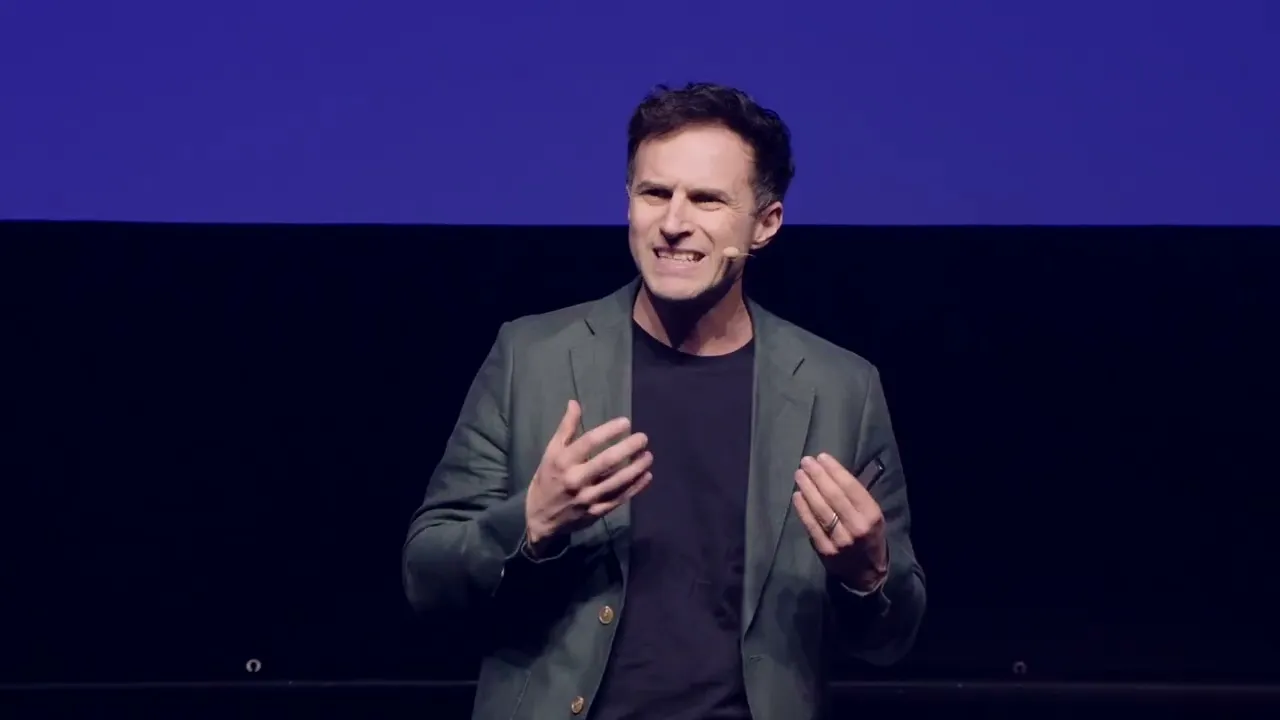
And me as a psychologist, neuroscientist. I have a lab where we study consciousness, intuition, decision-m, the imagination, something called aphantasia. But like you heard, I now call myself a neurofuturist.
So for the last year and a half, we've shifted focus to try and figure out how the AI revolution is going to affect us. what we can do about it, where we're vulnerable, to build toolkits that people can use to navigate their way through the next sort of decade or two of AI change. So, there we go.
So, AI is yes, overwhelming at the moment. You hear it every day. AI this, AI that, and lots of things are happening.
I thought I'd start off today in one second with a little game we're going to play. First, the theme throughout everything I say is no surprise surprise that being human, our quality of life is really our northstar and it should be for the next decade or two. We're in for a lot of change and that change is h going to happen really quickly.
But first up, I want to play a game. I'm going to play you two videos and your job is to tell me which one is the real me and which one is the AI Joel. Okay?
So, turn your intuition up. Watch and listen carefully. Here's video one.
Hi, I just wanted to see if you guys could tell the difference between the real Joel and the AI generated Joel. So, what do you guys think? Is this the real me or was this made by AI?
>> All right, so that's video one. Here's video two. >> Hey everyone, what do you think?
Is this the real me or is this done by AI? Hm. What do you think?
>> All right, let's do video one AI. Put your hands up. Video two AI.
Oh, video two is the winner here. Well, they're both AI videos. Had to be done.
This is the kind of thing you can really easily do now. You can upload a few minutes of video, train an avatar, create your own videos. You don't have to get dressed up.
Don't have to have lighting. Any of that. Who's had a play with Sora, the new Sora 2 platform?
I had a good play with this. And after watching videos of myself doing things and saying things I'd never done, I had this mo have these moments which are really odd where I have these sort of memory gaps where I think wait did I actually do that or not? And me as a you know neuroscientist I'm fascinated by this.
I think there's huge potential uh therapeutic possibilities there but also it's a little scary right that we're going to have our memories corrupted a little bit. So I just wanted to flag that for the kind of things we're thinking about talking about. Now, deep fakes, you can now, you have been able for over a year now, be able to plug in a real-time deep fake algorithm into a webcam, into your phone and change how you appear, how you sound on the fly.
So, this is not JD Vance. This is someone running such an algorithm. So, what does this mean?
It means we need to have like human safe words, a family word, a work word. So if someone you know your partner, your colleague, your child calls you up and you see them and they say, "Oh, quick, I need some money. I need your credit card number or something, you need that password to know it really is them and not a scammer.
" So this is the world we're in right now. We have been for a little while. So seeing is absolutely not believing anymore.
We're sort of going through this revolution that what we see online, you know, photos and videos used to be about documenting reality and they are no longer that. They are something very different, something creative and expressive. The other part of the AI revolution, of course, is humanoid robots.
There's been a bunch of launches in the last few weeks of these. And this is the sort of the second wave, as I said, that's coming down. So, they're in factories.
They're in homes. Here's figure three that's running apparently fully autonomously. And it's really a play on learning, running AI to learn from us in our homes.
>> Some volume there. This is Neo, the other one. Is this paprika?
>> No, that's cayenne pepper. Also, your glasses are on your shirt. >> Could I use this in my chili?
>> They're both made from chili peppers and you could put cayenne in your >> So, another example, you can la you can buy this or you can pre-order it right now. And then just last week, the Xpang though, you may know from the car manufacturer in China, just launched their iron uh humanoid. Very different look, very different sway and walk as it moves.
Interesting different direction. So, I don't think it's an overstatement to say that AI is going to change everything in our lives. It's certainly going to change everything that uses electricity.
If you think about that for a moment, that kind of effect is going to filter down to change everything in our lives, everything in society, from the way we work to the economies to governments to what companies even are. Of course, education, everything's going to change over some given time period. And that's a lot of change.
And that's what I'm here to talk about. So, first up, how can we see clearly what's happening with the AI revolution with AI? So, if I take a piece of paper and I fold it once or twice, it's a little bit thicker.
Not that much. I keep folding it. When I fold it about 42 times, that one thin piece of paper now goes from the Earth to the moon.
And that's exponential change. That's doubling each time I fold it. And humans are really bad at understanding exponential change.
We have bad intuition for it. We just don't get it. So, what does that mean for the AI revolution, which really absolutely is exponential at this stage?
depending on how you measure it's doubling about every six months or so in terms of power speed and usage. Well, it means we predict out in this black line when we try and think about what's going to happen next year, the year after in 10 years, but it's actually happening with that red line. So, we massively underpredict and we can't help this.
We've just evolved as humans with the brains we have to think in very linear terms. So, it makes it very hard to predict what's going to happen and we just continually underpredict these changes. And AI is really this sort of tide that's lifting all the boats.
So it's not a single exponential. There's lots of different exponentials happening right now. So AI is changing, you know, physics, mathematics, material science, protein folding, chemistry, lots of different fields.
So when you get this number of different exponentials, trying to figure out the future, trying to predict what's going to happen becomes almost impossible. And that leads us to the elephant in the room, uncertainty. So, we're living in a world of uncertainty now, not just with AI, but with geopolitics and everything that's happening in the world.
And we know from a ton of neuroscience that uncertainty basically causes or triggers anxiety and stress in the human brain. Not just our brains, but basically any all animals. So, trigger warning.
Look away. You don't like snakes or spiders. It's gone now.
But I show that just to give a feel for a moment of what what uncertainty is like. ambiguity, uncertainty triggers this fear response in our lyic system and our amydala that puts us in this fight orflight state. And we don't want to be in that state for any extended long period of time.
And I've been going around giving talks like this to all different kinds of companies and governments. And everyone's feeling this uncertainty just ratchet up week in and week out. And it's putting us in this sort of ongoing low-level stress and anxiety state.
So, we need to figure out how to live and thrive going forward in this sort of this new uncertain state. And I sometimes call this this uncertainty transformation that we're all going through. And we need to adapt and learn to live like this.
A bit like the digital transformation, but it's more much more effective or more impactful to us humans. So, what do we do about this? Well, first is to embrace the fact that the world is full of uncertainty.
You can't make the world certain. You can't pull all the uncertainty out of the world. It's like fighting quicksand.
It's just not going to happen. You're going to burn yourself out. So, step one, just accept that's the way it is.
Step two is to understand that uncertainty and ambiguity will trigger your brain. Some people a lot more than others. And it will put you in this fight orflight state.
And it does that, like I said, for all animals. So, it's not your fault. There's not anything wrong with you.
It's simply the nature of having brains like we do. So something else you can do to speak to it specifically is reframing or cognitive reframing. And this is something my kids are fantastic at.
They take something that seems negative and flip it to a positive. They're much better at it than I am. So when it comes to uncertainty, there are lots of examples in our lives where we love uncertainty, right?
Horror films, roller coaster rides, fancy meals at fancy restaurants where you might have 10 different courses and you have no idea what food they're going to bring. So there is examples that people like. They're kind of controlled uncertainty, but they're uncertainty nonetheless.
So what I invite you to do is just practice every day on a small scale refraraming something that feels uncertain, perhaps a little bit scary. Reframe that as a wave of excitement, positivity, and thrilling, something that you know that you can get ahead, that you can jump on board and really thrive with that. Second, I want to mention this this beginner's mindset idea.
This word shin. If you're a leader in today's world, you need to try and have this beginner's mindset, right? None of us are really experts in how to integrate AI into our lives.
We're learning on the fly. So you may have built your career over 10, 20, 30 years and have a lot of expertise, but you really need to find ways to set that aside, to put the ego aside and work on a sort of even playing field with everyone else in your team or organization and figure out how to bring AI into your organization. Right?
The other thing we're seeing is that expertise is taking sort of a a step back and other skills like rapid acquisition and transfer and this idea of unlearning is becoming really interesting and really valuable. So the classic ways you've always done things can be really sticky and it can be hard to let them go and figure out new ways of doing things. So one of the tips there is to actually let yourself make mistakes.
When we mess something up, we make a mistake, it triggers a what they call an error signal in the brain and it speeds up your learning. It literally puts your brain into a plastic dynamic state where you can learn something new. So let yourself make mistakes.
Don't be embarrassed about it. Be open. Communicate it and let those mistakes happen.
So as kind of Greg mentioned yesterday a little bit in his talk, jump on board with AI. Use it as much as you can. And the interesting thing about using AI, it's not like you can learn it from reading a book or listening to me tell you how to use it or watching YouTube videos.
You have to do it like riding a bike. You have to jump on board, be on the tools, and start using it every day. I also want to mention this idea of cognitive offloading.
There's been a lot of talk about AI causing brain rot. There's this study from MIT which got sort of misconstrued a bit or taken to mean that if you outsource to AI, we're going to become lazy. Our brains are going to sort of decay, atrophy.
And there's some truth in that. But if you're outsourcing all the time and you just step back and do nothing, that's not a good thing. So who's seen the film Wall-E?
Remember that? Little old now. But it's called cognitive complacency or atrophy.
So if you end up, you know, doing nothing as you outsource to AI, that's not a place you want to be. So what's the solution? Something I call cognitive upsizing.
So as soon as you outsource to AI and do that as much as you can, then fill that space with bigger, juicier, more complex tasks, more human things, don't just sit around and relax. Don't treat it like a holiday, like retirement. Fill that gap as quickly as you can and build that habit so you don't get in the habit of just doing nothing and relaxing.
And the same applies to creativity. Next, I want to say a few words about intuition. So this is my book, The Intuition Toolkit, which sort of documents the science we've been doing over a decade about intuition.
So I hear from a lot of people that they're using intuition at leadership levels, but they're kind of a little bit embarrassed to talk about it publicly. And that's part of the mission of this book is to take the science of intuition, right? It's a real thing.
We can measure it in the lab now. It doesn't have to be something woo woo or spiritual or magical. It can absolutely be those things.
So very quickly, I'll take you through these five rules we developed for when you should or shouldn't use intuition. And the acronym is smile. So first up, self-awareness of emotions.
Don't use your intuition if you're highly emotional. You're not going to feel that embodied feeling of intuition. The emotions are going to flood those things out.
Second, mastery. You can't use intuition unless you have some mastery of the thing. You can't sit down and play chess for the very first time and be an intuitive chess player.
You have to give your brain the chance to learn the patterns between where the chess pieces are and all the possible outcomes. So then third is impulses. But I sort of put a lot of things in there.
Impulses, instincts, and addiction. So first up, that craving you feel to to addictive things, substances, food, alcohol, drugs, social media, checking your email, that is not intuition. That's something else.
Um, oh, then low probability. There's thousands of papers in psychology just showing how bad we are at feeling our way through numbers, probabilities. So, the rule there is don't use your intuition for anything around probabilistic judgments in a casino.
You're trying to figure out low probability events. Just don't use your intuition. And finally, E for environment or context is really about that learning piece, that mastery.
So when we learn things, our brain actually sort of imprints the context, the room, literal space you're in when you're learning it. So if you master intuition at work like say Steve Jobs did, then try and use your intuition at home or for a different topic. It's not going to transfer that well.
So we really need to be careful where and when we use our intuition. So that's intuition. And when I talk to people in professional space, I'll sometimes call that professional judgment.
And intuition is a real thing. But there are rules to guide you when you shouldn't or shouldn't use it. Absolutely use it, but don't use it all the time.
And as Amanda kind of alluded to, we're seeing an interesting sort of development of augmented decision-m using wearable information from our physiology. And the future is really going to bring those two things together. So we can, if you like, outsource our intuition with AI to some degree to overall improve our decision-m and actions to some degree.
The other point I want to make before I wrap up is that a lot of people still think about AI revolution as being good or bad. Is AI going to be good? Is it going to be bad?
Is it going to be the Terminator scenario or it's going to be utopia? And the point I like to make, it's not about it being good or bad where it's hitting us right now. Even really good things, good change can be really hard to manage.
A surprising number of people that win millions in the lottery end up regretting it totally. Their life falls apart. They get addictions.
They lose their friends and family. So even really positive change can be very hard to manage. So the message here is about managing that change.
Like I said before, the amount of change in the velocity is what we need to focus on going forward. So we need to understand how uncertainty affects us, right? It will make you feel bad.
It can make trigger you. That's not your fault. It's the nature of the brains we have.
We need to sort of accept that. practice reframing on small scales, getting bigger and bigger. And sometimes it's okay to feel a little bit uncomfortable.
That's actually good for us and good for our brains. So yes, AI is overwhelming and everything that's happening, all this change is overwhelming. But if we focus on the human side of everything, focus on the quality of our life as our north star and really notice how it affects us and start practicing these habits, build a psychological toolkit if you like to guide us through the next few decades, that's our way through.
We can absolutely thrive through these next few decades of massive change if we pay attention to these things. So in other words, we can have our cake and eat it too. We just need to focus on us humans as we move forward.
So that's it for me. Thank you very much.