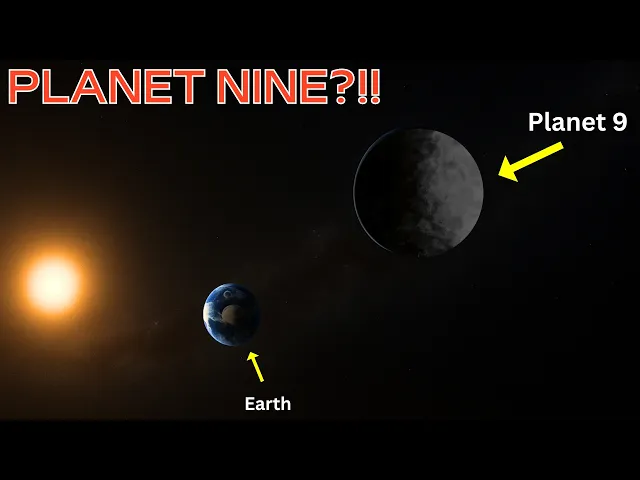
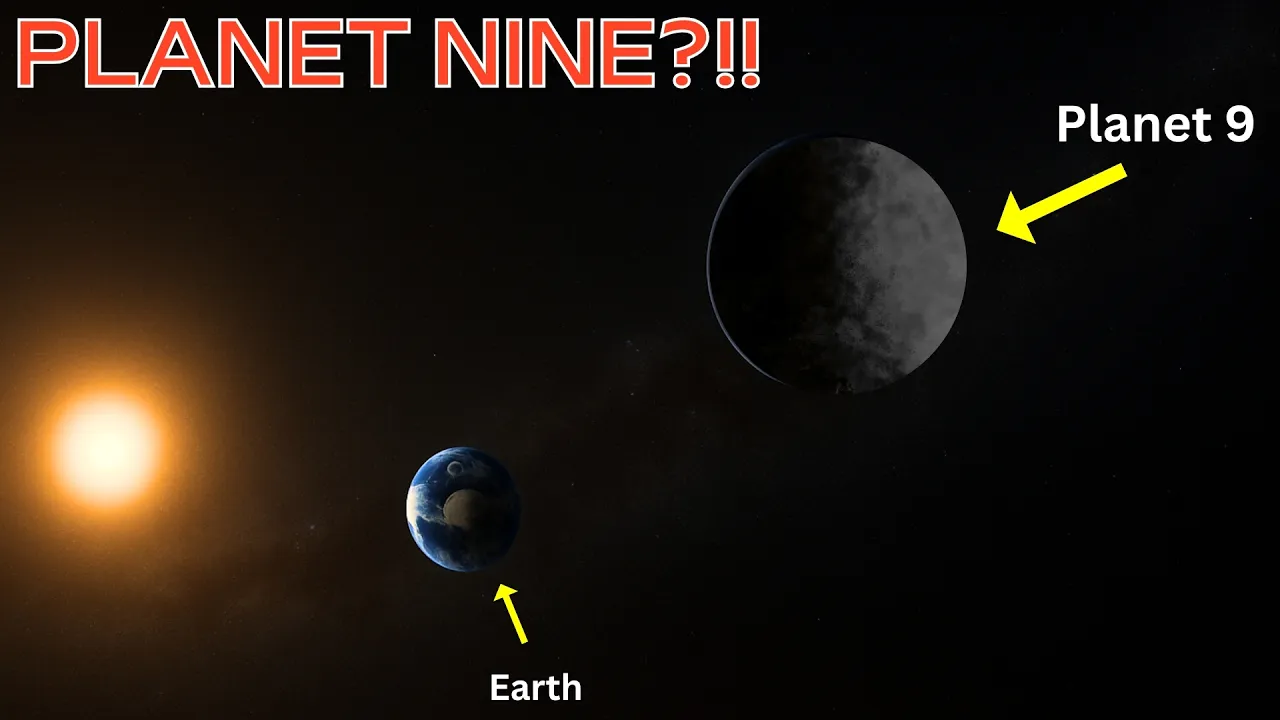
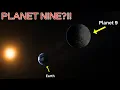
For years, scientists have speculated that something massive lurks in the outer reaches of our solar system. This hypothetical world, Planet 9, could explain puzzling gravitational effects observed among distant celestial bodies. But despite decades of searching, no one has been able to find it.
Now, a new study led by Terry Long Fawn has uncovered a possible candidate. Using infrared data from two space telescopes taken decades apart, the team may have spotted something slowly creeping through the cold, dark edges of our cosmic neighborhood. In this video, we'll explore the evidence, the science behind the discovery, and what it could mean for the future of planetary astronomy.
The renewed interest in Planet 9 began in 2016 when astronomers Constantine Bedigan and Mike Brown analyze the orbits of several trans neptunian objects, TNOs's. These small icy worlds orbit far beyond Neptune and showed a strange clustering in their orbital elements, particularly their arguments of perihelion and longitude of ascending node. This kind of alignment is statistically unlikely unless something massive is shaping their paths.
The best explanation is a large planet between five and 10 times Earth's mass on a wide eccentric orbit ranging from 400 to 800 astronomical units AU. At these distances, orbital periods stretch into tens of thousands of years, and any gravitational influence from known planets becomes negligible. Yet such an object could shepherd TNO's into aligned orbits through a process known as mean motion resonance or secular perturbation.
Detecting planet 9 is a technical challenge. At 800 astronomical units, sunlight is about 0. 01% as strong as it is on Earth, making reflected light incredibly faint.
Even large objects at that distance would fall below the sensitivity of many optical surveys. Infrared detection becomes a more viable option since massive planets emit residual heat from formation. Detectable in far infrared wavelengths even after billions of years.
That's why Fan and his team didn't just look harder, they looked smarter. They searched existing infrared data for signatures of slow faint movement. An approach that takes advantage of how distant bodies behave over long baselines.
The team's approach centered on two infrared observatories, Iris, infrared astronomical satellite from 1983, and Accari, a Japanese mission that scanned the sky in the 2000s. Both satellites captured full sky infrared data, ideal for detecting cold, distant objects. What made their work special was the time gap, 23 years, between the two missions, giving astronomers a long baseline to detect motion in the far solar system.
Infrared detection works differently from optical imaging. Cold objects like icy planets or brown dwarfs emit most of their energy in the infrared spectrum. Instead of relying on sunlight reflecting off the surface, telescopes like Iris and Accari pick up the thermal radiation, essentially the object's own glow.
Fans team used Accari's monthly unconfirmed source list, Musul, which includes transient signals seen in short windows. Objects moving slowly wouldn't be seen in the same place again, making this data set ideal for tracking distant candidates. The researchers developed simulations to estimate Planet 9's apparent brightness based on mass and temperature, applying those models to cross reference iris and AARI data.
They applied strict filtering based on brightness and expected motion, narrowing down from thousands of detections to just 13 candidates. Of these, one object met all criteria. Its movement between epochs matched predictions and it wasn't visible in periods where it shouldn't be.
The angular separation between the detections around 42 to 69 arc minutes was consistent with an object slowly orbiting at hundreds of astronomical units. Importantly, this candidate only appeared in the expected time windows with no repeat detections before or after, ruling out common infrared noise or background stars. If real, it could be a genuine slowmoving object in the solar system, possibly even the long sought planet 9.
The search for planets beyond Neptune dates back to the 19th century when astronomers attempted to explain anomalies in the orbits of Uranus and Neptune. These early efforts led to Pluto's discovery, but Pluto lacked the mass to explain the observed irregularities. In recent decades, the detection of unusual TNOs like Sedna and 2012 VP113 revived the theory of an unseen massive planet tugging at their orbits.
What distinguishes the current study is its use of archival data to track movement that unfolds over decades. Instead of relying on short-term observations, the team leveraged the concept of astrometric displacement, tracking how a nearby object appears to shift slightly against a backdrop of fixed stars due to its own slow movement across the sky. This is especially valuable for outer solar system searches where motion is too subtle to be spotted over short periods.
The next step is crucial confirming this candidate through optical observations and measuring its orbit. For that, fans team proposes using the dark energy camera at the Cherolo Inner American Observatory in Chile. DECAM offers a combination of deep imaging and wide sky coverage essential for catching faint slowmoving bodies.
Once observed again, scientists can calculate the object's proper motion, which if consistent, would provide enough data to begin plotting an orbit. If that orbit is stable and solarbound, and if the object shows sufficient mass based on brightness and temperature, we might finally have a confirmed new planet. But it's also possible this object is something else.
a super Earth-sized brown dwarf, a scattered disc object, or even a former rogue planet captured during the solar systems chaotic early days. Each scenario holds enormous scientific value. The implications of confirming planet 9 would be enormous.
It would force astronomers to revise models of solar system formation, particularly the role of planetary migration and gravitational ejection. Did planet 9 form near Jupiter and get flung outward, or was it captured from another stellar system during the sun's youth? Whatever the outcome, the discovery process itself underscores the power of combining historical data with modern computing and scientific imagination.
The solar system isn't a finished puzzle. It's a dynamic system still full of surprises. We're closer than ever to answering a question that has fascinated astronomers for generations.
The candidate found by Terry Long Fans team is the most promising lead yet. Not because it's flashy, but because it fits the scientific expectations. A faint, slowmoving object seen in two surveys decades apart.
With no detections at the wrong times and a brightness that lines up with predictions, this could be the moment we turn theory into reality. Further observations will decide whether it's truly a new planet or another strange member of our distant cosmic family. But either way, this journey driven by patience, science, and curiosity reminds us that even in the digital age, there's still value in looking back to go forward.
Thanks for watching. If you enjoyed this video, please like, share, and subscribe for more fascinating space stories. Stay curious and keep looking up.
Heat. Heat.