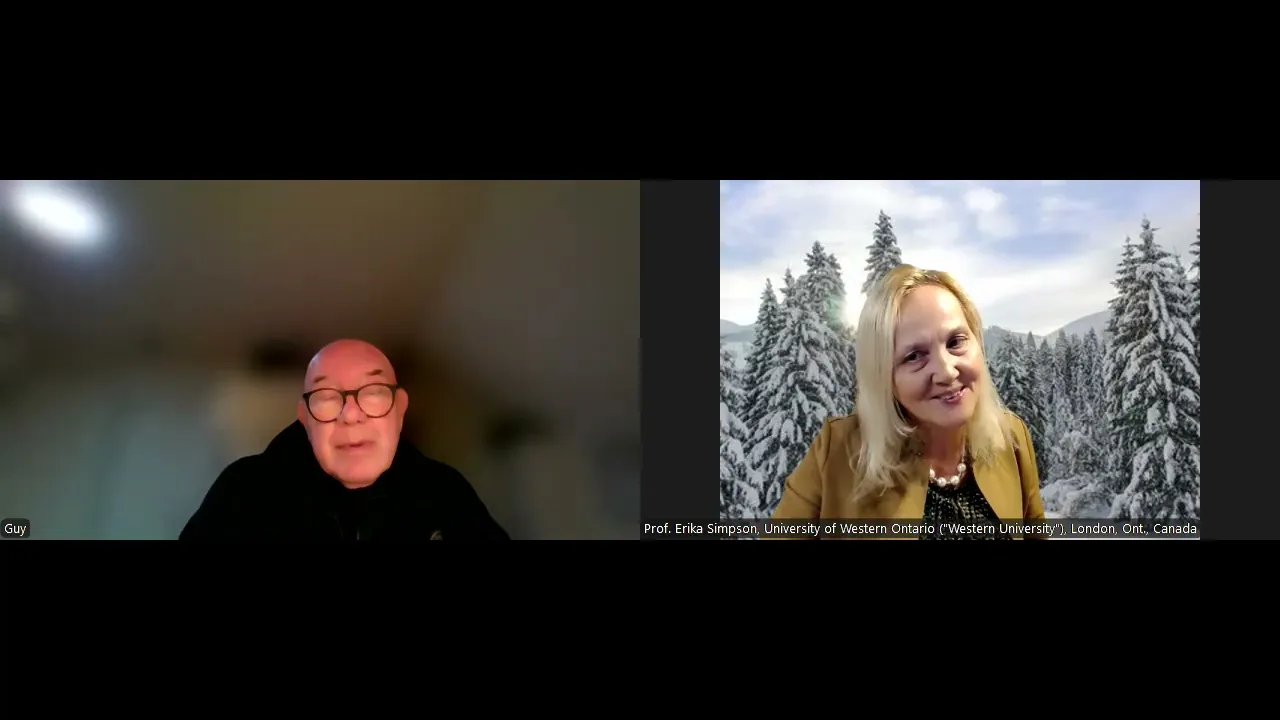
let's do it that's my option to hi everyone I'm I'm very well I'm happy to introduce to our class um by Roberts who is the former United States assistant secretary of defense for nuclear biological and chemical weapons and he was appointed as I've mentioned in the in the biography uh which I'd like you to read separately that he was appointed by former president Trump and he served under the first Trump regime and uh he's going to be talking to us today about nuclear modernization preemptive nuclear weapons and I'm hoping that we'll talk a little bit
about China and north of Korea but we don't have a planned overview so guys say hi to the students if you don't mind just so we can hear that your audio is working yes well again it's a pleasure to be here and thank you for inviting me and I'm hoping that we can have a good conversation well I think it'll be more I want to hear your views I'm sure the students don't want to hear my views but so let's just talk a little bit about um uh Vladimir Putin's uh threats uh to possibly use
tactical nuclear weapons so the Russians have a lot of tactical nuclear weapons in Europe and people are concerned that there might be a nuclear war over let's say the Crimean Peninsula or over the Black Sea or a nuclear war somewhere else like in the Arctic uh are you worried about those sorts of of threats yes well I'm I'm concerned about the fact that he is making those threats and it you have to put that in Ju position with his statements uh that all the P5 made about the fact that nuclear weapons should never be used
and yet and he turns around and then makes these threats and attempts to intimidate uh and and uh uh one of the things that I thought was most concerning was the rewriting of their nuclear policy and then having it leak to the press that in fact they have a strategy which we knew all along of escalating to escalate or escalating to win kind of strategy that escalating to deescalate is what I say I'm hoping it's not escalating to escalate be really scared true but in a way it would be that right it would it would
be that it would be the ultimate so we'd be back into kind of an arms control kind of En or an arms race kind of environment yes so um I'm very concerned about when you said they leaked it what does that mean do you think that they purposely leak and does the American government do that too do they purposely leak well you have yes I mean that's the part of your public relations campaign is to you know make certain things available uh on a you know a high ranking official that uh is not uh legally
able to provide that particular information but yet they're willing to speak off the Record me we use those kind of vehicles all the time and I did I did that in my when I was in the government and I know they're doing it as well but you send these very New York Times uh or you would call up a reporter and just say I would like to speak to you off record as the as the US assistant Secretary of Defense could you please report this without saying my name is that what they do well usually
it's the other way around and other words the New York Times Ro report would who's very knowledgeable who you know whose beat if you will is to cover these topics knows what kind of questions to ask and develops a working relationship with various government officials for that very reason well that's so cool that's very interesting okay well I'm sorry to be distracted there I was just wondering how that works um so uh who's the famous guy who's written so many books with interviews of trump the book Trump rage and I forgot his name now Bob
Woodward Bob Woodward yeah so Bob Woodward would not be great call from Bob Woodward be like oh no he's your classic case I mean goes all the way back to the Nixon era you know where uh they had a source deep throat they called him and uh and that's they passed information back and forth and leaked so to speak yeah they leak I I had dinner with that guy Daniel the one who leaked the Pentagon papers ellsburg yeah Daniel ellsburg I sat beside him and he told me the whole evening about the various leaks he
would did not regret it did not an iota of regret or or any kind of feeling of responsibility toward leaking um it was he's he's died now but yeah yeah I mean you know in many respects uh he basically kind of set the standard in what in the respect that well you you shouldn't be releasing classified information but as as so often is the case documents that are classified should never have been classified uh and you end up having you know for example uh the analytical conclusion of an Intel analyst yeah that becomes you know
senstive information yeah but the data behind it is public um and it goes a little bit overboard I remember very vividly when case that I had where I was in a negotiation with uh an ally uh are discussing certain things and I wrote up a report that was classified about that conversation and then later I wanted to share that with my Ally and they wouldn't let me because it was classified well I remember when I first met you in 2006 at NATO headquarters yeah um and you were talking to me about the Europeans and their
attitude like behind the scenes kind of a reluctance to talk about nuclear deterrence and so on and so you were saying some off-record things about the Europeans and that's when we we actually first met yeah way back then uh when you were discussing kind of the ideas of the nuclear Planning Group and and you chaired the nuclear Planning Group on behalf of the United States is that right am I remembering uh no the nuclear Planning Group is chaired by the Secretary General I chaired the staff group that supports staff group oh and that met every
Monday morning as I recall this is I'm looking yeah or or more I mean it was at least once a week for the most part yeah imagine if you had to cheer that now with 30 31 allies instead of in the 20s way back then and also some that are kind of confusing Hungary and and uh and the polls okay well focusing on um Vladimir Putin you cons you not as concerned about um the Russians perhaps escalating to escalate but you are concerned about um other threats as well so um in in the context of
Putin are you more worried about the rising threat from China with their icbms and the number words that um you've referred to in different Publications like their types of weapons and what they're testing and so on are you more worried about China I am I am well let me put it this way too I mean what we're facing is an unprecedented uh adversarial threat in which we might have two uh major Powers uh working together and how do you craft a deterrent strategy for both this is a unknown territory this is something we've never done
before and it's uh re we first recognize that each country Russia and China has a different set of circumstances that we have to deter um and prevent from happening and how you send the right signals in each case is is a very big challenge well I mean a two-front war is what everyone is worried about about Taiwan the United States has had two enemies Germany and Japan before and of course Pearl Harbor is evidence that deterrence didn't work and the Japanese attacked that's true conventional deterr yeah you you individually deter them but you're saying you
think you need to deter both both great Powers simultaneously simultaneously and that's what we see happening with the more and more collusion between the two and also with North Korea because they are the Russians are using North Korean soldiers in Ukraine along the front in Russia to fight yes that's right so are you also worried about um a simultaneous attack let's say from Kim Jong-un in a moment of insanity or do you think the United States would just completely obliterate Pyongyang and therefore there's no no risk well that's a very good question BEC as uh
I've often thought about that uh in terms of how would we react if he actually fired a nuclear weapon would would we fact be that would be our response U and of course the bigger concern I have frankly because I think uh I think Kim youngan is is rational I think he recognizes that it would be the end of him we've sent that in many different venues uh vectors if you will that uh if he did something like that it would be the end of him uh and so I frankly am more concerned about South
Korea we've now seen many statements uh many uh in fact uh poll um I can't cite to you where I saw it but a poll of South Korean people said they should have their own nuclear weapons a vast majority yeah they they you know I just co-authored a paper with a South Korean doctor wayang and uh he wrote to me he thought Canada this is a person who has a PHD okay and he wrote to me he thought Canada had nuclear weapons because we're such a large country so I very politely corrected him and said
well actually no we don't we we disarmed and so on but it's interesting that there was that idea among an educated person with a PhD so I'm not surprised to hear that I thought you were going to say you were worried about a biological attack cuz remember yes well I amri about that biological weapons and chemical weapons and the question there of course is how do you deter the use of those weapons now we I think we sent a very good strong deterence message during the first Iraq War War uh where the reason Saddam Hussein
didn't go down that path of using him was we made it as clear as possible that we would probably respond with a nuclear weapon um and I think that that's you know the again one of the questions but from a non-proliferation standpoint I'm seeing more and more talk about uh questioning the resolve and will of the United States states to provide that nuclear umbrella I mean we've uh heard Turkish diplomats say that if Iran gets a nuclear weapon we're going to have our own despite the fact that they are under the the nuclear umbrella if
you will we've heard the Saudis talk about that and oh guess what they're building nuclear reactors there now kind of wonder why they need more energy than they already have you you've got um you know long history of many other countries that are starting to think for their own security purposes they somehow need to have this in their back pocket so to speak uh so I am concerned from a non proliferation standpoint the erosion of the the Nuclear Ban if you will uh and and there are several countries that have are virtual nuclear weapon States
Japan is a n virtual nuclear weapon state Germany is uh turkey could be going down that path particularly once their uh nuclear reactors come online um we've had of course Iran worrying about them and uh and so I I do worry about that uh we've got a very successful nonpol foration regime you do think successful that was going to be my next question is do you think the nuclear nonproliferation treaty has been successful because of course Kennedy thought there would be 253 powers and you know in a sense over it has managed since 1968 to
restrain not because it's buttressing extended deterrence but because it's G it's putting forward a regime yeah that is a disarmament regime so I mean I agree with you extended deterrence is under threat um and and PE it is logical to want to think of possibly about building one's own nuclear weapon and I agree with you about Saudi Arabia and Iran and all these countries that are looking at the example of what happened to Ukraine but the argument that's usually made is that they should build conventional forces well the problem with that of course is conventional
costs a lot more money than having a nuclear weapon capability I mean a division of soldiers you're talking at least a billion dollars a year to maintain and support and uh you know that gets to be really expensive very quickly and and it's a an e easier way out is to you know threaten nuclear Annihilation so to speak um so again I'm I'm really concerned about that uh because I think countries are looking at it and you mentioned the Ukrainian example uh and ukrainians probably Ru the day that they gave up their nuclear weapons based
on a promise from Russia that they would guarantee their territorial integrity and Independence and sovereignty and was a promise from the United States too was from your government and UK failed by the way United States two years later I think it was two years later uh Ukraine and Russia signed a agreement a legally binding treaty not not a politically binding agreement but a legally binding treaty that Russia would do just that again uh guarantee their sovereignty and Independence and of course when they invaded Crimea they they violated that agreement and here we are but again
the Russians don't trust at all they've violated every single arms controll agreement they've ever negotiated uh with us or and other countries um and by the way we document that in the state Department's yearly compliance report but um so when you have a party that doesn't comply with their legal obligations under Almost 100% circumstances then you know why do you go down that path and you ought to be taking other me measures to guarantee that that uh you can make them comply with their agreements so they they didn't comply with the open Skies agreement or
with INF are you saying that no no INF of course that was the administration finally pardon me the Obama Administration uh yeah no or you're saying oh since the Trump Administration I thought you were saying they didn't comply previously with treaties like the open Skies yeah and they didn't comply with the biological weapons convention the chemical weapons convention I mean we've done down the list of just about every Arms Control agreement like I said that you're hard place to find one where they actually are complying uh they VI that's what I was trying to think
of is I was trying to think of one and and it's true the btwc they're not compliant with chemical weapons they're not not compliant but doesn't that then therefore point to the fact that what you're saying is that ARS control does not work but then at the same time you're saying well we have to rely on the npt regime and it is not as successful or it is a successful regime or it could be improved I'm I'm not sure what what direction you are thinking we should go well I think again uh the whole concept
of having these arms control agreements were based on you know two things one is that you would have a you know like President Reagan you say do ey no pry trust but verify and so built into those agreements was a verification regime that gave you very high confidence that the the opposing party was in compliance the second element of that is that there were costs to be had that compliance failure of compliance would result in costs that would exceed the benefits of that agreement and there are no costs that is never happened and there's the
rub yeah there's the rub the CWC came closest by having this challenge inspect regime and that's the kind of regime where you have basically go anywhere any time any place to build the confidence that the other part is in compliance we don't have that you every other agreement it doesn't exist yeah I mean I'm thinking out loud because the you know Canada extols the global partnership program we give a billion we've given a billion dollars which is a lot of money for us uh so we extol that but of course the Russians have withdrawn from
that but that was a measure of compliance but without any hard um like there was no stick there was saying give them the stick give them the carrot but also give them the stick and there really is no way um to punish them like in Game Theory would say there's no there's no punishment here except for the prospect of a limited nuclear war which would lead let's say the nuclear taboo fails and some countries use nuclear weapons like let's just say India and Pakistan use 100 tactical nuclear weapons well then we'd have a nuclear winter
around the world within two weeks right Global temperature would drop yeah more like 1.5 degrees Fahrenheit Centigrade whatever you want to use we'd all be starving let me go back a minute to that the nonproliferation the other element that I forgot to mention which was very concerning for me was that we have a new player in the game which is international criminal organizations uh where we have uh you know the uh AQ conon case yeah Pakistani father of the Pakistani bomb who was selling nuclear technologies around the world we still don't know the full extent
yeah of how much that's involved how many other players are out there we just uh recently had the one of the heads of Yakuza Japanese um criminal organization that offered to sell uh highly enriched uranium and plutonium really I didn't know and he was just arrested a few months back and uh this is you know here we have a second very disturbing case Yakuza has their tentacles worldwide and who knows what they could be doing with intern with International terrorist groups like Isis um that could possibly be in cahoots to you know provide these technology
the the ability to build a nuclear weapon is on the internet the sinquin known of nuclear weapons is the fiza materials we control that very well but if we ever let it loose and maybe we one country plon Japan has huge stockpiles of plutonium from their nuclear reactors that that's a real danger I'm very concerned about that I I've written a lot of oped guy about the proposed nuclear waste site uh in Canada for where all of our highlevel and our intermediate level nuclear waste we don't have as much as the Americans but we do
have quite a few nuclear reactors that are being decommissioned so they've decided to put it way up in Canada's North close to Manitoba it's 1500 uh about 1,500 miles from Toronto which is our um capital of Ontario but not the Canada um anyway and so the I I wrote about how this could be a terrorist threat by the Great Lakes they've moved it from by the Great Lakes since I wrot wrote that oped 2 months ago to uh to Manitoba so that's safer I'm not saying I'm advocating it but it would be built over the
next 100 years um and that need needs to be done in the United States and in Japan and in uh South Korea and actually Romania and all the countries that are going to have this high level waste that's very could be made into a dirty bomb or threatened used I'm glad you and I are concerned about the same things and we have been for years which is terrorists and dirty bombs and also the threats of using nuclear weapons but to get back to India and Pakistan are a tactically for winter aren't you I'm more worried
I'll be frank about a nuclear winter than I am about a full-scale nuclear war among the great Powers because I think they learned from the Cuban Missile Crisis not to go there aren't you more worried about a a uh Regional nuclear war and that leading to a nuclear winter well I think that's I don't I'm not as worried right now about that but I see the trend lines heading in that direction especially if again the nucle Bella of the United States starts to have holes in it and people are don't have high confidence that they
have that protection and would rather have and spend the money and many of the countries we just mentioned have the capability uh as I said some are virtual nuclear weapons weon States they they have everything they need they just like the political will to do it so you know uh and I can foresee a scenario five 10 years from now where that is a a real reality if yeah we're we're entering what they say I I always say we're entering a nuclear jungle yeah and we're it's going to be it's going to be interesting to
see what happens my last question for you because the students this is about 20 minutes and I could talk to you forever obviously but um you were in charge as the US assistant secretary of defense for the decision to modernize the United States Triad of nuclear weapons uh this was extremely expensive program that's being undertaken uh for the next 30 years and it was arguably extremely necessary to modernize the nuclear weapons to make them safer are you worried about Russia and them or or China modernizing their nuclear weapons because they could hit North America by
accident are you not worried about their modernization like they need to to hurry at the same speed as as the United States well the uni uh first of all with with Russia the biggest concern there is there development of many other n types of nuclear weapons that have never been constrained by an arms control agreement and I'm thinking the Hypersonic missiles the submarines uh the other the whole laundry list of things that Putin mentioned in one of his speeches a couple years ago that have never been under any kind of restraints whatsoever and in addition
since the start treaty has been suspended the new start treaty I should say New Start um again they uh have uh Gone on a rapid buildup as well as modernization program uh with China uh the most opa of Nations when it comes to this we really don't have a good clue as to how many they have but we do see the signs from overheads that they're on a Glide path to build at least 1500 uh nuclear silos I'm sorry 450 to 600 nuclear silos uh with the stated goal of a really of achieving par parity
or actually exceeding the United States um as so I mean and it's very concerning they they've developed uh again a whole series of other weapons that have are not constrained uh by any treaty whatsoever so you have this real kind of explosion if you of uh new technologies that we have don't have good handle on we really don't I don't know um and we're not set up and I don't think we will see this in the uh Trump Administration any effort to re-engage in an Arms Control process that would actually be able to build some
constraints on this the modernization program I would just note that the U us the defense budget was approved by bipartisan support right and it was $895 billion for this year I mean that's a lot of that's an incredible amount of money and there is bipartisan support for completely modernizing and in fact now now there is of course strong support for building the new uh Naval launched nuclear weapon um and so that process is going down so we will have a new although it it's really not new in the sense that it we used to have
something called T lamn which is the Navy ship a nuclear weapon launched from a Navy ship so this would be a replacement for that um have the long range standoff missile which allows us to keep our b52s for another 30 years um and um and going a whole series of of very as you rightly pointed out very expensive systems um to just modernize not increase U you know except with that except for the exception for the naval uh cruise missile launch missile um we we're not we're not building anything new yeah I know I'm just
concerned about you know Russians using old floppy discs in their computers because they don't have enough money and so the risk is to the United States it I I'm I have faith in the United States deterrent and the United States command and control capacities and intelligence capacities where I am nervous is that their uh icbms and their cruise missiles are pointing at Europe and at uh the United States and and even Canada so um whereas you were in charge of the modernization it it led the United States to modernize but the problem is now the
United States and China I mean China I I talked to a Chinese Diplomat from the Canadian Council a few weeks ago he didn't know how many nuclear weapons China had and then he went on to Wikipedia in front of me to look at how many nuclear weapons and then he said well I think we have 300 um so what I'm saying is that that Chinese then the Russians are far far behind in terms of Game Theory and deterrence and understanding rational decision making and so they're the threat that's the threat is is there lack of
communication miscalculation miscommunication all sorts of problems there that the game is is not clear to them it it really is not clear to to other countries they're quite far behind that's where I'm concerned I think we both a lot of the same concerns but um yeah well again that that there the the possibility of an accidental launch again I don't see it happening but on the other hand um the I don't know if you've read and I commend it to the students they should read David Hoffman's book called The Dead Hand oh yeah I have
not read that that is an excellent book and it reads like a thriller and it talks about the period of time it really does I'll put a link to it I'll put a link as well to your recent article in peace review which was on the the this these same topics so I'll put a link to that as well uh thank you very much for allowing me to interview you today for our class my pleasure very very large class and they're all very interested I'm sure to hear your views and thank you so much for
coming on and I I really really appreciate it I hope that I hope you have enjoy good health and that you I hope that we can meet again online yeah okay well thank you very much it was a pleasure and it's always great to see you








![Live Aid (Queen) Full Concert [1985, London, Wembley Stadium]](https://img.youtube.com/vi/PLIAp5nr0q0/maxresdefault.jpg)