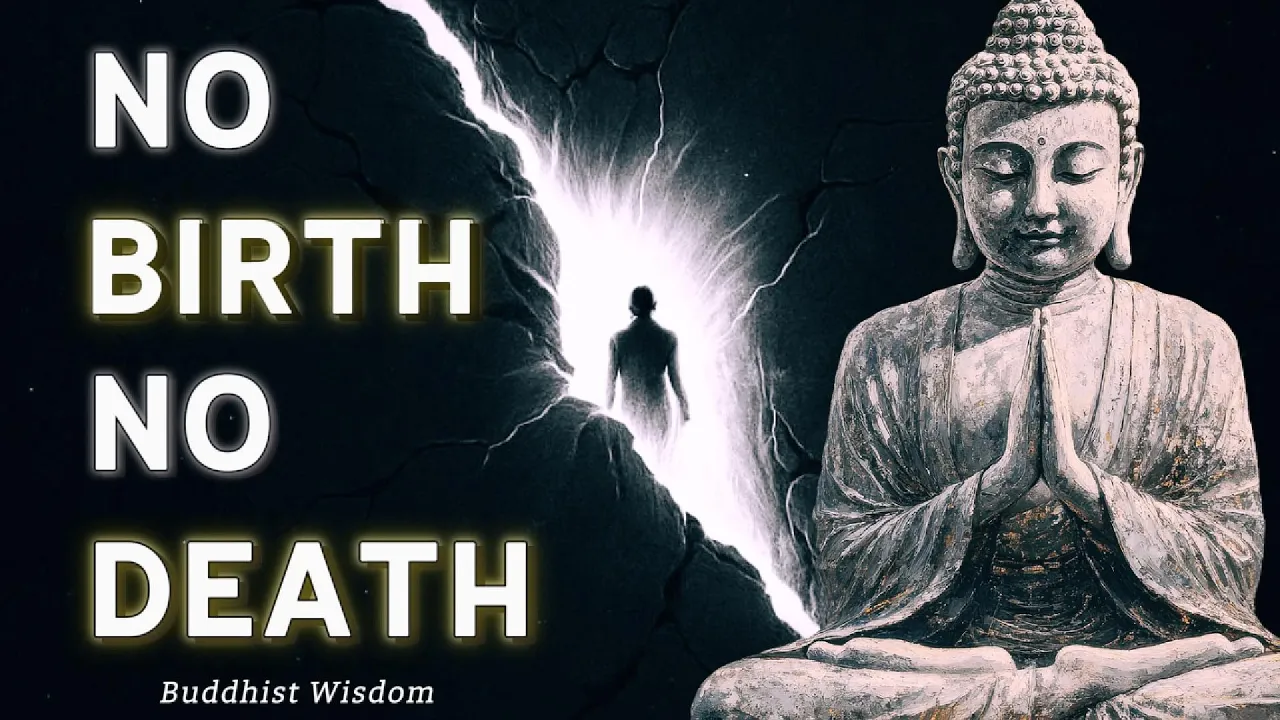
"No Birth, No Death": BUDDHIST WISDOM. CHAPTER 1: Facing Fear, Questioning Life/Death There is a feeling that stays with us, deep down, a shadow often just out of sight. It's the feeling that everything we are, everything we love, everything we know, will one day stop.
The fear of ending. The fear of being separated forever. This fear touches us all, no matter who we are or where we come from.
We see life as having a clear start a birth - and a clear end - a death. It feels like a switch turning on, and then later, turning off. We tend to see the world, and ourselves, through this simple idea: something is, and then it is not.
But does this way of seeing show us the full picture? Does it show us the true nature of reality? The Buddha pointed to a wisdom that looks at this very question.
It is often spoken of as "No Birth, No Death. " This is not just a phrase, or a simple belief to accept without thinking. It is a deep understanding that can free us from the tight grip of fear, from the suffering that comes with thinking about birth and death.
It is a wisdom realized through looking very, very closely at how things truly are. Where does this strong feeling of birth and death come from in the first place? It comes from how we usually think about ourselves.
We have this idea that there is a separate "me," a solid "I," that was born at a certain time and will eventually die and disappear completely. We tend to feel that this "me" is our physical body. Or maybe it's our feelings, our thoughts, our memories – the things that make us feel like a person.
But look closely at your body. It changes every day, doesn't it? Look at your feelings – happy one moment, sad the next.
Look at your thoughts – always moving, never staying still. Yet, we hold on tightly to this idea that this changing body, these changing feelings and thoughts, are a permanent "me. " The Buddha reminded us that suffering arises when we hold on to things that are temporary.
The body is temporary. Feelings are temporary. Thoughts are temporary.
They do not have a fixed, unchanging core. Yet, we cling to them as if they are a solid, lasting "self. " And because we see ourselves as a fixed "self" that is born and will die, the fear of that ending feels very real, very powerful.
According to the Buddha's teaching, this common way of seeing life, through the lens of a fixed "self" that is born and dies, comes from not seeing clearly. It comes from a misunderstanding of how reality works. This not seeing clearly is sometimes called Ignorance.
But it's not about being unintelligent; it's about not seeing the true nature of things. What if we could look beyond this usual way of seeing? What if we could pull back the curtain of this misunderstanding?
This is what we are going to explore together. We will look at the wisdom the Buddha shared, not as something distant or complicated, but as something that speaks directly to our deepest fears and our everyday lives. Our aim here is to build a clear starting point, to spark a sense of wonder, and to see how this ancient wisdom is deeply connected to the reality we live in, and the struggles we face.
CHAPTER 2: Three Keys: Change, No-Self, Causes We questioned our usual way of seeing life and death, the feeling of a separate self that is born and ends. To understand the Buddha's wisdom of "No Birth, No Death," we need to look at the foundation it rests upon. There are three key understandings that open the door to this deeper view.
The first key is the teaching of Impermanence. The Buddha taught that everything, without exception, is always changing. From the smallest particle to the largest galaxy, from our deepest feelings to our passing thoughts, nothing stays the same, not even for a moment.
Think about your own body. It changes from a baby, to a child, to an adult, to an old person. Every cell is replaced over time.
Our emotions rise and fall like waves. Our thoughts come and go like clouds. The universe itself is a constant dance of forming and dissolving.
If everything is always in motion, always transforming, then what is it that is truly born? And what is it that truly dies? This constant change already begins to loosen our fixed idea of a solid beginning and a final end.
Building on this understanding of change, the second key is the teaching of No-Self. The Buddha stated clearly that there is no permanent, unchanging "I" or soul that exists independently behind our body and mind experiences. We tend to think of ourselves as a single, solid entity.
But when we look closely, a person is just a temporary collection of five changing parts. These parts are the physical body, our feelings (pleasant, unpleasant, neutral), our perceptions (how we recognize things), our mental formations (thoughts, intentions, habits), and our consciousness (our awareness of things). These five parts are always changing and depend on each other.
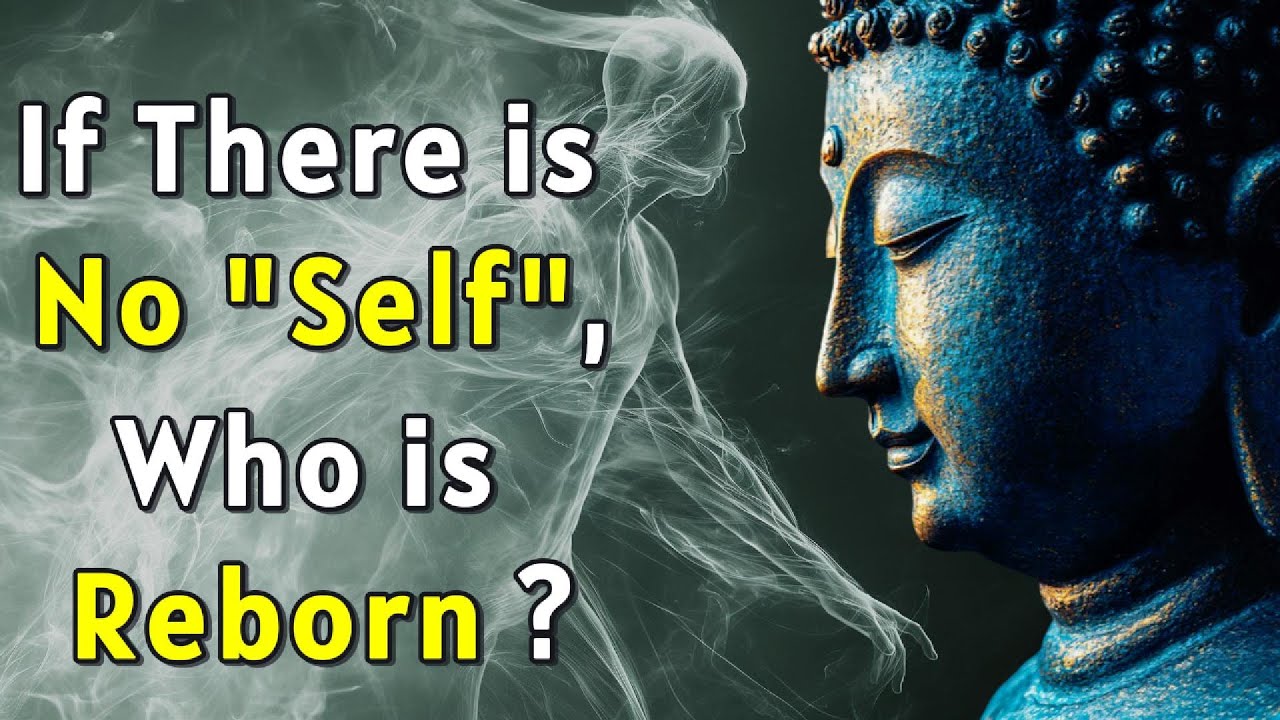
There is no separate, independent core "self" controlling them. If there is no fixed "self," no unchanging being in charge, then who exactly is born? Who is there to die and go through different lives?
This teaching challenges our most basic assumption about who we are. And the rule that explains how all this works, the principle that connects Impermanence and No-Self, is the teaching of Dependent Origination. This is a golden key to seeing reality.
The Buddha taught that things and events do not appear out of nowhere, and they don't happen because some powerful being creates them. They arise and cease entirely because countless causes and conditions come together or fall apart. Think of a simple example, like a plant growing from a seed.
The seed is a cause, but it needs conditions: soil, water, sunlight, air. Without all these, the plant won't grow. The plant doesn't come from nothing, and it doesn't exist independently.
It depends on its causes and conditions. Similarly, a flame appears because of a wick, wax, and oxygen. When these conditions change or are removed, the flame disappears.
According to the Buddha's teaching, what we call "birth" and "death" are really just links in this endless chain, this continuous flow of causes and conditions. They are not absolute beginnings or absolute endings, but moments of appearance and disappearance within a larger process governed by this fundamental law. Understanding these three keys – Impermanence, No-Self, and Dependent Origination – starts to shift our view, showing us a reality far more fluid and interconnected than we usually imagine.
CHAPTER 3: How Rebirth Works Without "YOU" We have seen how everything changes and how there is no fixed, independent self. This often brings up a difficult question. If there is no real "someone" here, if the nature of things is "empty" of a fixed self, then how can we talk about rebirth?
Who, or what, is reborn if there is no soul, no core being to move from one life to the next? This seems like a puzzle, a contradiction that is hard to put together. It is true, this is one of the points that many people find most subtle and easy to misunderstand in the Buddha's teachings.
It can look like a problem that cannot be solved. But what if we look closely at this apparent puzzle? Perhaps we will find that there is no contradiction at all.
Perhaps the teachings of No-Self and the nature of things being "empty" are exactly what allow the flow of cause and effect that we call rebirth to continue. To understand this, we need to look again at the nature of things being "empty. " This idea of Emptiness is very important.
It does not mean that nothing exists. It means that all things, all events – including our mind and body – are empty of a fixed, independent nature. They do not have a core essence that exists all by itself, separate from everything else.
The Buddha taught that because things are empty of this fixed nature, they can interact, they can change, they can arise, and they can cease according to the law of Dependent Origination. If everything had a solid, unchanging nature, how could it possibly change? How could there be birth, growing old, sickness, and death?
How could one thing lead to another? It is precisely because things are not fixed, because they are "empty" in this way, that they can move and change. You can think of it like empty space.
Empty space allows objects to exist, to move, and to interact within it. The Emptiness of things is the condition that allows the cause and effect of the universe to operate without end. As the Zen master Hui Neng pointed out, "Originally, not one thing exists.
. . " This points to the true nature of mind, which is pure, not held by any idea of a fixed "thing" or "self.
" When we think about rebirth, we often fall into two simple ideas that are not quite right. The first is the idea that something is born from nothing. The Buddha reminded us through Dependent Origination that every appearance of a form, every "birth," is the result of causes and conditions coming together.
Nothing suddenly appears out of absolute nothingness. Think of a child being born. A child does not come from nothing.
The child's body forms from elements from the parents – the sperm and egg are important conditions. And, according to the teaching, a stream of energy and consciousness from a past chain of causes is also a main cause. None of these – the physical elements or the stream of karmic energy – are "nothing.
" The second simple idea, and perhaps the most common misunderstanding, is that something travels to be reborn. Because we are used to thinking of a "self," we naturally think there must be something – a soul, a core consciousness, some kind of entity – that leaves the old body when it dies and enters a new form to start the next life. But the truth taught by the Buddha is that absolutely no entity, no object, no immortal soul, not even a separate "Consciousness" as a thing, travels or goes to be reborn.
If such a thing truly existed and moved from life to life, that would mean there is a permanent "self," which is the opposite of the core teaching of No-Self. So, what is rebirth then, if nothing travels? It is not the movement of an object through space.
It is the continuous flow of cause and effect. It is the passing on of karmic energy, the ongoing appearance of tendencies and results of actions, all happening according to Dependent Origination. How does this work without a "carrier"?
Every action we do with intention – through body, speech, or mind – creates an energy, a mental tendency, a karmic seed. This energy is not a physical thing, but it carries a strong potential to create results later. This karmic energy is not destroyed when the physical body breaks apart.
Think of consciousness not as a fixed thing, but as a river always flowing, changing moment by moment. This stream of consciousness carries the karmic energies, the seeds planted from past actions. This stream is not a soul standing outside watching; it is the flow itself.
The crucial moment happens at death. The very last moment of consciousness just before the body dies holds the energy of the strongest karma active at that time, plus the total energy of past actions. This last moment of consciousness becomes the direct condition for the first moment of consciousness in the next life.
There is no time gap, and no physical movement. The ending of the consciousness at death is the immediate condition for the arising of the consciousness in the next life. It is like a reflection appearing in a mirror the instant an object is placed in front of it with light.
No image flies from the object into the mirror. In the same way, no "consciousness" flies over to become the next consciousness. There is only a cause-condition-effect relationship happening instantly.
We can use simple examples to help understand this. Imagine lighting a new candle from an old flame. The "old flame" doesn't jump over.
The heat from the old flame, combined with the wick and wax of the new candle, causes a new flame to arise. The new flame is a result of the old flame and the new conditions. It is a continuation, not the same thing moving.
Or think of pressing a seal into soft wax. The seal, like past karma and consciousness, creates a new image in the wax, which represents the new life. No piece of the seal goes into the wax.
Only the pattern, the information, is transferred. The image in the wax is not the old seal, but it depends completely on the old seal. The apparent puzzle between rebirth and No-Self or Emptiness only appears when we try to put our usual idea of a fixed "self" onto the Buddha's teachings.
In truth, the opposite is true. It is exactly because there is no fixed self, because nothing is permanent, that the flow of cause and effect can operate so flexibly and continuously. This creates the ongoing appearance of mind and body that we conventionally call rebirth.
There is no soul being reborn. No "thing" is reborn. There is only the flow of Karma and Consciousness, which are themselves without a fixed self and always changing, operating without end according to Dependent Origination.
This flow continues, creating the experience of suffering if misunderstanding and wanting still control it, or it can lead to the complete stopping of the cycle if true freedom is reached. Understanding this deeply helps us see that we are responsible for our actions because they create effects, and it helps us let go of holding onto the mistaken idea of a lasting "self. " CHAPTER 4: Death: Transformation, Not The End We have looked at how everything is always changing, how there is no fixed self, and how things arise and cease based on causes and conditions.
We also explored how rebirth happens not as a soul moving, but as a continuation of this selfless flow of cause and effect. Now, let's look directly at the event we call "death. " From the Buddhist perspective, death is not an end, not a disappearing into nothingness.
It is a natural process of transformation. It is the temporary combination of the five parts that make up a person – the physical body, feelings, perceptions, mental formations, and consciousness – falling apart. It is a shift in the state of being for these elements.
Think about what happens to the physical body. The basic elements it is made of – earth, water, fire, and air – gradually lose their connection and break down. They return to their natural state in the environment, becoming part of the soil, the water, the air, and the energy around us.
This is a clear transformation of the physical part. For the mental parts, the types of consciousness tied to the senses – seeing, hearing, smelling, tasting, touching – and the usual thinking mind, depend on the physical body and brain. As the body stops working, these sense consciousnesses gradually stop too.
However, the deeper stream of consciousness, the one carrying the accumulated energy of our actions, continues its flow, unless a person has reached full liberation. This brings us back to a core principle we touched upon. Nothing is born from absolute nothingness, and nothing dies into absolute nothingness.
There is only a continuous transformation, a succession of elements and energies happening according to the natural law of cause and effect. When we look at this through the lens of modern science, we can sometimes see interesting points of connection, though it's important to remember that science and Buddhist wisdom look at things in different ways. In physics, there are ideas like the law of conservation of energy and the law of conservation of mass.
These laws state that energy and matter are not created or destroyed; they only change form. We can see a similarity here with the Buddhist view of the physical elements of the body transforming and returning to the environment after death. The materials themselves change form but continue to exist as part of the larger physical world.
Ideas in cosmology, like how the universe formed and changes, can also be cautiously related to Buddhist ideas of cycles of forming and dissolving, emphasizing that the universe arises from specific conditions, not from absolute nothingness. In biology and medicine, the process of physical death shows the transformation of the physical body very clearly. After death, tiny living things break down the body, returning basic chemical elements to the soil, water, and air.
These elements then take part in other life cycles on Earth. This is a visible example of the physical body transforming. Science is also learning a lot about the connection between the brain and consciousness.
However, science today cannot fully explain the deepest nature of consciousness. More importantly, there is no validated scientific proof that consciousness can exist or continue after the brain stops working. This is a fundamental difference from the Buddhist teaching about the continuity of the stream of consciousness carrying karmic energy.
Experiences sometimes reported near death are complex events that science is still studying, but they are not considered proof of rebirth in the Buddhist sense within a scientific framework. It is important to respect the different ways that science and Buddhism explore reality. Science focuses on the physical world, on what can be observed and measured.
Buddhist wisdom, while not ignoring the physical world, also looks at the nature of mind, action, and the path to freedom from suffering. Similarities we might see, like ideas about conservation or transformation, are best understood as conceptual points of connection, without trying to say that one is the same as the other. The Buddhist view of death is part of a larger understanding of the cycle of existence and the possibility of liberation, which goes beyond the current limits of scientific study.
CHAPTER 5: Living Without Fear: Peace Now We have explored the nature of change, the absence of a fixed self, the law of cause and effect that connects everything, and how rebirth is a continuation of this selfless flow, with death being a transformation, not an end. What does this understanding mean for our daily lives, especially for the fear we began by talking about? When we truly begin to see that our nature is not a solid, temporary self that can be lost forever, and that death is not total disappearance, but a change of state, the deep fear of ending and separation starts to soften.
It doesn't mean we stop feeling sadness or loss when someone we care about is no longer physically present. But the raw terror of annihilation, of simply ceasing to be, begins to lose its power. This understanding also helps us live more fully in the present moment.
If we are not constantly holding on to what was "born" in the past, or worrying about the "death" that we think is coming in the future, our minds can settle here, now. We can be more present for the life that is happening right before us, experiencing each moment more completely, practicing simple awareness of what is. Seeing that there are no solid boundaries between things, that everything is connected through cause and effect and lacks a fixed, separate nature – this understanding of "No Birth, No Death" naturally opens our hearts.
When we see ourselves in others, and others in ourselves, it becomes easier to feel empathy and unconditional kindness. This deep awareness of interconnectedness, often called interbeing, grows stronger. Life brings change – birth, aging, sickness, death, meeting, parting.
If we expect things to be permanent, we suffer when they change. But when we understand Impermanence as the basic law of reality, we learn to accept these changes gracefully. This acceptance does not mean giving up; it means finding a way to be at peace even when life is difficult, because we are no longer fighting against the fundamental nature of things.
How do we make this understanding more than just an idea in our heads? There is a path of practice. One way is through reflection.
We can regularly think deeply about these truths – Impermanence, No-Self, Dependent Origination, Emptiness – not just in abstract terms, but by looking at them in our own body, our own feelings, our own thoughts, and in the world around us. Another way is through meditation. Different forms of meditation help train the mind to be still and focused, and to see the true nature of mind and reality directly, beyond just thinking about it.
And living an ethical life is also practice. Following simple guidelines for good conduct is not just about being a good person; it is a way to plant wholesome seeds for the future, to clear the mind, and to create the right conditions for deeper wisdom to grow. The ultimate purpose of this path is to reach Nirvana.
Nirvana is not a place in the sky. It is a state of supreme peace, the complete stopping of suffering. It is the state where the roots of the cycle of birth and death – misunderstanding and wanting – are fully removed.
The Buddha taught that Nirvana is the full realization of the wisdom of "No Birth, No Death. " It is a state of freedom, beyond all ideas of being and not being, of birth and death. We have looked together at the wisdom of "No Birth, No Death," exploring the nature of fear, the key teachings that support this view, how rebirth happens without a self, and how death is a transformation.
Understanding and living with this wisdom is not about escaping life or feeling negative. It is about living more deeply, with more meaning and courage, no longer held back by the fear of birth and death. It is about finding true freedom.
May this sharing be helpful for your own journey of learning and practice. May you find peace, wisdom, and liberation.