There is a place in the world where the soil holds memory. A mountain where the ground has absorbed tears of kings, blood of prophets, the sweat of a son of God in humanity's longest night. This place has a name and if you have never paid attention to it, what you are about to discover will forever change the way you read your Bible.
And it is exactly this mountain that will split in half when the feet of the son of God touch its summit for the second time. It is a prophecy with an address registered over 2,000 years ago. To understand why this specific mountain will split, we must first understand what it carries.
When David fled Jerusalem during the rebellion of his own son Absalom, the text of Second Samuel describes a scene that hurts to read. The most powerful king of Israel, the man who had defeated Goliath, who had unified the kingdom, who had danced before the ark of the Lord, was climbing the Mount of Olives on foot, barefoot, with his head covered, weeping. The people around him wept as well.
It was a procession of defeat, of shame, of a father whose son had turned against him. The mountain absorbed those tears. Centuries later, another son of David climbed this same mountain .
Jesus looked at Jerusalem from the heights of the Mount of Olives, the city that had stoned prophets, that had ignored every warning, that was about to reject the very son of God. And Jesus wept. Luke records that moment with a Greek word that does not mean just silent tears, it means sobbing, it means the cry of someone mourning something that has not yet died, but is already lost.
The mountain absorbed those tears too. And then to Gethsemane , at the lower part of the Mount of Olives, among the oldest olive trees that still exist in the region, is the garden. It is there that Jesus went on the night he would be arrested, not to hide, not to flee, but to pray.
And what happened in that garden is one of the most humanly devastating scenes in the entire New Testament. Luke, who was a physician, records a detail that no other evangelist mentions. He says that Jesus 'sweat that night was like great drops of blood falling to the ground.
Medicine knows this condition, a rare phenomenon that occurs under extreme stress. Jesus' body was responding to the weight of what he was about to carry even before the cross. And where did this happen?
On the Mount of Olives . The same mountain where David had wept, the same mountain from where Jesus had looked at Jerusalem with mourning. The same mount that on that Thursday night absorbed not only tears, but blood—the blood of the Son of God mixed into the earth He Himself had created.
There is a thread that runs through all these stories, and it is not just historical. It is the thread of God’s presence, which always returns to the same place. And the final scene of this mount in the Gospel narrative is the quietest of all.
40 days after the resurrection, Jesus gathered the disciples, went up with them to the Mount of Olives, and there, while blessing them, He was lifted up and a cloud received Him, taking Him out of their sight. The disciples stood gazing into the sky, motionless, until two angels appeared beside them and spoke what may be the most promise-laden phrase in the entire New Testament. The book of Acts, chapter 1, verse 11, records the moment.
This same Jesus, who was taken up from you into heaven, will come in the same way you saw Him go into heaven. He departed from the Mount of Olives and will return to the Mount of Olives. But when He returns, something will happen to that mount that no previous generation has seen.
I am sure you will be impressed by what I am about to detail next. The prophet Zechariah wrote around 520 BC, more than 500 years before Jesus was born, more than 2,500 years before any geologist mapped the Jerusalem region with modern instruments. And what he wrote about the Mount of Olives is so specific that , read carefully, it takes your breath away.
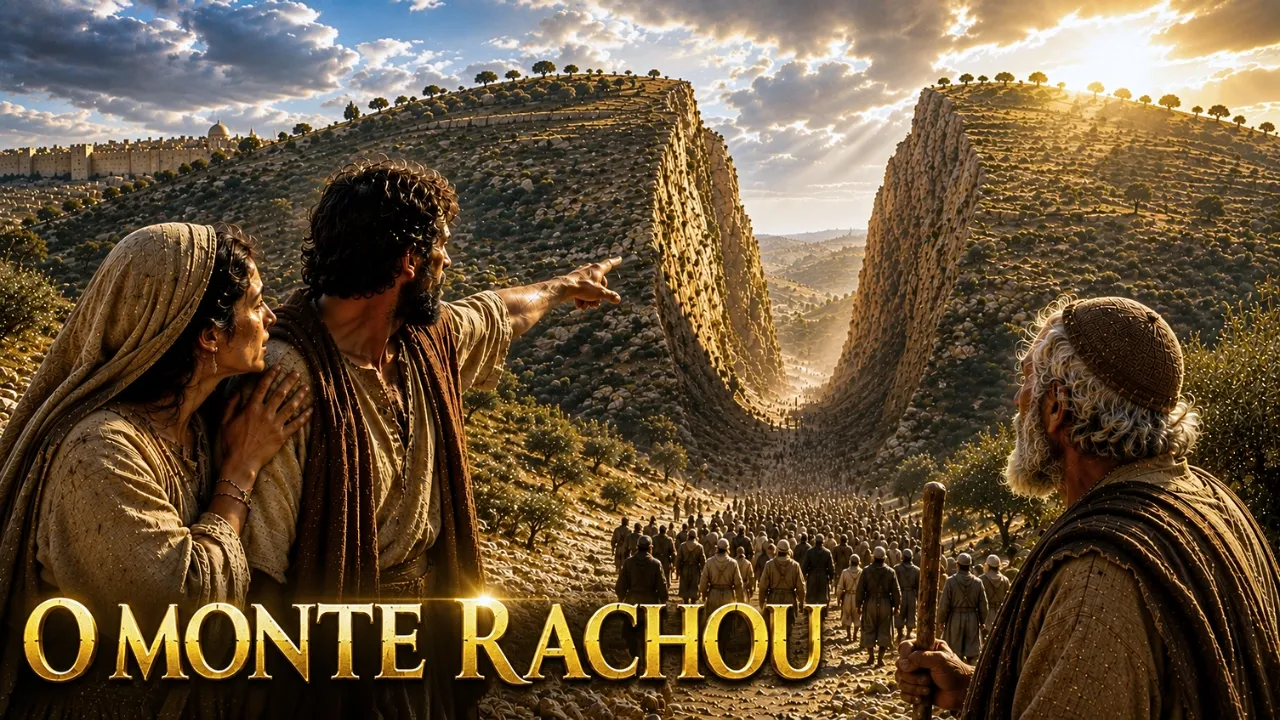
On that day, His feet will stand on the Mount of Olives, which lies before Jerusalem on the east. The Mount of Olives will split in two, from east to west, forming a very large valley. Half of the mount will move to the north and the other half to the south.
Read that verse again with the eyes of an engineer, not just a theologian. Zechariah does not generically say the mount will be destroyed. He specifies the direction of the splitting from east to west, creating a valley that cuts the mount in half horizontally.
He specifies what happens to each half. One goes to the north, the other goes to the south. He specifies that the result is a valley of extraordinary dimensions, a very large valley, where there was once a solid mountain.
And this is where the story becomes even more impressive. When modern geologists mapped the region of Jerusalem with imaging technology and tectonic analysis, they found something that no 6 th-century BC prophet could have discovered by natural means. There is an active geological fault that runs through the Mount of Olives.
The Dead Sea fault system, one of the longest and most active tectonic rupture zones on the planet, stretching over 1000 km and passing exactly through the Jerusalem region. Jerusalem suffered devastating earthquakes in 749 AD and in 1033. Both caused significant destruction in the city and visible changes to the region's topography.
The ground beneath the mount is not stable and never has been. What God prophesied through Zechariah 2500 years ago is already physically prepared in the Earth's structure. But there is a third layer to this prophecy that goes beyond geology.
Because Zechariah does not just describe a physical event, he describes a purpose. And to understand this purpose, we need to connect Zechariah 14 with another prophecy written around the same time by the prophet Joel. Joel chapter 3 speaks of a valley called the Valley of Jehoshaphat.
The name in Hebrew literally means the Lord judges. And Joel describes it as the place where God will gather all nations for judgment in the last days. Verse 14 of the same chapter uses an expression that echoes through the centuries with an intensity that does not diminish with time.
The text says: "Multitudes, multitudes in the valley of decision, for the day of the Lord is near in the valley of decision. " The Valley of Jehoshaphat is identified by Jewish and Christian tradition with the valley between the Mount of Olives and Jerusalem, the same valley that will be expanded dramatically when the mount splits in two. It is no coincidence that the place of the splitting is exactly the place of the judgment of the nations.
God does not choose geographies by accident. Every coordinate in biblical prophecy carries theological weight. And here the weight is total.
The mount that will split is the mount that separates the holy city from the valley where the Lord judges. When it splits, judgment and redemption will happen in the same movement, in the same place, and at the same time. But there is still a dimension that most studies on Zechariah 14 do not mention with the clarity it deserves.
The valley that will be created is not just the stage for judgment, it is an escape route. And understanding why God tears a mountain to open a path, instead of simply removing the danger, reveals something about the character of God that runs through all of Scripture, from Exodus to Revelation. I will now detail the prophecy of Ezekiel in chapter 44.
I must admit that this prophecy leaves me in awe at the wealth of detail with which the prophet brings extraordinary events about God's return . There is a gate in Jerusalem that has not been opened for almost 500 years. It is there, visible, imposing, with stone arches that still guard the elegance of its original architecture.
But where there should be a passageway, there are massive stone blocks cemented one upon another, sealing the entrance with a determination that has spanned centuries, empires, and generations. And in front of this gate, someone placed a cemetery, not by accident, but by precise calculation, from a very specific understanding of what that gate represented. and of who, according to prophecy, would pass through it one day.
To understand what is happening here, we need to go back to the biblical text. Ezekiel 44 describes an extraordinary vision of the restored temple. And in the midst of this vision , the prophet hears something about the eastern gate of Jerusalem that echoes directly to this day.
In Ezekiel, chapter 44 verse 2, it is written: " This gate shall be shut, it shall not be opened, and no man shall enter by it , because the Lord, the God of Israel, has entered by it; therefore it shall be shut. " Jewish and Christian tradition interprets this gate as the Eastern Gate, the eastern entrance of Jerusalem, which looks directly toward the Mount of Olives, the gate through which the Messiah would enter the city on the day of his coming. In 1541, the Ottoman Sultan Suleiman the Magnificent ordered this gate to be sealed with stone blocks.
Historical accounts regarding the exact motivation for this act are complex. There were military, political, and religious reasons intertwined in the decision. But what tradition has preserved and what the Islamic leaders of the time themselves recognized is that the Jewish and Christian prophecy about the Messiah entering through that gate was known, and sealing the entrance was a way to try to prevent its fulfillment.
To be even more certain, they placed a Muslim cemetery directly in front of the gate. The logic was theological within the Islamic context. A Jewish priest cannot come into contact with the dead.
Therefore, a cemetery in front of the gate would make the entrance ritually impure for any Jewish priestly figure. It was an attempt to use the law of God against the fulfillment of God’s promise. And there is something deeply revealing in this scene.
When human, political, religious, and military powers realize that a prophecy is nearing fulfillment, the instinctive reaction is not surrender, it is resistance. It is the attempt to build a blockade between the word of God and its realization. But the story of the entire Bible is the story of how this resistance has always failed.
Pharaoh tried to block Israel’s exodus from Egypt, and the Red Sea opened. Haman tried to eliminate the Jewish people in the Persian Empire, and the decree was reversed. The religious leaders of Jerusalem tried to block the resurrection, sealing the tomb with a stone and placing Roman guards at the entrance.
And on the morning of the third day, the stone had been moved. Sealed stones have never been an obstacle for God. And there is an almost poetic irony in the fact that the same hand that will split the Mount of Olives in two, opening a valley where there once was a solid mountain, will have no trouble at all with the stone blocks that seal a door.
Because the splitting of the Mount of Olives is not just an event of judgment; it is, above all, an act of mercy. Zechariah 14 makes this explicit in a way that many hurried readings of the text miss. Immediately after describing the splitting of the mountain, the prophet explains the purpose of the valley that will be created.
Zechariah chapter 14, verse 5, describes: "Then you shall flee through my mountain valley, for the mountain valley shall reach to Azal . ""And you shall flee as you fled from the earthquake in the days of Uzziah king of Judah. " The valley is not created just to mark the return of Christ.
It is created to save lives. At the moment of the final battle around Jerusalem, when the nations are surrounding the city, when there is no visible escape route, when the human scenario is one of total defeat, God will tear a mountain apart to open a way in the midst of the siege. It is the exodus happening all over again.
It is the same logic, the same language, the same God who makes a way where there is no way. And then there is the moment when all of this converges. Jesus 'feet touch the mountain, the earth responds, the valley opens, and the Golden Gate, sealed 500 years ago by human hands that believed they could stop a divine promise, is exactly in the direct line.
between the Mount of Olives and the temple. The same path that Jesus traveled on Palm Sunday, descending the mountain on a donkey, while the people spread branches and shouted: "Blessed is he who comes in the name of the Lord! " That same path will be traveled again.
At this moment, we enter the final part of this documentary, where we will understand the general context of what the Bible wants to reveal to us about the return of the Messiah and the final judgment. The Dead Sea is the lowest place on the earth's surface. It lies more than 400 meters below sea level.
A geographical depression so deep that the air there is denser, the sun burns differently, and the water has a salt concentration so high that no fish survives. It is a place of strange beauty and silent death. The Israelites knew it as the Salt Sea.
And there is a prophecy about this sea that, when read alongside Zechariah 14, reveals the full extent of what the splitting of the Mount of Olives will set into motion. Ezekiel 47 describes a vision the prophet had of the restored temple and what flows from it. Water begins to spring forth from the right side of the temple.
First it is a trickle, then a stream reaching the ankles, then a river reaching the knees, then the hips. And then a current that cannot be crossed on foot, growing without ceasing, descending toward the desert. And wherever this water reaches, death retreats.
Listen carefully to Ezekiel chapter 47, verses 8 and 9. When it enters the sea, into the waters that are foul, the waters of the sea will become healthy. And it shall come to pass that every living thing that moves, wherever the river goes, will live.
And there will be many fish, for these waters will go there, and the others will be made healthy. The river that flows from the temple descends into the Dead Sea. And the Dead Sea, the most barren place on earth, the symbol of all that has no life, becomes alive.
But there is a geographic connection here that the text does not explain directly and that most readings do not develop. Ezekiel's river needs a path, and the valley that will be created by the splitting of the Mount of Olives. A valley from east to west, descending toward the Dead Sea.
It is exactly that path. The mountain does not split only to create an escape route, it splits to open the riverbed that will heal what is dead. Zechariah 14 describes yet another detail about that day that deserves attention.
On that day there will be no light, no cold, no frost. It will be a unique day , known only to the Lord, without day or night, but at evening time there will be light. Reflect on this part.
A day when the sun will not behave as it has always behaved, when the normal alternation between light and darkness will be suspended, when something different from anything any previous generation has experienced will happen to the very nature of light upon the earth. The entire creation will respond to the return of its creator. This is not the first time this happens in Scripture.
On the day Jesus died on the cross, the text of Luke records that there was darkness over all the earth, from the sixth hour to the ninth. 3 hours of darkness in the middle of the day, with no natural explanation. Creation had responded to the death of the Son of God with mourning.
On the day of the return, it will respond in a different way. And this is where we arrive at what all this means. Not just as a prophecy to be fulfilled in the distant future, but as a truth that speaks directly to those watching this video right now.
The splitting of the Mount of Olives marks a transition that all of humanity awaits, consciously or unconsciously: the transition from the rule of men to the rule of God, from the endless cycle of wars, injustices, and powers that rise and fall without ever solving what is truly broken in the human condition. The millennium described in Scripture is not just a period of political peace. It is the restoration of what was lost in Eden.
The presence of God dwelling with His people, without a veil, without an intermediary, without the separation that sin installed between the Creator and creation. The river that heals the Dead Sea is the most powerful image of this, because what was dead not only survives, but flourishes. And this river begins in the temple, it begins in the presence of God.
It always begins in the presence of God. The mountain is standing. The fault line is down there, accumulating tension for millennia.
The Golden Gate is sealed with stones that will not hold back what is to come. The Dead Sea is still, waiting for a river that has not yet arrived. And the question this silent mountain asks each of us is this: when Jesus' feet touch this mountain and the earth shakes, when the valley opens and the river begins to flow down, when the gate that no man could open is crossed by the only One who always had the authority to do so, will you be on the inside or the outside of that path?
The only thing still being decided is where each of us will be when that happens. We have reached the end of this documentary. I hope you enjoyed the content.
I would like to invite you to watch a video already available on the channel about the two witnesses of Revelation. In that video, I detail the different theses on who the final witnesses described in Revelation might be, the mysterious reasons associating Elijah and Enoch, men who did not die, and also Moses and the mysteries linked to a dispute between the archangel Michael and Satan for his body. Take a moment out of your day and watch the video.
See you in the next documentary here on the channel.