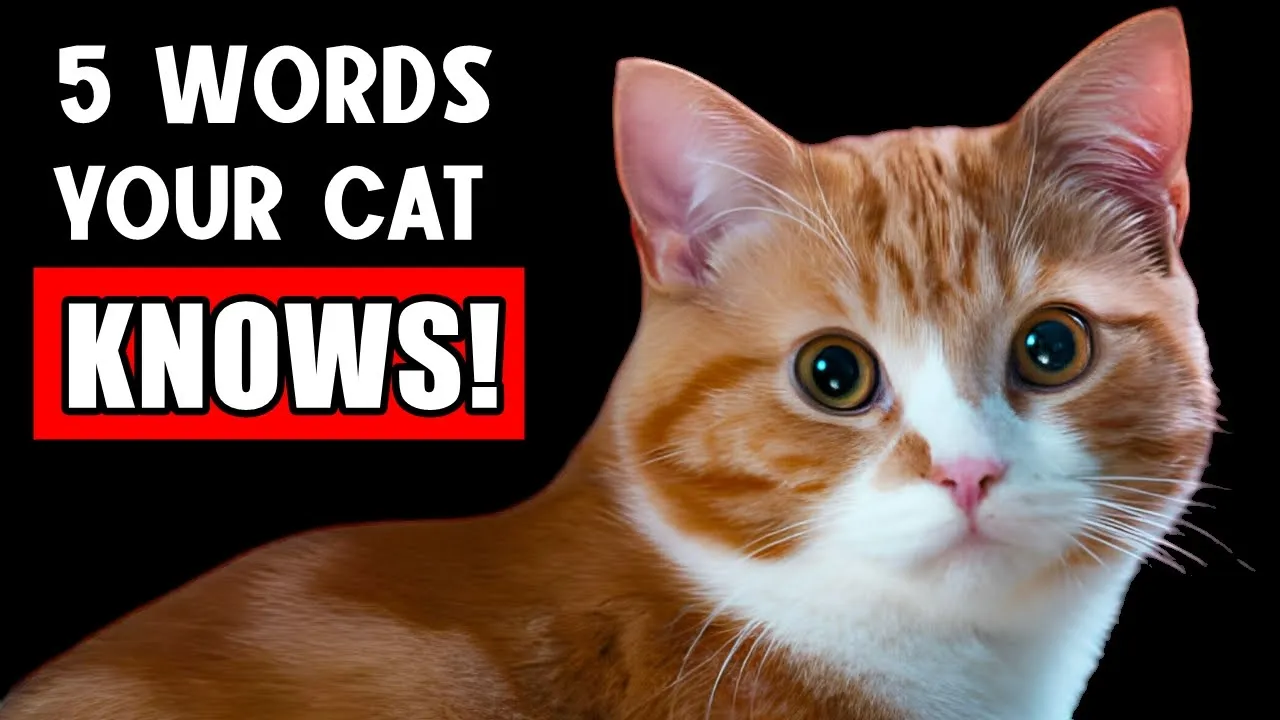
Have you ever wondered why your cats suddenly perk up at the sound of the word treat, but completely ignore you when you tell them to get off the counter? Well, there's a scientific explanation for what your cats actually understand and why sometimes they choose to ignore you. Today, we're diving deep into feline psychology to reveal five words your cats really understand.
And the third one is a total gamecher. But before we get to the magic words, let's clear something up. Do cats actually understand words the same way dogs do?
According to a study conducted in 2019 by the University of Tokyo, cats can recognize and differentiate human words, but they don't react in the same way dogs do. Unlike dogs, which were domesticated to obey human commands, cats evolved as solitary hunters and don't depend on us socially in the same way. But that doesn't mean they don't understand anything.
In fact, it's quite the opposite. Imagine dogs as that eager student who's always raising their hand in class while cats are like that genius sitting in the back pretending not to pay attention but actually absorbing everything. Dr Atsuko Sido, a Japanese researcher specializing in feline behavior, discovered that cats recognize their names even when called by strangers.
In fact, [music] cats not only recognize their names, but they can also understand human vocabulary. And there's [music] more. They associate certain words with actions, emotions, and routines.
So, yes, your cats know a lot more than you might think. Unlike dogs, which rely on verbal cues and commands, cats link words to experiences. If a word is consistently connected to something important, like food or affection, your cats will pick up on that.
But since cats don't rely on social approval like dogs do, they might understand but not show it as clearly. Now, let's get into the five words your cats really understand. Word number one, no.
This might surprise you, but cats actually understand the word no. They grasp negative commands better than we realize. But here's the catch.
They simply don't care. That's because they have a completely different value system than ours. Cats process this through a decision-making system as sophisticated as a teenager's ability to ignore their parents.
While dogs have been domesticated over thousands of years to seek our approval, cats are still essentially wild animals in plush costumes. Why don't cats obey? They know.
Unlike dogs, which rely on social rewards, cats do a costbenefit analysis of ignoring you. If continuing the problematic behavior is more fun or rewarding, they'll keep at it. They prioritize their own desires over approval.
Here's what happens in your cat's brain when you say no. First, they analyze your tone of voice. Yes, they definitely know you're not happy.
Then, they weigh the possible consequences against the reward of continuing the behavior. Finally, and here's the most impressive part, they consciously decide whether or not to obey. Want to see this in action?
Notice how cats often pause briefly when they hear no. That's not hesitation. It's literally their brain processing the situation.
And here's a very recent finding. A 2023 study from the University of Helsinki found that cats that often ignore no score higher on problem solving tests. Those little rebels aren't being difficult.
They're showing off just how smart they are. Want to make no more effective? Instead of just saying no, redirect your cat's attention to something they can do and reward them with affection or treats if they comply.
Think of it this way. Your cats understand no, but they're waiting for you to make them a better offer. In fact, cats respond best to a calm, disappointed tone.
But here's the catch. They only care about that if they've already built a bond with you. Word number two, their name.
This one's obvious, but it's also backed by science. Your cats know their own names. A study published in the journal Scientific Reports tested how cats react to their names compared to other random words.
The researchers found that even when called by strangers, cats responded to their names by flicking their ears, turning their heads, or twitching their tails. Cats prioritize their name as an important sound, but whether or not they respond depends on their mood. Unlike dogs, which are eager to please, cats respond only when they feel like it.
Try calling your cat's names in a neutral tone, then in a happy voice, and finally in an annoyed voice, and see if they react differently. Most cats respond best to a soft, higher pitched voice, the kind of tone we naturally use when talking to babies. So, if they're ignoring you, you might just need to sweeten your tone.
Number three, come here. Now, let's talk about the phrase every cat guardian dreams of mastering. Come here.
And here's something fascinating. Researchers have found that cats process this command very differently from dogs. While dogs are naturally wired to respond to social signals, cats need a really good reason to come when called.
It's like they're little freelance workers. They want to know what's in it for them. Dr Sarah Ellis from International Cat Care discovered something amazing.
Cats can learn to respond to the come here command with up to 80% reliability. But here's the catch. It all depends on how you've programmed that phrase in your cat's memory.
Think about it. When do you usually say come here to your cats? If you're like most people, it's probably when you want them to stop doing something wrong, right?
That's exactly why your cats might be ignoring you. Now, here's a revolutionary approach. Start using come here only when something amazing is about to happen.
Maybe it's dinner [music] time, opening a can of fresh tuna, or when you're holding their favorite toy or treat. The secret is consistency and positive association. And here's the coolest part.
Over time, cats develop what scientists call anticipatory behavior. They start responding to come here even without seeing the reward simply because they've learned that good things happen when they obey. It's like they're thinking, "Well, last time I checked, this human's pretty reliable with the treats, so let's see what they want.
" If you're enjoying the video, don't forget to subscribe to the channel and hit that thumbs up button. It helps push this video out to more people. Number four, good job.
This one's deeply emotional because in the end, our cats might care about our praise more than we think. In 2021, researchers at Oregon State University made a discovery that surprised the world of feline behavior. They found that many cats actually prefer human interaction and affection over food.
But the really interesting part is that the study showed cats are highly attuned to the emotional state of our voices. When we say good kitty or good job, they're not just hearing the words. They pick up on our emotional state, our body language, and even small changes in our facial expressions.
[music] Dr Kristen Vitali, who led the study, discovered something extraordinary. Cats that consistently received verbal praise accompanied by physical affection, formed stronger bonds with their guardians, and showed greater interest in interacting with humans in the future. It's as if every good kitty was actually a step toward building a stronger relationship.
Think of it this way. When you praise your cats, you're not just saying words. You're creating what scientists call a positive emotional feedback loop.
Your cats do something cute. You say good job in that special voice we all use with our cats. And they learn that making you happy makes them feel good, too.
Try starting your day by saying good morning to your cats. Always using the same tone of voice. Consistent morning interactions set the tone for communication between you and your cats throughout the day.
And here's something you might not expect. Cats are so attuned to praise that they can sense the difference between when you're genuinely happy with them and when you're just saying it. But remember, every cat is unique and your cat might have a special word that only the two of you know.
Word number five, food and related words. If your cat seem to develop super hearing whenever you say treat or dinner, it's not just your imagination. Researchers have found that cats associate specific sounds with rewards.
[music] Words like food, eat, or treat trigger an instant reaction. Cats learn food words through classical conditioning. Every time you say treat, and then feed them, your cat's brains create a link between the word and the reward.
They can even recognize words in different tones. And some cats learn to recognize the sound of specific food containers. Try saying treat in a completely different tone and see if your cats still react.
Some cats learn by tone and context while others recognize the sound of the word itself. So, how many of these words do your cats understand? And what's their special word?
Tell us in the comments below. Now, do you know why your cats almost always stretch when they see you? In this video right here on the screen, I talk all about that.
And not just that, I also explain the reasons behind many other strange cat habits. Interested? Then click on the screen and continue with me into the amazing world of cats.