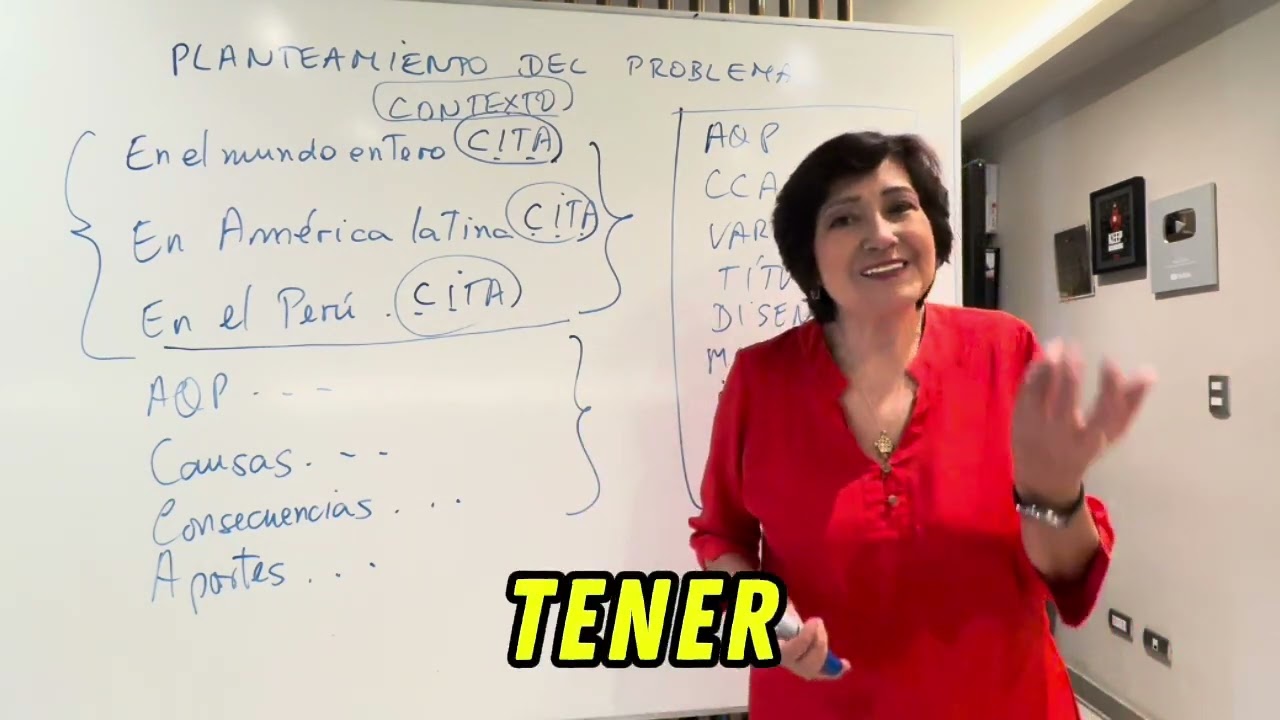
The statement of the problem is the first section of a research work or thesis, usually applied to final high school, baccalaureate, bachelor's, master's and doctoral projects. It is generally the section with the shortest length, compared to the rest of the chapters that make up this type of document. In this video we will explain the structure of the problem statement, how you can do it and at the end we will give you two examples, explaining each part.
If you want more information or read carefully you can visit the description link. The problem statement is used to present the problem to be investigated, developing ideas in an organized and logical manner. For this, it is necessary to make a recognition of representative facts in the context of the investigation.
Subsequently, the problem that the research will address must be indicated, in order to conclude with the formulation of a research question. Erroneously, the statement of the problem is usually considered as the text that states what the research problem to be treated will be. When, in fact, the statement of the problem refers to the argumentation of how the researcher arrived at the questions about the problem that he is really interested in dealing with.
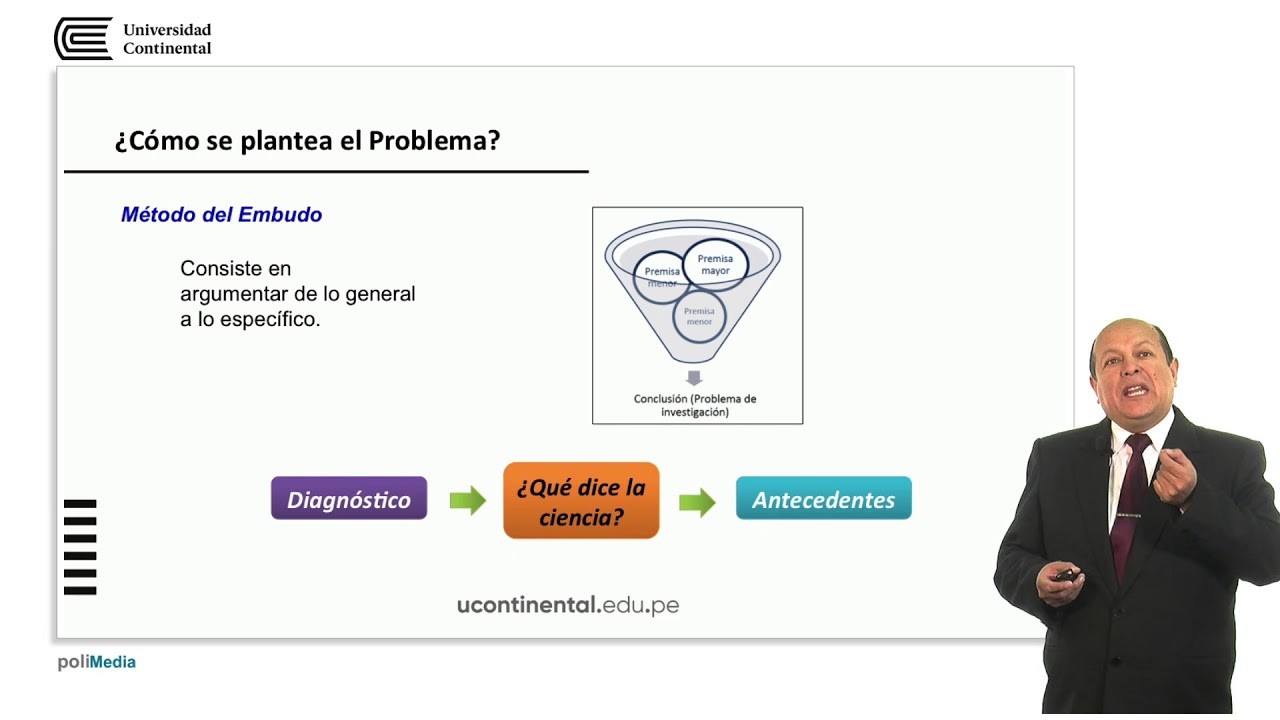
For the writing of this section, initially the subject must be approached from the general, and then move on to the specific. In addition, everything that is expressed in the statement of the problem must be demonstrated in the investigation that is carried out. The extension that the statement of the problem in an investigation must have is essentially related to the academic level that is being studied.
In this way, for a bachelor's or master's degree it will be considerably shorter, compared to a doctorate. In the preparation of the problem statement , the cause of the problem should not be assigned, nor should the culprits be exposed, nor should a solution be provided or more than one problem treated simultaneously. Structure of the problem statement Although there can be several ways to structure a problem statement, this is a simple way that you can use.
At the end of the video we will give you several examples with this same structure: Observation and description of data and facts In the first place, the facts related to the context of the investigation are exposed, as well as the greatest amount of empirical and theoretical data related to the subject . to study. This is done with the aim of substantiating the absence of information regarding the topic to be investigated.
In addition to this, it is necessary to justify the study, giving the reasons why it is going to be carried out. Finding the problem Next, the discovery of inconsistencies about the knowledge of the subject is expressed. To expose these inconsistencies, empirical or theoretical data that contradict each other are presented.
To demonstrate these contradictions, the following techniques are applied: Contrast a current fact with a previously formulated theoretical approach , indicating here their mutual opposition. Reveal a contradiction of a theoretical approach with some empirical approach. Research question The problem statement includes the research question.
It explains what is going to be investigated, proposing a question that arises from the problem found. Raising the question is essential for the investigative process, since from it arises the general objective of the investigation. This question should be formulated after carrying out a rigorous analysis of the information presented in the previous points.
How to make a statement of a problem? You already know what the structure of the problem statement is, but what is the step-by-step to do it? You can follow these steps: 1- Establish the subject of the investigation First of all, the subject on which the investigation is going to be carried out is chosen.
For undergraduate or graduate degrees, the selection of this topic will depend on the area of study being pursued. For example, if it is an environmental degree, it is normal for the subject to be related to pollution, climate change or the greenhouse effect. 2- Give the context of the investigation When you have already established the research topic you can start writing, beginning with the first part of the structure, that is, the observation of data and facts.
In this description of data and facts it is necessary to give a context to the investigation: The place where the data and facts occur It refers to the question Where? This can be a physical place, such as a country, a city, an institute or an office, among others. It can also refer to a metaphorical place, such as science or other disciplines.
For example, one place could be the Pacific Ocean, where there are islands of garbage. The time where data and facts occur Answers the question When? It refers to the period of time within which the problem is registered.
For example, 2020 is the time in history when there is more pollution in the sea, especially plastic. The way in which data and facts occur Describe the How? The approach that has been taken previously to this same problem is exposed.
For example, the way in which pollution of the sea is generated would be described; garbage islands and other forms of the ocean floor and surface. Note: in addition to describing the place, time and mode of data and facts, the inconsistency of information that exists on the problem to be studied will be explained. This is the second part that we explained in the "structure" section.
3- Formulate the problem and research question This section sets out how the research will be tackled, the characteristics of the work to be carried out and the need to prepare it. The research question is also formulated. Below we see a couple of examples.
Examples of problem statement To facilitate understanding of these examples, they will be divided into the structure previously explained (observation of data and facts, discovery of the problem, research question). - Environmental pollution in Mexico City Observation of data and facts: Poor air quality in Mexico City affects both the environment and human beings. In the environment it affects flora, fauna, rivers and lakes, and in cities it causes deterioration of monuments and buildings.
Likewise, in humans it causes respiratory and nervous system disorders, and can trigger serious diseases such as cancer, among others. According to a study of the state of air quality in Mexico City, prepared by a University, it was reported that the permitted standards were met with respect to the level of contamination in the air for carbon monoxide, nitrogen dioxide, ozone and carbon dioxide. of sulfur.
Finding of the problem: However, the location from where the measurements made by the University are taken is within an area with lush tree vegetation, which is why it is difficult to obtain a real measurement of the contamination that exists in the area. city. Research question: For this reason, for the purposes of this research, it is pertinent to pose the following question: Where in Mexico City should the air pollution meters be located, so that their results reveal the actual air quality conditions in the city?
- Coronavirus (COVID-19) Observation of data and facts: Although respiratory infections are not new in the world, due to globalization there has been a change not only in the environment, but also in the way in which beings Humans interact with each other, causing their spread and increasing mortality rates throughout the planet. The World Health Organization establishes protocols for the prevention of infections that are adopted by all nations, and that they can modify to adapt to their environment. The Coronavirus brings together a large number of viruses that can cause respiratory infections such as Middle East Respiratory Syndrome (MERS), Severe Acute Respiratory Syndrome (SARS), or the latest, known as COVID-19, among others.
In some cases, COVID-19 can cause a stuffy nose, sore throat, runny nose, or diarrhea, and most commonly causes fever, dry cough, and physical exhaustion. Not all people who become infected experience these symptoms, and approximately 80% of those infected recover without the need for any particular treatment. COVID-19 usually affects both older people and those with heart problems, diabetes or high blood pressure more seriously.
Statistically it is proven that the mortality rate of the virus is around 2% of those infected. Finding the problem: The actions that must be carried out to prevent its spread are similar to those that are carried out to prevent any respiratory infection. However, in the universities of the city of Buenos Aires, Argentina, there is no uniformity in the way these measures are taken by the academic community.
Research question: From this, it is appropriate to formulate the following question: How to educate the academic community of the universities of the city of Buenos Aires, to generate preventive and early warning actions, which allow controlling the spread of respiratory infections? and viruses?