For those serious about becoming successful, consistently profitable options traders, now is the time to build skills in technical analysis, market analysis, and implied volatility to get those results. We have multiple memberships starting with our GO membership that teaches rules-based trading and our PRO membership that teaches more subjective trading. For more information, go to LockeInYourSuccess.
com/memberships Hello, everyone. My name is John Locke, and I'd like to welcome you to the winning trade, but first the required disclaimer material. This presentation is given for educational purposes only.
We're not brokers, dealers or financial advisors, and we're not making any specific trade recommendations. Also, please be aware that your risk in trading options is substantial. Please make sure you are aware of all your risks prior to placing any trades.
Also note that in this presentation, we include hypothetical computer simulated trades. They are believed to be as accurately represented as possible. Keep in mind live results can vary from simulated results for many different reasons.
If this is your first experience with us, my name is John Locke. I'm a trading performance, wealth, and success coach with Locke In Your Success LLC, where myself and my team of mentors are here to help you win in the markets and in life as well. The type of trading that we specialize in is called high probability options trading.
That's where we utilize options strategies to make money through the passage of time, rather than depending on price movement alone in order to be profitable. This means we can often make money whether the market goes up, down, or sideways. And today, a strategy I'd love to share with you is called The Rock.
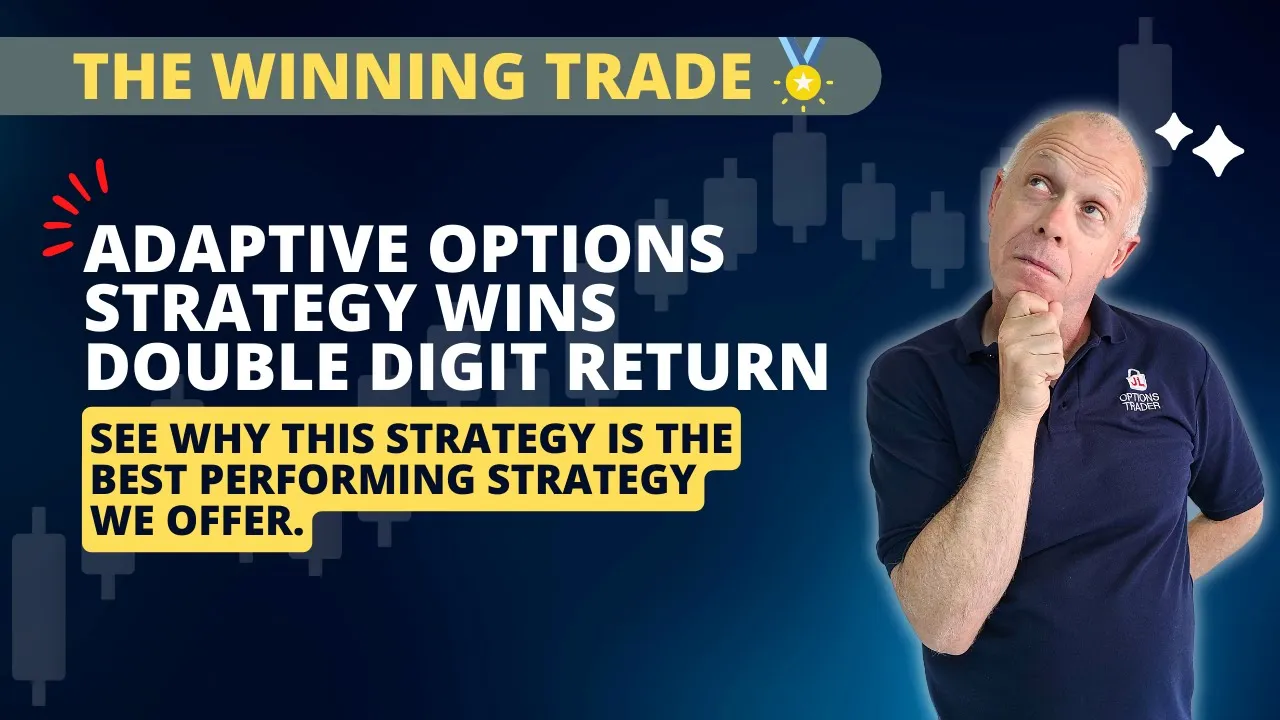
The Rock has been our best performing trading strategy since 2007. Year over year, it's usually the highest performing strategy, and certainly overall on average it has been the highest performing strategy or best performing strategy in that timeframe. That is because The Rock is what we call an adaptive strategy.
It's traded differently depending on implied volatility skew curves and so forth. We're not taking price direction into consideration, but the strategy guidelines themselves do take in the implied volatility vertical skew curve into consideration, and we make adaptations as we go along. That really helps us maximize our returns in all different types of market conditions.
Now the strategy requires a minimum of $5,000 capital in order to trade. The example size we're going to show you today is a $50,000 planned capital position. It's going to have an exit loss trigger of 20% or $10,000, and it's going to have a profit target of 20% or $10,000.
So let's show you the position. But first I'd like to take a moment to ask you to help us by subscribing to our YouTube channel and making sure that you comment and like our videos. It helps us continue to bring this wonderful content to you.
Also we invite you to subscribe to our email list. Come on over to thewinningtrade. com.
That's thewinningtrade. com. Okay, so here we are.
This example is going to be the March 15th, 2024 expiration cycle, and that being the case, we're going to enter the trade usually about 30 days to expiration, but that may vary a little bit depending on what the trade cycle before that is if we have an overlapping trade. And in this case we did, so we're actually entering 29 days to expiration. It is Thursday, February 15th, 2024.
Now what we're going to do is we're going to come in and we're going to purchase or call it sell an iron butterfly with the short strikes, approximately 17 to 27 points under the money. If we do that, we're going to be at the 2040 short strikes and we use 50 point wings. And from there we're going to have a negative Delta position.
We're going to flatten that Delta out to near zero or usually slightly positive with a call. And in this case here we're using a 19 Delta call. It brings our total position Delta to 2.
16. So from here we basically have rollbacks under two types of conditions. Number one is if we are experiencing a dollar drawdown with a point move of 8% of the asset price.
Also, if we have a Delta of positive 50, it's also going to require an adjustment to the downside. Other than that, we leave the position where it is to the upside. We have a minus 15 Delta trigger and we also have, if we go more than 10 points past our long strike, we have a trigger to roll the position up higher and basically go back into entry position.
There are also many other types of adjustments within this strategy and different types of configurations. This is entered this way in what we call M3 positioning much of the time, but we do go into like a triple butterfly, almost bearish butterfly position like it at times. There has different Delta guidelines at that point and so forth.
But this trade here is going to stay in M3 configuration, so it's a simple example. And from there, let's move forward. I'm going to jump ahead to our next adjustment.
So it's Thursday, February 15th. If I go to next adjustment, what ends up happening here is we've gone about 12 days. We're now 17 days to expiration.
If we take a look at our position, we're actually still within our tent, but what we have is a Delta of minus 22 and our maximum acceptable Delta guideline is minus 15. So what we're going to do is we're going to take this call. We're going to move it deeper in the money to make that correction.
So if I do that, I bring it down to here. And at this point here, we're now well within our guidelines for the trade. So with that minor adjustment, we're going to move forward and I'm just going to jump to our next adjustment.
That happens on March 1st, so a little bit more time has gone by. Our Delta number has increased to minus 21 on this day with this up move. And what we're going to do is we still have a Delta of 36 here, so that can be driven deeper into the money.
So we're going to go ahead and do that. So I'm just going to do a vertical. We're going to sell this call and we're going to buy one here at 2,060.
Again, that puts us relatively neutral Delta. And we're currently up 2420. So let's move to next adjustment.
It's Friday, March 1st. Now on Monday, we get a continued up move and our Delta increases to minus 19. Again, that's going to create another adjustment.
We're at a 61 Delta in our call, so we can bring that deeper in the money. We're going to go ahead and we're going to do a vertical and bring that to 2020 for our long call. That brings us Delta to relatively neutral.
And this is our current positioning as we're sitting. Notice we're getting more capital in the trade. So we have a 50,000 planned capital, but we only have about 16,000 in the trade.
As we adjust this to the upside, it tends to get higher. If it gets too high, particularly close to expiration, that's going to violate our downside risk parameter. We're not in danger of that yet, but you'll see, I believe that happens later in the trade.
So let's see, we're March 4th. Let's go to next adjustment. What happens here is we get a continued up move.
With that continued up move, we are negative Delta again. At this point, our long call is like 83 Delta and realistically going deeper in the money really doesn't make a whole lot of difference. So we're going to have to make a more aggressive adjustment at this point.
What we're going to do is we're going to try to roll up some of these short strikes here. So similar to this, and that's going to give us a Delta correction. So the actual move we made here is going to be five verticals.
So what I'm going to come in here, I'm going to do plus five. And minus five. Now with that move, I'm still not quite as negative Delta as I would like.
So what I'm going to do is I'm going to also take this and do a vertical here. And I'm going to drive that deeper in the money. So our resulting position is going to look like this.
So now we did five contracts here from 2040 to 2050 and we brought this call a little bit deeper in the money. That brings us relatively neutral Delta. We're still slightly on the negative side, but the market's been going up quite a bit.
So we definitely don't want to overdo it there. If I go to next day here, what ends up happening is we are over our maximum negative Delta parameter again, we're at minus 21. So what we're going to do is the same thing.
We will plus five and minus five. At this point, look, we have like about 25,000 in the position. I'm also going to move the call because this puts us maybe a little bit more positive Delta than I'd like.
So I'm going to kick this call back again to a lower strike number. The actual location we go here is going to be shown after adjustment. So now we have a 40 point upper wing.
We have 10 contracts short at the 2050 and our call here is at 2020. Again that gives us a relatively neutral Delta. We're actually within our price downside parameters and this is what we look like here.
And then if we go to the following day, we end up getting a 15 point down move. So what happens here is I am within Delta limits, but what starts to happen is I'm looking at an 8% down move in the asset price and I'm making sure that the trade doesn't draw down more than $20,000 with an 8% draw down because we don't want to get ourselves into a position where we have some sort of a catastrophic loss if the market decides to just come down like crazy. So what I do to correct that is I roll in these lower longs and that cuts a lot of the capital out of the trade.
And when I do that, most of the time I'll also adjust this side. So here what I did is I rolled these up, I rolled these up. I'm too positive Delta at this point.
So what I'm going to do is I'm going to take this and I'm going to bring this to a lower Delta number. So when we take a look at our final position, we end up with a 30 point upper wing, a 40 point lower wing, and we end up with the call up here at 11 Delta. That gives us a slightly negative Delta here.
It gives us a maximum risk in the position to the downside of $15,000. It puts us in our Delta limit and we have a position that looks like this. So from here, if I go to next day, what happened is we end up getting a good value increase.
Remember, we're only three days to expiration at this point. So this T plus zero line is going to move relatively fast. We get a relatively flat day and we shoot up to a $10,000 profit and loss.
With that, we can exit the trade here. We're arguably at our profit target number. But one of the things I like to do in our examples, if we're in a kind of a gray area, in other words, if I didn't quite get the execution that I got here, my timing was a little different.
It's very conceivable that we're going to end up by the time we exit under 10,000. So a lot of the times I will push these a little bit and that's the case here. So what I'm going to do is I'm going to make an adjustment here.
And our adjustment is going to be, we're going to, including our adjustment is going to have to roll this up. When I start to do that, I start to take on more down risk. So if I roll these up enough to correct my Delta, what happens is my down risk becomes too high.
So for example, if I was to do something like this, I would actually have to go further than that. I'd have to go all the way up maybe to here. And then I look at my, Hey, what happens if the market drops out?
Oh, wait a minute. That's too much downside risk. So in that case, I'm going to end up rolling some of these up higher to bring that total size down again.
So you'll see that here where I bring these 10, two thousands up to 2010, I go into a 30 point wing here. I rolled these up into 2070. I go into a 20 point wing here, and then I move my call to the appropriate location to give me a relatively neutral Delta.
And again, this here total risks to the downside. If we have some very unusual thing happening, we get this catastrophic down move. There's only about 12,000.
That's very reasonable with a $10,000 exit loss trigger trade. And this allows us to let it play out. And then if I go to the next day, let me ignore trades.
I go to the next day here. We ended up getting a bit of an up move. And now our profit and loss is $11,165.
That's solidly over our $10,000 profit target. And that being the case, we're going to want to exit this position. We're going to sell off our Condor.
We're going to sell off our call and we're going to close the position for a nice healthy profit of $11,165 on our $50,000 planned capital, making for a 22. 3% return in only 27 days. What's even better than that is the maximum amount of capital that we got in the position was approximately $25,000, meaning that we actually made on our actual capital at risk a whopping 44.
6% of our actual capital in only 27 days. And that is the mighty Rock, this episode's winning trade. If you love that fantastic example, as I did, I invite you to come on over to Locke In Your Success.
com. That's Locke In Your Success. com and discover how you too can follow along with the mighty Rock trade every week during our Options Trading for Income webinars, where we also cover 11 other powerful non-subjective trading strategies every single week.
Also come on over to The Winning Trade. com where you can learn about upcoming winning trade presentations, explore past winning trade presentations, and perhaps best of all, check out our free Trading Performance Podcast where you can learn to skyrocket your trading regardless of the type of trading you do. If you have any questions, comments, or anything else you'd like to see in the next winning trade, make sure you like and subscribe to our page and also leave a comment on this YouTube video.
I answer all comments and questions personally. Thank you for joining me and I look forward to seeing you on the next winning trade. LockeInYourSuccess.