another important mechanism for control of enzyme activity is by reversible phosphorylation let's first consider the general principles of this mechanism and then look at an important example by phosphorylation we mean the covalent attachment of a phosphor real group to an amino acid side chain the donor of the group is typically the nucleotide ATP and the bond forms by attack on the phosphorous atom by the nucleophile within the sidechain most commonly this occurs with the oxygen atom in the hydroxyl groups of serine threonine or tyrosine phosphorylation is a very common mechanism and typically results in a
significant change in enzyme activity phosphorylation of one enzyme may result in inhibition of activity whereas the very same event in another enzyme may result in activation later we'll look at phosphorylation in an example of membrane transport let's consider the example of glycogen phosphorylase as you will learn later this is a key allosteric enzyme that releases glucose molecules from glycogen stores you can think of this enzyme is allowing us to open our cabinets and take out the food we need when current resources are limited as is true for all allosteric enzymes it has two confirmations and
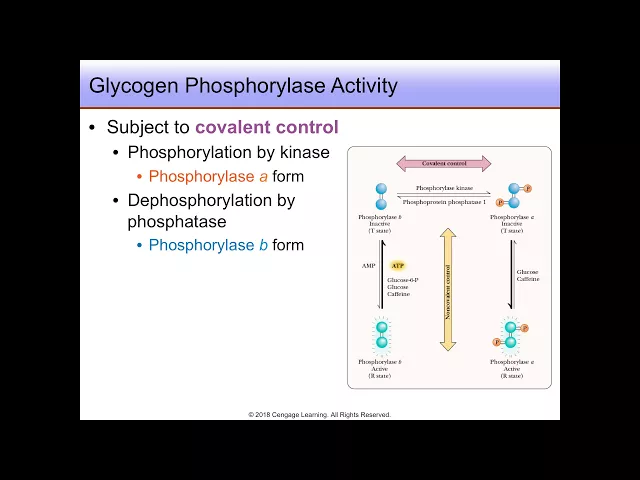
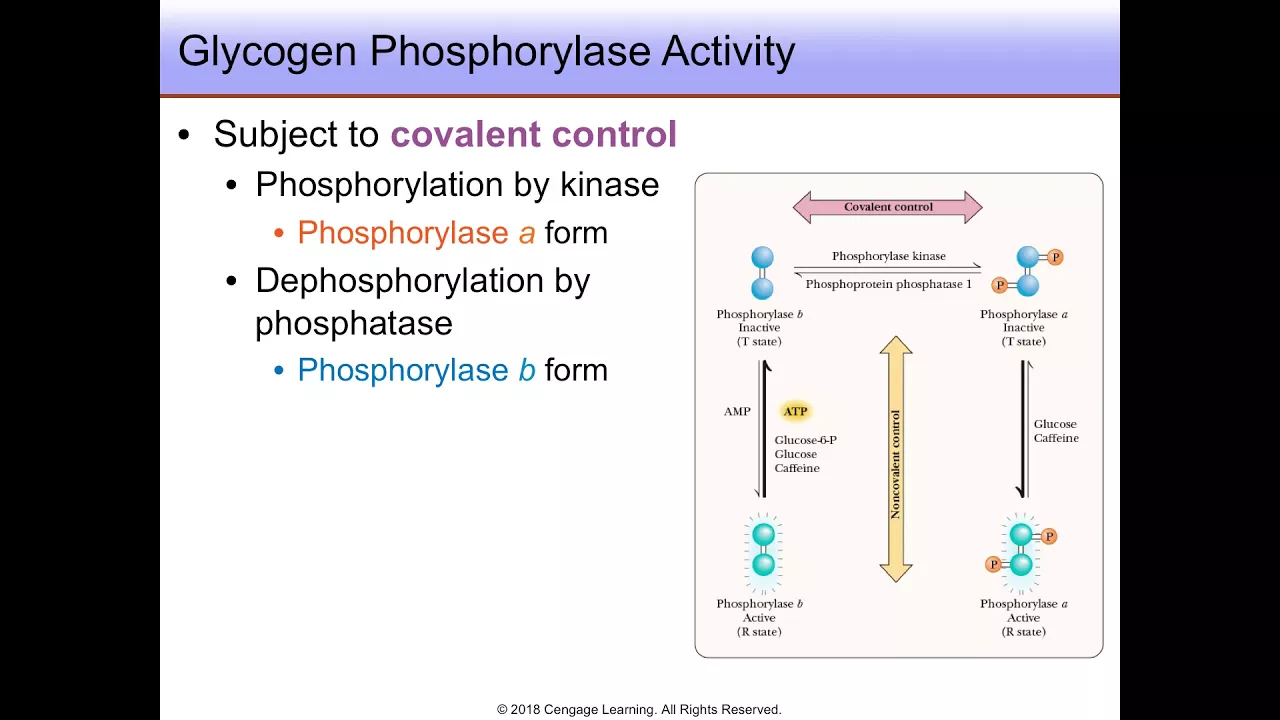
can be influenced by various effectors to favor one or the other it is also subject to covalent control through phosphorylation kinase enzymes attached phosphoryl groups and phosphatase enzymes remove them control is therefore balanced between these two activities phosphorylation of glycogen phosphorylase converts it to the more active a form as shown on the top right of the figure removal of this group converts it back to the less active B form on the top left notice from this figure that the two forms of glycogen phosphorylase the a form in the B form may each exist in either
the R or T conformation this means that each is subject to allosteric effectors though they are different in each case well look at this example in more detail later for now suffice it to say that the net effect of covalent modification and allosteric effectors in this case is that the active a form predominates when energy is needed from glycogen breakdown