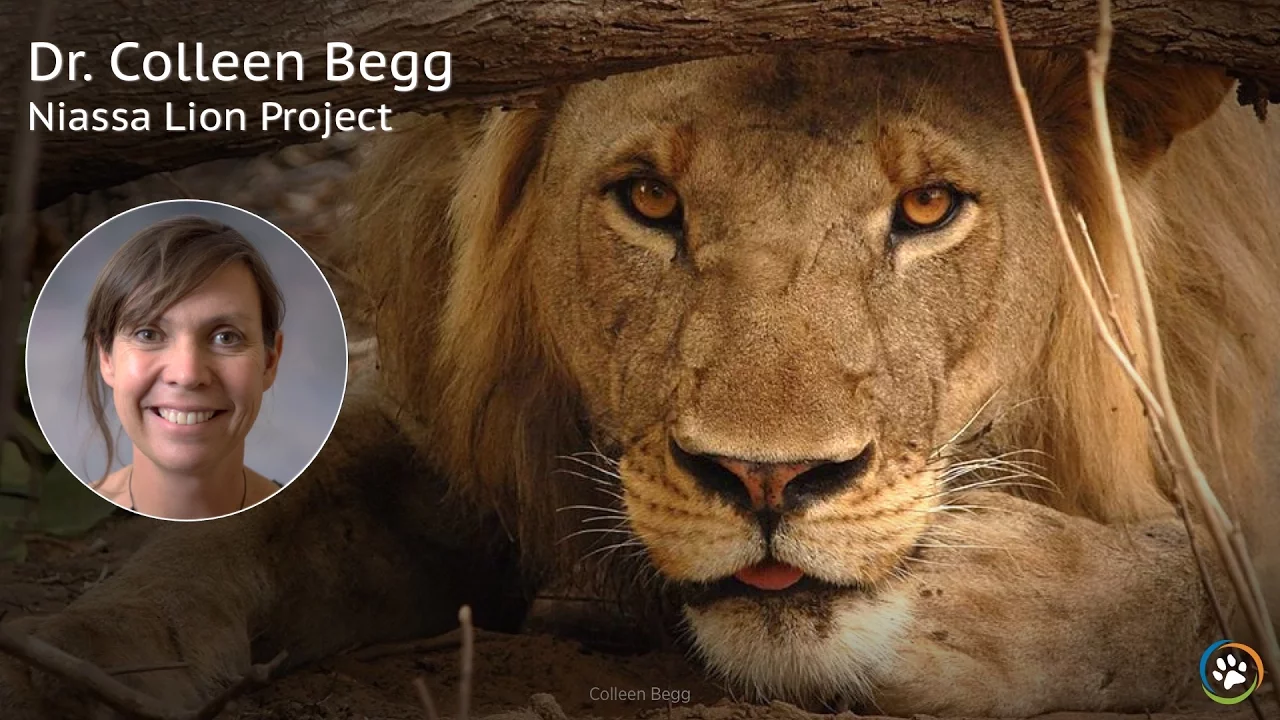
good afternoon everybody and thank you very much for coming here this afternoon for weeks before I do this talk I think about what I want to tell you CU so many of you have been to hear me so many times and this is a process as we learn about conservation and one of the things I really want you to leave today with is that we cannot save lions or anything else if we don't concentrate on Community Development because people who are the poorest people in Africa are living with this wildlife and they can't care when
they don't know what they're going to eat for supper and so that's really my message to you today there's a place where Lions lie under 4,000 year old paintings and where a ANS are dwarfed by Granite inselbergs that rise up above the Mio woodlands and where the ancestors of people are believed to reside in The Mists that rise up over the rivers in the mornings and in the biggest trees like the bay Babs and in um the mountains these Spirit mountains or inselbergs and this is a place that so few of you know about it's
bigger than Switzerland it's bigger than Denmark it's a place that no no one is really paying attention to and yet it is one of the most important Wilderness areas left in Africa today yet it is a place where there are 40,000 people living inside the protected area and I grew up in South Africa where I thought that Fortress conservation where you had people on one side and you had Wildlife on the other was the way that you did conservation well this place has turned it all on its head it is a place where the normals
normal ideas about conservation don't work and yet it is an incredible Wilderness and today we think that Wilderness doesn't have people in or perhaps it's just because our definition of wilderness has become something other than it was because people have always been in Africa and people have always been with Wildlife this is NASA National reserve it is in Northern MOS on the border with Tanzania and is managed by the wildlife conservation Society in partnership with the go M government of mosm Beek it's the biggest Wilderness Area in mosm Beek and one of the most important
Wilderness areas left in Africa 16,000 square miles 42,000 Square kilm there are so few places left like this and this is where Keith and I who founded this project have decided to dedicate Our Lives and just to orientate you it's on the Eastern Seaboard side of Africa between the the sea and Lake Malawi it's right on the border with Tanzania and many of the people there speak Swahili yet people can't seem to decide whether it belongs in southern Africa or East Africa there are 800 to a, Lions living in the Asser I can't tell you
how many exactly it's impossible to count them this is one of only six populations of this size left in the world today lions are in very serious trouble and it still amazes me that so few people understand this I know that many of you have already been to shani's talk and she spoke about this we have to pay attention this is just the red is where the Lions used to be and the yellow is where lions are today and you look at that they've lost 92% of their range and Imaginee if 92% of this audience
got up and left the room or 92% of your house disappeared overnight 92% of the range there are only 20,000 lands left in the world today and if we are going to do this and if our children are going to have Lions then we need to get a move on and one of the things I wanted to say to you is that this is a conversation that I am having with you today it's not action and action when we need all of you to help us with and I'll talk about that a little bit more
I found this quote the other day and thought it is exactly how I feel that the more I sense the miracle the more intense appears the tragedy I've spent my whole adult life with animals in Wilderness and yet I can see them disappearing in front of me and it's a tragedy it's a tragedy for all of us I know that that Elon mus was talking about going to Mars do we really want to live on Mars it's a wonderful idea idea to be Innovative but do we want live on Mars when we are the only
species that's going to be there what is that going to mean for all of us when there's nothing nothing there but but humans I think that we need to protect the world that we have my planet and your planet before we decide that we want to go somewhere else I'd like to tell you a story and many of you who follow us in Facebook already know the story this is about a lion called Fatima I've known her since she was born in September 2006 she was one of three Cubs and her mother these were the
first Cubs we ever saw in the ASA reserve and about two months ago a anti-poaching scout told us that they'd seen a lion with a snare on her paw it took us a while to figure out which lioness this was and when we went in we were able to Dart her hoping we could get the snare off and realized that she had been speared through her lungs and there was nothing that we could do Fatima died and we brought her back to our camp our entire staff or most of our staff come from a local
Village around there this is a dead lion and I think you can tell from the way that they are carrying her that they care they didn't just pull her out of the truck our staff was there and carried her out there and everyone was very upset what we found out later was that Fatima had been caught in a bush meet snake caught for wild meat the um Hunter had found her in the snare and then had decided that perhaps she would be worth some money for her skin her teeth her claws and her bones and
this is the story of lions all over Africa she's the known she's someone who we knew her name and it was devastating for everybody but there are many lions out there that are the unknown and the unnamed and we can't follow them all we couldn't protect Fatima who we knew so protecting all the unnamed requires a different type of conservation and I also believe that it requires us focusing on all species and focusing on Wilderness areas not just Lions because while I'm here today to talk to you about lions I don't just care about lions
I care about elephants I took this leaning out a plane that my husband Keith who's just got his license was flying the other day this gives me joy to see elephants we've lost 7,000 elephants my daughter sees as many dead elephants at the same time she sees live elephants I know you don't want to see pictures like this but we see them every day and until we can stop this we need to be able to show people what's happening and we need to care many of you too know the story about P the pangalan we
were asked to help help rescue a pangalan from nula in the middle of mosm Beek a female and a tiny baby were confiscated they contacted the ward in the reserve and he contacted us and said could we help we had just managed through WC and Donas to get an airplane Heath flew down to nula brought p and his mother back to our camp unfortunately the mother never unrolled and we were left with a 2.8 kgam pangalan which took us n months to hria before we could release p and many of you followed us on that
Journey with a scout called mataka who every night for nine months took this pangalan walking in the bush armed with just he had his rifle and a torch and would take pee the pangalan off into the bush until he could Fain for himself we care about pangin we care about lions we care about all the small creatures because we care about world but I also care about people and until conservation starts to look at human well-being when people are having school outside under a mango tree when people are still suffering from leprosy and chera and
measles and many of these treatable diseases we can't do conservation so the human side of the story is very important and humans and people in the are exactly the same as you and me they have aspirations they want a motorbike they want a cell phone they want a future they want to be able to make their world and their life exactly the same as you and I do and we have to be very careful that we don't go against human rights because conservation has a terrible reputation and one of the reasons so many of our
conservation areas don't have people in is because all the people were removed a long time ago and we have forgotten about it so I think it is very important to always keep your humanity and remember that the poorest people in Africa are living with the wildlife and we need to help make this possible of course they are these increasing threats and Naser is a crazy Place one year I'll come and tell you about one and every year they just seem to increase loging mining bush meat snaring trade in lion bones Ivory skins it goes on
and on yeah when we catch a person this is a suspected elephant poacher and you have them with you you cannot hate him and I defy anybody who is here to meet the people and to want and to not realize that they're human like you and I and sometimes on our Facebook page I'm horrified by the comments of people when we catch poaches because these are people trying to make their way in the world in 2014 we arrested 250 illegal gold miners in 2015 we arrested 1,500 this year we've already arrested 2,500 and it's increasing
and that is just one really small area of NASA Reserve but again these are who they are and you ask them why are you gold mining because they don't have any other option and it's like G Ling you hoping for a better future and so these are the kind of people we need to listen to and find a way to find solutions for coexistence with lions and leopards and all the other Wildlife I'm going to leave NASA Reserve in Northern mosm Beque stretches 16,000 sare mil or 42,000 km it is the largest protected area in
mosm Beek the 40,000 people living in the reserve live a subsistence lifestyle largely based on agriculture despite measures to keep Wildlife out of their fields they still manag to get through fences and cause crippling damage to the people's Food Supplies [Music] elephants are despised for the damage they do to crops in a desperate attempt for food villagers set snares to catch wild animals for meat but these simple wire snares have a devastating effect on Wildlife big or [Music] small lions are not targeted for food but regularly get caught up in these snares many of NASA's
l Lions carry the scars of these damaging wire traps and when injured the Lions become an even greater danger to people accidental snaring of lions is by far the largest threat to NASA's lion population and the NASA Carnival project works hard to reduce this threat on rare occasions villagers will report Lions caught in snares and sometimes we are able to release these lions we remove the snares and treat the wounds with an antiseptic spray we hope these lies can make a full recovery but often we don't find the Lions caught in the snares anti- poching
Scouts on the project are constantly searching for and removing wire snares they're also persistently on the lookout for the individuals involved as this practice is illegal Hunters earn an income from snaring and people want red meat protein the same individuals who have lost their crops to Wildlife lay Bush meet snares to prevent starvation we know that the only long-term solution is to provide alternative livestock as well as different means to make money our small livestock breeding programs focus on rabbits ducks and guinea file we also assist the farmers to build elephant beehive fences to keep
elephants out of their crop lands this also provides honey that the farmers can sell under an elephant friendly label to provide an income for the village [Music] I just wanted to give you an idea of it's sometimes with video it's easier to show you what NASA looks like rather than just pictures and to understand the people that are living there and why they do what they do they're not the enemy I think that NASA's people are an asset and that we can work with them and our vision is a Wilderness where lions and other Wildlife
Thrive with the full participation of Nas's people we have an incredible team and I always feel slightly overwhelmed because I am here today to represent them so please when you see me see them we have 50 mosm beans that are on our permanent staff and over 80 to 100 seasonal staff of which 75% of them come from the local Villages everybody trains somebody else we have a very strong mentorship program when you have someone under you you Mentor them into your position very strong training we send everybody on training many of our staff are illiterate
and so we send them to practical training opportunities whether it's to an ecotourism Lodge to learn to make beds and look after tourists or learning mechanics these are some of our team and they are some women on it now we're a diverse group but there is something that binds us all and that is that we are all passionate about NASA and passionate about its Wildlife Keith and I um and our two children ell and Finn who are now 9 and 7 years old and many of you have seen them grow up in the pictures over
the years um our family is growing up in NASA our children speak the local languages their best friends are from NASA reserve and we have dedicated Our Lives to this place and this project and we live in a very simple camp out of choice people keep asking us why we don't build a house but it's because we want to be connected to the Wilderness in which we live we want to hear the lines at night we want to have elephants in our camp we want to feel it because that is what makes it um important
to us we live on a bamboo deck under a sausage Tree in a Mazzy doome net um we have no cement in our camp and we hope that one day when we do leave it will all just disappear into the bush and something I wanted to say to you today to give you hope is that never underestimate the influence the changings one person's life can have because sometimes when you look at what has to be done it is almost impossible to understand how you can make a difference but this is florenda she's one of our
best duck and rabbit breeders she's holding in her hand money which is the first money that she has ever earned and she is just like in Silicon vany you have the innovators and the entrepreneurs she is the innovator and the entrepreneur and we are now building her bigger hatches so that she can become a producer so she can produce these ducks and rabbits to provide protein for people in her Village and at the same time earn an income in every livelihood group that we have and we have more than more than 100 households involved over
five villages we have entrepreneurs and you know what entrepreneurs are like you come from a place which is full of them and there are entrepreneurs in these Villages too that will be the people that saved Thea but most of all we listen we are constantly talking to the villages we are constantly having meetings so that we can understand what their needs are and we can better form our conservation programs to meet those needs many of you too have seen the progress of our Environmental Center which this is the construction crew that you can see up
here these are the men from Amba Village who had no skills in construction that have built a center that is now fully operational that is beautiful and busy and exactly what we need and we have people coming in all the time we feed about 50 or 60 people for lunch every day all our staff eat together plus all the children plus the adults that are coming in we have accommodation for all the local children and adults that come and spend six day Bush visits with us in the Assa everywhere you look you can see the
influence of the people who built the camp and over this past year we have had courses in design for women design and craft that they canar learn new skills we have got a group called The Kushi Group which means to come together where they are learning design with all their local materials so that we can sell them and have an income we take a truck filled with stickers of animals out to all the villages in Naser and bring the children of Naser into a beautiful place and one of our aims was always to put the
Environmental Center in a place that could be used for ecotourism because often people put environmental centers in the worst places and it outside the reserve and expect that to impire inspire the children while the ecotourists stay in the best place we've put it in a dropd gorgeous place to inspire the children about the place in which they live and these kids learn about what happened to the elephants these are 77 elephant sculls that have been collected just in 580 Square kilm in the area that we manage since 201 and people can't visualize what the elephant
crisis looks like until you show them a memorial and we hope that this Memorial will just be an example of something that happened not all that's left of elephants but we need everybody to be a participant in conservation and the children love it we have children that now say they want to be the warden of the reserve they want to be the president of mosm Beek they ask us why how they can stop their parents from eating bush meat they are so engaged and so interested and we have been testing whether they take these messages
back to their their parents they look they come with their teachers they look through binoculars for the first time they learn how to to draw a map they learned about the extent of the protected area in which they live and most of them had no idea beforehand that they lived in a protected area and when you ask them how was your trip did you enjoy it they they not only come in on the conservation but they comment on the place and they really enjoy being there and being with our staff where they can learn about
the birds they can learn about ways they can contribute to conservation and they can see wildlife in a way that is non-threatening before they either saw animals as food or something to be scared of now they can watch elephants and appreciate them from the safety of the Environmental Center but we don't have time to only focus on children because we will lose NASA before these children grow up and can have an effect on conservation so we have adult education courses too in conservation and this was an amazing Workshop that was done this year with the
prosecutor with the head of the police with the GU Frontier the Border guards with the anti- poaching Scouts to try and bring everybody together to understand why we were getting no prosecutions when we arrested people and how we could bring all the adults together to have a common vision of conservation because often it is simply a lack of communication and a lack of coordination and now with the Environmental Center we have a place that can bring people together and most of all it's about making conservation fun because what happens is conservation becomes about saying no
you can't do that and you can't do that and you're going to go to jail and you're going to get a fine and we need to make conservation fun for people and a culture of conservation where they actually want to do it and one of the most extraordinary things which is so simple in its Essence is our vegetable garden we have an incredible Campa Logistics manager called Thomas and he has managed to produce a miracle at the environmental center of an incredible vegetable garden simply using elephant dang and buffalo dang and B guano as fertilizer
and whenever the communities come in to see us and say they can't grow anything and they can't do anything cuz the soils are so bad we hand them over to Thomas who takes them to the vegetable garden garden and shows them that it's all possible and we have our 26 Wildlife Guardians that come from that represent 30 Villages across the reserve last year they recorded 10,000 um sightings of special species they are the ones that are getting their communities to protect their goats they are the ones they're all on WhatsApp and they all have we
have a group of WhatsApp Wildlife Guardians that are sending us information every day I've just seen this seen this bush meet what should I do Alliance come into my Village the other day they were having a meeting in a village that was um in maago which was about 2 days away and our coordinator sent me a picture of them having the meeting and I could say to them put them all in the circle don't have them sort of standing in front and so that was mentorship via WhatsApp where immediately he was able to tell them
to all sit in the circle so technology is very important and WhatsApp has been transformational for us to be able to reach people that are so far far away but they can feel that we care and feel that they can send the information to us and that we will respond we held a first aid course and some of these things might be so obvious to you but we have Scouts all over the reserve and none of them had ever received any first a training so we got SOS International to come with their mosan representative to
come to the Environmental Center and teach the scouts from not only our the area that we manag but the whole of the reserve um for their Scout leaders on how to do how to do a first aid what to do if they got shot what to do if they got bitten by a snake what to do if they got chased by an elephant we have we teach carpentry and we have these film nights where we have 150 people watching Alan Root's films which have been translated into Swahili because what has happened in the past is
these documentaries have reached you and they've reached me but they haven't reached the people that live with the wildlife and if there's any reason for making those documentaries and I know because my husband used to make Wildlife documentaries it is because we need to reach the people who live with the wild life because they are the ones that are going to make the most difference and so you should be asking me after all this effort what's happening to the Lions because after all that's what the whole point is so the lion population in NASA is
stable at present I'm a little bit concerned this was from 2015 that it's starting to decline and that the we have some areas where we're losing Landes it's not as homogeneous as it was but we're holding our ground the threats are increasing dramatically there's no time to rest but we are having some success but we did realize that there was something missing and a lot of what we were doing was us going into a community with our alternative livelihoods or our environmental Outreach programs but we weren't making them our partners in conserving the areas so
in 2012 we took which was for us a very scariest decision and that was to Tender for a concession inside the reserve so we opened a company in mosque and the 25% shareholders are held by a community of 3,000 people who live inside this area we wanted to see if we could get it to work if we made them equal partners with us no paternal conservation if it was there was a contract and whether we could do it we hired anti-poaching Scouts from the village is um that the village that we are partnering with we
had many meetings to discuss the needs of that Community not our conservation needs but what did they need and they spoke to us about food security employment education and one of the major things they said was we need help to get our children into school so on our contract we have five responsibilities they have five responsibilities we get fined if by them if we don't meet our responsibilities they get their payments stopped if they don't meet their responsibilities we have an AGM every year where we have to report back what we do and we started
a school food program and in the first two months we had 124 more children come to school simply because we provide lunch and the deal is we provide the food the parents have to cook it and the community pays the parents to cook it we don't believe in charity um everything comes with benefits and responsibilities including our own work we have to report back to you but we have to report back to the communities that we work with as well and um I know most of you don't understand Portuguese but this is part of our
AGM where we work out performance payments the community gets a base fund for honoring a land use line and then together with them over the years we've developed a system of performance payments for every month an elephant doesn't die they get three $0000 into their fund for every month for every elephant that does die $250 gets taken off they are many different performance payments every village will have a different one um but this is a way easily countable EAS things that we can make the community take responsibility for conservation in the area next year we'll
be opening some Trails camps for ecotourism these camps are designed to get money into the communities there is no investor the money to build these camps comes from conservation philanthropy it's all built locally from local materials um no cement very few Nails the communities will manage them and all the profits not a bed Knight fee all the profits will go to uh designated communities because they need to get the benefits from conservation and I hope one day perhaps next year or the year after that many of you will come to finally visit us in the
Assa and know that you are part of conservation travel this is not ecotourism this is that direct benefit to the communities built by them and which they will get the benefits from it so the human face of conservation is extremely important and something that we take very seriously and in this concession that we have been managing with the community our line population is going up much higher than than it is across the the rest of the reserve four new Cubs were born the other day and samel and AIA came to us with exciting news these
actually the smallest Cubs I've ever seen so it was very exciting to see them especially after the horror of Fatima our ele our hippo populations have increased I'm just showing you some of the animals and our elephant poaching has gone from 25 elephants killed a year to two and that is because the community [Music] and that is because the community is taking responsibility and the bush meets naring in the village it's still carrying on but it's declined they're taking much smaller animals and we've gone down 1,000 kilograms of bush meat this is through our intelligence
networks so even our livestock breeding programs are having effect and you we should be asking these questions if we're pouring all this money into these conservation programs is it having an effect and so the monitoring is a very important part of what we do and most importantly we had Chiefs arriving this is Chef Nala from a little village called en couti coming to our camp and asking please can I partner with you please can I be part of this program to include the communities and so we've now been asked to take over another 1,500 square
kmers with six Villages which are essential for NASA Reserve because they risk splitting the reserve into East and West it is a nightmare area with huge poaching and huge challenges but we think that this model and part of our scaling up has a lot of potential to save NASA into the future and now that we have in position an environmental center our team my husband Keith has just got his pilot's license we're able to fly we are in the position to be able to take on these extra areas and conservation is made up of many
small moments that give you hope and just 3 weeks ago we got a call of another Pangolin and Keith was able to hop in the plane conf fetch the pangalan from 2 hours away bring the pangalan back to Naser we looked after her for the night to see that she was okay and release her those small moments mean a lot to all of us I think and so we had a scalp selection course we had 20 places 100 130 young men from the communities around us came to try out for those Scout positions many of
them or several of them we knew were major poachers in that group and so there is hope and people are starting to see conservation as a future for them we see new Lions on our camera traps we also see communities dancing for us in front of our camera traps and you know that many many people people have a problem with their their camera traps being stolen not in this area they give us a dance and so that really made me smile the one morning when I which actually went on for about 60 um pictures they
basically made their batteries flat but it was very cool to see this response from them to us to just say hi and now what just want to we're nearly done that just show you that small actions make m magic happen and this is our lion fund days which we do every year in November I think it speaks for itself so I'm going to take a break and just take you watchh for a couple of minutes of what happens when a culture of conservation starts to come together [Music] [Applause] [Music] [Applause] [Music] [Applause] for [Applause] [Music]
[Applause] [Music] [Applause] [Music] [Applause] [Music] [Applause] [Applause] [Music] [Applause] [Music] [Applause] [Music] [Applause] [Music] way [Music] [Applause] [Music] [Applause] [Music] up [Applause] [Music] [Applause] [Music] [Applause] [Music] [Music] [Applause] on [Music] [Applause] [Music] [Applause] [Music] [Applause] [Music] [Applause] [Music] you see Lions become part of everything and then that's when you know you're starting to win because lions are part of a dance group and lions are part of school theater and lions are part of everything and that's when you know that something is starting to happen this is my son Finn with his best friend Amina reading
about primates and I am FY and Jane Goodall and she's a little girl from in babba Village and that's when you see conservation starting to happen but we need to make this happen and the other message I have for you is the government of mosm Beek or these governments in these countries can't do it and the communities can't pay for it and the wildlife can't pay for it I don't buy this if it pays its stay anymore I've gone through that whole trajectory with Keith the wildlife cannot pay for it because there isn't enough any
equ tourism or sport hunting or whatever that you want to do and so all the people in the world that care are going to need to do that and if we pay it stays and that is what I think we need a global conservation culture that decides that these species and these places are important and we want them and we are going to make this happen and not expect other people to do this for us and I think other people will say well that's not sustainable it is sustainable because your caring doesn't stop today your
children's children are still going to care about that and we just have to make that leap of faith that it doesn't have to be economically sustainable it has to be sustainable because we will always care and then the Lions can do what Lions do and they don't need to earn their keep they just need to sleep in the Sun for 18 hours a day or whatever it is that lands do and then the Wilderness areas with everything else that Lions represent will also still be there because after all it's not just about the Lions it's
about a little new species of frog that was founded our Environmental Center last year all the ones that we don't have WCN partners coming to you to talk about because they're not charismatic enough or we simply don't know enough about them but we do care we care about the whole system and it's all about collaboration and I think the thing that gives me the most hope is that there are signs that finally everybody is letting go of their ego and is starting to collaborate and this is um pride is something that I'm very proud to
be a founding member of with six of us leading conservation projects in Africa from five projects four countries working at 30% of landine range three of us are here today Shani Amy and myself I know there is the Uganda Carnival project is outside the African people and Wildlife Fund who also work on lands and alternative livelihoods are outside too we work with everybody body we work with everyone that's in this audience today because that collaboration is what's going to win this and I know that WCN has a number of plans of FO too for wider
collaboration to bring people together for Landes and so really what I want to end with today is to introduce a person on our team who epitomizes this Spirit of collaboration so I am delighted today to introduce you to Andre kaj who is our education manager a teacher from akula who is now in Palo Alto San Francisco which is a pretty extraordinary journey and he does an incredible job with our L scholarships doing all our education programs as well as our school lunch programs so thank you for your patience and without further Ado I'd like to
hand you over just briefly to Andrew who's just a pleasure to me uh good afternoon everybody as Colin said my name is Andrew kanaji I work with nas Salan project this is my second year I started in November 2014 uh the most interesting thing I would like to share with you because she has talked a little everything about what we do the amazing work you do in NASA province the amazing work he do in uh our country is that before I started working with Colin I was a teacher and I had this passion with word
life because when I was at primary school I was reading many stories and our school I mean The Curriculum by that time was talking more about strong animals in the bush we have got this king of the Bush line we have got this clever animal in the bush so I was always interesting to know what are these clever animals cuz I was only I was always listening about these animals I mean hearing about these animals in the books but I did not see them on reality so I got this interest that one day i' would
like to live with these animals I would like to contribute a little bit about one life so when I came to meula in 2004 working as a teacher I started a Wildlife Club at the school where I was teaching and this was to share the passion I had in One Life to children who have never been heard about conservation in meula but they were living inside this protected area so I started the club and 2009 is when I met colen and Kei uh directors of n Salan project and it was amazing that these two amazing
people also had an idea here to open an environmental center so that children of nyasa would learn about conservation would learn about coexistences and this happened now I'm with her and I'm there running education programs now since she has already said everything but one program I would like to share that we are doing is scholarship program because as she said if you are doing conservation if you're doing worldlife conservation we need also to care about people because the threats that Wildlife face nowadays are all happening because of people so we noticed that the majority of
people who are involved in illegal activities are the youth group of between 15 and 30 year old as you see in one of the pictures there uh on the presentation so the reason is that these people had have no job OPP unities they have low education and they don't have any job opportunities so we decided we sat that and decided what can we do let's offer scholarship to children who finish Primary School to secondary school so that they can go further their education they can thereafter have job opportunities and now we have got 19 children
in different secondary schools in different grades uh one of them is finishing grade 12 this year and he's hoping himself said that he wants to continue to go to university he wants to become a doctor so we hope if this child from Bamba Village which is inside our consens where we are running becomes a doctor as a from the benefit from conservation he will expire other children from those from that area we have got other children in different grades so whenever we're talking of conservation we need not only focus to animals or we life but
we need also to focus on people who are living with one life because they are them who care for who care of one life so I don't have more to talk because I just came to introduce myself it's my first time it's my pleasure to meet you or people who love world life people who do much effort to make this world life exist so I'm I'm very grateful because the more you care about what life the more you help the people of nyasa the more you help nyasa land project the more the ecosystem of nyasa
will exist forever thank you so I'm happy to take questions but I think you can see that our project's not just about me and so it's wonderful to have an incredible team with us with such a lot of passion that it makes me feel like this is all possible and Keith and I are absolutely convinced that we will hand this over to MOS and beacons where it should be