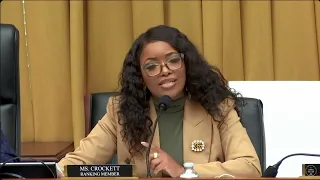
Jim Jordan expected another routine committee hearing where his trademark smirk and combative style would dominate the proceedings. But when Jasmine Crockett opened that Manila folder and began reading from internal memos, the next 7 minutes would not only silence the hearing room, but expose a pattern of procedural manipulation that had gone unchallenged for years. The House Oversight Committee hearing room carried the weight of institutional power in every detail.
Mahogany panels absorbed the harsh fluorescent lighting, casting subtle shadows across the faces of committee members and witnesses alike. The air conditioning hummed at a pitch just low enough to be constant without being intrusive, pumping chilled air that contrasted with the heated exchanges expected that morning. The subtle scent of furniture polish and paper hung in the air.
The alactory backdrop to the theater of governance. Every cough, every shuffle of papers, every whispered consultation was captured by the sensitive microphones. Their red recording lights, a silent reminder that every word spoken became part of the permanent record.
From the elevated committee deis, chairman Jordan projected the confidence that had become his political trademark. His blue shirt sleeves were rolled up precisely to the elbow, his gold colored tie loosened just enough to signal his self-styled image as a political fighter unbound by Washington formality. The characteristic half smile that opponents had come to recognize as a prelude to aggressive questioning played at the corners of his mouth as he shuffled through his prepared talking points, occasionally exchanging knowing glances with allied committee members.
Across the room, Representative Crockett sat with a different kind of confidence, measured, composed, patient. Her crimson blazer stood out against the sea of navy and gray suits, its structured shoulders framing a posture of attentive readiness. Small gold earrings caught the light when she turned her head to consult her meticulously organized notes.
The subtle pin on her lapel, a simple balanced scale, was the only outward symbol of her former career as a public defender and civil rights attorney. Her expression remained neutral, but her eyes missed nothing, cataloging every gesture, every expression from the chairman as she arranged the documents in her folder with deliberate precision. Between them sat the committee members, staff, press corps, and public observers, all settling into what they presumed would be another predictable partisan confrontation, unaware they were about to witness a moment that would be replayed countless times on news broadcasts that evening.
Jasmine Crockett hadn't planned to be the focal point of today's hearing. Her path to Congress had begun in courtrooms across Texas, where she had spent years representing clients whose voices were routinely dismissed by systems of power, now representing a Texas district in the House. She brought that same commitment to justice into the halls of Congress.
A brief memory flashed through her mind as she waited for her turn to speak, standing before a judge in a Texas courtroom, facing dismissive skepticism as she represented a lowincome client. You really think that argument will persuade anyone? Counselor, the judge had asked with the same kind of condescending smile she now saw on the chairman's face that day.
She had responded with legal reasoning so meticulously researched that the judge had been forced to rule in her favor. The lesson learned, preparation overcomes prejudice. The system she challenged today was more complex, an intricate weave of political power, partisan media, and a growing divide in how different Americans understood truth and facts.
The hearing had ostensibly been called to investigate allegations of politicization in government agencies, but the real agenda was evident to everyone present, create sensational headlines and video clips that could quickly circulate on conservative social media. The forces arrayed against her were formidable, a committee dominated by a majority that often prioritized partisan loyalty above objective truth. a conservative press ready to amplify every criticism of her and a voter base conditioned to distrust political figures with her progressive record.
That morning she had arrived at the capital early reviewing case details over her unsweetened coffee, a ritual that helped her maintain focus. "Jasmine, are you ready for today? " a fellow congresswoman had asked as she passed her desk.
always," she'd replied with a confident smile, concealing the slight nervousness she still felt before every major public confrontation. Like many women in positions of power, she knew she would be judged not just on her words, but on every nuance of her tone, every facial expression, every gesture. As she watched Chairman Jordan repeatedly interrupt the witness with loaded questions, she recognized a familiar pattern.
The same dismissive tone that millions of American women, especially women of color, faced daily in workplace meetings, where their ideas were ignored until a man repeated them and received credit. The first skirmishes of the hearing began subtly. Chairman Jordan made a seemingly innocent remark.
I appreciate my colleague from Texas joining us today, though I doubt she's fully familiar with the technical details of this specific matter. Representative Crockett kept her expression impassive, responding only with a brief acknowledgement to the chairman before directing a precisely formulated question to the witness. A question that demonstrated not just her knowledge of the subject, but also her understanding of the legal implications the chairman had conveniently overlooked.
This pattern repeated throughout the morning, the chairman making subtle illusions to her supposed inexperience. She responding not with indignation but with increasingly impressive displays of specific knowledge that gradually began to shift the dynamics in the room. The second level of tension emerged when the chairman began interrupting her questions, citing time constraints.
If the congresswoman could be more concise, he suggested though he had allowed his allies to speak well beyond their allotted 5 minutes. Mr Chairman, I'm simply following the same line of questioning you established earlier. I asked for the same respect afforded to my colleagues across the aisle," she responded calmly, refusing to be rushed or to show any sign of irritation, a tactic she knew her opponents often used to later characterize strong women as emotional or hostile.
The tension escalated when the chairman began questioning the relevance of her inquiries. I failed to see how this relates to the matter at hand today. Methodically, she traced the connection between her line of questioning and the stated purpose of the hearing, citing precedents from previous hearings and even the chairman's own public statements, demonstrating that her questions were not just relevant, but essential to a complete understanding of the matter.
As the confrontation intensified, the audience began to notice a pattern. The more the chairman tried to discredit or diminish Representative Crockett, the more she responded with a factual and legal precision that made his tactics increasingly transparent. The critical point of tension came when the chairman made a factually incorrect claim about a key document, whether through ignorance or strategic calculation, and then smiled dismissively to his committee colleagues, as if expecting no one would challenge him.
The momentary silence that followed seemed endless. Everyone in the room realized a line had been crossed. A distortion so flagrant it demanded response.
Yet committee protocols and social expectations of civility created an almost impossible dilemma. How to correct the record without being labeled as disrespectful to the chairman's authority. Mr Chairman, may I ask just one clarifying question?
Representative Crockett's voice was soft, almost collaborative in its tone. The chairman, confident in his position of authority, made a gesture of permission. Of course, the gentle woman from Texas is recognized.
Ah, his dismissive smile remained, anticipating what he presumed would be an ineffective attempt to challenge his statement. Could you kindly point to exactly which page of the report contains the statement you just cited? just so we can all follow along.
The seemingly simple question triggered a defensive response. It's somewhere in the report. Obviously, I don't have the exact page number at hand right now.
I completely understand, Mr Chairman. Would this perhaps be the passage? She held up a copy of the report with one page marked, because the text here seems to directly contradict what you've just claimed.
The chairman attempted to deflect. We're getting lost in insignificant details when we should be focusing on the bigger picture. With methodical calm, she then removed from her folder a series of documents.
I have here five independent sources that contradict your characterization. First, the official report itself on page 34, paragraph 2. Second, the director's sworn testimony in the March 15th hearing.
Third, the department's official correspondence dated April 7th. Fourth, the court ruling in the related case, and fifth, interestingly, your own statement at a press conference in January, where you acknowledged exactly the opposite of what you claim today. " She then passed copies of these documents to the committee cler, ensuring each member received a set.
The chairman tried to interject, but she continued in the same calm professional voice. The issue, Mr Chairman, is not about politics or partisanship. It's about factual accuracy.
And I respectfully suggest that when we chair investigative hearings with such serious implications, we have a collective responsibility to ensure our characterizations are accurate. her as the chairman attempted to formulate a response. She added, "I would like the record to clearly show that the chairman's previous statement directly contradicts the documentary evidence available to this committee, unless of course the chairman wishes to retract his statement.
" His dismissive smile finally disappeared, replaced by a look of genuine irritation. "The gentle woman is twisting my words. I'm simply citing the official record, Mr Chairman.
The words are yours, not mine. The tension in the room was palpable, as she concluded with an observation that captured the essence of the moment. Perhaps it's helpful to remember that the dignity of this institution isn't measured by the volume of our voices or the firmness of our convictions, but by the accuracy with which we honor facts, even when they contradict our preferred narratives.
The chairman, visibly irritated by the methodical exposure of his inaccuracy, resorted to the tactic he had used countless times before, a personal attack thinly disguised as a procedural observation. I thank the gentle woman for her contribution, but I must remind everyone that this committee has traditions of decorum that must be maintained, suggesting that the chairman would deliberately mislead this committee, is he paused, his dismissive smile returning, "Well, let's say it reflects more on those making such accusations than it does on me. " It was at this precise moment that the turning point occurred.
Representative Crockett leaned slightly toward the microphone, her posture straight, her gaze direct and steady. The room fell completely silent, each person present, sensing they were about to witness something significant. "Mr Chairman," she began, her voice clear and perfectly modulated, without any trace of anger, just quiet resolve.
"The truth doesn't need your smirk to be the truth. " The devastating simplicity of the phrase hung in the air. It wasn't a personal attack.
It wasn't an inflammatory accusation. It was an observation so fundamentally true and universally applicable that its power derived precisely from its unanswerable simplicity. The impact was immediate and visible.
The dismissive smile instantly vanished from the chairman's face. Several committee members straightened in their chairs, some exchanging meaningful glances. A staffer in the back of the room dropped his pen, the sound echoing in the stunned silence.
A journalist in the front row began typing frantically on her phone, recognizing the potency of the phrase she had just heard. The shift in power dynamics was palpable. In a single 10-word sentence, Representative Crockett had not only corrected the factual record, but also exposed the fundamental tactic that had been repeatedly employed to distort public discourse, the use of performative confidence and dismissive smirking to substitute for factual accuracy.
The truth doesn't need your smirk to be the truth. The phrase perfectly encapsulated the confrontation between substance and style, between factual evidence and rhetorical bluster, between institutional authority and intellectual integrity. All in an observation so succinct it would fit any headline, tweet or news.
Chiron. The chairman, momentarily speechless, retreated to his last refuge. Procedure.
The gentleoman's time has expired. We'll now move to But the moment had already transcended procedural control. Another committee member sought recognition.
Mr Chairman, I'd like to yield my time to the representative from Texas so she may conclude her questioning. The unexpected gesture coming from a moderate member of the opposite party signaled a seismic shift in committee dynamics. For the first time in that session, factual accuracy and intellectual integrity were superseding traditional party lines.
As the hearing continued, the moment was already spreading far beyond the walls of the room. Video clips of the exchange were circulating rapidly on social media. The phrase truth doesn't need your smirk instantly transformed into hashtag and meme.
Political commentators were analyzing the moment in real time, describing it as an inflection point in civic discourse. Within hours, the video had amassed millions of views. News anchors introduced the segment with variations of an extraordinary moment in Congress today when the representative from Texas delivered what some are calling the perfect line in response to intimidation tactics.
The impact extended beyond immediate politics. Educators shared the clip as an example of effective communication and evidence-based reputation. Lawyers praised the questioning technique that had exposed inaccuracy without resorting to personal attacks.
Ordinary citizens across political leanings recognized the universality of the moment. Everyone had experienced the frustration of seeing factual truth dismissed by someone in a position of authority. For Representative Crockett, the moment brought both opportunities and challenges.
Interview requests flooded her office. Supporters sent messages of gratitude. Critics attempted to mischaracterize her words.
But through it all, she maintained the same careful, principled approach she had demonstrated during the hearing, refusing to frame the moment as a personal or partisan victory. This isn't about any individual or party, she explained in a brief press statement. It's about our collective commitment to factual truth as the foundation of democratic governance.
Without that, we have nothing. In the weeks that followed, the impact of the moment continued to reverberate. Deeper analyses emerged, contextualizing the exchange within broader traditions of civic rhetoric and legislative oversight.
Historians drew parallels to other defining moments when factual accuracy prevailed over political intimidation. For ordinary citizens, especially women who had faced similar tactics in their own professional lives, the moment resonated on a deeply personal level. Messages came in from across the country.
I used your phrase in a board meeting yesterday when a colleague tried to smirk through my data presentation. It worked. My 14-year-old daughter has your words pinned to her inspiration board.
Thank you for showing her how to stand for truth with dignity. The most lasting legacy, however, was in the subtle shift in tone at subsequent committee hearings. The dismissive smirk appeared less frequently.
Factual claims were made more carefully. sources were cited with greater precision, not because of some sudden transformation in political culture, but because everyone in the room was aware of the power of a moment of crystal clarity that exposes the distance between posturing and substance. Representative Crockett continued her work without fanfare, approaching each new challenge with the same combination of meticulous preparation and unwavering conviction.
When asked months later about that viral moment, she simply smiled and said, "Dign isn't something we request from others. It's something we demonstrate through our commitment to truth, especially when especially when the truth is outnumbered. " What happened in that hearing room wasn't just about a confrontation between two political figures or even between two political visions.
It was about the enduring power of factual truth when presented with precision and dignity. A lesson not just for political discourse, but for anyone who has ever felt silenced by those who mistake authority for veracity and confidence for correctness. Many of you watching have experienced the subtle diminishment that comes from someone in power dismissing your expertise with a smirk or a condescending tone.
You felt the frustration of knowing you're right on the facts, but struggling against the institutional advantage of those who would rather not engage with uncomfortable truths. What Representative Crockett demonstrated wasn't just a political technique. It was a universal strategy for maintaining dignity in the face of dismissal.
For decades, communication experts have understood that the most powerful rhetorical techniques are often the simplest. The truth doesn't need your smirk approach works because it returns the focus to substance rather than style. It acknowledges the tactic being employed without becoming entangled in it.
It responds to dismissiveness, not with anger, but with clarity. This doesn't require special talent or position. It requires only preparation, precision, and the quiet confidence that comes from knowing you've done your homework.
Many of you have accumulated decades of expertise in your fields. Expertise that deserves respect rather than dismissal. The technique demonstrated here offers a template for ensuring that expertise is recognized.
The key elements are worth noting. First, the methodical preparation that ensures you know the facts better than those who would dismiss you. Second, the calm refusal to be baited into emotional responses that can be used to discredit you.
Third, the strategic use of documentation to move beyond competing assertions into the realm of verifiable fact. And finally, the ability to distill the entire dynamic into a clear, memorable phrase that exposes the fundamental issue at stake. What makes this approach so effective is that it doesn't seek to win through the same tactics being employed against you.
It changes the game entirely, shifting from performative confidence to substantive accuracy. This isn't just effective strategy. It's a reclamation of the integrity of public discourse for those of us who have spent decades navigating professional environments where substance is too often overshadowed by style, where expertise is dismissed by those with institutional authority but less factual knowledge.
Representative Crockett's approach offers a masterclass in maintaining dignity while correcting the record. The truth indeed doesn't need a smirk to be the truth. And those who recognize this fundamental reality will always eventually prevail over those who mistake confidence for correctness.
This is the enduring lesson from that remarkable moment. A lesson as applicable in boardrooms and family discussions as it is in the halls of Congress. In the days that followed, political analysts attempted to dissect exactly why the moment had resonated so deeply across partisan lines.
What they often missed was the universality of the experience it captured. The frustration of having substance dismissed by style, of having expertise undermined by authority, of having truth overshadowed by confidence. I've been waiting 40 years to hear someone say exactly that, wrote one retired professor in a letter to Representative Crockett's office.
In academia, in business, in politics, everywhere I've worked, I've seen truth dismissed with a smirk. Thank you for naming it so perfectly. a high school debate coach in Minnesota incorporated the exchange into her curriculum, teaching students the difference between assertiveness and aggression, between confidence and arrogance, between winning points and advancing truth.
The most important lesson here, she told her students, is that you don't need to adopt your opponent's tactics to prevail against them. Often the opposite is true. Professional negotiators and conflict resolution specialists cited the exchange as a textbook example of what they called disarming precision, the technique of responding to emotional provocation with calm factual accuracy.
What made this moment so powerful, explained one mediator in a professional journal, was the refusal to engage on the terms being set by the provocator. By redirecting to factual specificity, Representative Crockett essentially changed the rules of engagement Midgame. Public speaking coaches identified three specific techniques that had made the confrontation so effective.
the strategic use of pauses to create space for reflection. The deliberate lowering of vocal tone to convey authority without aggression. And the use of simple declarative sentences that left no room for misinterpretation.
Notice how she doesn't say I think or I believe or use any other hedging language. One communication expert pointed out. She states the observation as the self-evident truth that it is.
This is the confidence that comes not from bluster but from knowing you are factually correct. For many women watching, particularly those who had spent decades in maledominated professions, the moment represented a validation of experiences they had rarely seen acknowledged in public forums. The specific dynamic being dismissed with a smirk by someone with institutional authority but less factual knowledge was painfully familiar.
I watched that exchange with tears in my eyes, confessed a retired corporate attorney. For 30 years, I dealt with that exact smirk from opposing council, from judges, from my own colleagues. I wish I'd had that perfect phrase in my arsenal.
D. What made Representative Crockett's approach particularly valuable as a teaching tool was its transferability across contexts. The same techniques could be applied in corporate boardrooms, academic settings, community meetings, or even family discussions.
The core elements remained consistent. Thorough preparation, calm delivery, precise documentation, and the refusal to be diverted from substantive truth by procedural maneuvers or emotional provocations. The most important thing to understand, explained a crisis communication consultant who used the clip in training sessions, is that this approach requires advanced preparation.
You can't improvise this level of factual precision. Representative Crockett had those five sources ready because she anticipated the chairman's likely arguments and prepared to counter them with specific evidence. This emphasis on preparation resonated particularly with the over 50 demographic, many of whom had learned through decades of professional experience that there are no shortcuts to substantive authority.
The meticulous organization of Representative Crockett's documentation, the precision of her citations, the clarity of her questioning, all reflected a professional thoroughess that couldn't be faked. Young people sometimes think charisma or quick thinking can substitute for deep knowledge, observed a retired educator. What this moment illustrated so beautifully is that there's no substitute for doing your homework.
That Manila folder with its carefully organized evidence, that's the real source of power in that exchange. And in professional development seminars across the country, facilitators began using the exchange to illustrate what they called evidence-based assertiveness. The ability to stand firm not through volume or aggression, but through factual precision.
The revolutionary aspect of this approach, one facilitator explained, is that it's simultaneously assertive and collaborative. By focusing on factual accuracy rather than personal conflict, Representative Crockett invites everyone present to align with truth rather than with individuals or parties. This creates the opportunity for unexpected allies.
This collaborative dimension was evident in the aftermath of the exchange when a moderate member of the opposite party yielded his time to allow Representative Crockett to continue. This crossing of partisan lines illustrated how a focus on factual accuracy could sometimes transcend political divisions, creating temporary alliances based on shared commitment to truth. For many Americans disillusioned with the increasing polarization of public discourse, this moment offered a glimpse of an alternative approach, one that prioritized accuracy over allegiance and evidence over emotion.
It suggested the possibility of a discourse grounded in shared reality rather than competing narratives. What struck me most, commented a political scientist, was how the focus on specific verifiable facts created a momentary space where partisan identification became secondary to factual accuracy. For just a few minutes, the question wasn't whose side are you on, but what do the documents actually say?
This shift from tribal allegiance to factual verification represented for many observers the most promising aspect of the exchange in a political landscape often characterized by competing realities rather than competing interpretations of shared reality. The insistence on specific documented facts offered a potential path back to common ground. The phrase, "The truth doesn't need your smirk," quickly entered the lexicon of political commentary, but its application extended far beyond politics.
Management consultants adopted it in training sessions about workplace communication. Educators used it to discuss classroom dynamics. Family therapists referenced it when addressing patterns of dismissiveness in relationship conflicts.
Its universality stemmed from its identification of a ubiquitous dynamic, the use of dismissive confidence to avoid engaging with substantive challenges. By naming this tactic so succinctly, Representative Crockett had given people across contexts a tool for recognizing and responding to it. The power of a perfect phrase is that it crystallizes something we've all experienced but perhaps never articulated.
explained a linguist who studied political communication. Once named, the dynamic becomes more visible and thus less effective as a tactic. For those who had spent decades in professional environments where their expertise was routinely dismissed, this naming function was particularly valuable.
It transformed what had often been experienced as a personal failing, why can't I get them to take me seriously, into a recognizable tactical pattern that could be countered with specific strategies. After watching that exchange, I realized I'd been handling dismissive colleagues all wrong, admitted a senior engineer. I'd been trying to match their energy, to be more assertive, more confident.
What I should have been doing was calmly presenting documented evidence and refusing to be diverted into emotional exchanges. This realization that responding to dismissiveness with more forceful assertion often played into the dynamic rather than disrupting it represented a paradigm shift for many professionals. The alternative approach demonstrated by Representative Crockett offered a more effective strategy.
respond to dismissive style with substantive precision. The counterintuitive lesson here, noted a conflict resolution specialist, is that the most powerful response to dismissiveness isn't more forceful assertion, but more meticulous accuracy. It's about changing the terms of engagement rather than trying to win on the terms being imposed.
This insight proved particularly valuable for those who, by temperament or socialization, were uncomfortable with aggressive confrontation. It offered a path to effectiveness that didn't require adopting tactics that felt inauthentic or unethical. For years, I thought I was ineffective in confrontations because I wasn't aggressive enough, confessed a nonprofit director.
Watching Representative Crockett, I realized there's another way to be powerful through precision, preparation, and principled persistence. The approach resonated especially with those who had learned through decades of experience that sustainable authority comes not from dominance, but from demonstrable expertise. It validated a path to influence based not on power plays, but on painstaking accuracy.
What Representative Crockett demonstrated, observed a business ethics professor, was that factual precision is not just morally superior to bluster and dismissiveness. It's ultimately more effective. The truth, plainly stated and thoroughly documented, has a power that no amount of performative confidence can match.
This perspective offered a particularly valuable corrective in an era often characterized by confidence culture, the elevation of assertiveness and self asssurance over substantive knowledge and factual accuracy. It suggested that while confidence might win momentary advantages, precision ultimately prevails. The most important lesson here for professionals of any age, concluded one career coach, is that doing your homework still matters.
Having the receipts still matters. Knowing your facts cold still matters in a world that sometimes seems to reward style over substance. This reminder of the enduring power of methodical preparation and factual precision is immensely reassuring.
Indeed, in the months following the exchange, as its impact continued to reverberate through professional and political circles, perhaps the most significant development was the quiet shift in how similar hearings were conducted. There was no dramatic transformation, no sudden conversion to a more factual discourse, but there was a subtle change in how claims were presented, how evidence was cited, how assertions were challenged. The chairman's trademark dismissive smile appeared less frequently.
Committee members on both sides began prefacing assertions with specific citations. When factual disputes arose, there was more often a turning to documents rather than an escalation of conflicting claims. Not because anyone had undergone a moral transformation, but because everyone in the room had witnessed the power of a moment when the distance between posturing and precision was exposed with crystal clarity.
They had seen how quickly the advantage could shift when dismissive confidence encountered methodical accuracy, and none wished to find themselves on the wrong side of such a moment. This perhaps was the most enduring legacy of that exchange. Not a revolution in political discourse, but a subtle reccalibration of the balance between assertion and evidence, between confidence and accuracy, between institutional authority and factual precision.
For those watching from outside the political arena, especially those who had spent decades navigating professional environments where similar dynamics played out, this recalibration offered a template for their own interactions. It suggested that the path to effectiveness lay not in matching dismissiveness with more forceful assertion, but in responding to it with calm, documented precision. After all these years, reflected one viewer, I finally understand what my mentor meant when she told me to let the facts do your fighting for you.
It's not about avoiding confrontation. It's about choosing the ground on which that confrontation takes place. This strategic wisdom, choosing to engage not on the terrain of performative confidence, but on the solid ground of factual accuracy, represented the core lesson of that remarkable exchange.
It offered a path forward not just for political discourse, but for professional communication across contexts. In a world often divided by competing narratives, the insistence on specific verifiable facts offered a potential bridge across those divisions. Not because facts alone can resolve value differences, but because a shared commitment to factual accuracy creates the necessary foundation for meaningful engagement with those differences.
The truth doesn't need a smirk to be the truth. And those who recognize and honor this fundamental reality will always in the long run prevail over those who mistake confidence for correctness, authority for accuracy, and dismissiveness for reputation. This is the enduring lesson from that extraordinary moment.
A lesson as valuable in boardrooms and community meetings as in the halls of Congress. A lesson about the quiet power of preparation, the subtle strength of precision, and the lasting authority of factual truth presented with dignity and resolve. It's a lesson many in the audience had learned through decades of experience, sometimes at considerable personal and professional cost.
Seeing it validated so dramatically in such a public forum offered not just practical guidance but a kind of moral vindication, an affirmation that the path of methodical accuracy, while often more difficult, ultimately leads to more sustainable influence than the shortcut of dismissive confidence. After watching that exchange, one viewer commented, "I finally felt seen. For years, I've been told I need to be more assertive, more confident, more forceful to be effective.
But what Representative Crockett demonstrated was exactly the approach I've always tried to take. Thorough preparation, calm delivery, precise documentation. Maybe I wasn't wrong after all.
This recognition that effectiveness can come through precision rather than dominance offers a particularly valuable perspective for those navigating the complex power dynamics of professional and public life. It suggests that there are multiple paths to influence and that choosing the path of factual accuracy over performative confidence is not just an ethical choice but potentially a strategic advantage. In a world that sometimes seems to reward the loudest voice rather than the most accurate one, this reminder of the enduring power of methodical preparation and factual precision offers both practical guidance and moral reassurance.
It suggests that doing the hard work of getting the facts right still matters, that having the receipt still matters, that knowing your subject cold still matters. And for those who have built careers and lives on these principles, often swimming against cultural currents that reward quick confidence over painstaking accuracy, this validation is both practically useful and deeply affirming. It confirms what experience has taught them, that in the long run, substance prevails over style, precision over posturing, and factual truth over dismissive smirks.
This ultimately is the universal lesson from that extraordinary moment in the hearing room. A lesson not about political tactics, but about human communication, not about partisan advantage, but about enduring effectiveness. A lesson as applicable in professional settings and personal relationships as in political discourse.
a lesson about the quiet, sustaining power of truth presented with dignity and precision. What makes this moment particularly valuable as a teaching tool is its demonstration that responding effectively to dismissiveness doesn't require adopting the same tactics being used against you. You don't need to outskirt the smirker.
You don't need to be more dismissive than those dismissing you. You don't need to be louder or more aggressive or more intimidating. You need only to be more accurate, more prepared, more precise.
You need to change the terrain of the engagement from performative confidence to factual specificity. And in doing so, you reclaim not just the particular exchange, but the integrity of the discourse itself. This approach requires more work, the meticulous preparation, the careful documentation, the precise formulation of questions and responses.
But for those committed to both effectiveness and integrity in their communications, it offers a path that accomplishes both without sacrificing either. In an era often characterized by the degradation of public discourse, by the substitution of confidence for correctness and dismissiveness for reputation, this alternative approach offers not just practical effectiveness, but a kind of moral victory. It demonstrates that one can prevail not by descending to the level of dismissive tactics, but by elevating the exchange to the level of factual precision.
For those who have spent decades navigating professional environments, where substance is too often overshadowed by style, where expertise is dismissed by those with institutional authority but less factual knowledge. This alternative approach offers both strategic guidance and moral reassurance. It confirms what experience has often taught, that in the long run, accuracy trumps assertion, precision prevails over posturing, and factual truth outlasts dismissive smirks.
The truth indeed doesn't need a smirk to be the truth. And those who honor this fundamental reality in their communications will find in it not just moral satisfaction but strategic advantage. A way to be effective without sacrificing integrity.
To prevail without adopting the tactics they oppose. This is the enduring lesson from that remarkable moment. A lesson about communication, about dignity, about truth.
A lesson as valuable in professional settings as in political discourse. A lesson for anyone who has ever felt the frustration of having substance dismissed by style, expertise undermined by authority or truth overshadowed by confidence. It's a lesson many in the audience had learned through decades of experience.
Seeing it validated so dramatically in such a public forum offered not just practical guidance but a kind of vindication, an affirmation that the path of methodical accuracy, while often more challenging, ultimately leads to more sustainable influence than the shortcut of dismissive confidence. And in a world that sometimes seems to reward the loudest voice rather than the most accurate one, this reminder of the enduring power of factual precision offers both strategic guidance and moral reassurance. It suggests that doing the hard work of getting the facts right still matters, that having the evidence still matters, that knowing your subject thoroughly still matters.
For those who have built careers and lives on these principles, often swimming against cultural currents that reward quick confidence over painstaking accuracy, this validation is both practically useful and deeply affirming. It confirms what experience has taught them, that in the long run, substance prevails over style, precision over posturing, and factual truth over dismissive smirks. This ultimately is the universal lesson from that extraordinary moment in the hearing room.
A lesson not about political tactics, but about human communication, not about partisan advantage, but about enduring effectiveness. A lesson as applicable in boardrooms and family discussions as in congressional hearings. A lesson about the quiet, sustaining power of truth presented with dignity and precision.
A lesson that many in the audience had learned through decades of experience, sometimes at considerable personal and professional cost. A lesson now validated in the most public of forums, offering not just practical guidance for future communications, but a kind of moral vindication for past choices to prioritize accuracy over assertion, evidence over emotion, and dignified precision over dismissive posturing. The truth doesn't need a smirk to be the truth.
And those who honor this fundamental reality in their communications will find in it not just ethical satisfaction, but strategic advantage in every professional and personal interaction. In the weeks after that hearing, Representative Crockett received hundreds of letters from people who had watched the exchange. Many came from individuals in their 50s, 60s, and 70s who saw in her approach a validation of communication principles they had developed through decades of experience.
Your handling of that situation reminded me of my 30 years managing difficult board meetings, wrote a retired executive. I always found that the best response to arrogance was not more arrogance, but irrefutable evidence presented calmly. Thank you for demonstrating this approach so perfectly.
A 68-year-old professor emeritus noted, "What you did in that hearing was execute flawlessly what I spent decades teaching my students. That authority comes not from position, but from precision, not from volume, but from veracity. Your preparation was evident in every response.
" These reactions highlighted something important. While the exchange had gone viral among younger audiences on social media, its deepest resonance was with those who had accumulated enough life experience to recognize both the dynamic at play and the effectiveness of the response. For many viewers over 50, the moment validated approaches to communication they had refined through years of navigating complex power dynamics in professional settings.
It affirmed that the path of methodical preparation and factual precision, often more difficult than the shortcut of assertive confidence, ultimately leads to more sustainable influence. This validation was particularly meaningful for those who had sometimes questioned whether their commitment to substantive accuracy over performative confidence was a strategic disadvantage in environments that often seem to reward the latter over the former. After decades in corporate law, I sometimes wondered if my insistence on factual precision over forceful assertion was holding me back, confessed one retired attorney.
Watching you transform that hearing with exactly that approach was profoundly affirming. The universal applicability of the approach was evident in how quickly it was adopted across contexts. Management consultants incorporated the technique into conflict resolution training.
Negotiation experts cited it as a case study in maintaining leverage through factual advantage. Public speaking coaches used it to illustrate the power of understatement delivered with precision. What made the moment particularly instructive was its demonstration of how to change the terms of engagement when faced with dismissive tactics.
Rather than attempting to match the chairman's dismissive confidence with more forceful assertion, a response that often plays into such dynamics, Representative Crockett had shifted the terrain entirely, moving from competing assertions to documented facts. This strategic pivot from assertiveness to accuracy, from confidence to citation, from smirking to sourcing, offered a template for anyone facing similar dynamics, whether in professional settings, community meetings, or even family discussions. I've spent decades in meetings where men with less expertise but more institutional authority dismissed my contributions with a smirk, wrote a retired engineer.
I wish I'd understood earlier that the most effective response wasn't to try to match their style, but to overwhelm it with substance. The approach resonated particularly with those who, by temperament or socialization, were uncomfortable with aggressive confrontation, but unwilling to accept dismissive treatment. It offered a path to effectiveness that didn't require adopting tactics that felt inauthentic or compromising.
For years, I thought my discomfort with confrontation was a weakness, shared a nonprofit director. Your approach showed me that one can be both effective and dignified. That standing firm doesn't have to mean becoming aggressive.
This insight that responding to dismissiveness with calm precision rather than matching aggression represented a paradigm shift for many professionals who had long struggled with similar dynamics. It validated an alternative path to influence, one based not on dominating exchanges, but on elevating them. For Representative Crockett, the viral moment was never about personal vindication or partisan victory.
When asked months later what she hoped people would take from the exchange, she emphasized its broader applicability. That interaction wasn't about politics. It was about a dynamic that plays out in boardrooms, classrooms, and community meetings across the country every day.
When someone uses dismissiveness to avoid engaging with substantive challenges, the most effective response isn't to match their tone, but to change the terms of engagement entirely. Shift from assertion to evidence, from confidence to citation, from dismissiveness to documentation. This perspective, viewing the exchange not as a political confrontation, but as a case study in effective communication under pressure, expanded its instructional value beyond partisan contexts.
It offered a template applicable in any situation where institutional authority or dismissive confidence is used to avoid substantive engagement. What makes this approach so powerful, explained a communication expert, is that it doesn't require matching the emotional energy of the dismissive person. It doesn't demand that you become something you're not.
It simply requires that you know your facts cold and present them with calm precision. knee. This focus on substance over style, on preparation over performance, offered particular reassurance to those who had sometimes felt disadvantaged by cultural preferences for confident assertion over careful accuracy.
It suggested that while performative confidence might win momentary advantages, factual precision ultimately prevails. For many in the audience who had accumulated decades of professional experience, this validation of substance over style was profoundly affirming. It confirmed what they had learned through years of observation that sustainable influence comes not from dominant behavior, but from demonstrable expertise.
After watching that exchange, reflected a viewer. I realized I've been right all along. All those times I was told to be more assertive, more confident, more forceful when my instinct was always to be more prepared, more precise, more factual.
Maybe I wasn't wrong after all. This recognition that effectiveness can come through precision rather than dominance offers a particularly valuable perspective for navigating professional life. It suggests that there are multiple paths to influence and that choosing the path of factual accuracy over performative confidence is not just an ethical choice but potentially a strategic advantage.
In the final analysis, what made Representative Crockett's approach so powerful was its demonstration that responding effectively to dismissiveness doesn't require adopting the same tactics being used against you. You don't need to outsmirk the smirker. You don't need to be more dismissive than those dismissing you.
You need only to be more accurate, more prepared, more precise. You need to change the terrain of the engagement from performative confidence to factual specificity. And in doing so, you reclaim not just the particular exchange, but the integrity of the discourse itself.
This approach requires more work, the meticulous preparation, the careful documentation, the precise formulation of questions and responses. But for those committed to both effectiveness and integrity in their communications, it offers a path that accomplishes both without sacrificing either. In a world that sometimes seems to reward the loudest voice rather than the most accurate one, this reminder of the enduring power of factual precision offers both practical guidance and moral reassurance.
It suggests that doing the hard work of getting the facts right still matters, that having the receipt still matters, that knowing your subject cold still matters. And for those who have built careers and lives on these principles, often swimming against cultural currents that reward quick confidence over painstaking accuracy, this validation is both practically useful and deeply affirming. It confirms what experience has taught them that in the long run substance prevails over style, precision over posturing, and factual truth over dismissive smirks.
The truth indeed doesn't need a smirk to be the truth. And those who recognize and honor this fundamental reality will always in the long run prevail over those who mistake confidence for correctness, authority for accuracy, and dismissiveness for reputation. This is the enduring lesson from that extraordinary moment.
A lesson as valuable in boardrooms and community meetings as in the halls of Congress. A lesson about the quiet power of preparation, the subtle strength of precision, and the lasting authority of factual truth presented with dignity and resolve. I could end it here, but what's really going to stay with you is in the next video.
It's on your screen now, and honestly, it's the best thing you'll watch this week.