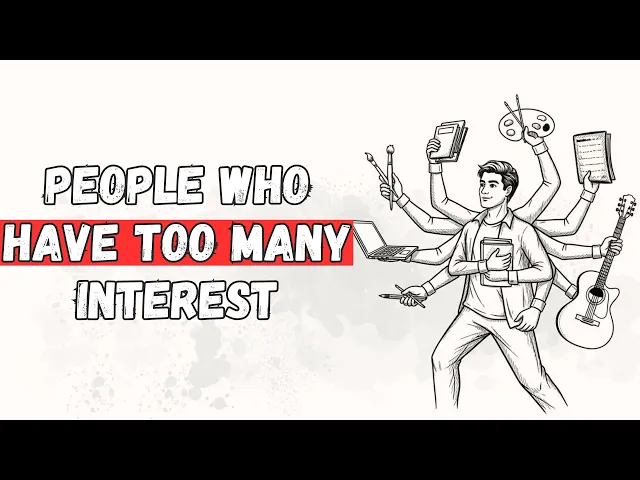
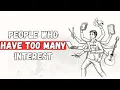
If you look at your life and see a graveyard of halffinish projects, a guitar in the corner, a half-cco-coded website, a set of baking tools, and a sudden urge to learn jiu-jitsu, you probably feel a very specific type of shame. Society has a word for you, dilotant. They tell you that you are chaotic or that you lack the grit to specialize.
You feel like an impostor because you can't just pick one lane and stay in it. You might even know the phrase jack of all trades, master of none, and you use it to beat yourself up, but you are forgetting the rest of the quote. The full quote is, "A jack of all trades is a master of none, but often times better than a master of one.
" Psychology suggests that this feeling of being scattered isn't a defect. It is a symptom of a highly adaptive nervous system. You aren't failing to specialize.
You are unconsciously building a rare cognitive architecture known as the M-shaped mind. While the world tells you to focus, your brain is trying to prepare you for a future where hypers specialization is actually a liability. Before we break down why your chaos is actually a survival strategy, let me know in the comments where are you watching from.
And if you love deep psychology like this, check out my newsletter community after watching linked in the description. To understand why you feel this anxiety, we have to look at the lie you were sold. For the last century, the world was an eye-shaped game.
It rewarded people who dug one hole a mile deep. It was a kind learning environment like golf where the rules never changed. If you practiced your swing for 10,000 hours, you won.
But you you don't live in a kind environment. Your brain instinctively knows that the modern world is a wicked environment. The rules change every day.
In a wicked environment, the specialist is fragile. If the industry changes, they are obsolete. Because of this, you naturally drift.
One year you are obsessed with electrical wiring and HVAC systems and the next you are deep into yoga, heavy lifting and DJing rave music. To an outsider, this looks like a chaotic personality. They might call you a strange man or unfocused.
But what you are actually doing is gathering data points from disperate domains. This is where the magic happens. Psychology calls this far transfer.
The specialist uses near transfer. They solve problems they have seen before using the same old tools. But you you use far transfer.
You take a concept from one completely unrelated field and apply it to another. Think about the web developer who used to be a beekeeper and a farmer. On paper, those things have nothing to do with coding.
But that agricultural experience allows them to understand organic systems and growth cycles in a way that a specialist coder who only stares at screens could never grasp. They aren't just writing code. They are cultivating an ecosystem.
That is far transfer. That is innovation. You feel like an imposter because you aren't the best at any one thing.
But you are failing to see that your value isn't in your depth, it's in your synthesis. Now, understanding that your curiosity is a superpower is a great relief. But it doesn't solve the immediate crushing problem, the burnout and the feeling of being behind in life.
You see people your age becoming senior vice presidents or lead engineers and you feel like you're still at the starting line because you keep switching tracks. This happens because you are misunderstanding the geometry of your own potential. You aren't T-shaped general knowledge with one specialty.
You are Mshaped. An M-shaped person has multiple pillars of depth connected by a bridge of curiosity. But here is the trap.
You cannot build all the pillars of the M at the same time. If you try to learn data science, write a novel and start a business all in the same month, you will collapse. The people who successfully navigate this life, the true polymaths practice, what we call serial mastery, you have to view your life in seasons.
You might spend your 20s obsessing over music and art. Then in your 30s, you pivot to programming to pay the bills. You didn't quit art, you just finished that season of construction.
I saw a story of a 53-year-old who finally found peace with this. He realized he couldn't choose art over programming. So, he let programming be the pillar that paid the bills while music, philosophy, and game design flourished as the other pillars on nights and weekends.
He denied high demand team lead positions to keep his work week at 30 hours. He protected his psychic energy. He didn't try to merge them all instantly.
He let them exist sequentially. and eventually they all merged into his own personal video game projects. That is the M shape in action.
There is one final psychological trait you have that makes you bulletproof and it comes from evolutionary biology. It's called redundancy. In nature, redundancy is a strength, not a waste.
Elephants rarely get cancer because they have massive genetic redundancy. Multiple copies of the same cancer fighting gene. If one fails, another takes over.
Your chaotic interests are your redundancy. If you are just a specialist software engineer and AI takes your job, you are terrified. But if you are a software engineer who also knows how to do electrical wiring, fix HVAC motors, and teach English, you are unbreakable.
You haven't been wasting your time dabbling. You have been engaging in strategic adaptability. You have been building a safety net of skills that ensures no matter what happens to the economy or technology or the job market, you have a pivot ready.
So, stop apologizing for your graveyard of hobbies. Those weren't failures. They were semesters in the university of your own making.
You were never meant to be just one thing. You were built to be the bridge between worlds that others can't even see. If you are ready to embrace your M-shaped future, drop a heart emoji in the comments to show you're putting it all together.
And if you want the deep dive research on how to structure your seasons, subscribe and check out the newsletter community in the description.