all right welcome to unit four oo which stands for Oceanic Oceanic or oceanic continental convergence so what happens when two oceanic lithospheric plates or an oceanic and a continental lithospheric plate run into each other um this is our first video we're going to be talking about plate Theory and we're going to further investigate uh what the surface of the Earth is like coming off of unit three which we spent a lot of time talking about like chemical composition viscos um I previewed this in the in the middle of unit 3 uh with the plate Theory
so our review straight from unit uh from unit three uh I have my upper part of the earth the upper like you know two or 3% of the Earth really um the very upper part is the lithosphere which is solid um and so you have continental crust or you have Continental lithos here which has continental crust and the upper part of the mantle or you could have Oceanic lithos here which is the oceanic crust and the upper part of the mantle side note on this I'll often refer to for com just based on habit I'll
often refer to like continental crust or oceanic crust and what I'll mean is oceanic lithosphere or Continental lithosphere um slight difference because once again the lithos here is that upper part of the mantle um with the crust on top because that's the upper part of the mant and the crust is solid together once again if I refer to it as like oceanic crust or continental crust common mistake all right below the athenos phere still inside the mantle is the uh sorry below the lithosphere uh inside the mantle is the athenos spere um remember the athenos
spere is part of the mantle so it has the same chemical composition of the solid mantle above it however it is now a plastic so uh Plastics uh can uh can flow so they're almost solid but they can flow the athenos spere does have convection currents in them because it can flow uh and because there's it's hotter as you go down remember as you go further and further in the earth it gets hotter and hotter and hotter so the athenos spere is heated from below and then remember the crust is very cool because it's on
it's on top of the Earth in contact with the atmosphere so I have a plastic which can flow being heated from the bottom and cooled from the top and whenever I have something that can flow being heated from the bottom and clue from the top it will naturally form a convection current almost like I purposely had unit one be unit one to help you understand unit this unit almost like that was part of the plan plate Theory um so modern plate theory is really actually very exciting didn't really come around till like the 1960s 70s
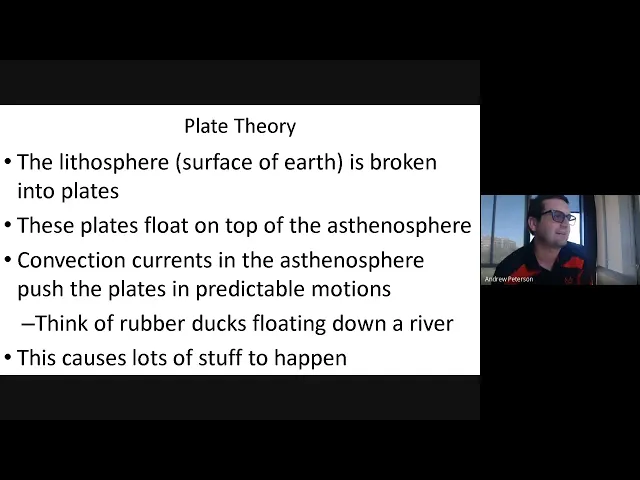
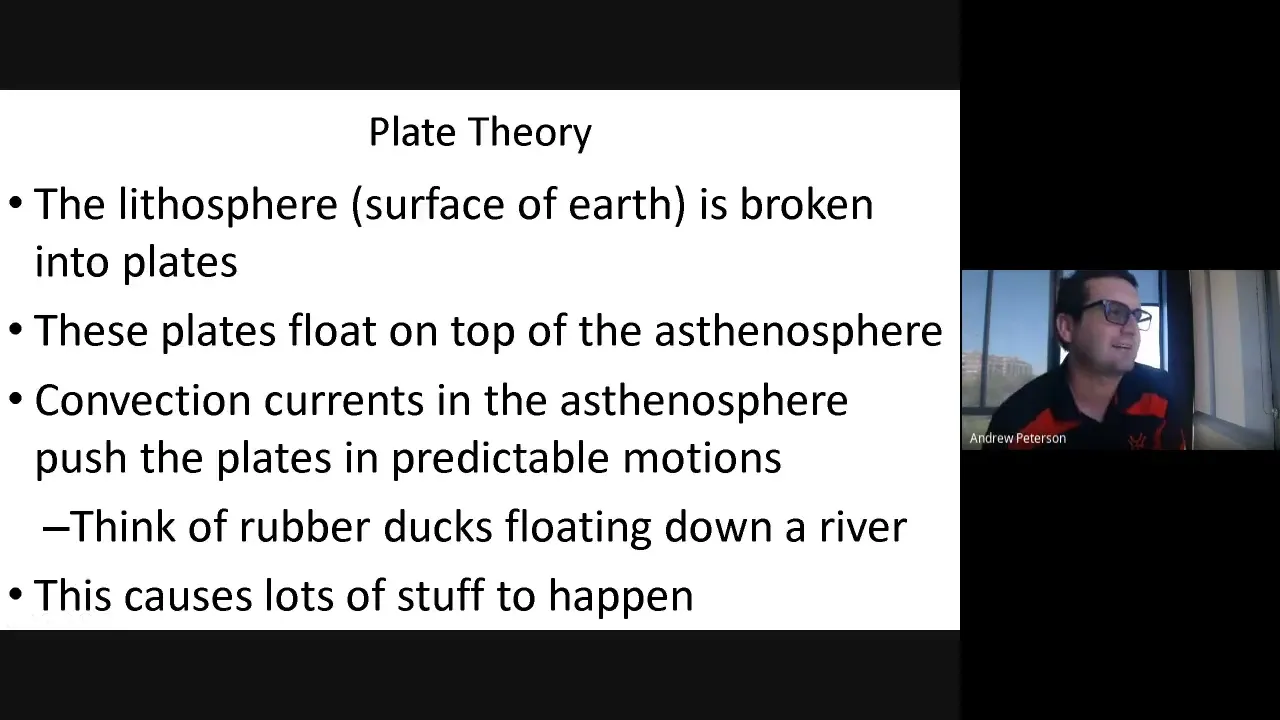
and 80s actually it's one of our as far as like large scientific theories it's actually one of the most modern ones um so the lithosphere uh the lithosphere the Earth is broken into plates I have this solid outer crust but it is broken up into chunks it's not one complete solid it's like uh pieces of Ice uh floating in a cup of water so you have these individual chunks of ice that are solid but nonetheless they are not necessarily connected so these plates float on top of the ethosphere okay so the ethosphere is Flowing convection
currents okay so the con the phosphere is moving since I have these lithos ERC plates that are floating on top of that movement the lithospheric plates get pushed around okay I always like to think of it as like little rubber ducks in a river right if I throw a rubber duck in a river and the Chicago um Chicago actually does um a duck a rubber duck race every year where they dump a bunch of rucks ducks in the river and they see which duck moves the fastest it's not like the ducks have Motors or anything
it's the rivers flowing and so the Ducks move in the river the other way to think about this is like a lazy river at like a water park you sit on your inner tube and if you're doing it right you're actually just supposed to sit and relax I know that's sometimes a struggle for seventh grade students you want to like swim around and stuff but you're sitting on an inner tube you are stationary or you're not trying to move but the water underneath you is moving and so you'll move with it and this causes a
lot of stuff to happen so much stuff I probably have another five units to talk about all the stuff that this hap causes the fact that the athenos spere is flowing and the upper part of the earth is solid probably have like another five or six units because you know kind of a big thing uh so here's a map of the world broken down into plates so this has some I like this map a lot because it really the red lines give you clear indications where the plate boundaries are um and then um on top
of it I like it because it has some topographic features which we'll talk about topic graphic features often tell you about the plate movements okay so topography often mirrors um what's happening with the plates one thing I always like to point out when we talk when I show this image is the cool fact that there are some plates that are oceanic crust so if I look at the Pacific Plate over I don't have my mouse right now if I have my Pacific Plate I wish I could nor if I have my Pacific Plate here there
it is if I have my Pacific Plate here I will note that this entire plate is oceanic crust if I look at the North American Plate I see that it has oceanic crust here but continental crust South American plates like that too oceanic crust and continental crust African plates like that too continental crust oceanic crust so I have some plates that are oceanic crust like the nasca plate or the Pacific Plate I have some plates that have continental crust and oceanic crust but there's no plates that are just Contin ental crust okay second image um
that I really like and I don't know why this got all messed up um is let me fix this really quick fix present a window the other the other L I like is this which is a they get rid of the topographic features but what they do here is they they show you the a specific type of plate boundaries so we see we have convergent boundaries indicated by the red lines with the little arrows we have um we have transform boundaries which are orange and we have divergent plate boundaries which are white and so we're
going to spend a lot of time looking at this image because this image has the major type boundaries we'll have when like an oceanic plate runs into oceanic plate when an oceanic plate runs into a continental plate which is both these units but then also what happens like up here when a continental plate runs into a continental plate or what is Divergence and transform so we have units on basically all those different types of boundaries which are I think very exciting that's the end of this