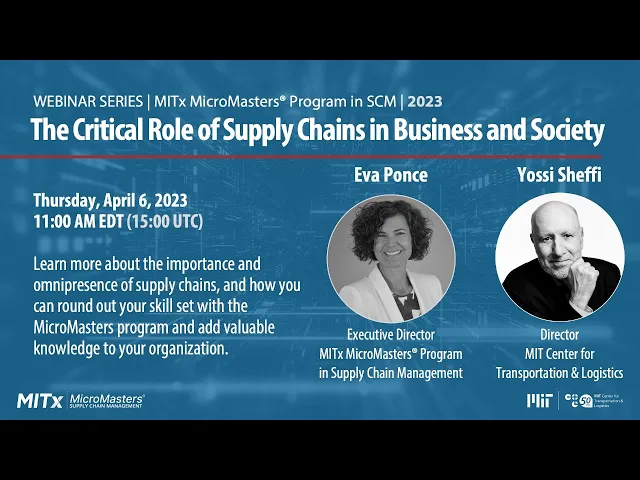
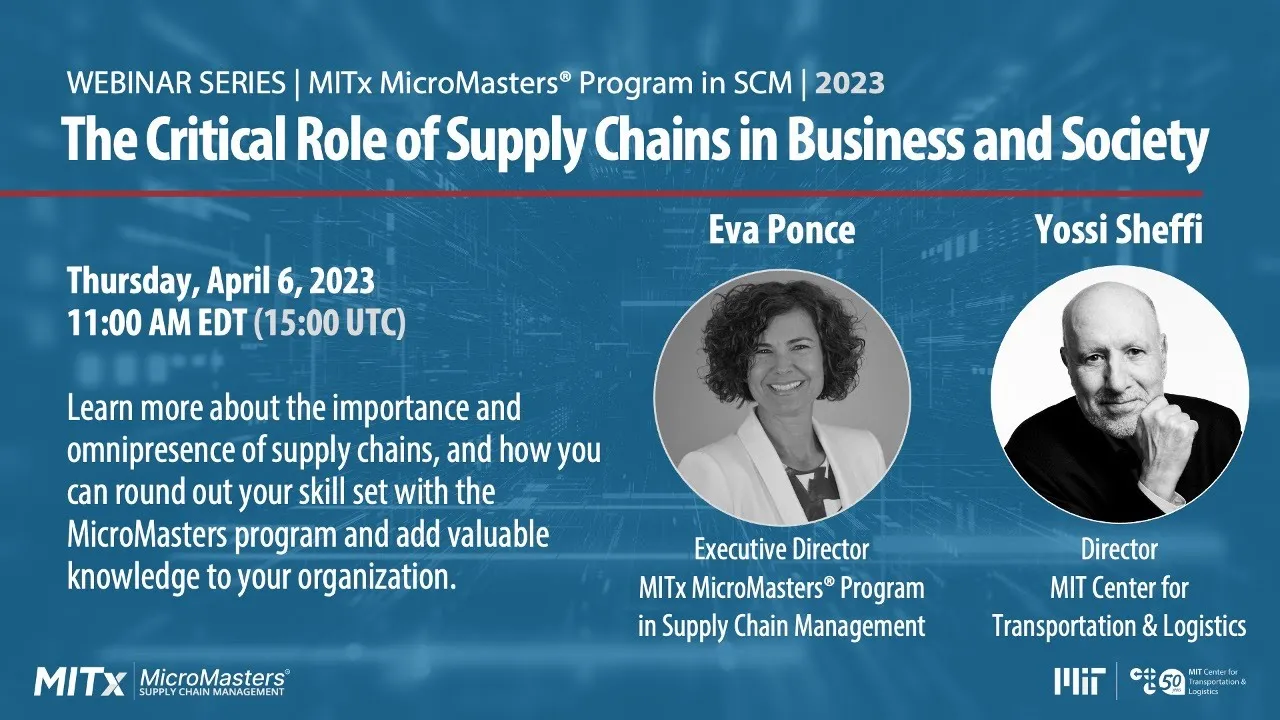
foreign [Music] executive director of the mitx micromasters program in Supply Chain management and it's truly my pleasure to host this event where we will be discussing with Professor Jose sheffy about the critical role of Supply chains in business and Society Dr Jose sheffy is the Alicia gray professor of Engineering Systems at MIT where he serves as the Director of the MIT Center for transportation and Logistics he is an expert in many different areas but more specifically in systems optimization risk analysis and Supply Chain management of course he's the author of many scientific Publications and nine
books it's truly a pleasure to have you today yossi thank you very much for having me my pleasure excellent so during this life event professor sheffy and I will be discussing the critic role of Supply chains chains in modern Societies in modern global economy for about 30 minutes then I will open the floor during 15 minutes four questions from you from the audience so please make sure that you use the Q a feature in the webinar so we can I can see the questions and bring these questions to professor sheffy and answer the your questions
at towards the end of the this event the plan for this event is to discover how Supply Chain management plays a crucial and political role in almost every aspect of business so my first question for you DLC is why is it important to learn about Supply chains well I think people maybe maybe people ask this question before the pandemic I don't think too many people ask this question after the pandemic because we found out that is consumed people in business always know but the consumer found out how important Supply chains are for sustaining life for
bringing food for bringing medicine as well as you know furniture and toys and everything else that you can imagine so supply chain actually support not only sustaining life but support standard of living and the difference between countries with high standard of living in countries that standard Ruby is not that high is supply chain efficiency in many many cases so it's also the difference between companies that do well in companies who don't do so well because supply chain is responsible for having the items of the shed for having the items in the Fulfillment center to having
the item get to your home having the item be at the pharmacy at the hospital [Music] um in the supermarket and when supply chain when when supply chain are being hampered and not allowed to work as they usually do with their usual efficiency uh we have disruptions and we have shortages like we had during the pandemic yes um yeah thank you thank you for for that because the supply chain is kind of the backbone of these modern societies they are helping everyone to get any goods and you mentioned many different Goods vaccines was one of
those medicines toys all of these goods and um you also mentioned the disruption the pandemic um it's true that um supply chain are interconnected systems and complex systems and during the last I would say 30 50 years we have been observing many disruptions many many reasons that are kind of bringing complexity to this supply chain and the pandemic was one of these big disruptions of course so um can you illustrate or bring some some examples of these aspects that you think are kind of bringing more and more complexity to the supply chains well uh interesting
you mentioned it in my latest book I talk a lot about it trying to explain to the uninitiative people who are not in supply chain how complex and how intricate Global Supply chains are and how many entities and people and organizations and private public NGO are involved in getting a product think about it from the mind taking the basic material from the field when we grow them to a finished product uh so in the book for example I follow a teacher what happened to a t-shirt from the and this does not even include all the
processes from the cotton to the textile but once you have a tissue just to get into the consumer you see how many people organization processes are in are involved in this and the traditionally the role of supply chain and was mostly high level of service which means try to maximize revenue and reduce cost this was complex enough running it of a huge network over the entire world Crossing Borders crossing different legal regime different different regulatory regimes uh this was complex enough in its own right now supply chain are expected not unexpected the only way you
can achieve new goals like resilience like the ability to withstand disruption we're talking about some disruption is by uh strengthening Supply chains or working in a different way in Supply Chain management so regardless of the disruption be it you know Fukushima earthquake and radioactive disaster or you know Katarina in the United States BP explosion in the uh in the Gulf of Mexico many many fires now in in California uh floods in Europe there are many many disruptions on all over the world and so being able to withstand it and keep the flow of goods to
uh to to Consumers it's crucial no again another new uh goal in the last 10 years is sustainability it's a people many people make mistake by judging how sustainable how green is a given company that's almost meaningless because the company can Outsource it's a dirty manufacturing operations to a country when they are and the regulations are not that tough when labor issues are not not a problem so you can have a problem both with environmental sustainability and Social Justice by just by reorganizing your supply chain so you don't have to worry about what the EU
thing with the U.S things and other country but go to Country when they don't pay attention to this so in order to judge supply chain on many many ground you have in order to judge companies you have to look at the supply chains looking for example and how green a particular company is is basically meaningless you have to look at the entire process of getting from the mine or the field the consumer to the supermarket to the home whatever it is what is involved in uh in all of this they are and people anywhere in
the supply chain using child labor people anywhere in the supply chain using forced labor are people anywhere in the supply chain polluting the local rivers are people you know uh emitting CO2 in in large quantities where it happened in the supply chain and so you have to look at the entire process the basic Approach at MIT in the in the micromaster is understanding the system and looking in the system view of of company operations so you understand where the problems are where the opportunities are as well because we are focusing on problem but there are
also opportunities along the supply chain to make the entire chain more efficient instead of customer better more sustainable whatever so this is a big a big opportunity and an interesting topic I I'm glad you mentioned this uh the important role not only the supply chain the end-to-end supply chain they understand to the entire system and this is one of the key things when I'm I'm hearing from our Learners in the micromaster program Supply Chain management one of the things that they gain because they are exposed to the fundamental concepts in Supply chains so they are
able to study about inventory management transportation management Global Supply chains and at the end of the program they are able to connect the dots and this because this dot connection this overall view of the entire supply chain is one of the beautiful thing I think that the micromaster programs blockchain management is bringing to the society and to the world which is a yeah great so uh you mentioned the critical role would you mentioned many many different important aspects I'm going to trying to Deep dive in some of those regarding the critical role of that Supply
chains um play in climate change um you mentioned this importance of the environmental impact of products end-to-end um for example electric vehicles is a good example that we're not we not only need to to look at the end of the supply chain and how this is contributing to less CO2 emissions we also need to look at the combustion the the initial part of the process isn't it so we we need to cover the the entire process the manufacturing process the origin of that product and not see all only the the end of that application correct
as well as well as where the electricity is coming from because if the electricity is coming from fossil fuel that is not you don't get as much savings as as you think you get and in countries where you can use Renewables or you can use actually uh nuclear power then it makes a lot more sense yes yes there's also there's also there's also economic issues in general when you talk about let me talk about the EV when people think that the if we are not polluted will they drive more I mean it's it's just the
there's a phenomenon that's well known when people buy cars that are less um that are more efficient in terms of the use of gas they actually drive more because it's cheaper yeah and so there's a lot of things to think about when you think about the entire system exactly and all of the implications that are are intricate on that and another um aspect I want to touch here talking about sustainability and this approach is the role of Technology how do you see technology as a playing a key role when we are talking about sustainability because
you also you also touch not only the environmental sustainabilities also social sustainability and economic sustainability so the these three aspects how do you see technology helping here Josie okay that's that's a really we need more time to to look at it because I think in some sense that's not the most important question the most important question maybe will people accept you know people will be willing to pay a little more for sustainable product and so forth despite all the talk and the teenage girls from Sweden it is not people are not willing to pay more
buy Lottery large enough there's always you know a minority that's a environmental minority in this meeting will to pay more but by and large people don't and in business knowledge so it's hard for companies to invest it's hard for even government to set to set regulation even though people are trying for sure um in terms of a of Technology there's some interesting way to think about it for example when we think about Trucking turns out that the autonomous Trucking will have um most likely a higher um green impact then electric trucks because autonomous because as
it turns out the 30 or 40 percent of the fuel used by trucks is used for the benefit of the driver and the driver has to slip in the truck when the driver just has to cool and and warm the uh um the cab once there will be autonomous trucks we don't have to worry about making the driver feel comfortable so there'll be a big um benefit in terms of uh uh emissions now uh if you combine of course electric plus uh plus autonomous it may be even even bigger but as you mentioned before electric
vehicles one is to look at the entire system not just at the you know even things like I was just came back from London and some of the cabins are worried about Uber introducing Atomic scams yes and the question is okay let's see where baton almost cabs and they will they will be cheaper because there will be no driver but will there be a lot more trips because of autonomous scale will it be a lot more congestion because of autonomous character there's so many input we know for example when something becomes cheaper it is used
more uh just demand Supply so he it's again we come back to the system aspect how will the technology what impact that technology uh uh will have I I look there are technology like the Renewables are an important technology yeah the wind or SunPower these are technological breakthroughs that now become cheaper and cheaper and we can use them more and more but they have inherent flaws they cannot provide what's called base load they can provide because the sun doesn't always Shine the wind doesn't always blow so it comes and goes and we need what's called
base load that is there all the time because you don't want to get your car into a charging station and then the charging station doesn't work because and and by the way we see it we see it in California today California today is brownouts cases when there's no electricity for homes and because they invested a lot in um in renewable and shut down a lot of nuclear plants so that there's no reliable energy yeah so we have to think about all these aspects exactly and again if we're talking about you you grow it again talking
about technology you need to evaluate the impact in the entire supply chain it's not just a partial thing or a narrow thing that we need to look at you also mentioned when I was asking you Josie about the complexity of Supply chains you just mentioned one of the uh basic trade-offs that is in between achieving this High service level and low cost or or do it in a very efficient way correct so there are many trade-offs in in Supply chains that companies are dealing with with then and trying their best in being efficient at the
same time trying to serve their customer uh or provide the best service to their customers um I want to call it here because Dr Chris Kaplan is in supply chain fundamentals he when he covered eventually management and transportation management always always at the end of the lesson he is bringing this trade-off in between cost and service that is one of the basic trade-offs in supply chain of course and I also want to connect here now with e-commerce and omni-channel we know that retailers like Walmart Tesco Target big retailers are facing the challenge of combining stores
and digital channels they are trying to serve their customers at the store at the curbside home delivery and offer convenience quality value at the same time so they are dealing with many trade-offs and it was very positively surprised the other day when I was watching one of the videos of the president of Walmart that he was bringing supply chain playing a key role in in all of this uh environment you know in this competitive environment this key role in all in order to help a their company to be sustainable in all sense uh in cost
environment and from the social perspective of course so and we also know that these fluctuations in inventory uh create extra costs and if you are not managing uh appropriately the the supply chain then it's impossible to offer for example this seamless custom experience or these fast deliveries at a efficient in an efficient way so what are your thoughts here about these trade-offs what are kind of the most uh the most recent challenging trade-offs that you are observing in companies in in this environment and this Dynamic environment there are many many answers to this but maybe
we can start with the consumer because today in many products you order from in Boston from Amazon you get it in two hours and four hours that is ridiculous I mean who needs the product in four hours we order a product in the evening it gets at 4am in the morning to get so on door um from Amazon so it's as long as people click on this and not you know uh yeah no they want it in two hours they want it for it even though Amazon always said Amazon there you can get it in
three days in two days but it's just so convenient so there's a big trade-off because when you if Amazon Amazon has a you know fulfillment set outside Boston if I order something that they have in the Fulfillment center and they get to me in two hours it's very inefficient it's it's a it's it's not green at all because they have to send it that uh um event directly to my home and and give it to me uh they don't it takes him an hour just to find it in the warehouse and then the event takes
another you know 45 minutes to get to me so it's just there's no they cannot build an efficient tour which uh which would like but in any aspect of uh of supply chain there's this trade-off for example uh let's say I make some stuff some widgets some items I in customers ordering it what I can do one way to do it is to put everyone in the FedEx envelope and then they'll get it the next morning another way is to wait and fill a truck and send it and and send it to the to the
story clearly sending in one at a time will be a very high level of service the cost will be enormous putting it in a truck I'll have to wait until I have enough to fill the truck so I'm sacrificing level of service but the cost is lower I maybe I want to do something in between something that will have relatively a high level of service and relatively low cost but we have to think about all all of this trade-offs uh along the supply chain how fast we want it how how good the level of service
at what cost are we willing what is the cost that we are planning to pay this goes beyond I mean it's a it touches on geopolitical issues it touches on reassuring do we want for example have a supplier in China which may take time to get to us but it's a low cost however supplier in in the United States which may be costlier but we can get it quickly and it's not subject to problems because if there will be if the tension between the US and China will continue to grow we may have more more
and more problems so there's the geopolitical history we saw what happened when the Russians invaded Ukraine that suddenly they wanted the food problem because Ukraine is a generates a lot of Wheat and a lot of food stuff that gets so there are nations in Africa that were suffering uh the supply chain of of oil when when Russia cut all the oil and gas most of the oil and gas treatment to uh to Europe at the beginning there was Panic until they realized they can adjust there are lots of adjustments to the supply of oil and
gas and it was not a big deal and you know the winter is passing no problem so a lot of these things are a question of of trade-offs and give you last example in Europe when when they're very conscious about green economy about sustainability it used to be until a few until short time ago that the oil and gas were considered you know dirty fuel it's true just a noun the gas is now green come on get surely guess has about half the emissions of of gasoline of uh you know oil but it's not green
really it's a lot of a mission so but you see the trade-off they had to agree okay so so it's a chance it's not only between cost and the cost and service even green and you know supplying energy to uh to the consumer than many many Traders yeah definitely I agree on that and thanks for bringing even more examples just to illustrate this key aspect of Supply chains and also Supply chains and you you grow to us no geopolitical tensions there are many aspects that are impacting and our intricate systems um with many stakeholders many
stakeholders that are involved across many geographies it's a global problem what we have um I want to connect here with the skills of the supply chain professionals so with the skills uh do supply chain professionals need to have in this increasingly complex space what do you think about that Josie well obviously we teach what we think is important in [Music] it but we we go from the fundamental understanding how supply chain work understanding how the basic components of Supply chains are are working what's what's involved in Inventory management in optimizing inventory what's important transportation management
these are the basic building block of logistics but we talk also about procurement we talk about distribution talk about all all kind of related issues okay there's a whole level of of knowledge that is just understanding what you have to do as a Supply Chain management what are the basics that you have to do we do try even in the micromaster to instill some of these ideas of trade-offs are everywhere Supply chains are you know complex system you have to look at it end to end they interact with other supply chain they don't they don't
stand you know uh Alone by themselves how do you deal with the uh with disruption and unexpected event so we also go to that to that length to give students a tool that they need to be successful in their in their profession so yeah I think I'm I'm happy to open it the question if you want yes yes definitely um yes um a lot of questions in the Q a yeah we are going to go to that just in in a minute I need to call one more thing but yes I I will do that
uh in addition to cover these basic concepts in the micromaster this system thinking the problem solving the critical thinking is there um Supply fundamentals Dr Chris cap is our alma mater in the micromaster program he's definitely being in this trade-offs since the very beginning the very first time he's talking about Supply chains he's bringing these trade-offs that uh Professor EF Chef is bringing here so that's important I just want to bring one more topic because it's one question from Claudia um Claudia Cardenas and connect very well with with my point here uh Claudia is asking
in your opinion how is artificial intelligence going to change the supply chain and our role the role of supply chain in it and I think it's a it's a great question and connects well with this with the skills with just being have been discussing Jose because definitely uh you I know I know that your book you have this dilemma in between is AI killing jobs or creating new jobs so I think probably uh we have here a very good question from Claudia about the role of AI and how this is going to impact and change
Supply chains well okay nisbore the famous physicist versus nuclear physicists it's very hard to predict especially in the future so I will try to predict the future anyway look in in the new book is you know my notebook in the new book I talk a lot about the about the book is called you know Ai and the future of work in the uh in the subtitle and I look at all the Industrial Revolution the the all and there were always tension everybody thought that there would be job losses uh and they were by the way
they were job losses but it what always happened there were more jobs created than jobs lost so a and job changed some jobs disappeared completely I mean we don't have elevator operators anymore we don't have people who use the phone exchange and put the stuff when you you try to call someone it's all automated so some jobs were lost um some jobs were this skilled you know people who use a lot of skill for them now require less skills in some job were democratized think about the the impact of say spreadsheets it used to be
if you wanted to build a model you have to go to some modeler in your company and write something Fortran or alcohol or God knows all this you know all languages and build a model and took back and forth many times now you just download the data you do it yourself in Excel um think about the the impact of chair gbt first of all you can write code which means managers will be able to write their own code without looking for programmers uh just and this will bring immense productivity because you don't have to go
back and forth between the personal programs and the person that's not what I meant I meant something here that the person who understands the problem will write the code in terms of writing text uh of course jgbt is still very far from perfect it still makes up data and make there's a lot of mistake but it will get better and the to me it's it's a tool it's just another tool so we will stop judging people by how well let's say the right prose but how will they use jdpt and can they look over or
changeability created and judge it does it make sense does it not make sense before they send it to the next next person I find it myself sometimes very useful in terms of starting to think so when I look at the new subject yeah I asked judging people sometimes I get you know one page of staff and I think yeah that's just garbage so I try to do something else yeah specify something else but sometimes I get stuff that is useful and I can start this start to work from there so at the end I think
it's a tool but let me add one more point about this in every one of these technological Revolution the problem is as follow you know that people are going to lose their job because this is the people that you know they do they do the job the the tasks that you know the jobs that you know they are cashier in the supermarket or whatever what you don't know is who are the people who will do the new jobs the jobs don't even exist yes and you don't know what's what's required for the new job but
I would say don't forget that some things that it will be a long time before AI will be able to do things like empathies and morals and understanding context and being able to judge algorithmic results I think that it would be a long while before I I can know some people for a long while still yeah and again the critical thinking you brought before as a as a key skill is is key here because you need to to have this critical thinking in order to interpret and um this information that you are receiving um this
also connect um I'm glad that you are bringing this about the new jobs that these new Solutions new technologies are creating at the end of the day um disconnect with the a recent video from the presidents of of Walmart he was talking about the role of automation um he said okay automation is going to help customers Associates and companies business of course um and he was asked about yeah but less manual label of course less manual labor but we might need and we are going to need different roles for associates are going to be required
new roles are emerging less manual and most likely or probably better paid jokes because are going to require more skills some people more qualified in order to be able to to to do that so yeah this is totally aligned with that okay so um we have a lot of questions DLC so let's try to bring more questions I have one question from Remy Remy he's saying that in May in mid-may the European Union uh is organizing a major conference about Beyond growth and participants will discuss how to achieve sustainable prosperity in the European Union after
growth has ended um the Remy is asking how can the supply chain supports Prosperity rather than material growth okay how do you define prosperity that's the question uh you know the European has a vision of industrial the Industrial Revolution 5.0 it's beyond industry 4.0 because it looks at growth but sustainable growth and with social justice as well um whether it will work it's not clear honestly it's not clear I it's not clear because the question is who would invest ask yourself would you invest in a somebody would come to you and say you have two
possible Investments this this company will pay you more will have better margin you know higher Revenue lower cost but it's not going to be that great and then this company will sacrifice margin for being more green would you would you invest well the investment Community doesn't work this way they go for the highest margin so whether the question is will they be able to have its cake in 82 and we have some some ideas on on how to do it um specifically I you know supply chain have to keep simply being as efficient as possible
um when I meant as efficient as possible I hope and the European Union is working on this on introducing the externalities emission for example into the equation so the carbon texts various ways of carbon taxes because with carbon taxes it's automatically you will you will want to use less energy in transportation and warehousing coding in everything so it works the economic incentive and the sustainability incentive goes hand in hand but I think it will be something that will be needed to be imposed from above not something that because the supply chain or a company will
do it on its own will be less competitive and in fact the European Union is introducing you know border tax because they are always afraid that let's say imports from China who don't have any any regulation will be cheaper so they they admit that without this environmental regulation product will be cheaper yeah and they want to to uh to maintain the competition yeah so this is a move a move towards it's just like carbon tax it's aligning the um economic incentive with the sustainability incentive so it's once they do it then Super action will automatically
response we don't have to do anything different yeah and different countries are using different incentives and this is a definition another big topic here another question a calling a calling is saying Professor Chevy thank you for the webinar today in your latest book The Power of resilience I don't think this is the latest I think this is the previous one but in any case the power the power of the religion is five books ago but exactly do you talk about the challenges with forecasting during a cruise crisis how can't you talk more about the ways
you are seeing um success with Supply demand forecasting during a crisis okay let me talk about it because this is tied to one of the to the previous question about the role of Technology yeah many companies are using noise technology being you know machine learning and others in order to forecast demand the problem during disruption if it's a big enough disruption there's a a structural change in the demand pattern and the algorithms fall apart we saw it through the pandemic we saw it during the uh financial crisis the Fukushima the algorithms are falling flat they're
not you cannot use them also there are questions we become more and more dependent on on digitization and we are more and more vulnerable to subject to cyber attacks and we saw how mersk for example came to Halt doing the same but they're not even they were not even part of it was not directed in them it was the Russian attacking Ukraine in 2017 Merc came to uh this comes back to um we're talking about AI jobs we need people who can still understand the processes and can run it by hand at the time immersed
they were writing manifest by hand still with the computer and faxing it to the to the various uh you know uh custom authorities because the computers didn't work but lucky they had enough people who still remember how to do it question is if we will have generations of people who just not to know how to know it on the computer the computer does a lot of the calculation not only they will not be able to work without a computer they will not even understand the underlying process what should be done in the first place not
only how it's done so companies will have to have a lot of people who understand the process because people by Nature are more flexible and understand the context and understand that they have you have to do things differently you have to create new collaboration you have to create new supply chain you know on the Fly very hard for algorithm AI machine learning whatever you want to do it and in the in the foreseeable future I don't think it will be it will be possible so we still need a lot of people to do it yeah
understanding the processes and again connecting the dose because you need to connect the dose with all of the implications we have one one question from Javier Javier is saying I'm a supply chain professional with more than 15 years of experience what should I do to build a relevant contributor to the supply chains of the future so maybe I can take this one and you come jump in yes yes I would say Javier connect with lifelong learning opportunities there are great opportunities now online education is is helping a lot to full-time professionals because uh are very
affordable are very flexible convenience you can learn from from videos uh whenever you want during the nights during the weekend so I think this online and asynchronous courses are very very helpful we are we are offering not only the micromaster we are also offering custom courses for company it's like Walmart series Robinson and they associate are finding this very helpful in order to just to learn and keep them up to date um with new tools and techniques uh and just to bring this to the to their company so yes um I wanted to add that
um yes let me just add something that it's not only our course online there are other courses online but it's also going to conferences going to meeting with people understanding what other companies are doing uh to try to get yourself into lectures and presentations about new technologies at least you understand what's what uh what's coming the the death the death nail of of people is just if you don't keep developing you must develop yourself keep developing all the time yeah yeah and confidence is a great source also to keep you updated um yeah definitely so
one question this is more a specific question from Johnny Vasquez uh he's saying of course thank you for the insightful meeting wonderful points ah he is highlighting the insta instant gratification and the risk about um cost for satisfying uh those instance gratification demands he's asking what are your thoughts on drone delivery service that satisfy delivery within hours with without using typical modes of transportation yeah it's a very specific question about last night delivery but we have the the lab here the last delivery we actually work on this there's a one of my colleagues Matthias winkenbach
is working exactly with a company with an actual company of doing experiments with vans that are moving and the vents can send drones to to do the uh uh their home delivery at this point as you know there are many many regulatory hurdles on this it's not clear that John can fly freely when drop bombs on on houses or or come down but it is happening by the way it is happening already in large part of with our it's partially populated like Africa there's a company that does drone delivery of medical supplies uh so there
are there are companies who do it already but if as I said the Dr winkenberg is here is trying to do it trying to see how it can be done in urban areas uh maybe not in New York City but in in suburbs in down to a specific home I don't see how you can put it in a in the window on the 21st floor in uh on Fifth Avenue but in it can be done in a in a suburb possibly in terms of instant gratification we have instant gratification already now so just this is
just another mode of creating its gratification maybe if the uh drones are electric drones and and I hope they are just for the for the noise that they create if they are not electric drones so um many of them will be will be Electric so maybe it would be a more efficient way to get instant gratification of course the main question is why do you need instant gratification yeah and that's part of education and just thinking about about the issue it's just but by the way government can step in government can step in and Outlaw
less than two-day delivery or lesson unless it's a medical supply or unless it's something threatened in life come on for which type of product do you really need this instant gratification yeah um let me connect now I'm going to combine two very good questions just to to to end the event one from broke down he's asking about what is your stance on technology are we going to share uh or to see companies sharing data end-to-end uh and collaborating this is a great question and I'm going to combine this with Pamela questions so you can answer
both at the same time because she's also bringing the importance of supply chain Security in terms of the data in order to achieve technological Advance Advantage so yeah data privacy and data sharing among different actors in the supply chain is the question it's it's I've understand it's not almost data privacy it's data security the company want to keep the data and it's people who were listening to to our latest last week we had the with a conference and one of the speakers was trying to put together a whole group of companies to create better forecasting
and and better cooperation and the main problems is the lawyers get involved with data sharing and the whole idea is to share data uh without sharing prices but just sharing you know total amounts of product ordered and product received it's a it's a big problem we are living in a competitive society and its companies are hesitating they do it on the margin with companies that they trust they look along the supply chain people do share data Computershare data with the customers and and suppliers the supply to share data but if you're talking about making a
big change you need a what's called a horizontal data sharing so companies are even competing with each other will share we share data so we can get a better picture of demand of supply of what's going on in the marketplace because especially when when something happens when there's a disruption companies start over ordering and we have what's called Phantom orders because they know that suppliers have to allocate and give 50 for each so they multiply the order that they get you know a higher numbers which is not really real order so security of course companies
are not willing to share because knowing the data is a competitive advantage and you know my data people know how much I order how much I don't order what's going on how do I keep inventory people can use it against me so and so companies are not not easily sharing data yes they are not so you'll see with more almost 400 people attending life as you can imagine we have many more questions but we you're running out of time so I really wanted to say thank you for a very insightful talk and sharing your experience
with our uh program with our Learners and thank you so much for bringing all of your experience here today thanks also to the audience for great questions has been a pleasure to host this event um if you want to be in touch with us just reach out to us and we will be happy to answer your emails thank you so much thank you Josie once again sure [Music]