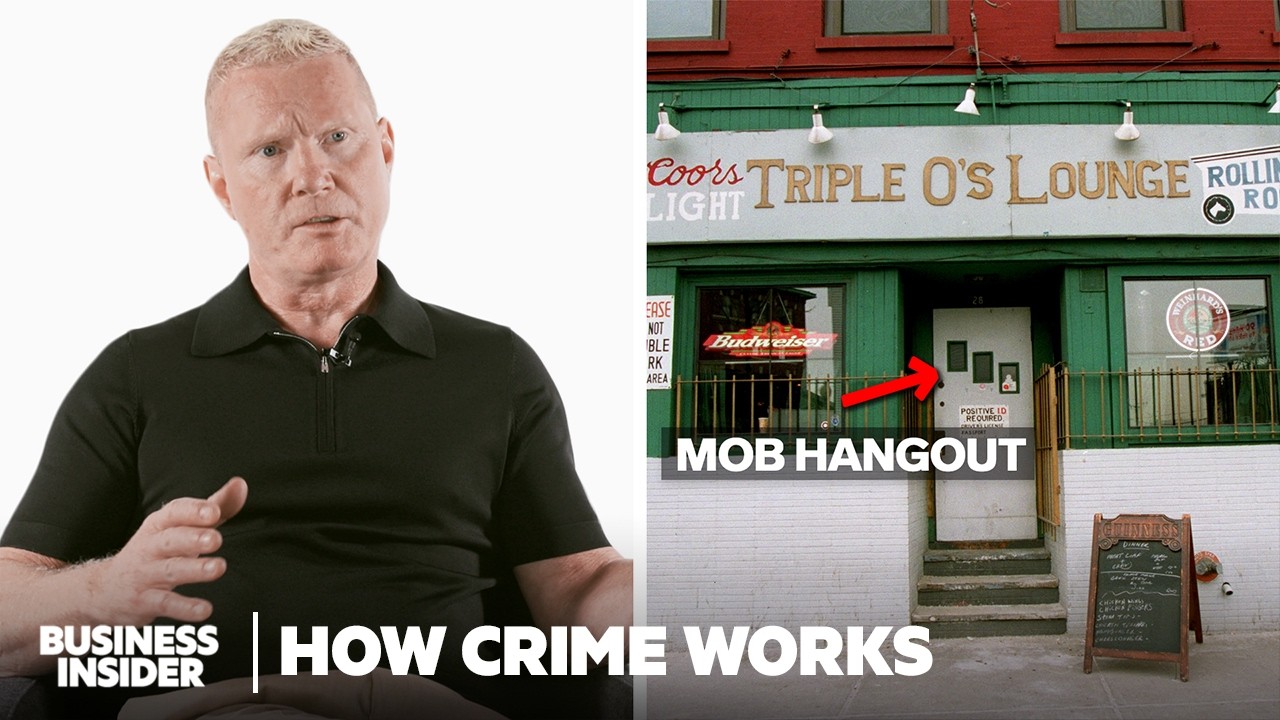
NARRATOR:<i> Through the 1990s,</i> <i> with most of The Commission leadership in prison,</i> <i> New York's mob families scratched and clawed</i> <i> to keep money coming in. </i> <i> They worked in conjunction with one another</i> <i> to bleed money out of the most lucrative targets</i> <i> in New York City. </i> The major mob racket in New York is extorting money from legitimate businesses, and this is commonly called the mob tax.
The '80s and the '90s are the height of this mob tax period. This is really where we see that organized crime has infiltrated almost every industry of labor. Every single element of the garment industry.
There is a profit of about $500 million just from garbage hauling alone. New Yorkers pay about 35% more than fair market value just to get their garbage taken away. A 1-2% tax by the mob, a "tax" on all windows being installed across the city.
You're paying percentages off of every single window in a city that probably has the most windows of anywhere in North America. <i> REPORTER: In addition, it's alleged that the mob</i> <i> greases the wheels of the Fulton Fish Market,</i> <i> controls most of the private trash removal industry,</i> <i> runs hardcore pornography, drug trafficking,</i> <i> and portions of the film industry. </i> <i> It's the consumers who are picking up the tab.
</i> EDWARD: After Donnie Brasco, infiltration of the family became public. It wasn't as if the Bonanno family ceased doing an operation. They continued to control the labor unions, bid rigging and extortion schemes.
And their stature had been diminished in the world of organized crime. As a result, they were not able to participate in some of these large scale schemes that the other four families participated in. Since they got locked out of the more lucrative and the more sophisticated operations, they became involved in other things.
They accelerated their involvement with narcotics. They were sort of pioneers in getting into Wall Street. They do whatever works.
The<i> Post</i> was the perfect example of targets of opportunity. NARRATOR:<i> One of the mafia's most successful ploys</i> <i> was the "no-show job. "</i> <i> The family would muscle control</i> <i> over a union or legitimate business</i> <i> and give high ranking members of the family a job.
</i> <i> A job with a good salary, a job with benefits,</i> <i> a job that they didn't even have to show up for. </i> <i> Richard Cantarella, a captain in the Bonanno family,</i> <i> held one of these union jobs at the</i> New York Post, <i> one of the most circulated daily tabloids in New York City. </i> When I got involved I had a no-show job and nobody was going to say anything because of who I was.
I was a tailman on a truck. That means I didn't do the driving, because if you are the driver, there's no way you could not show up. So I was the tailman, and at the end of the week I took care of the driver.
I did very well, I was getting paid. There's always gambling going on. So if that was going on by somebody in the<i> Post,</i> they'd have to give up a piece of that money, or we're not gonna allow you to do it.
Any gambling, any stealing, any lending of money, we had to get a piece of it. And I always managed to stay on the book someplace. Now I'm on Social Security.
And at that point, I got involved in taking over one of the parking lots in the Marine and Aviation. In New York, parking is a commodity. Parking was big.
Parking lots would be a good opportunity for organized crime, especially back in the '80s and the '90s, because there was less electronic bookkeeping, as it were. But back then it was largely a cash business. Not all of it makes it to the accounting books so that you don't have to pay taxes on all of it, so a lot of it goes right into your pocket.
It's a hard thing to audit when you don't have controls of how many cars are going in and how many cars are going out. RICHARD: From nothing, I wound up with 22 locations. I wound up having a home built.
Parking was very good to me. NARRATOR:<i> Richard Cantarella was bringing in</i> <i> serious money for the Bonanno family. </i> <i>And building a comfortable life for his nuclear family</i> <i> out in Staten Island.
</i> <i> For Richard's son, Paul,</i> <i> the riches that the life provided</i> <i> were too good to pass up. </i> PAUL CANTARELLA: As a kid, they always knew I was Richie's son, and I always got respected. Instead of going to summer camp, I would want to go with my father to Manhattan.
I would go with him to the parking lot and the newsstand. And then from there we would work our way to Mulberry Street. It was all business.
Restaurants, parking lots, you know, big Mercedes, always dressed nice. I just saw the respect on the block, you know, and who doesn't want to be like them? It was the greatest thing you could see.
I just was so loyal to them, and I looked up to them that whatever they wanted me to do I would do. And so, they decided to bring me in. I got made.
Me and Sal became very close. Actually, probably closer my son was to Sal Vitale. He's the one who promoted me to make my son.
He said, "Why don't you put your son's name in? " PAUL: It wound up being in my mother's basement. Joe Massino was there, Sal Vitale, Franky, Lino, my father, and a few guys that were gonna get made.
They pretty much explained that it's a brotherhood. And then they explained a couple of the rules. "You don't pick up your hands to any made guys.
You don't fool around with anybody's wife. That's your father, you know, Joe Massino, now. You know, any problems, you go to him.
" Joe was the real deal. You know who he was and my father always taught me, "You don't ask any questions, you do what he asks, you don't do anything behind his back, and you don't have to worry. " You know, people went missing, and you didn't ask a question.