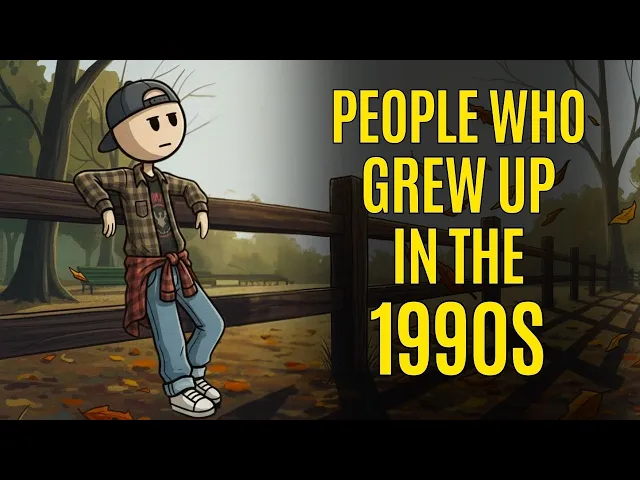
[Music] Have you ever noticed it without being able to explain it? Talking to someone who grew up in the 1990s feels different. Not dramatic, not distant, just calibrated.
They listen without rushing to respond. They do not rush to fill every silence. They are present without performing presence.
There is a steadiness in how they hold a conversation like they're fully there but not trying to prove it. At first, it is easy to mistake this for personality. Maybe they are introverted.
Maybe they are laidback. Maybe they are simply not immersed in online culture. But that explanation does not quite land because this is not about temperament.
It is about timing. People born in the 1990s did not just grow up in a different era. They grew up during a transition the human nervous system had never experienced before.
They learned how to relate to the world before constant stimulation became normal and then had to adapt as everything accelerated around them. So what you're sensing is not detachment and it is not nostalgia. It is regulation.
A nervous system that learned how to be with itself before it learned how to broadcast itself. A way of moving through conversations that does not demand constant feedback in order to feel real. And once you notice that difference, it becomes hard to unsee because it quietly shapes how they relate to silence, to technology, and to other people long after childhood ends.
[Music] People born in the 1990s occupy a psychological position no generation before or after them fully understands. They are not purely analog and they are not truly digital. They grew up in the narrow space between the two.
Their early years were shaped by a world that moved slowly enough to feel solid. Communication required intention. Connection required effort.
Time had wait. If you wanted to see someone, you planned. If you wanted information, you searched for it patiently.
If you missed something, it was simply gone. Then, almost without warning, the ground shifted. Technology did not arrive gradually.
It accelerated. Suddenly, speed became the expectation. Availability became the norm.
Visibility became currency. And this generation had to adapt while their sense of self was still forming. This is what it means to be a bridge generation.
A bridge does not belong fully to either side. It exists to connect what came before with what came after. And psychologically that role is demanding.
People from the 1990s learned how to switch codes constantly. One moment they move comfortably through digital spaces. The next they long for a kind of depth that technology struggles to replicate.
They understand convenience, but they remember cost. They value progress, but they remember what was traded for it. This constant adaptation built flexibility, but it also created tension.
They are fluent in two worlds that operate by different rules. And living in between shapes not only how they use technology, but how they relate to time, relationships, and themselves. To understand them, you have to understand that they were never meant to choose a side.
They were shaped to carry both. For people who grew up in the 1990s, childhood unfolded without a record button. Moments did not come with a pause function.
There was no instant replay, no archive waiting online to be revisited later. If something happened, it lived only once and then it was gone. Saturday morning cartoons could not be rewound.
Family gatherings were not documented from every angle. Embarrassing moments faded instead of being preserved. Joy existed fully in the moment because there was no expectation that it would be captured, shared, or validated.
Afterward, this shaped something subtle but powerful in the nervous system. Presence was not a practice. It was a requirement.
When moments cannot be saved, the mind learns to stay. Attention settles naturally instead of being pulled in multiple directions. Experiences feel complete because there is no part of the brain holding back, thinking about how it will look later or how it will be received by others.
This is not nostalgia. It is psychology. A nervous system that develops without constant external observation learns how to be internally anchored.
It does not need to perform awareness in order to feel real. It does not require proof to trust that an experience matters. Later, when technology introduced endless documentation, this generation already carried a different baseline.
They could use the tools, but their sense of presence did not depend on them. Silence did not feel empty. Moments did not need witnesses.
That early environment trained a quiet kind of attention, one that stays with what is happening instead of splitting itself between the moment and its potential representation. And that difference still echoes today in how they listen, how they remember, and how fully they inhabit the space they are in. For people who grew up in the 1990s, boredom was not something to escape instantly.
It was something you eventually learned to sit with. There was no endless stream of content waiting in your pocket. No algorithm stepping in the moment stimulation dropped.
When boredom appeared, it stayed. And that forced a choice. Remain uncomfortable or create something from the empty space.
This is where imagination entered. Boredom became the doorway to inner activity. You invented games.
You daydreamed. You replayed conversations in your head. You learned how to occupy your own mind without external input.
Over time, this trained something deeper than creativity. It trained emotional self-regulation. When there is nothing to distract you, the nervous system learns how to settle itself.
It learns that discomfort rises, peaks, and fades without needing immediate relief. That skill is rarely named, but it matters. It becomes the foundation for being alone without panic, for waiting without agitation, and for feeling restless without needing to numb it.
Today, boredom is often treated as a problem to solve immediately. But for this generation, boredom was a teacher. It showed them that inner life could be rich enough to hold attention on its own.
This is why many people from the 1990s do not fear quiet the way others do. Silence does not signal emptiness. It signals possibility.
They learned early on that when the outside world goes still, the inside world does not disappear. It wakes up. And that relationship with boredom shaped how they think, how they cope, and how comfortable they are being with themselves without needing constant stimulation to feel alive.
For people who grew up in the 1990s, waiting was built into daily life, not as a lesson, but as a condition. You waited for movies to arrive at the video store. You waited for your favorite song to come on the radio, hoping the disc jockey would not talk over the intro.
You saved allowance money for weeks or months to buy a single compact disc. Desire did not lead directly to fulfillment. Time sat in between.
This repeated experience shaped the nervous system in a quiet but lasting way. Psychologically, delayed gratification is not just about patience. It is about trust.
Trust that what you want can exist without being immediately satisfied. Trust that anticipation does not destroy desire but deepens it. When rewards arrive after effort and time, the brain learns that waiting is survivable and even meaningful.
That lesson carries forward into adulthood. People shaped this way often approach goals differently. They are less likely to demand instant results and more willing to tolerate the middle phase where progress feels slow and invisible.
In relationships, this can show up as emotional patience. They do not rush connection or force intensity. They allow bonds to form gradually without constant reassurance.
This does not mean they care less. It means they are not driven by urgency. In contrast, a culture built around immediiacy trains the nervous system to equate delay with loss.
When everything is available instantly, waiting can feel like rejection or failure. For those raised earlier, waiting never meant absence. It meant process.
This difference explains why many people from the 1990s can sit with uncertainty without collapsing into anxiety. They learned early on that not everything unfolds on demand. Some things ripen, and that emotional patience still shapes how they commit, how they persist, and how they move through life decisions that cannot be rushed, no matter how fast the world becomes.
People born in the 1990s did not just adapt to a changing world. They witnessed the moment it changed. They remember when communication required boundaries.
When you called someone's house and spoke to whoever answered. When being unreachable was normal. When privacy was not a setting you had to manage but a default you lived inside.
Then almost suddenly those rules dissolved. Messages became instant. Availability became expected.
Silence started to feel suspicious. The world did not just move faster. It began to watch itself constantly.
sharing shifted from an option to a quiet obligation. This transition happened while their identity was still forming. They were old enough to remember what was lost, but young enough to be reshaped by what replaced it.
And that created a unique psychological tension. On one side, they carry a memory of slowness, depth, and unobserved moments. On the other, they live inside systems that reward visibility, speed, and constant response.
Moving between these worlds requires ongoing adjustment, often without language to explain the strain. This is why many people from the 1990s feel a subtle unease with modern exposure. Not because they reject technology, but because they remember a time when life did not need an audience to feel complete.
They understand the convenience of connection, but they also feel the cost. They are not resisting change. They are holding the memory of another way of being.
One where attention was not divided and presence did not require performance. And carrying both realities at once shapes how they engage with the world even now, long after the shift has become invisible to everyone else. One of the most misunderstood traits of people born in the 1990s is their relationship with silence.
From the outside, it can look like distance, a pause before responding, a comfort with gaps in conversation, a lack of urgency to fill every moment with words. But this is not emotional absence. It is emotional fluency.
This generation learned silence before they learned constant stimulation. Silence was not something to fix. It was simply part of being together.
You could sit in the same room without speaking and still feel connected. That early experience trained the nervous system to stay regulated without continuous input. At the same time, they became fluent in digital communication.
They know how to move through screens, platforms, and virtual spaces with ease. They understand the language of messages, timing and tone. They are not technologically behind.
They are bilingual. This creates a psychological duality. They can switch between presence and performance, between depth and speed.
They know when to engage and when to step back. And because of that, their quiet often carries intention. They do not confuse constant communication with closeness.
They understand that connection does not disappear when words pause. It simply changes form. For many people, silence triggers anxiety.
It feels like rejection or loss. For those shaped earlier, silence is neutral. Sometimes it is even grounding.
This ability to move comfortably between silence and screens is not indifference. It is a nervous system that learned how to stay steady both offline and online without losing its center. And that balance is rare in a world that rarely slows down.
Adaptability is often praised as a strength. And for people born in the 1990s, it truly is. They learned how to adjust, translate, and recalibrate as the world around them changed speed and structure.
But adaptability has a cost that is rarely acknowledged. When you grow up learning to handle things on your own, you also learn to minimize your needs. You become skilled at self-regulation but less practiced at asking for help.
You absorb discomfort quietly instead of signaling it outward. Over time, this creates a pattern where resilience is visible, but strain remains hidden. Many people from this generation are mistaken for being emotionally self-sufficient, calm, lowmaintenance, unbothered.
But that perception often overlooks how much they carry internally. Because they adapted early, they rarely announce when something is heavy. They simply adjust.
Again, there is also the cost of living between worlds. Being fluent in two psychological environments can mean fully belonging to neither. They understand the pace of modern life yet feel subtly out of rhythm with it.
They remember depth but operate in systems that reward speed. This creates a quiet sense of displacement that is difficult to explain. They are not disconnected.
They are managing complexity. The hidden cost of adaptability is that it can delay recognition. Others see competence and assume ease.
But inside there is often fatigue from constantly recalibrating to environments that do not pause. Understanding this cost is not about removing strength. It is about finally naming what that strength required and what it continues to ask of them every day.
Many people born in the 1990s share a quiet unsettling feeling. It is not burnout. It is not pessimism.
It is a sense of having lived through more than their age seems to justify. They often feel older than they are. This is not because they grew up too fast.
It is because they witnessed something most generations do not. They watched a world disappear while they were still learning how to belong in it. They remember a time when life moved at a human pace.
when attention was not constantly fragmented. When social rules were slower, clearer, and less demanding, and then within a single lifetime, those rules dissolved. Speed replaced rhythm.
Exposure replaced privacy. Constant adaptation replaced stability. That kind of transition leaves a psychological imprint.
When you carry memory of a world that no longer exists, you develop a form of emotional gravity, not sadness exactly, more like weight, a sense that something meaningful was lost, even if something useful was gained. This creates maturity without cynicism, awareness without bitterness. People shaped this way often appear grounded but tired, thoughtful but reserved.
They are not disillusioned with life. They are simply aware of how fragile systems can be because they have seen one vanish. This awareness ages the nervous system faster than the calendar does.
They do not chase every new trend, not out of resistance, but discernment. They know how quickly the new becomes normal and how quietly the normal disappears. Feeling older than your age is not a flaw.
It is the mark of having lived through transition with your eyes open. And that kind of experience changes how you move through the world slowly, carefully, and with a depth that cannot be rushed. [Music] This is not a story about one generation being better than another.
It is a story about timing. People born in the 1990s are not slower than the world around them. The world simply learned how to move faster.
They are not distant or disengaged. They learned regulation before stimulation became constant. What shaped them was not superiority or resistance to change.
It was exposure to contrast. They experienced life before constant visibility and then adapted when visibility became the norm. That timing left a psychological imprint that still shows up in how they relate to silence, attention, patience, and connection.
Understanding this is not about nostalgia. It is about self-recognition. If you see yourself in this, there is nothing you need to fix.
You are not behind. You are not out of place. You carry a rhythm that formed in a different environment and it still serves you even if it does not always match the pace around you.
And if you did not grow up this way, understanding it can deepen empathy. Because what looks like distance is often balance. What looks like slowness is often steadiness.
If this video helped you recognize yourself or someone you care about, you're not alone here. This channel is a space for understanding the quieter psychological patterns that shape how we think, connect, and move through the world. If you found this meaningful, consider subscribing so you do not miss future conversations.
And if any part of this resonated with you, share your thoughts or experiences in the comments below. Your perspective may help someone else feel seen. Thank you for watching.