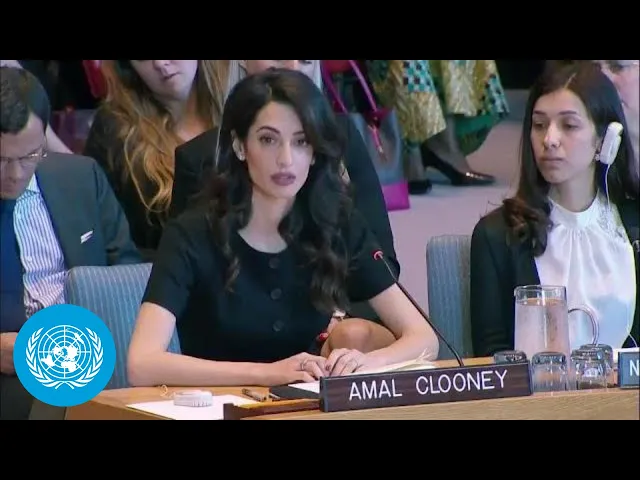
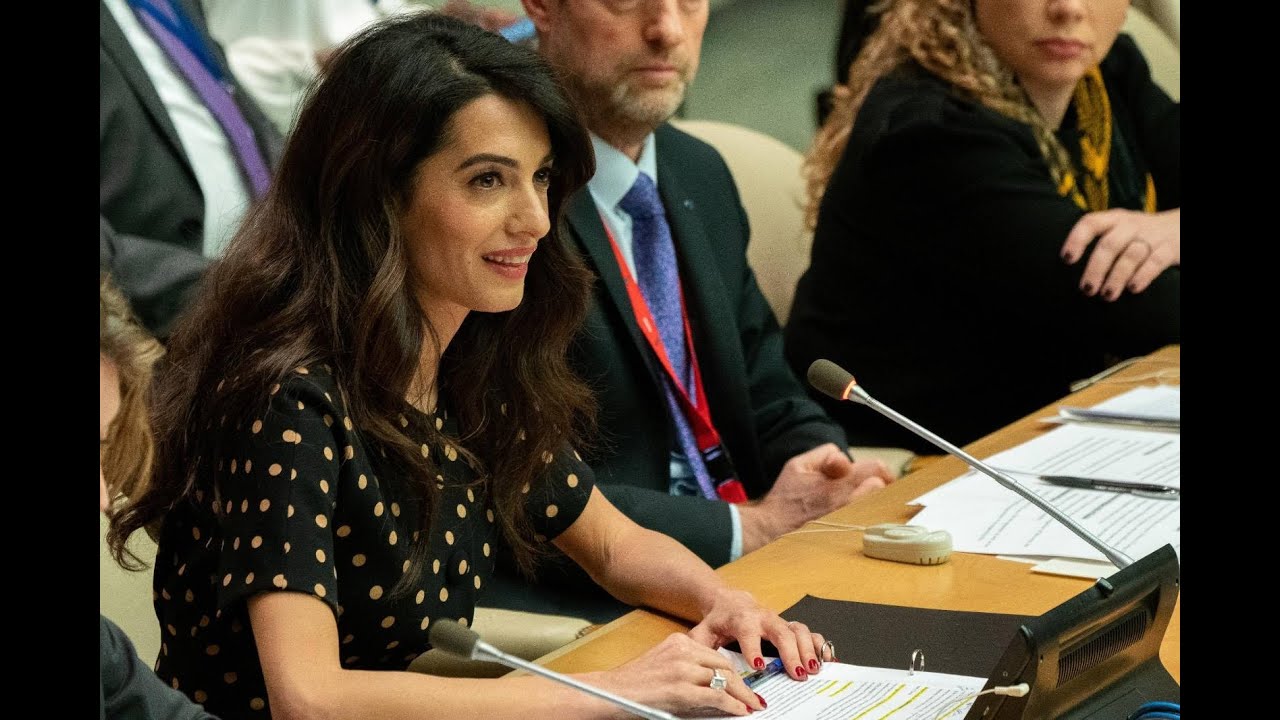
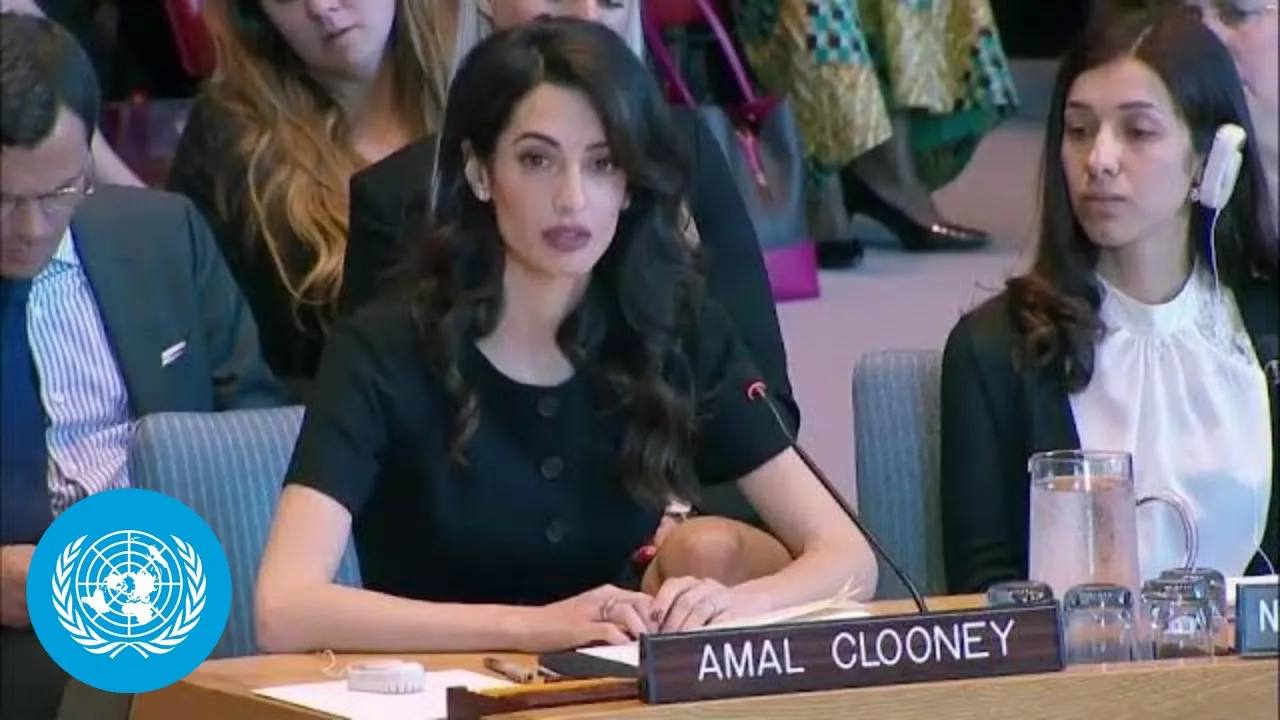
Excellencies, ladies, and gentlemen, I would like to thank the German government for inviting me to address the Security Council today on the topic of accountability for sexual violence in conflict. It is an honor to be included among such a distinguished panel of speakers. In preparing to deliver these remarks alongside Nadia, my client, my friend, and somebody I greatly admire, I thought back to a conversation we had when we first met.
Nadia told me of her suffering at the hands of 12 different ISIS men who enslaved and brutalized her. She recounted the murder of her mother and brothers. She showed me threatening messages that she had received from ISIS on her phone.
And as she did this, it occurred to me that she never expressed fear for her life, for her safety. Instead, that day and ever since, she has spoken of only one fear that when this is all over, the ISIS men will just shave off their beards and go back to their normal lives that there will be no justice. I am legal counsel to Nadia and to other Yazidi women and girls who were kidnapped, bought, sold, and slaved, and raped by ISIS.
And my brief is the pursuit of justice. But it was clear from an early stage that this was going to be a challenge. The world's powers were focused on a military solution and nobody wished to speak about justice.
So, we fixed on one imperative. We could not allow the evidence to disappear. So, Nadia and I came here to the United Nations and we asked you the Security Council for help.
We asked that you send a team of investigators to Iraq to gather evidence of ISIS' crimes so that one day trials would be possible and justice would be within reach. After many months of advocacy, with strong leadership from the United Kingdom and support from Iraq and the United States, Nadia and I sat together in this chamber and watched 15 hands go up and resolution 2379 come into force. We welcomed the appointment of an eminent lawyer Kareem Khan to lead the investigation team.
And we celebrated the moment four weeks ago, when the team, working alongside the Iraqi authorities, began to exhume mass graves and identify the victims’ remains. This first step in any criminal inquiry was a cathartic moment for many as Yazidi families. And we are encouraged to hear that the investigation in Iraq is now fully underway.
We have also seen milestones in national courts around the world. In the United States, I represent Yazidi women and girls who were held in the house of an ISIS member named Umm Sayyaf along with one of the few non-Yazidi victims of ISIS' sexual violence that we know of. An American hostage named Kayla Mueller who was held in brutal conditions for over 18 months and raped repeatedly by the head of ISIS, Abu Bakr al-Baghdadi.
Umm Sayyaf showed no solidarity with her fellow females. She locked them in a room, instigated their beatings, and put makeup on them to "prepare" them for rape. I am requesting her transfer to the U.
S. to face justice for those crimes. In France, I represent Yazidi victims in a case against Lafarge, a company that made multi-million dollar payments to ISIS and is the first multinational to be charged with complicity in crimes against humanity committed by the group.
In Germany, I represent a Yazidi victim in a case in which the German Supreme Court confirmed that the charges against an ISIS commander responsible for sexual slavery amount to genocide, the first judicial recognition of this fact anywhere in the world. And two weeks ago, I was in Munich where the first trial against an ISIS member for international crimes committed against a Yazidi victim has now begun. In that case, I represent the mother of a five-year-old Yazidi child who was enslaved, chained outdoors to a window, and left to slowly die of thirst in the scorching heat.
The ISIS member who allowed it to happen now faces charges of murder as a war crime. These are important milestones. And I would like to convey special thanks to the German prosecutors I have worked closely with over the last few years for their determination and professionalism in bringing these cases to trial.
But let me be very clear, this does not come close to the level of justice the survivors wish for or the scale of the international response that they deserve. Excellencies, ladies, and gentlemen, let us remember that the crimes committed by ISIS against women and girls are unlike anything we have witnessed in modern times. ISIS controlled territory, the size of the United Kingdom, and ruled over 8 million people.
More than 40,000 foreign fighters from 110 countries are estimated to have joined ISIS' ranks in Iraq and Syria. But the question of bringing them to justice has barely raised a whisper. And yet, if we don't act now, it will be too late.
Thousands of perpetrators, including some of the most high-ranking, are held by coalition-backed SDF forces in Syria. Those forces say that they "lacked logistical support to hold them for a long time. " And president Trump has warned that if Europe does not find a way to put foreign fighters on trial, the U.
S. will be "forced to release them. " Thousands more ISIS members are detained in Iraq.
But there trials that the UN says are lacking due process proceed on a single terrorism charge without witnesses and move swiftly to executions. None of these trials stand as a measure of justice for the Yazidis. They do not provide victims an opportunity to look their abuses in the eye and tell the world what ISIS has done.
The charges do not include sexual violence and crimes like genocide are not even on the books. This has to change. And there is now a unique opportunity for international accountability because thousands of ISIS militants are in custody, a UN team is collecting evidence, and survivors are waiting to testify, but also because people in the region are calling for international trials.
In Syria, as the SDF has called for "a special international tribunal to prosecute foreign fighters. " And in Iraq, the Kurdish regional government has made a similar plea. Meanwhile, this council has itself made clear that the genocide pursued by ISIS through murder and through rape represents a threat to international peace and security.
And when you reached a similar conclusion about such crimes in Rwanda and Bosnia, you established tribunals to put the perpetrators on trial. But if Baghdadi is arrested today, where will he go? Here are four options for you to consider.
First, this council can refer the situation to the International Criminal Court as many as 80 survivors have called for. Unfortunately, this seems increasingly unlikely. The United States government has recently said through its National Security Advisor John Bolton and its Secretary of State Mike Pompeo that the ICC is "dead to us" and that those who support certain ICC investigations can be denied entry to the U.
S. , have their assets frozen, and may even face arrest. A similarly devastating blow to the ICC has been delivered by another permanent member of this council.
A senior Russian official told this chamber last month that Russia would never refer another situation to the ICC nor would it ever "help our colleagues and the Security Council to create any more of such tribunals. " He added for good measure that maybe the whole "experiment" with international justice should never even have been started at all. Survivors of sexual violence can only hope that the council will find a way through this impasse.
But there are other ways that justice can be done. The second option is that like-minded states that do believe in justice could set up a court by treaty. This could be done by states that are members of the global coalition many of whom are represented here today.
After all, if 79 states can come together to fight ISIS on the battlefield, why can they not establish a court either in The Hague or somewhere in the region. The global coalition has stated that its mission is to "ensure the enduring defeat of ISIS. " But this is not possible without justice.
As members of the coalition have themselves acknowledged, a military defeat is not on its own an enduring one because until we kill the idea behind ISIS, it will simply regroup under a new umbrella. Third, if this council does not act and the global coalition does not act, the European Union can. The EU recently helped to establish a special court in The Hague to deal with international crimes committed in Kosovo.
This court had the support of all EU countries as well as the United States, Canada, Norway, Turkey, and Switzerland. And its cases are handled by international prosecutors and judges. With Iraqi support, the EU and like-minded states could do the same for ISIS' crimes or the EU could expand the mandate of the European Public Prosecutor's Office to cover international crimes and set up a new EU court with jurisdiction over them.
Fourth, Iraq could enter into a treaty with the United Nations to set up a hybrid court as was done for Sierra Leone and Cambodia to prosecute those responsible for international crimes. Excellencies, Mr President, none of these solutions comes without complication or cost. And none would replace the need to have credible trials in national courts alongside any international ones.
But the resolution you are considering today notes the prevalence of sexual violence in wars all over the world and states that you are "deeply concerned over the slow progress in eliminating sexual violence in conflict. " I agree that we are facing an epidemic of sexual violence and I believe that justice is the antidote. So, it is my respectful submission to you today that although this draft resolution is a welcome step forward, especially insofar as it strengthens the sanctions regime for those who commit sexual violence.
We must go further because if this august body cannot prevent sexual violence in war, then it must at least punish it. As the parents of Kayla Mueller and other American ISIS hostages have put it, when crimes like these are made public in an open court, victims like us can be heard and begin to heal and we can hope that justice will put an end to such crimes against humanity. So, instead of abandoning international justice, we must stand up for it because justice is not inevitable, it doesn't just happen, and it doesn't stand a chance if people in power, including those at this table, don't make it a priority.
After World War II, the victorious nations —the UK, France, Russia, and the U. S. — ask themselves the same question about the Nazis that we are asking now about ISIS.
When it comes to war, should we really care about justice? British Foreign Secretary Anthony Eden took the view that "the guilt of the Nazis is so black that they fall outside any judicial process. " Others thought that show trials or mass executions would be the better response.
But the United States under presidents Roosevelt and Truman pushed for trials because the U. S. said it was important to create a record of the Nazi system of terrorism.
And the American prosecutor who opened the trial said he did so because "the wrongs which we seek to condemn and punish have been so calculated, so malignant, and so devastating that civilization cannot tolerate their being ignored because it cannot survive their being repeated. " Excellencies, ladies, and gentlemen, this is your Nuremberg moment— your chance to stand on the right side of history. You owe it to Nadia and to the thousands of women and girls who must watch ISIS members shave off their beards and go back to their normal lives while they the victims never can.
Nadia has been given many honors since she decided to bravely speak out about the horrors she and her people have suffered. She has received titles, awards, words of thanks, promises of assistance. But she would trade her Nobel Peace Prize in a heartbeat for the chance to get what she really wants— the chance to face in a court of law those who murdered her mother and her brothers and those who brutally and repeatedly raped her.
It is time to make justice your priority so that history can record what happened so that we can stop it from happening again and to truly honor survivors like Nadia who have already suffered too much. Thank you.