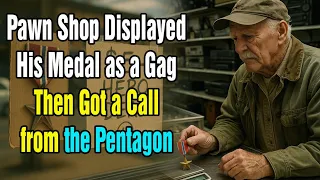
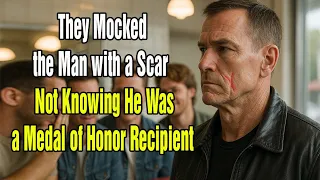
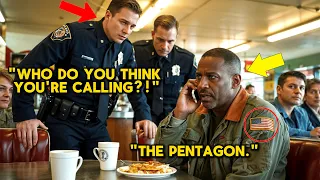
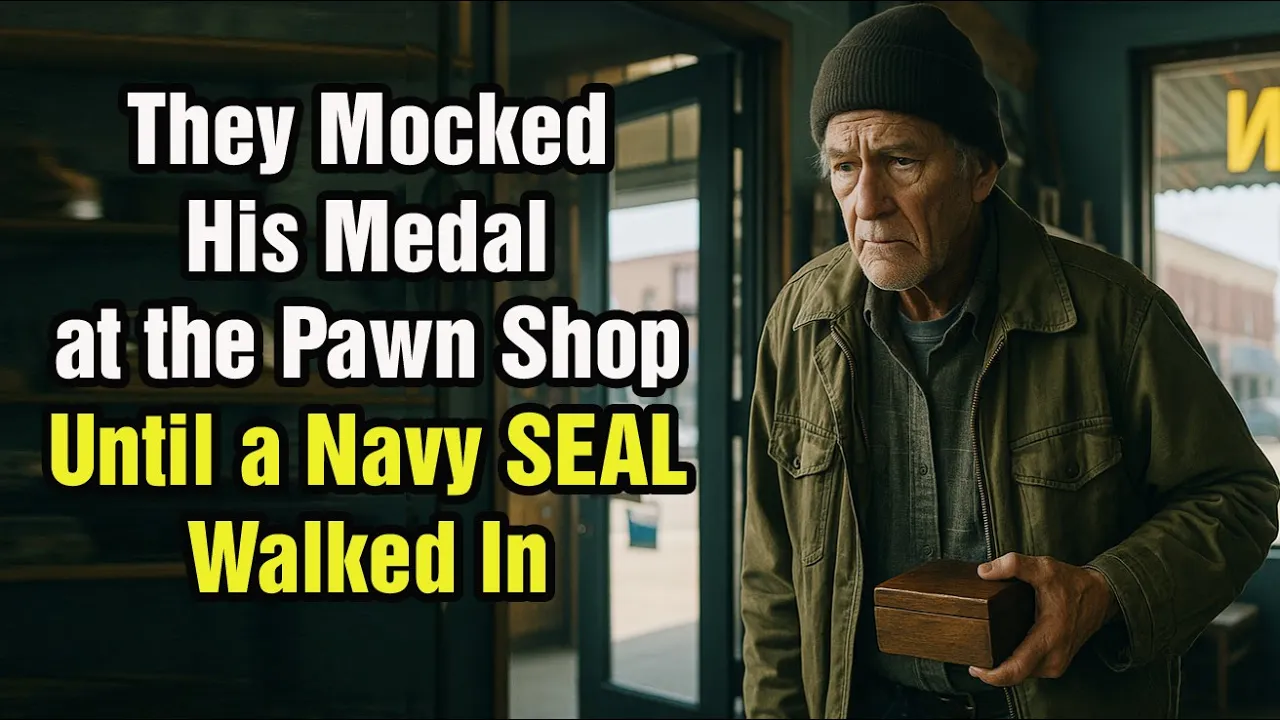
He didn't come to beg. He didn't even ask for money. He just walked into the pawn shop quietly.
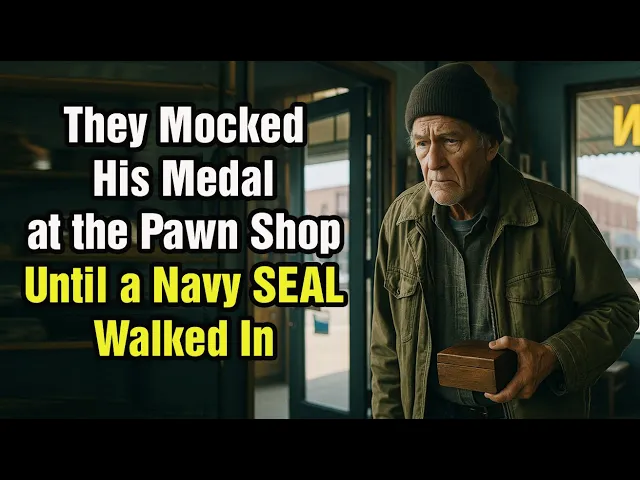
Placed a small wooden box on the glass counter and opened it slowly. Inside was a metal silver scratched and engraved with a name no one in the room recognized. The clerk barely looked up.
"Whatever it is, it's probably fake," he scoffed. A customer in the back laughed out loud. "Is that your grandpa's toy?
" And yet the old man didn't flinch. He simply said, "I just wanted to know if it still meant something. " They mocked him.
They mocked the medal. But then the door opened and a Navy Seal stepped inside. Welcome to Endless Stories, where forgotten honor finds its voice again.
If you believe true respect doesn't fade with time and some medals carry more than metal, stay with us and help us keep these stories alive. He didn't walk in with swagger. He didn't limp like some old Hollywood war cliche.
He moved quietly like a man who'd spent most of his life walking into places where no one really wanted him to be. The pawn shop wasn't busy. A single fluorescent bulb flickered above the counter, casting a jittery light over shelves of forgotten electronics, rusting tools, and scratched guitars that hadn't been tuned in years.
The air smelled of dust and disinterest. Behind the counter sat a kid no older than 23. hoodie, wireless earbuds, and the kind of look on his face that said he'd already decided this shift wasn't worth the trouble.
The old man paused by the entrance, hand resting on the flap of his coat. He looked around the room like someone who'd seen too much and still couldn't find anything new. Then, without a word, he approached the counter.
His boots, cracked leather, clean but worn, made almost no sound on the tile. He reached into the inside of his coat and pulled out a wooden box. It was small but heavy, the kind that holds weight even before it's opened.
The surface was scratched, but the hinges had been oiled. The box had been carried a long time and cared for in the way only soldiers and fathers care for things they can't explain. He set it gently on the glass, then opened it.
The clerk didn't even look up at first, still scrolling his phone, chewing gum like time owed him something. "You selling? " he asked, bored.
No answer. The clerk glanced up, annoyed, then paused, his brows furrowed, not in recognition, but confusion. He leaned forward.
Inside the box lay a silver star metal. The ribbon was faded into dull reds and muted blues. The edges were chipped.
On the back was an engraving, still sharp despite the years. SJ Everett, 1972. The kid tilted his head.
"Is it real? " he asked, squinting. "I mean, it kind of looks old.
Where'd you get it? " The man's eyes didn't move from the metal. "It was given to me," he said quietly.
"For what? " The kid chuckled, not cruel, just ignorant. "Winning a potato sack race in boot camp?
" A breath passed. The man looked up slowly, steadily for pulling two boys out of a fire I didn't start, he said. The clerk blinked uncomfortable now and tried to recover.
Look, I don't know what you're trying to do here. We don't buy this kind of stuff. You might get something online.
There's collectors for that kind of military stuff. There was no anger in the old man's face. No shame either.
Just a quiet that made the humming of the overhead lights sound like thunder. I'm not here to sell it, he said finally. The kid blinked.
Then why are you here? To see if anyone still knew what it meant, he replied. The kid stared, then shrugged.
It's just metal, man. And with that, the room shifted. Not in temperature, not in noise, but in weight.
Because sometimes the heaviest things in the room aren't the loudest. They are the ones that stay still, waiting to see if anyone remembers how they got there. The man reached out, closed the box with both hands, like sealing a grave, and stood to leave.
The bell above the door hadn't even stopped swinging from his arrival. When it rang again, but this time, it didn't announce someone ordinary. This time, someone had heard.
and he wasn't laughing. The door hadn't even closed behind the old man when it happened. A sharp laugh cracked from the back of the pawn shop.
Too loud, too sudden, too deliberate. It came from a man leaning on a dusty electric guitar, wearing a leather jacket and mirrored sunglasses. The kind of guy who hadn't outgrown high school even though high school outgrew him years ago.
"You trying to pawn that thing? " he scoffed, nodding toward the box still in the old man's hands. What's next?
You selling purple hearts for gas money? Another laugh joined in thinner higher from a teenager seated near a stack of old video game consoles. He didn't even look up, just muttered.
Bet he bought it off eBay and made up the story. The clerk chuckled trying to play it cool. Told you, man.
Everyone's a hero when they're broke. The old man didn't move, didn't blink, but something shifted. Not in the air, in him.
Because it wasn't just the words. It was the way they said them. The casual cruelty, the empty bravado, the disrespect served not like an attack, but like entertainment.
He'd heard laughter like that before. Once overseas in a bar outside base when someone called his unit a bunch of wannabe John Waynees. Once at a memorial when a reporter whispered during a moment of silence.
And once, worst of all, at a funeral. Caleb's funeral. When a kid too rose back, chuckled at the wrong time and someone let it slide.
But here in a pawn shop about this, he almost left. Almost. His hand was already on the box.
He could have walked out without saying a word, gone home, locked it back in the drawer, and told himself the world just didn't understand. But instead, he stayed. He stayed because walking away would have been the easy thing.
And after everything he'd done, everything he'd survived, Ezy had never meant right. So he stood there holding that box like it was the last piece of someone else's courage and waited. And just then, the bell above the door rang again.
The laughter stopped because someone else had entered and he wasn't smiling. The bell above the door didn't sound different, but the room knew it had to pay attention. Something about the air shifted the moment he stepped inside.
not louder, not colder, just stiller, as if the walls themselves recognized a presence that didn't come in often. He didn't speak. He didn't scan the room for trouble.
He didn't have to. Trouble usually saw men like him, and moved out of the way. His boots were clean, but worn the way a working man keeps them, used, but respected.
His shirt tucked sharp, dark navy, with a small gold trident resting just above his heart. No name tag, no words, just a quiet symbol of something earned the hard way. He walked straight to the counter, not glancing at the clerk, not even acknowledging the others, because whatever brought him here wasn't curiosity or accident.
It was something he'd felt before in other rooms, in other places, when honor was being trampled under jokes and ignorance. His eyes fell on the box the old man still held, and for a brief moment, nothing else in the pawn shop existed. He reached down slowly like the object was sacred, like it might burn him or break if he moved too fast.
He picked up the metal, turned it once in his hand, and read the name engraved on the back without saying it out loud. Then he stood straight. No flare, no drama, just a silent movement that froze the room like cold steel through warm water.
And then he saluted. Not for the people watching. Not to make a point, but because someone had to.
The kind of salute that isn't about the person in front of you, but for the ones who never came home. For the names carved in walls. For the faces you only see in dreams.
For the promises you whispered into radios and carried in silence for the rest of your life. The clerk didn't breathe. The guy with the guitar didn't blink.
Even the fluorescent hum above them dimmed for a second. Or maybe that was just how it felt, like time had stepped back and told them to listen. He lowered the metal, turned to the old man, and nodded.
Not in apology, not in pity, but in quiet understanding between soldiers who didn't need to speak to be heard. No one said a word. They didn't need to.
The silence was louder than anything they could have spoken. And that silence finally belonged to someone who deserved it. He didn't need to raise his voice.
The way he stood, the way he held the metal, the way his silence cut through the room was enough to make every shallow laugh, every careless word, every smirk that had lingered just moments ago feel like ash in the air. The man behind the counter tried to look busy again, fingers fidgeting with a receipt roll that didn't need changing. His mouth half open as if thinking about a joke, but none came.
The guy in the leather jacket shifted his weight, crossed his arms, then uncrossed them, pretending to check the guitar's strings as if that would undo what had already happened. But they weren't the ones being looked at. Not really.
The Navy Seal had his eyes on the metal, then on the man who brought it in, and finally, calmly, without anger or performance, he turned toward the clerk and said the first words anyone had spoken since the salute. This medal represents more than metal. It's not about how much it's worth in your register.
It's about what it cost the man who earned it and what it saved when it was pinned to his chest. He didn't need to say more, but he did. Not out of rage, but out of duty.
I was there. Different war, different sand, same silence when the shooting stopped. Men like him don't ask to be remembered.
They just remember everyone else. The clerk opened his mouth to respond. Maybe to apologize, maybe to save face.
But he stopped himself because what do you really say to a man who knows the weight of blood? Who can hold a metal like it's a folded flag and speak like he's carrying 20 names in his chest? The seal turned back to the old man, handed him the medal with both hands, not ceremonially, not stiff, but with respect, with quiet hands that had seen war and still knew how to be gentle.
And then looking around the room just once, eyes sharp and still, he said one sentence, calm, low, final. You don't get to mock what you never had the courage to earn. Then he stepped back, gave one last nod to the man who had come in.
Not for money, not for praise, just to see if the world still remembered, and without waiting for permission, he turned and walked out. The bell above the door rang again, softer this time. But what remained in the room wasn't just silence.
It was shame and maybe if they were lucky, a sliver of understanding. The door closed behind him with the same jingle as before. But now even that sound felt changed, softer, as if it too understood it wasn't welcome to speak loudly in a room that had just been taught something sacred.
No one moved. Not right away. The old man stood there, metal back in hand, eyes fixed on nothing and everything at once, like he was halfway between memory and now.
The guy with the guitar finally set it down, careful this time, as if even wood and string deserved respect under the weight of what just happened. He didn't say anything. He didn't need to.
The silence had already done the speaking for him. The clerk cleared his throat, a weak sound that disappeared before it landed. And for the first time in what may have been years, he looked someone in the eye, not as a cashier, not as a kid behind a counter, but as a man who' just been reminded that some things can't be scanned, priced, or pawned.
"Sir," he said. But the word hung there empty. He didn't finish the sentence.
He just stepped aside. The old man didn't gloat. He didn't say a word.
He simply closed the box. the metal resting like it had always known its place wasn't behind glass and tucked it under his arm with the quiet care of someone folding a flag at the end of a long day. He turned toward the door slowly, not because he was old, but because he was letting the moment settle, giving the silence time to linger before the world forgot again.
But the world didn't forget this time. Because when he reached the door, he noticed something strange. No one behind him was looking at their phones.
No one was scrolling, laughing, moving on. They were still. They were watching him.
And they weren't watching out of curiosity. They were watching because something in them had shifted, too. Something they didn't have words for yet, but they felt it deep.
The way you feel cold air after a fire has gone out. He didn't nod, didn't wave, just opened the door, stepped back into the daylight, and walked away like he always had. Quiet, steady, with nothing to prove and everything still worth carrying.
And for the first time in that shop's forgettable little history, not a single soul dared to laugh. He didn't tell the story to strangers, never wore the medal in public, never marched in parades, or gave speeches on Memorial Day. Not because he didn't care, but because he cared too much to turn something sacred into decoration.
The silver star sat in that box for decades. Not on a shelf, but close to his chest. Kept in the inside pocket of an old coat he rarely wore unless the weather or the weight of memory called for it.
Most people who knew him just thought he was quiet, a little distant, maybe lonely, but they never asked why, and he never offered it. Because it wasn't just a medal, it was a day. It was a name.
It was a night no one came back from the same. He had been 24, two weeks from coming home. When the call came in, bad coordinates, bad timing, bad luck.
But orders were orders, and they moved in under black sky and dead radio silence. The hill wasn't supposed to be occupied. Intel said it was clear.
Intel was wrong. The first shot hit Johnson in the shoulder before they even got halfway up. And by the time they reached cover, Simmons was down and bleeding out, calling for his mother in a voice too soft to echo.
He could have stayed behind cover. He could have waited for air support, but they didn't have that kind of time. He ran, not because he was brave, not because of training, but because someone had to move first, and he couldn't bear the thought of hearing another boy die with his name on no one's lips.
He dragged them out one at a time, limbs torn, blood soaking through his uniform, bullets snapping past his ears like dry twigs breaking in the wind. He didn't remember screaming, didn't remember crying, only remembered the way Simmons gripped his hand with what little strength he had left and whispered, "You brought me home. " He was still holding that hand when the medics arrived.
Still kneeling when the sun came up. Still shaking when they pinned the medal to his chest 3 weeks later in a quiet ceremony he didn't invite anyone to because the ones he would have wanted there weren't. So the medal stayed in the box not because he was ashamed but because it was never about him.
It was about two names he still whispered every November. It was about nights that still came with echoes. And it was about remembering what courage looked like when no one else saw it and what it cost when they did.
It wasn't written on a wall. It wasn't etched into a monument or printed in a folded program handed out at a town memorial. But every November, without fail, he said the name.
Quietly, just once, the same name, the same breath in the same place. No audience, no flag waving, just him, a coffee he never finished, and a bench that had long since stopped asking questions. Some years it rained, some years it snowed, but he always went, not because he was obligated, not because someone told him to, but because promises made in blood don't fade just because the world forgets to ask about them.
He never said the name out loud to anyone else. Not even in those years when the pain turned sharp and he thought maybe speaking it might ease something in his chest. Didn't because the name wasn't just a person.
It was a moment, a final breath. A kid from Arizona with too much energy and too many dreams who once carved their initials into the butt of his rifle and joked about becoming a country singer if he made it out. The last thing Caleb ever said was, "Tell my dad I wasn't scared.
" He hadn't been. He died with his eyes open, looking not at the sky, not at the blood, but at the man pulling him out. So every year on the day the letter was dated, the one that started with, "We regret to inform you.
" And ended with a name typed in someone else's handwriting, he walked to that bench, sat down, and whispered Caleb. That was it. Just the name.
No speech, no stories, no medals worn. Because in some corners of the heart, a single name carries everything. The noise, the silence, the weight of survival, and the guilt of being the one who still gets to remember.
He noticed the boy before he heard him. A small figure hovering near the far end of the park, backpack slung too low, camera around his neck, sneakers untied. Not the kind of kid who usually wandered into a place like this, and definitely not on a cold November morning.
The old man figured he'd pass by like the rest. Glance at the bench, maybe snap a photo of the fog rising off the grass, and keep walking, earbuds in, world tuned out. But he didn't.
He stopped about 10 ft away. Looked, really looked, not at the flag resting on the old man's lap or the coffee cuping by his side. He looked at the silence itself, like he could see something their others had missed.
The old man didn't speak. Neither did the boy. Instead, he stepped forward, not fast, not slow, and sat down on the opposite end of the bench, legs swinging gently, camera still hanging from his neck.
He didn't take a picture, didn't fidget, just sat there quietly, as if he understood that some spaces aren't meant to be filled with noise. A few minutes passed, then a few more. Still no words.
Finally, the boy spoke, not looking at him, but at the sky. My brother was supposed to come home last year. The man didn't respond, not because he didn't care, but because he knew what that sentence really meant.
The boy reached into his backpack and pulled out a notebook. Not a school one, a leatherbound journal, the kind you don't write homework in. He flipped it open, thumbmed through sketches and lists and photos tucked between pages until he landed on one small square.
torn from a letter. It read, "Keep doing what matters, even if no one claps. " He handed it to the old man without explanation.
The man took it, read it once, then folded it neatly, and tucked it into the pocket behind his medal. A space usually left for names he never said out loud. "You know his name?
" the old man asked finally. "Yeah," the boy said. "I say it every day.
" They didn't speak after that. They didn't have to because sometimes grief doesn't need to be explained. Sometimes it just needs a place to sit.
And on that quiet bench, for the first time in a long time, remembrance didn't feel so lonely anymore. It started with a photo. The boy hadn't meant to take it.
Not really. He just looked down at the bench after they sat in silence. seen the way the morning light caught the wrinkles in the old man's hand, the edges of the folded flag, and something told him it mattered.
He posted it that night. No capsin, just one word. Still, by morning, it had been shared dozens of times, then hundreds, then more.
People didn't comment with fire emojis or empty hashtags. They shared their own names, dates, letters never sent. They wrote about grandfathers they never got to meet.
Brothers who left and didn't return. Metals found in attic boxes and never understood until now. And that's when the town, the same one that had walked past him for over a decade.
The same one that never asked why he sat there every November, finally paused. The first to show up was the librarian. She brought a stool and placed it gently beside the bench.
Didn't say a word. just sat with a book on her lap and a small candle in her hand. Next came the mailman, still in uniform, setting down a sealed envelope with thank you, written in pencil across the front.
Then the coffee guy, then the pastor, then the kid who used to skip school but never missed a beatbox competition, standing with both hands in his jacket pockets, staring at the flag like he just realized it wasn't a prop from some movie. It was real. It had weight.
And so did the man who carried it. By noon, the grass surrounding the bench was filled. Not loud, not performative, just present.
Some stood, some sat, a few cried, and no one was filming. The mayor arrived last, not with a speech, not with a camera crew, but with her father's dog tag around her neck. She didn't approach the old man.
She simply walked behind the bench, placed a small wooden plaque into the ground, and whispered, "This spot matters. " The old man didn't say anything, but his hands stopped trembling. Because for the first time in years, he didn't have to carry the silence alone.
And sometimes that's all remembrance ever asks for. Not applause, not attention, just someone else willing to hold part of the weight for a while. He didn't come back the next year.
The bench was still there, the flag still folded, the town still remembered. But the man who had once sat so, so steady, had finally found a place where he no longer had to carry the silence for anyone else. He passed quietly without ceremony, just the way he lived.
No noise, no spotlight, just a folded letter on the kitchen table and a coat still hanging by the door. But he left something behind. The boy was the first to return on the morning of November 6th.
He carried the flag now, not in a box, not on his shoulder, but held gently in both arms, the way you carry something that once held someone else's whole life. He placed it on the bench, sat beside it, and waited. One by one, they came, not because they got a notification, not because it was a trending topic, but because some people still believe in showing up when it matters.
The barista brought two cups this time, one black, one with cream. The mayor arrived early, this time without the badge, just the dog tag and her silence. Even the pawn shop kid showed up, standing in the back, not saying a word, but not looking away either.
When the sun reached its highest point, the boy stood. He unfolded the flag once, then again, and one more time until it was stretched wide, full visible. Then with slow, deliberate hands, he folded it back.
Sharp corners, crisp lines, just as he'd been taught by the man who used to carry it. He didn't cry, didn't speak. But when he placed the final fold over his heart, every person in the crowd raised a hand.
Not to wave, not to record, but to salute. Not just the flag, not just the man, but the promise that he wouldn't be the last name remembered this way. Because one fold can mean loss, but 10folds, tenfolds mean legacy.
Thank you for staying until the last fold. This wasn't just a story about a metal, a man, or a bench. It was a story about silence, about sacrifice, about what it means to remember when the world moves on too fast.
If the story meant something to you, if it reminded you of someone or made you realize you never asked enough about the medals in your family drawer, then do one small thing that can echo louder than words. Subscribe to Endless Stories. Share this story with someone who still carries a name.
And if you have a story that no one's told yet, let us help you tell it because some heroes don't wear uniforms anymore, but their stories still deserve to stand. One flag, one fold, one story at a time.