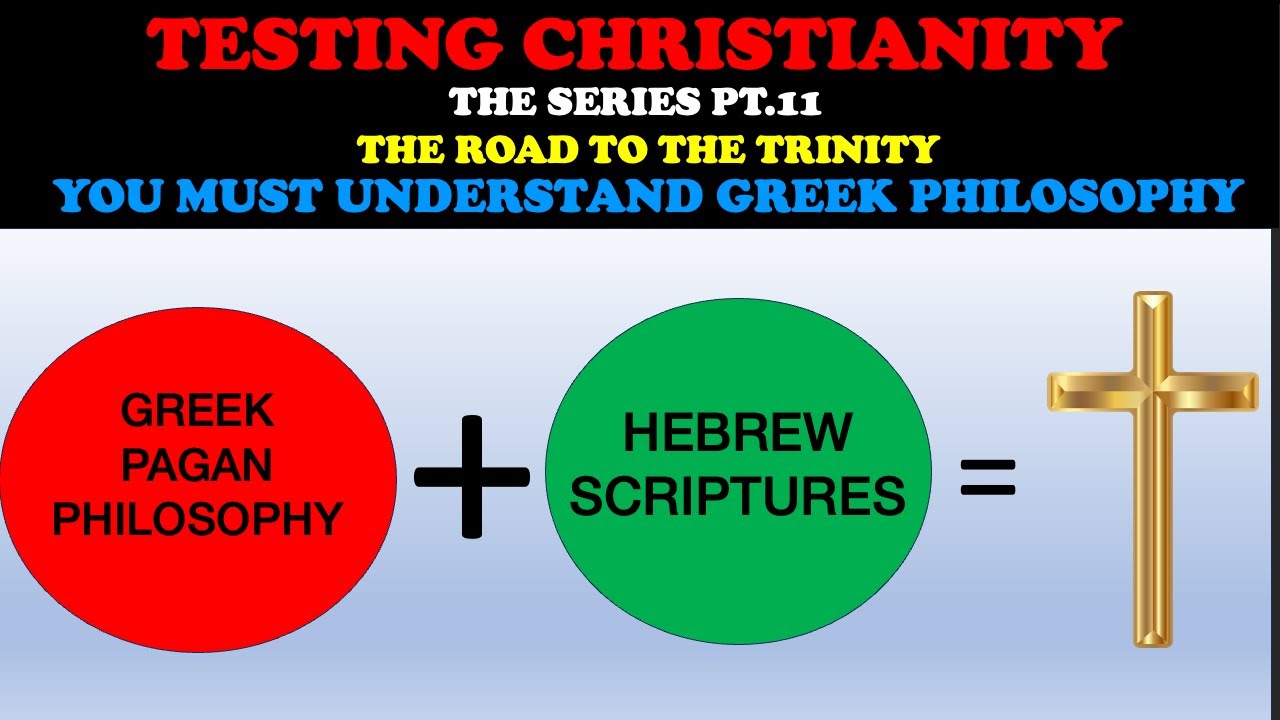
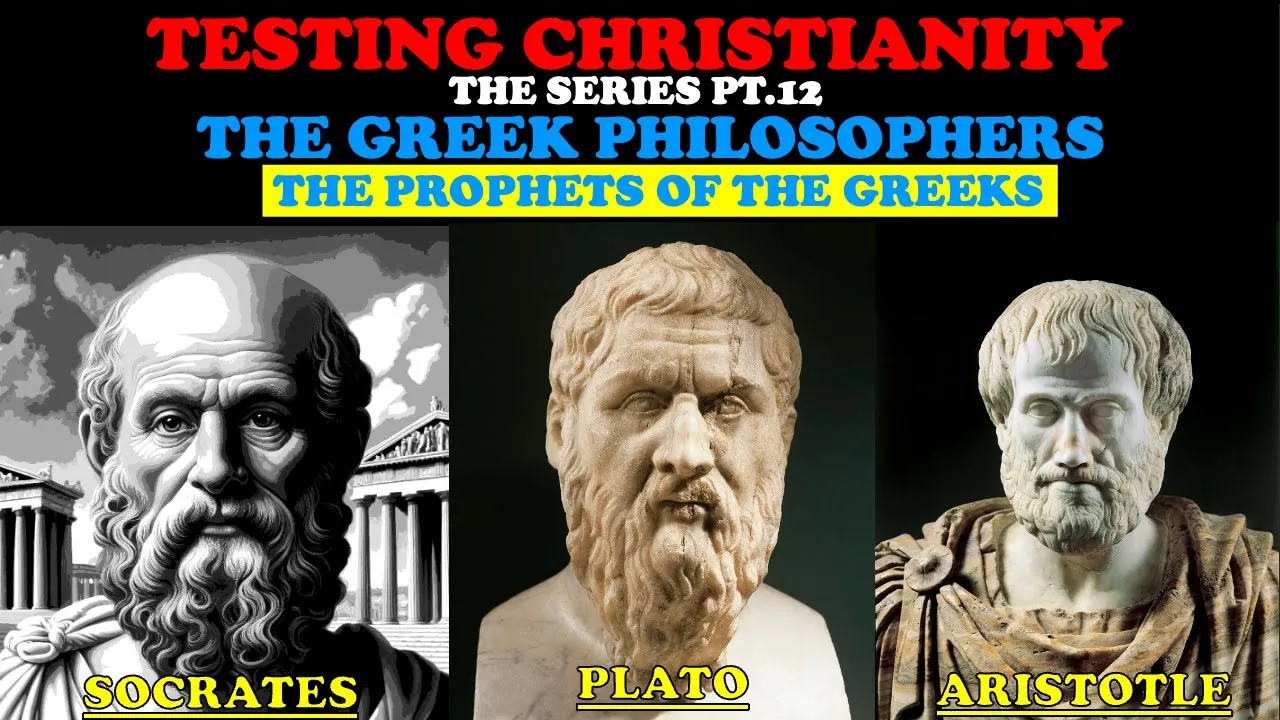
Okay, so you should be coming from part 11 of this series. These videos are a part of a topical series and should be watched from the beginning in order if you're going to understand what is being presented. So please, if you have not watched from part one, stop this video and start back from video one. Okay, so in the last video, part 11, we were introduced to Greek philosophy and began to understand this foundation because this is what the current world is centered around. In part 11, we began to learn about the first Greek
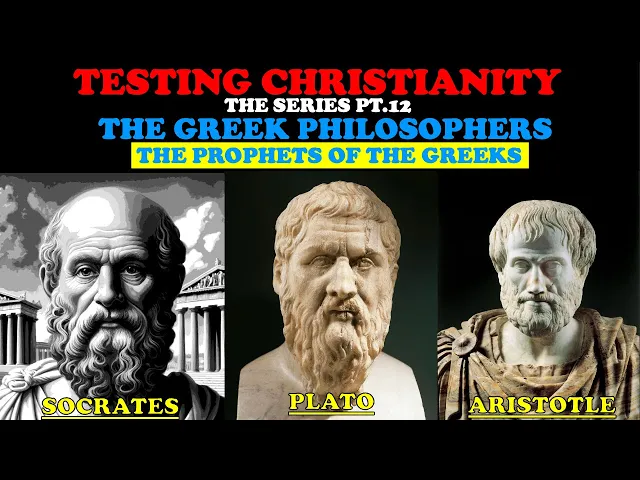
philosopher, Thales of Miletus. He is known as the father of Greek philosophy; but as we continue to grow in this subject, it is imperative that we learn more about the other Greek philosophers and how their influence began to spread and grow. This part of the lesson, though it has nothing to do with the scriptures directly, has everything to do with the history of the world and the main influences that are behind much of the mindset that many of us hold today. If you review the history of the Middle Ages, also known as the medieval period,
this is the time period that generally spans from around the 5th century, following the fall of the Western Roman Empire, until the early 15th century, at the time of the beginning of the Renaissance. This 1,000-year period is a time when Christianity began to spread around the world. You would not be Christians today without this history that followed during this period, whether you want to believe that or not; it's just history. During this time period, amongst the Christians, Aristotle was the primary influence of thought. Aristotle's philosophy had a profound impact on the intellectual world of the
Middle Ages, influencing the fields of philosophy, science, and theology. Aristotle's ideals became the foundation of Western scholasticism, the philosophical system of the Middle Ages. In the 13th century, Thomas Aquinas combined Aristotle's philosophy with Christian dogma, which became the basis for Catholic theology and science. Aristotle's ideas influenced medieval philosophers in the natural sciences and the philosophy of science. This philosopher and his ideas were the main mindset of the Christian world during this time period. But you see, if you know nothing about him and the philosophers who came before him, he's just a name to you, and
you do not understand the influence. That's the missing link in regards to history. Here’s some more for you: also during the Renaissance period, the Medicis influenced and built the Renaissance and began to spread their beliefs through the practice of humanism. I made a video about this last year. The Medici decided to go back to the occult of the Greeks and began to embrace Plato instead of Aristotle. Even more important than that, when Christianity was being formed and the doctrine of the Trinity was being formed, men like Origen, who was the founder of the Trinity doctrine,
were influenced by Plato's philosophy to form the doctrine. I am getting there, so I will not rush through it, but just understand that when Origen adapted it, it was called Neoplatonism. They adapted Plato's view to fit Christianity. You see, all of this is not hidden; it's just not discussed. Once you take these terms and these people and do a few Google searches, all of a sudden you will see a whole new world in the realm of Christianity that’s not spoken about in mainstream Christianity. It pretty much goes unnoticed, but you have to ask yourself why.
I've been getting a lot of people challenging me right now, trying to come against this ministry. Before I started this series, I knew that when I began speaking against Christianity, it was going to happen. But you see, every person that has challenged me about all of this and why I'm speaking against Christianity, I always ask them straight up if they agree that their Christian beliefs should be merged or influenced by Greek philosophers like Plato, Aristotle, or Socrates. Now, while all these critics want to easily yell out that I'm a false teacher, not one of them
actually wants to deal with the elephant in the room. They just want to wipe off all this Greek philosophy and all this Greek influence; they want to act like it doesn't exist, but it clearly does. So many people are being used because now that Satan and his influence are being exposed, he's sending out his minions against me to either distract or deter me, but it’s not working. I want you to understand that Satan has been hiding in this whole little realm of Greek philosophy, and he has not made it known to the masses, which is
why people do not know it. If you bring it up, they just want to act like it’s inconsequential. But the more you start understanding this, the more you will see how big of a deal this is, and that’s what I'm going to bring out. You see, the fact is that Christianity is heavily influenced by Greek philosophy. If you don't know anything about the philosophers themselves, then why would you think that this even matters? This, to me, should be a subject that every Christian pastor or one who tries to defend their Christian faith should be able
to deal with directly. If they want to say my premise about Christianity being a faith of tears is false, you see, the Greek philosophy and the Greek influence being mixed in with the faith of the Hebrews is the reason why people need to go to theology school and undergo seminary training. They need to be taught how to merge the Greek philosophy in with the Christian faith and make it seem like it’s just biblical beliefs. are being emerged, and people aren't being told this is why they need training. Because why would you need training to read
your Bible? Why would you need training to be led by the Holy Spirit and understand what the Scriptures are saying? Everyone that is a pastor that says that they're in seminary training or in divinity school is being led by other influences, but they think it's proper. It's not. All right, so I want to say a few introductory things about what we are going to do this semester and why it is important to do them. This is, of course, in Old Testament interpretation. Loosely translated, that means this is a course in which we try to help
you understand what the Old Testament is, how it has been interpreted, how it contributes to the lives of faithful people in contemporary communities of Christians, Jews, and Muslims, and most importantly, how to become responsible biblical interpreters ourselves. We take the course title seriously. I've already said that this is a course in Old Testament interpretation. Anyways, I have men that comment on this channel often, and they seem to come from a good place in their hearts. They just don't want to actually deal with the fact that they're being lied to, so they think that coming against
me makes me the enemy or that I just have to be misled, or whatever it is. So they don't really want to deal with what I'm actually saying, and they think it's more about me and less about the information. They say things like, "This Christianity has been my religion for many years, but I didn't receive my understanding from the early church fathers. I've actually studied the Bible under the guidance of the Holy Spirit, not man." This is what they think. But then people will say that Christianity is their religion and that they receive their understanding
from the Bible only. But here's the thing: there is no religion of Christianity in the Bible. So just calling yourself being in the religion of Christianity has to do with some kind of influence. Somebody has raised their hand and said, "This is a religion of Christianity," and you have attached to it. You can't say that you are influenced by nothing but then be in the religion of Christianity. It makes no sense; it's double-minded. You see, most people are unaware of how their belief in the Bible has even been brought to them. We are not without
influence. This is how Satan deceives the whole world. And the thing is that if people are so proud that they do not want to admit there could be influences and tricks from Satan that they have come up against, then they will always live in deception. There is not one person awakened today that cannot say that they have been lied to, and if this is a hard thing for you to admit, it's only because you are still very much trapped in lies. I'm just giving out information about how the lies got there, and these Greek philosophers
are a major source of how these lies got there. They are not spoken about and are highly glossed over, though, and so I'm going to teach about them and who they were so we do not live in ignorance. Hosea 4:6 says, "My people are destroyed for lack of knowledge; because you have rejected knowledge, I also will reject you from being priest for me; because you have forgotten the law of your Elohim, I also will forget your children." I simply want to do my part in providing knowledge about important subjects that are a main influence in
the world that we live in but yet are not spoken about. If people were just reading their Bibles and applying what it says, then there would be no reason to use these teachings. But the thing is that all these people being trained in seminary schools, going into divinity training, are learning about the Greek influence, but it's being taught to them by people that they trust. So they're not computing that they are being taught a different way than what the bases of the Scriptures are actually based upon. And that's why they go against Hebrew roots and
say this is wrong and that, because they're not being rooted in the Scriptures; they're being rooted in the faith of Christianity that is influenced by the Greeks, and I have no tolerance for it. This is what you're seeing through these videos. If anyone wants to challenge me and say that this information is incorrect, you actually have to deal with the information presented and just say, "Oh, I'm not influenced by that; I'm influenced by the Bible." You're lying to yourself. You can keep that lie. Anyways, when we ended up in part 11, we spoke about the
father of Greek philosophy, Thales of Miletus. So now that we know about him, let's look into those who come from his influence, and that understanding will bring us into the Golden Age of Athens, which is also considered the Golden Age of Greek philosophy. We are now in the 6th century BC. Nebuchadnezzar and his Babylon are said to have first destroyed the first temple in Jerusalem in the beginning of the 6th century BC, about 586 BC, and the Persian king Cyrus the Great is said to have freed the Jews from exile in Babylon in 538 BC.
So you should have a period of reference point biblically of what was happening to Israel during this time. Okay, so let's get into it. Around 530 BC, a philosophy based on the teachings of a philosopher named Pythagoras was thriving in a Corinthian colony in southern Italy. Pythagoras is best remembered for his mathematical formula known as the Pythagorean theorem. Pythagoras was influenced. By Anaximander, a Greek philosopher who was a student of Daes Pythagoras, grew up on the island of Samos but traveled the Mediterranean with his merchant father. He lived in Egypt, where he studied its religion.
Pythagoras studied with Egyptian priests in Thebes and became the only foreigner that we know of to be granted the privilege of participating in their pagan worship. There is a consensus that Pythagoras learned the foundations of geometry, mathematics, and metempsychosis while studying in Egypt. Okay, so in 525 BC, the Persian king Cyrus II invaded Egypt, and Pythagoras was carried off to Babylon as a prisoner. Remember, at this time, Babylon was under Persian control. It was just a decade and a half earlier that King Cyrus let Judah go back and rebuild the Temple. Again, just so you
can understand the time period they were in. They were talking about all that history matters, you see, because Yashar was split and trying to rebuild itself. The devil was busy creating his new religion. He knew Yashar was prophesied to have a redeemer, and Satan began preparing his people for the change that Yahweh would bring. Anyways, back to Pythagoras. It is said that he was treated well in Babylon, and while he was there, he learned astrology, mathematics, music, and a very mystical worship of the gods. You see, in his travels to Egypt and Babylon, he was
being initiated into the mystery religions. He was initiated into the Egyptian and Chaldean Mysteries and became well-versed in the esotericism of both the East and the West. From this, he created a philosophy containing elements from both science and the mystery religions. So understand this right here: Greek philosophy is just the Greeks' adaptation to the mystery pagan religions of the Egyptians. All their knowledge comes from the Egyptians. Make sure you understand that. From this influence, he founded Pythagoreanism and the philosophy of the Pythagoreans. This was a philosophy that included the belief in the transmigration of souls,
a.k.a. reincarnation; also, a belief that the key to knowledge is contained in mathematics; and a belief that a life of harmony is obtained through contemplation, music, and gymnastics. Pythagoreans developed a complex doctrine in the mystic meaning of numbers. They also practiced vegetarianism. In Albert Mackey's Encyclopedia of Freemasonry, Pythagoras is mentioned in much of the symbolism and items in the encyclopedia. When reading about him specifically, they write that on his return to Europe, he established his celebrated school at Crotona, a Dorian colony in the south of Italy, about 529 BC, much resembling that subsequently adopted by
the Freemasons. His school soon acquired such a reputation that disciples flocked to him from all parts of Greece and Italy. Pythagoras taught, as the principal dogma of his philosophy, the system of metempsychosis, or the transmigration of souls. He taught the mystical power of numbers, and much of the symbolism on that subject, which we now possess, is derived from what has been left to us by his disciples. For of his own writings, there is nothing extant. Okay, okay, so what I'm saying is that Pythagoras was a great influence on the occult and esotericism for the Greeks.
His influence is well known even within Freemasonry, but they say that it's not by his direct influence but by those who followed his work down the line. This is how Greek philosophy goes: it goes from one teacher and is passed down the line. The reason why this is important, like I said, is because in many ways, Pythagoras laid the foundation for future Greek philosophers. That's why you need to understand him. So let's keep going through these philosophers; let's go through their history. Nearly a century after Pythagoras, Athens and Sparta went to battle in the Peloponnesian
War. The war significantly weakened the Greek city-states, particularly Athens, and it left Greece divided and vulnerable with a major power shift that moved from Athenian dominance to Spartan control. This led to widespread economic hardship. Okay, Athens was once a powerful naval and political force, but now it lost its empire and influence due to the war's outcome. They experienced significant economic and social disruption. Because of this, a new philosophy fueled by the effects of being overcome by war formed among a new generation that was made soft because of the prior success of Athens. You see, these
people were dealing with the great success of Athens, and they became soft and spoiled. But then, after their fall, a new mindset began to emerge. The people began to question the old ideas of absolute good. This new movement taught that virtue was defined by personal desires and personal feelings, and this brought about materialism. Materialism became the ultimate goal of life. These new philosophers that began to spread this ideology were called sophists. “Sophist” is said to mean "clever" or "skilled man." The sophists traveled from city to city, teaching various subjects like rhetoric, philosophy, and politics to
wealthy young men, often focusing on the art of persuasive argumentation and achieving aitia or excellence in public life. Of course, they did this for a fee. Their teaching methods, often seen as prioritizing winning a debate over absolute truth, eventually gained a negative connotation known as sophistry, which now refers to intellectually dishonest arguments or manipulation of logic. Now let me say this: You see, in Christianity today, everyone wants to debate this and debate that. If you look on YouTube today, there's not a lot of teaching; there's a lot of debate. People want to debate this and
debate that. This is the culture in Christianity. It is a common practice that is just accepted, but people don't recognize where it comes from. Understand, debate was not a mindset of Yasharel; it did not come from them. Nobody debated about Yah and His ways. They weren't allowed to speak what they needed to do. They followed it; they believed it. In fact, understand that the rebellion of why Yahusha was murdered did not start until the Pharisees and Sadducees began debating about him. You see, while the Pharisees were largely resistant to Greek culture and actively rejected the
Hellenistic practices, they still were influenced by some aspects of Greek thought, and debate was a part of this. This practice is what led to the rebellion that actually crucified our Messiah. What I'm saying here is that debating is not a culture of Yahsh; it is a culture of the Greeks. Every Christian that believes in this practice is just showing their influence by the Greeks, but because of a lack of information, they don't recognize where it comes from. These same tactics that people apply today are what led to the crucifying of our Messiah back then, and
these same Christians that practiced this will lead to the persecution of those living in the truth when the time of the Antichrist comes. Just saying, this is why I reject the way of the Greeks. Anyways, let me get back to it. The sophists, in regards to materialism, believed that all matter was comprised of the smallest particles called atoms. They believed that the material universe, including human life, was a result of blind chance. They claimed that all cultures and religions were human inventions. The existence of the gods was debated in some sophists; they even promoted atheism.
The reason I bring them up and the reason they are important is because of who followed after them. You see, the philosopher Socrates (460 to 399 BC) was one of the philosophers who stood against the sophists by arguing for the existence of objective standards of good and evil. Socrates is noted as the founder of Western philosophy and was known as one of the first moral philosophers of the ethical tradition of thought. Though Socrates was not around after the time of Pythagoras, he absolutely was influenced by Pythagoras's beliefs about reincarnation, also known as the transmigration of
the soul, which were similar to those of Pythagoras and the Pythagorean Society. All this is just the mystery religions being passed down. Please don't forget this; it's not just about a way of thinking; it is the occult, dealing with spiritual demons that are giving them this way of thought. Socrates taught that instead of abandoning oneself to passions, human emotions, and impulses, the virtuous person controlled his thoughts and actions through the study of philosophy. By living a virtuous life and doing good deeds, a person could obtain true happiness. But look, he was not well received at
his time, and he was a mockery to most Athenians. The Athenians actually demanded that he denounce his philosophy, and when he refused, they demanded his suicide. But through that, Socrates stated that he did not fear death because it is the goal of philosophy to reject material things and prepare the soul for the afterlife. You see, Socrates brings a divide in Greek philosophy. When you understand philosophy up until the time of Socrates in history, it's labeled as pre-Socratic philosophy. As I explained in part 11, philosophy first started with a preference for rational explanations and argumentation over
mythology. That's how it started. They emphasized rational thought, arguments, and logic over using their mythological ways. After Socrates, though, philosophy shifted towards a greater focus on individual ethics and the examination of personal virtue. It has been said that Socrates' greatest contribution to philosophy was to move intellectual pursuits away from the focus on physical science, as was once pursued by the so-called pre-Socratic philosophers such as Thales, Anaximander, Anaximenes, and others—leading away from the focus on physical science and into the abstract realms of ethics and morality. He brought the divide in philosophy, and no matter the diversity
of the schools that claim to carry on his teachings, they all emphasized some form of morality as their foundational tenet. This right here is what paved the way for the acceptance of Christianity. Let me explain what this means: Before Socrates, good and evil were not really concepts thought of by these people; that was not their way of thought. They were lawless. Now, Socrates did not bring law to them, but he did bring the thoughts surrounding good and evil, and this is what began to prepare the Greeks, which was then taken over by the Romans. It
provoked these people to a different way of thinking. Socrates' belief was that people don't desire what is bad. As my brother Hakeem said in the comments, it should all bring us back to the scripture that we are all born in sin and shaped in iniquity: "Behold, I was brought forth in iniquity, and in sin my mother conceived me." (Psalm 51:5). Socrates believed the complete opposite, that people don't actually desire to be like this. These philosophers did not know Yahweh, and they made religion based on their own thoughts. That brings me to this scripture: "There is
a way that seems right to a man, but its end is the way of death." (Proverbs 14:12). And that’s Christianity. This leads me to explain exactly the importance and relevance of Socrates and how intertwined the religion of Christianity is with Greek philosophy. Here it is: the concept of morals, as we understand them today, largely originated from the ancient Greeks. This is a major thought in the Christian world today about morals. The Hebrews did not have morals; they had a Torah. It was just how Yahweh guided them. The Greeks had morals, immorality, and ethics, and they
were easily able to be debated, which is how what was once considered evil can now be considered good. This is all Greek philosophy. Mingled into our lives, hi, uh, hi. I was just reading, uh, the catechism, uh, and I'm going over morality right now and the sources of it. Yeah, and, uh, I'm just kind of confused on the wording that they have in the catechism. Like, uh, I'm not sure if it says that morality comes from God or if it comes from a rational consideration of, like, the consequences of our own actions. So, I'm just
kind of confused. It's, yeah, it's in different senses. One of the classic problems in philosophy is what's known as the Euthyphro dilemma. It's called that because it's discussed in Plato's dialogue, Euthyphro. In that dialogue, Socrates has a question that he poses to people about where morality comes from, uh, and what morality is. One of the ideas proposed to Socrates is that morality is whatever is pleasing to the gods. Socrates says, well, okay, but why is it pleasing to the gods? Is it just arbitrary, or is it pleasing for some other reason? Looking at that, you
could say, well, okay, if it's just because the gods like it and there's no other reason, then morality seems arbitrary. On the other hand, if there is some reason, then morality seems superior to the gods because they didn't create it, and it seems to be binding on them. So, Christians have looked at this, and this has been a question in philosophy throughout the ages. Christians looked at this and said, okay, God is the fundamental bedrock of all reality. Nothing would exist if it wasn't for Him and His eternal nature. We know, though, that God is
intrinsically good because He is all-perfect. He has all possible perfections, including moral perfection. He's all-holy, He's all-good, and that means that goodness itself is part of God's eternal nature. That's the solution to the Euthyphro dilemma: morality is not independent of God, and it's not arbitrary; it's rooted in His own eternal nature. When we do things that are moral, we are participating in God's own goodness, which is neither arbitrary nor independent of God. So, we're participating in God's own goodness when our actions conform to His moral will. But then there's the question, how do we come
to know what God's will for us is? And that's where reason comes into the picture, because God gave us intellect that allowed us, unlike other animals, to scrutinize our own nature and determine what the best course of action is based on our own nature. So, in that sense, our knowledge of morality originates from our intellect, but more fundamentally, it originates from God's own eternal nature. You understand what I'm saying? I understand now. It took a while, but I got it. You see, Christians today will tell you that it's all about morals; they will tell you
that. But that is not the way of the Hebrews. It is the mindset of the Greeks. The way of Yasharel was the Torah, and it was the way Yahweh led them. You may say, hey, there's no difference. Well, you see, morality has no law. What was accepted yesterday can be changed tomorrow. So, now today in Christianity, it's considered immoral to speak against homosexuality. I'm not—this is not a bash. I need y'all to hear my heart on this. This is not a bashing. This is not—if I was there, maybe I would have told him, is there
something in the middle you could do? Like, kind of a, like a little, maybe if somebody said, well, I was born like this, I don't know how I feel. I feel you, and I wish that there was an option of 'other' in the Kingdom. I know, honestly, I wish God would have made it so much simpler. It was like A, B, C, or D. Like, frick! No, I'm serious. As a pastor, like, so what do you think about gay? Man, I don't know! If you love people, how can you not accept homosexuality? It's about morals.
If you love, you should love everyone because it's about morals. People don't understand what this Greek philosophy intermixed with this faith has produced. Morality is a mindset of the Greeks, and it started with Socrates. Christianity can, of course, compare its morals to the Torah because, of course, Yahweh's law is perfect. But Christianity has no actual laws, and it's why morals can change, which is exactly why we see it changing today. The concept of morality and morals and ethics is from the ancient Greeks. People need to wake up. Now, back to Socrates. He's noted as the
founder of Western philosophy. All the philosophical schools that were spread during the Hellenistic age can be traced back to Socrates. After you understand these Greek philosophers, it's then important to understand how this all was spread. After the doctrines were created, they then started spreading this, and it's known as Hellenism. This started through Alexander the Great. Alexander still did not come on the scene yet. Through all this, not until this foundation of Greek philosophy was cemented. Let's keep going. Socrates challenged the mythical stories about the gods. He attempted to motivate people to have as much concern
for their souls as they did for their bodies. I will get to him next, but in Plato's writing, "Apology of Socrates," Plato writes that Socrates claimed to have a demon, literally a divine something that frequently warned him in the form of a voice against mistakes but never told him what to do. So, he was guided by a demon, and it was this man, Socrates, who was… A great influence on Greek philosophy that was intermingled with Christianity. Christianity is influenced by a man influenced by demons. If you research Socrates and Christianity, the information and correlation are
amazing. I've read things like, "Was Socrates a Christian before Christ?" Stuff like that. It's amazing, and they want me to attach to this stuff? Absolutely not. Let's keep going so you can understand. So, Socrates left no original writings; his legacy is known through his students. One of his most known students was Plato (427 to 347 BC). Plato recorded his teacher Socrates' ideas in a series of dialogues in which Socrates asks questions and leads others to his conclusions. This technique became known as the Socratic method. Plato is best known as the author of philosophical works of
unparalleled influence and is one of the major figures of classical antiquity. Plato continued to develop and build his philosophy based upon Socrates' ideas; that was his teacher. Understand how this all worked: it went from Thales of Miletus to Anaximander to Pythagoras to Socrates, now to Plato. Each philosopher built a foundation that the next philosopher built on, and throughout it all, the mystery religions and their ideas were passed down through each of them. With Plato, he believed in two realms of existence: mind and matter. In the realm of the mind, or Spirit, there are ideals or
archetypes. Plato called the creator God of the universe the demiurge, meaning "Craftsman," who was the idea of the Good, also known as the Form of the Good. The demiurge was the creator in Plato's theory of forms, in which forms are defined as perfect, eternal, and changeless concepts existing outside of space and time. The Form of the Good is the mysterious high form and the source of all other forms. I need you to remember that part right there: the theory of forms. I'll get back to that soon, but we're about to get deep here. Listen, all
of this matters. You may wonder where I'm going with all this information; maybe you're wondering, "Am I just drawing out a lot of history for you?" No, that's not the case. This is a foundation of the Greeks, and if you don't understand this, you will not understand what was done when Christianity began to form. So, dealing with Plato, let's say this: according to Plato, after the demiurge made the universe, he created the deities of Mount Olympus, and then the souls of lesser beings—human souls—first inhabited the heavens but eventually desired to experience the material world. So,
the lesser gods prepared bodies for them to inhabit. The Earth itself was given a soul. This is what he believed. For Plato, the goal of human life was to become virtuous through philosophy and reincarnation, eventually returning to the original divine state. In Plato's writing, the Republic, he quoted Socrates. He said, "Then this must be our notion of the just man: that even when he is in poverty or sickness or any other seeming misfortune, all things in the end will work together for the good of him, in life and death, for the gods have a care
for anyone whose desire is to become just and to be like God, as far as a man can attain the divine likeness by the pursuit of virtue." Here is another quote from Republic 398a: "Then it seems that if a man whose wisdom enables him to take on every possible shape and to imitate anything at all were to arrive in our city anxious to put himself and his poems on show, we would fall down before him as though he were a sacred object, a wondrous and pleasing one at that. But we would say that there is
no one else of the sort among the citizens of our city, nor is it permitted that there ever shall be. We would anoint his head with myrrh and give him a garland of wool, but, for our own benefit, we would ourselves employ the more severe and less pleasing poet." Okay, you see, in this writing, Republic, Plato writes of an anointed one, one that is “anointed.” The idea of a just man being anointed is a metaphor signifying that the truly just person will be recognized and honored by society, essentially being set apart as someone of exceptional
moral character, much like a person being anointed with oil in a ritualistic way. This imagery is used to highlight the high regard and respect such a person would receive in an ideal society, and this influence must be understood. Let's take a look at another quote from the Republic, from Book Two, sections 361e and 362a: "We must tell it then, and even if my language is somewhat rude and brutal, you must not suppose, Socrates, that it is I who speak thus, but those who commend injustice above justice. What they will say is this: that such being
his disposition, the just man will have to endure the lash, the rack, chains, the branding iron in his eyes, and finally, after every extremity of suffering, he will be crucified." And you see, what you need to understand is that the Jesus of the Greeks is just Plato's just man. It is these writings from the Greek philosophers, like Plato, that spurred the actual acceptance of the anointed one that they call Jesus. It was not an attachment to the Hebrew Messiah, which is why everything about him is attached to the culture of the Greeks and not the
Hebrews. Consider this writing of Plato to be like the scriptures for the Greeks; consider Plato to be like their Isaiah or Jeremiah. The Hebrews had the scriptures and the prophets; the Greeks had the writings of these philosophers, and so Socrates would be like Moses, and Plato would be like Jeremiah, Ezekiel, or Isaiah. Plato put forth the... idea of an anointed one, and this cannot be ignored. Now, Plato founded the Academy, which is an educational center considered by many to have been the first university in the Western World. The Academy became the model for other schools
of higher learning and later for European universities. Later on, when the Medici funded the Renaissance, you will see that they went back to Plato's teachings in order to push forward their way of humanism. His influence on our society cannot be understated, but unfortunately, he is not taught in this way; he is not taught about at all. Cosimo de' Medici was so taken with Plato that he founded a Platonic Academy in Florence because of his Platonic influence. Understand that the idea of the anointed one, or Christos, comes from Plato. People want to believe that this is
just a Greek way of speaking about the Hebrew Messiah, but it is way more than that. As I keep explaining, there were people called Christians before the Messiah ever came. Those who worshiped the cults of Sarapis were already called Christians. Their use of Christos with the Hebrew Messiah is the Greeks adapting their philosophy to the faith and prophecies of the Hebrews, but adapting it to their own ways and their own thoughts, and it needs to be understood. Plato's Republic is a major influence in our world; we just don't know it. In that writing, the Republic,
not only is there talk about the just man, but there's also the allegory of the cave. This is what you get when you research this on Google: Plato's allegory of the cave is a metaphor that compares people to prisoners in a cave who are only able to see shadows on the wall. The allegory is a way to illustrate the concept of idealism and how people can only understand a small part of reality through their senses. Plato's allegory of the cave is a passage from his work, the Republic, written around 380 BC. It has been used
as a metaphor by philosophers for thousands of years to help people overcome materialism and superficiality, and that's what it's about. Do you know that they put these philosophies directly in our movies? Like the movie *The Truman Show*, in this movie Truman is a prisoner in the cave, only able to gain artificial and illegitimate knowledge. They say this movie is one of the most direct adaptations of the allegory. Also, the movie *The Matrix* is one of the many movies that uses the idea of Plato's Cave. The movie *Interstellar*, in that movie, the other realm that they
were going to is the exterior of the cave. The main character, Cooper, must complete an arduous journey to reach it. In further inspection, we see that the tesseract also uncovers the cave of knowledge. This knowledge not only is capable of saving the human race, but it also allows Cooper to communicate back to Earth and share what he has learned. They are teaching you Greek philosophy through their stories. The idea of Plato's Cave has been used extensively in storytelling; it's the Greek philosophy being told to us through their stories. So when people like to say that
they are not influenced by Greek philosophy, yet our entertainment is filled with stories that use Greek philosophy, you only say that because you don't understand Greek philosophy. The crazy plot twist of all this is that in our satanic world, it's influenced by Plato's philosophy. This world is created around Plato's allegory of the cave. The last thing I'll mention in regards to Plato is that he had the theory of Forms. We talked about it earlier in this philosophy: one and the many. Remember that; it's a philosophy from Plato. One and the many refers to the concept
that a single perfect form underlies and gives definition to the many individual imperfect things we experience in the physical world. Essentially, the idea that a single universal essence, the One, is the source of all the diverse manifestations, the many, that we see around us. That’s the philosophy. Now, why is that important? You see, this philosophy is the primary influence that Origen used as he created the doctrine of the Trinity. Now, I will be getting to that soon; I'm getting close to it, but I'm just dropping crumbs for you to follow on your own. Let's continue
on with discussing the philosophers. As I end with this study, I will end with the last philosopher, and that's Aristotle. Aristotle (384 to 322 BC) was a student of Plato. He developed a system of logic and scientific exploration. Aristotle divided philosophy into three categories: mathematics, physics, and metaphysics. He further taught that practical philosophy is concerned with ethics and politics, while poetic philosophy dealt with emotional reactions to art, poetry, and drama. His *Nicomachean Ethics* established a concept of virtue ethics, emphasizing the cultivation of good character traits to achieve happiness, which continues to be a cornerstone of
moral philosophy. He began the wider Aristotelian tradition that followed, which set the groundwork for the development of modern science. Science and Western philosophy, including all philosophy, have their roots in Aristotle and Plato. Until the Renaissance, the modern world was influenced by Aristotle's philosophy the most. As I shared in the beginning, you see this information was hard to get through, but it had to be presented because this is the influence of the early church fathers. They were influenced by the writings and thoughts of these men before they ever heard of the faith of the Hebrews. What
these men believed matters, and you can see that none of them were inspired by Yahweh. In fact, Socrates himself admits to being guided by a demon, and he was the main philosopher who prepared the Greek thought for Christianity. The work and thoughts of these Greek philosophers are highly involved with the... Esoteric and influences from the occult, in many ways, we have heard of their names but know very little about them. Again, Plato literally helped prepare the minds of the Greeks for the acceptance of a coming anointed one; his writing literally referred to a Christos. You
can't understand how they started accepting the Messiah until you understand the influence, and this is the beginning of that influence. These were the scriptures and the prophets of the Greeks. None of their views had anything to do with Yahweh and his truths. People want to believe that all of a sudden, people started believing in the resurrection of the Messiah, and then from that, they started adapting to the Hebrew faith that came through the apostles; but they are ignoring the influence of the Greek philosophers that influenced the society of the Greeks and the Romans. This was
the main influence that led the early Church Fathers, like Justin the Martyr, a highly anointed early Church Father. I read about him in part 8. He was a former pagan and highly influenced by Plato himself. These people just didn't turn and start believing in the God of the Hebrews—absolutely not. But this is what we're meant to believe. Christianity is, again, none of their views had anything to do with Yahweh and his truths. It was preparing for the seed that Satan was going to plant when the Messiah he was preparing for actually came. Today, the modern
world uses the philosophy of these men to prepare the world for the Antichrist. For example, the movie *Man of Steel* about Superman, which is highly suggestive to the coming Antichrist, is preparing the world for him. For those who know Plato's philosophy, you know that the Man of Steel is Plato's just man. For those who accepted Yahusha, they accepted him as Plato's just man. But that's why they adapted him to Greek, which is why you call him Aus, then to Jesus, and he does not have a Hebrew identity. The Jesus of the Greeks is Plato's just
man, and he will be leading the masses to the Antichrist. Many people just don't know because we're not educated; they don't teach this in our schools, they don't teach this in the churches. All this influence is right in our face, but because we are not taught about it, these people can manipulate us. Again, my people are destroyed for lack of knowledge (Hosea 4:6). People argue all day about the word "Christos" and why it should be accepted, but they ignore the influence of the Greeks and why they were even expecting an anointed one. This idea came
from Plato's just man. Let me say it like this: people are completely naive to think that Satan did not know that the Messiah of Yasharel was coming. It was the first prophecy Yahweh ever gave in the scriptures, in Genesis 3:15, about who would defeat Satan. Satan absolutely knew, and the moment that Yahweh started prophesying about this Messiah to the prophets is the moment when these philosophers came on the scene. And then what happened three to four centuries later, after this way of thought was accepted by the Greeks and then the Romans? When our Messiah rose
from the dead and news of him began to spread, these same people, already prepared by these Greek philosophers, were now ready to accept the Messiah in their own way—not how the Hebrews presented him, but through their own philosophical way. This was the basis for how they took over Christianity, and then they got their own teachers and their own theology to be able to teach the people how to merge their Greek beliefs in with the faith of the Hebrews, and that is what Christianity is today. This is why people need to go be trained in Theology
and Divinity to even teach this stuff. Paul says, "Let no one deceive himself. If anyone among you seems to be wise in this age, let him become a fool, that he may become wise. For the wisdom of this world is foolishness with Elohim, for it is written, 'He catches the wise in their own craftiness.' And again, 'Yahweh knows the thoughts of the wise, that they are futile'" (1 Corinthians 3:18–20). The wisdom of these Greek philosophers was futile, but they were a foundation of the early Church Fathers. The Christian world wants us just to ignore this,
but we cannot and we should not. As John says, "They are of the world; therefore, they speak as of the world, and the world hears them. We are of Elohim. He who knows Elohim hears us; he who is not of Elohim does not hear us. By this, we know the spirit of truth and the spirit of error" (1 John 4:5–6). What we're doing is uncovering the false foundation of Christianity. Every church that teaches should have this understanding. The reason why Christianity is an accepted religion in this world is because it is a spreader of Greek
philosophy in the guise of the faith of the Hebrew Scriptures. People call on a Greek Messiah; they use Greek philosophy when trying to teach our ways of morality, talking about things like the Golden Rule. They use Greek philosophy to understand him and refer to the Trinity. They reject the Torah and the commands of the Most High. They celebrate pagan holidays tied to the worship of other pagan deities, and they rest on the first day, not the seventh. I mean, I can keep going on and on. Christianity is not a religion of the Hebrews; it is
a religion of the Greeks. The only way they were able to get the Hebrews to accept it was by taking our ancestors in chains, enslaving them, wiping their memory clean for a couple of hundred years, and then reaching... To us through their foundation, and the only way that we can learn about being a Christian is by going through their theology schools and their Divinity schools. People always ask me, "What are his qualifications? What Divinity School did he go to? What Seminary training did he go to?" None of them, and I'm free. Because of this, we're
almost at the end. It is us who are waking up and rejecting these falsehoods and repenting from the sins of our ancestors. Whether natural branch or wild branch, we are all turning back to Yahweh in full truth and living the way He desires us to. And it does not come through this false, phony religion that is a religion of tears. From this, you now have a foundation of the Greek philosophers, and you know more than pretty much all these other Christians who speak as if they know the truth. Anyone that feels they know the truth
needs to give you an explanation about why they feel Greek philosophy should be intertwined with Christianity. This now gives you a great deal of understanding about this world, and now that you understand how Greek philosophy was created and who the philosophers were, you need to understand how it was spread. That brings us to Alexander the Great, and all of this is leading you to understand truly what Christianity is because most people just don't truly know. So in the next part, we will discuss Alexander the Great, and you will understand how the Romans took over Greek
culture. From there, we will go back to after Christianity was created and read about Plato and Socrates and how they intertwined into this faith of Christianity that the world holds on to so deeply, and how they were used to create the doctrine of the Trinity. All of this goes back to them. I appreciate all of your patience as you wait for me to bring all this out. All this is foundational; if I do not explain all of this, there can be no real understanding. This is why people are so confused—because people want me to skip
over to the answer without explaining the foundation of how we got to that whole question. So I'll get there. Thank you for your patience with me. In the meantime, please remember that Christianity is a religion that on the surface seems biblical, but when you dig deep into the doctrines, it is not a doctrine of service to our Father, but a doctrine of abusing grace, editing covenants, rejecting the way our Father actually chose to reach humanity, and making it only be about the way Christians want to receive Him. It lacks the love, obedience, and reverence for
our Father that He deserves, and in the end, it does not prepare those who follow it to be ready for what our Father plans to do in the last days. If you desire to be ready for our Father and His plan for us, you must come out of this religion of tears and come to our Father in truth. Please move to part 13 in this playlist, and we will discuss Alexander the Great. Click the link to the next video, and let's talk some more. Be blessed. Hallelujah! Praise Yah! Okay, thanks again for watching. If this
has blessed you, please don't forget to like this and share this with your family and your friends. This series should be seen by all who claim Christianity. This video series is highly important for those trying to be ready for our Father. This is part 12 of the series. Click the link or just move on to the next video in the playlist. As always, I want to thank all of you who donate and contribute to this ministry. This series would not be possible without your support. I thank you sincerely. Be blessed. Okay, thanks again everyone for
watching. See you in part 13. I love you all.