Hello guys and welcome back to my channel. If you are new, welcome! My name is Germana and this is my first podcast.
Today I decided that I want to tell you something about Made in Italy: of its value, its history, its characteristic elements and what represents nationally and internationally. Are you ready? Let's start!
Made in Italy. What is this well-known Made in Italy? In short, we could say that it indicates everything that is manufactured.
mainly in Italy and I say mainly why not always that which is labeled as Made in Italy is 100% produced in Italy. Did you know It means that some stages of the production of what we define Made in Italy can also take place abroad. According to the Reguzzoni-Versace Act of March 2010, a product can be defined as Made in Italy when at least two stages of its processing take place in Italy and this has often been a topic of discussion, especially by great Italian entrepreneurs whose production of clothing, footwear and Textile is made entirely in Italy.
This concept, therefore, seems today swinging impetuously between the logic of fast fashion and those related to Italian tradition and crafts. Think about how important it is to know the origin of a product, the origin of its materials and the place of its production, so important that it even influences our choice of time to buy it. In fact, if you think about it, Made in Italy has all the characteristics to be a real brand because it is identification of a historical tradition handed down in Italy from the early years Fifty, which still exists and grows today and that is why embodies a strong identity that makes it unique and recognizable in the international scene.
Pause this podcast and Think of three characteristics that come to mind when you listen to them. palabras Made in Italy. Done?
Let's see if I guess right. Quality. Crafts.
Tradition. Creativity. Authenticity.
Innovation. Luxury. Did I guess any?
Made in Italy is characterized by operating in four product sectors defined as "4 A". Clothing including also textiles and accessories; Furniture and design; Agri-food; Automobiles In today's episode I'm going to tell you something about clothes and then about Italian fashion. Please don't forget to Subscribe to also follow the next episodes in which I will tell you about the other A.
que caracterizan to Made in Italy. It all started in the 1950s, the so-called Italian economic boom years. Italy begins to enter the international fashion scene that Until then it was a Parisian monopoly .
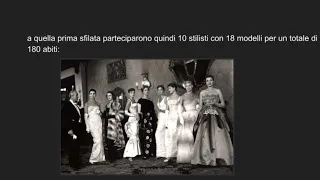
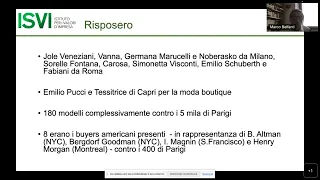
An important date to remember is undoubtedly February 12, 1951, the day that the then businessman Giovanni Battista Giorgini organized at his home in Florence a parade of models of Roman tailors and Milanese. Giorgini took advantage of the large presence of journalists Americans and shoppers who came to attend French haute couture shows yes took place in those days in Florence, to make known the Italian fashion that was born in that period from Italian artisan shops and succeeded with success. February 12, 1951, in fact, became an iconic date for the Italian fashion that from that moment began to be recognized by primarily the American foreign media, an event that led to the gradual weakening of the French monopoly on the international fashion scene.
Thus was born the Italian style, which is a style characterized by refinement. and quality of fabrics, from craftsmanship and innovation. What Italy communicates with the outside is the taste of know-how, or rather of know-how.
Fashion, art and culture begin to mix and advertise. influence each other. Italian art that inspires fashion and vice versa gives rise to unique creations that, with the growing industrial activity of those years, they reach the whole world.
The last fashion show in Florence dates back to 1967 and guess which city Will it become the haute couture capital of the time? It is still early for Milan. Haute couture moved to Rome, while the fashion boutique continues to grow in Florence.
Something was changing and starting to happen space a new fashion concept, ready-to-wear, which is being developed in Italy squarely in Milan, avant - garde industrial city and symbol of the boom Italian economy. In short, ready-to-wear represents a new idea of Typical Milanese fashion that differs from French and Roman haute couture. It is an industrial product but of design.
It was in the seventies that Milan began to build a new identity that then leads it to be defined as "capital of Italian fashion. " The figure of the stylist who distinguished himself from tailor who worked in boutiques and whose haute couture couturier. The stylist is in fact, tailor and entrepreneur at the same time.
Think of Domenico Dolce and Stefano Gabbana, to Valentino y Giancarlo Giammetti, to Sergio Galeotti y Giorgio Armani. In the seventies and eighties, Made in Italy peaks and becomes a recognized mass phenomenon internationally as a brand. The new economic boom increases the phenomenon of consumerism that, unlike what was already happening in the sixties, yes it is characterized by being more individual and less related to the family environment.
Those who buy, buy durable goods such as appliances, cars, but also fast consumer goods such as clothing and accessories. Thanks to new technologies, women take less time to dedicate themselves to housework and this is just the beginning of a social change that sees radical changes in the roles of men and women. Fashion, the cult of aesthetic beauty, begins to take more and more foot and both become significant elements in the definition of the individual.
Fashion embraces both men and women, indiscriminately. And from the social revolution of the time, an increasing role of the woman, who will also cover managerial roles at work. Thus Milan, the city of industry, is transformed into the so-called "Milan to drink", a city dynamic and lively, especially rich in fashion events.
In the nineties, however, the large luxury fashion groups such as Prada and Gucci took shape. The brand begins to be more important than the product itself. Stores from mere points of sale become real scenarios where the brand expresses and communicates its personality.
From here comes a slow The decline of ready-to-wear fashion that will thus begin to make room for luxury. In fact, if we think about it, it is no coincidence that today the big Italian brands Fashion have a lot to do with the world of luxury. Well, that's all for today.
Now that we have covered the main historical stages together of the evolution of Made in Italy fashion, what would you say are the factors main contributors to its development? Let me know in the comments below what you think. I hope this podcast has been interesting for you and have you given a starting point for reflection and research.
Thanks for listening and I hope to see you in the next episode. Bye!