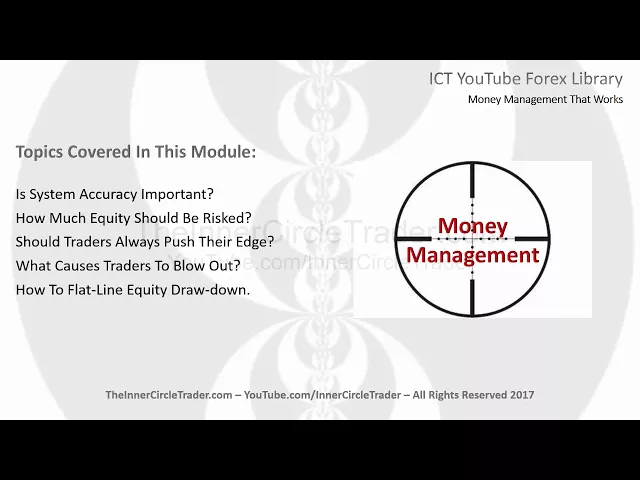
you okay folks this lesson right here this lesson out of every lesson I've ever taught this is the most important one unfortunately many times it's viewed by developing traders as the most boring topic but you need to understand sound money management and I'm going to give you a perspective on money management techniques that I view is one of the best okay ready tackling money management and the topics vary in covering in this module is system accuracy important I don't believe system accuracy is all that important I believe that a relatively low accuracy rate could still
be profitable and I'll give you an example that in this specific module but I want you to understand that a lot of new traders developing traders and traders that have been unprofitable for a while tend to believe that it's their system and the lack of high accuracy that is what prevents them from seeing a positive outcome and that's not it but it really isn't it it's the losses that erode by the means of drawdown every losing trader every busted account starts with a single loss and it compounds and what generally happens is traders will lose
their mind because they are not disciplined they don't have a procedure or protocol in place to deal with a losing trade or a series of losing trades so I think that system accuracy is kind of like a misnomer certainly there's nothing wrong with an accuracy that's high but it also goes along with just because it's been accurate a certain number of times in the past is in no way shape or form a promise or guarantee that that system is going to deliver the same going forward it could fall apart it could have you know Lord
knows how many losing trades I've had systems and developed all kinds of methods over my last twenty five years and some of them look great on paper but soon as you try to plug them in to live markets and walk forward with them they didn't hold up and they were all based on TradeStation systems and I was trying to cut you back in the 90s with the bond in the S&P market but if you are on the fence about having the dependency on system accuracy and we're finding it terribly important I don't think it's something
that you should lose sleep over all right so how much equity should be risked well I don't believe there's a cookie cutter approach to this everyone and I have done this in the past uses a standard 2% as a maximum and truth be told when you know what I'm trading I've risked as much as three and a half percent and sometimes when I was really being a cowboy I was risking as much as five and seven percent they were more or less just working towards accelerated growth and also testing what I was able to do
as a trader but generally my risk appetite is about one percent one half if I really want to push it everything they're really good I'll go as high as 3% generally it's about as high as I'll go so I think the question really is a matter of personal choice and preference what I'm willing to assume as risk percent may not be as welcome as a percentage for risk for some view for some of you 1% may be extremely too high for others it may not be high enough so everyone's gonna have their version or comfort
zone for risk and I don't want to be the type of mentor that tells you this is how much you should risk because I teach in a demo account so I think that it's reasonable to assume 1% or less as a risk parameter for your demo account but I would never tell you what you should do with your live account because it's gonna be all dependent on what you're willing to assume is risk what you can tolerate you know some of you if you put a trade on even in a demo account you'll lose your
mind over it because it's just can't you can't deal with the uncertainty and there's really no money on a line it's just that you're so keyed up about being right and that's gonna translate into problems with your money management because if you need to be right you're not going to trade profitably should traders always push their edge I see this a lot online and it's one that gets under my skin because again gets back to the first question is system accuracy important I don't believe that a trader should always get in there and push their
edge because no matter how good you are how good your system is it's going to incur a loss and you don't know if it's gonna be a single loss or it's going to be a series of losses and it could be a string of losses that you were not expecting and at some point you're going to need to pull the plug and say okay I can't trade anymore this day or this week or even this month if it's really bad the problem with pushing your edges you're always going to have a reason or excuse to
do so so I have over the years built in kind of like a a breaker for my activity and thresholds because if I do not see a turnaround in my losing trades or a string of losses I can very easily wipe out on account just as well as anyone else can so it has to be some kind of a measure in place that helps me throttle back when I'm active and when I'm going to resume again so while I'm not gonna be talking about that so much I do talk about that new mentorship and I
do go into great detail with money management and specifics with trading plans that will be taught in 2019 but the members should have gone through the entire core content but for this teaching I want you to focus on the importance of sound money management and risk control what causes traders to blow out I personally believe it's their inability to weather a series of losses now anyone can take a loss or two and it doesn't really make anyone go crazy about it but what happens is is if there's a back-to-back consecutive five six seven maybe even
ten losing trades in a row as a developing trader that's normal you know if you're trying to avoid that you're actually hurting and stunting your growth as a developing trader so you want to be able to experience that phenomenon of being convinced almost that your trades gonna work out but then see it not come to fruition and then having to wrestle with that because the internal dialogue that takes place in your mind the emotions that well up after that you need to wrangle them because they're going to always be there as a trader now you
either can make them allies or you can view them as enemies okay they're always gonna be plaguing your your results and certainly plaguing your your clarity or perspective on the marketplace and you don't want to give them that power okay fear and greed they can be dealt with but it has to be with a process and a clear developed plan so every trader bloser account with a series of losing trades but it starts with one losing trade it always starts with one and what goes on between your ears okay inside your mind is what manifests
in your account now if you take the loss and you think to yourself well that didn't work out next and that's your mentality but you don't think next I'm gonna get it back right now and on the over-leveraged and go through the martingale procedure if you just took a loss of 100 bucks now you're gonna risk 200 bucks when they ain't gonna risk 400 bucks now you know risk 800 bucks that doesn't work eventually you're busted so I've looked at all kinds of money management approaches I've studied Ralph Vince and Ryan Jones work which i
think is exceptional work it's really hard to read it's rather dry but if you can tolerate those types of things it really stimulates the ideas that are potentially there for gaming theory and the Kelly principle and Optimo F so if we can see there are measures of controlling risk and money management approaches in gaming okay and for instance like blackjack or roulette which I admittedly have never been to a casino to play either one of those but I did study the games and I did study gaming theory and I've always been fascinated with the world
poker championships and I've always been fascinated to see the same faces generally make it to the last table or so and I don't believe it's the cards that they're winning with I believe it's they know when to push their money and when to cut it back and if you watch them play I watched that part of it I don't watch the what they're doing with their hands because they have no idea what the next cards are going to be but they do know how much they're going to risk from the pot perspective if you will
how much are you gonna ante up and I've always been fascinated with that so I've kind of like used those ideas from professional gamblers okay and use some of their approaches and applied it to a money management strategy which I think you'll find rather interesting in this teaching the takeaway is I'm going to teach you how to flatline equity draw down all right have a flatlined equity drawdown all right so when we start trading obviously we're all excited that what we're going to potentially see as a result you know you open your demo account up
you want to start seeing that increase or that that jump up in the demo equity that builds your confidence to eventually at some point in the future when you make the decision to do if you ever do it to trade with live funds you'll be able to have the experience that look back on as a demo trader and see that you've done certain things over a consistent length of time where it warrants by your own decision in your own timing you elect to go with live fund trading I never tell anybody when to do that
and I'm certainly not advocating to use live funds with the information I'm sharing here this is just informational purposes only and everything I teach it should be viewed in light of a demo account application only but if you're practicing with a demo account you have how do we practice money management approaches well we're going to go into that now obviously as I mentioned already the every trader is gonna have to encounter a losing trade that's a new trader especially if you start with live funds you're trying to avoid dis like the plague and Jan generally
it's a good idea to try not to lose money but you can't avoid it it's going to happen it's absolute you're going to run into a brick wall and money will be withdrawn from your account whether demo or eventually if you ever decide to do it live funds will come at your account and it's guaranteed you need to be able to have a frame of mind and a procedure on how you're going to encounter and engage and overcome that obstacle equally so every trader will experience a series of losing trades now this is where that
wave of emotion comes in and you feel regretful you wish you wouldn't have done certain things and then certain emotions will trigger a response that may result in anger you may lash out at your computer will ask out your friends and co-workers or your family your spouse or children your dog don't do that the procedures that you need to have in place is what you're going to do - number one control the bleeding okay you have to slow the bleeding whether it be a live account or a demo account said stop losing money slow it
down and then eventually look to mitigate it but you can't come back from massive losses if you don't first identify what you're doing wrong and stop doing that very thing which is over leveraging or keeping risk at a constant now professional money management concepts are used by the informed speculators that can help keep their equity base smooth all right so we have here a hypothetical random result of 20 trades and these are not actual trades it is hypothetical for the purpose of giving an illustration here it's all of the illustrations here are hypothetical but they
will give you a comic a perspective to consider and it's important for you to take these as general rules of thumb go through using a demo account using these applications and you see what you get from in terms of experience but the outcome with these 20 trades here for this particular trader we'll call it the trader a the trader starts with a $5000 account and using a three to one reward the risk model they're willing to hold on to a trade three times what they're willing to take as an initial risk or stop-loss and they're
using an aggressive start that means they're going right in using 2% risk right from the start and they show no regard for future losing streaks the typical equity this is what you may have encountered with your demo account you first started treating you start seeing a little bit of a drawdown you know something you get lucky with something that starts to pop up in the equity line starts to increase and it always feels good and then all of a sudden starts to drop down in here and it's this part of the movement in your equity
line this is what causes the freakout movement because when it's a little bit of drawdown it's not that they would deal but when it starts to be consistently pointing lower our minds don't like to see that okay we like to see Italy increasing okay and what will happen is you're going to want to do things more frequently trade with larger leverage and do more than you should traded times when you shouldn't be trading this less active times in a 24-hour time of the market day you don't want to be doing those types of things but
invariably this line okay is the biggest indicator okay it makes traders do more things than any other and it's not an oscillator even though it does oscillate many times it just goes to oversold and most traders in terms of their equity dropping but I think that this line or this cumulative line of our equity drives more traders to do the wrong thing than anything else we could put on our chart and I don't believe that indicators should be used on charts but I think everything that you would put on your chart as an oscillator is
safer than worrying about this line okay everyone that has the ability to see what their equity line is or an equity curve as a developing trader this is the least important thing okay there's so many rules that you've got to apply before you would ever get any kind of information or feedback loop from this information because you don't know what you're doing there's no system or procedure or progress that way you're just starting so the worst thing you can do is look at your equity curve and base that on whether or not you're doing well
enough because initially you could have luck and many times and you've probably done this open a demo account and done a couple different things over leveraging and you think that this was a skill that caused that and when it was just a coincidence and coincidences sometimes happen in the marketplace so what we're going to do is we're gonna look at how we can engage trading and you sound money management concepts to help weather the storm through losing streaks you I said here's a model that's three to one they were holding the trade are willing to
hold the trade three times longer in terms of what they were willing to take as at risk or a stop and they had a soft start here that means they didn't go right in at 2% or the maximum risk that would be permissible and this trader shows a regard for future losses and I'll explain that in a minute and the trader does drop to the lowest unit of leverage after five consecutive wins now what does that mean in this little spreadsheet here this com Dylan eats what the trade idea is gonna be and this is
assuming that you get a full stop at 20 pips or full target at 60 pips now obviously these are best-case scenarios and worst-case scenarios just gonna be a askew and the results obviously but from a practical standpoint for illustrative purposes we're using this as a means of providing the illustration the set number here is how many times you have five winning consecutive trades when you have five winning consecutive trades as we have here one winning trade two winning trades three 4/5 winning trade you have to drop down to your smallest unit of leverage okay so
he starts with 25k or $2 could you sense a perp it works up to a maximum 60 K and then after that five consecutive winning he drops back down to his lowest one by doing that this trader is actually preparing themselves for the future loss or losing streak so this gets back to should the trader always push their edge no because you will always push yourself right into drawdown and most traders not everyone but most traders have an issue with drawdown they will lose their mind as soon as they start suffering draw them for a
series of losing trades they start panicking they start freaking out and what's even more amusing is they feel these symptoms in a demo account which is it's odd but it's true so maybe some of you have experienced that you know you you want control and you can't control price as soon as you put the order in whether it's a demo or live account you've submitted to the marketplace whether you like to admit that or not and the markets going to do what it's going to do and you have absolutely no control over it whatsoever your
control is limited to what you have in terms of where your stop-loss is or how long you stay in a trade without being stopped that's it so we can control the things that are directly related to us but we can't control price so we have to have some kind of a shield so my threshold is five winning trades so I have a beginning unit leverage of more it's not 25k but for the sake of argument we'll just say it's 25k that's my lowest starting point okay two hours and fifty cents per pip and I'm going
to stay with that okay until I can get above my equity starting point which happens here beginning balance is five thousand when it gets back about five thousand then I can start jumping I'll go up to the next unit leverage which is doubling to 25k to 50k so now it's five dollars per pip I'm risking if this is a winning trade I can start now utilizing the 2% rule as a maximum leverage so 2% of 5350 brings us to 53 K or 5 dollars and 30 cents per pip if 60 pips is hauled off that
trade that's $318 and this would go on I would keep adding all the way up to the 5th trade at that moment if I take a win on this trade my next trade does not go to percent of this equity balance it drops back down to 25 K and then this is what it's meant to do and eventually you're gonna get a losing trade and now you don't have as much leverage on there and what that does is it flatlines your equity drawdown see in here we have initial drawdown but we are starting with our
lowest level of our leverage unit now we can go lower than this but I'm just using this as this model the lowest one we'll go to is 25k and we'll stay there until we can come out of that drawdown this period here is this drawdown here very modest very low then it comes out we have some growth which is seen through here but the fifth trade that's aware I want to be getting out of that cycle and preparing for a measure of drawdown or a potential losing trade the worst thing you can do is keep
building out your leverage and risking the trade and then taking that biggest loss because your biggest loss is gonna come so I plan and schedule and if you want to call it this I forecast the next losing series of trades and to help weather that I build in five winning trades once I have five laying trades I can not up my leverage I have to drop back down to my lowest one and what that does is it will Plateau to draw them so I'll go up get equity growth and then I know what's coming and
if I don't get a loss it doesn't matter because it's still not going to show a whole lot of movement in here and it creates a real nice stair-stepping approach to my equity curve I don't see a whole lot of peaks and valleys I don't see you know the ski slope or the you the landslide if you will that sometimes plagues traders equity curves what I do is I want to protect what's been made in terms of gains and there's no better feeling or empowerment knowing that by doing something like this it's such a simple
thing but it takes discipline to do it see it feels good when you're making money you're trading and it's in that little voice in your heads gonna say keep pushing it keep pushing your edge up your leverage you're on a hot streak and usually about then that's when you're losing trades are gonna come and they don't come just singular they'll come in a wave and if you don't compensate for that you can go through a large degree of drawdown and it's nothing fun about that at all so with this approach contrasting with the previous trader
the drawdown is less with this trader because they have five winning trades and they cut their leverage to the lowest unit of leverage to anticipate future losing trades results in three hundred forty six dollars more of preserved gains so there's a benefit even though we've used random numbers here the benefit is the equity curve is preserved and it's starting to plateau versus going up and then starting to go back down that's what you don't want to do you want to control how much it drops the best way you can do that is forecast and schedule
drawdown you don't know when they're coming just like you don't know when and what's the next winning trade is either but we can plan for and whether drawdown and we're losing streaks by doing this now if there ever is a losing trade the equity protected also by dropping down to the lowest increment or unit of leverage okay so here is another model where the trader starts with 25k so it's a modest start to the start - 25k winner the next trade goes to 50k then from there a standard 2% risk model is used on the
equity and three-to-one reward risk is the idea behind this the trader is willing to hold four moves that are three times what the initial stop-loss is and this trader shows a regard for losing streaks and what that means is when the trader has been making money and takes a loss here that trigger drops down to its lowest leverage unit 25k happens the winner so he bumps up to the next one 50k takes a loss it has to drop back down to the lowest one and stays there okay until you get so a win right here
now as long as he's above his beginning balance he can ante up to 50k if he was below 5,000 in here he had to stay at 25k until he got above 5,000 dollars or whatever the equity balance starts with here winning trade takes him to 50k and standard 2% rule applies and then a losing trade comes then drops back down to 25k which is the lowest unit of leverage and the same procedure starts again 2% model after 50k leverage is used and keep doing that now what happens here on the fifth winning trade because have
one two three four five winning trades the very next trade he's not going to or she's not going to use this type of leverage here or higher they'll drop back down to 25k because there's been five consecutive winning trades and you're on an equity high here so you want to plan for drawdown so you get a wave of wins plan for a drawdown a wave of wins plan for drawdown a wave of wins and now you're gonna equity high if you've ever studied your equity curve whenever it looks like this this is where you want
to send it on Twitter okay this is where you want to put it on Facebook because it looks great and it's almost like magic soon as you do that you know what happens boom if you don't know what you're doing the equity just falls off a cliff okay so the way we avoid that and control it is I've built in procedures where after five winning trades okay that completes a complete win set cycle for me okay so the wind set cycle once this goes through five wins okay then I would be on cycle or set
number two okay but wind sets are what we have here in individual trades that are consecutive but winning trade that's one a second winning trade it's two three four five on the fifth one drop back to the lowest increment unit for leverage okay and you're going to determine what those are I don't want to give you anything here except for just stimulate the ideas you can use these as general rule of thumb and play with them see what you get in terms of results we're going to look at some things that help build a management
model that'll help with this equity curve idea and also I'll give you some examples of how you can accelerate it and still keep drawl down at a minimum all right so this is an example of what not to do okay and we're gonna see the effects of using a trading approach that either is by way of a new trader seeing very marginal gains and being excited or scared to hold on to it and closing at 20 pips but willing to suffer as much as 40 pips per trade so we have a reversal if you will
of the reward to risk they're only allowing themselves to make 20 pips but holding on to losers much longer than they should and they're averaging around 40 pips so with a 1 to 2 reward the risk model and 20 to 40 pips respectively this trader is using 2 percent risk but look what happens with this approach we can see that the drawdown takes us below the starting equity so we have starting equity drawdown which is never fun it's not that bad when you're losing open paper profits in other words profits that you have not taken
home and pay the income tax on those those are little easier to take us draw down on it's not fun but it's better to take those than it is losing what you put into the market place yourself so we suffer starting equity drawdown at this point here and goes down to the degree of 6.7% of starting equity so this is not fun we don't want to see this so seeing drawdown below the starting equity balance not good so we're gonna look at how we could use a money management approach using this reversed reward the risk
model so in other words we're only allowing ourselves to make 20 pips but suffering a loss of 40 pips we're going to see the effects of doing something like that next again risk is twice the potential reward here you want to avoid this okay so now we have a model using the money management approach you see Singh losses in the same location using 20 pips as their gain and 40 pips they're assuming in terms of drawdown or being stopped out at 40 pips when the trader takes a loss it drops down to its lowest leverage
unit which is 5 K then 5 K drops down to 10 I'm sorry moves up to 10 K after a win then another loss comes and then drops down the 5k and stays there for every loss when it makes money but we're below the equity balance beginning point which is $5,000 so they have to stay at their lowest unit once we get back to the 5,000 then we can start adding and then we go to 15k which is a dollar fifty per hip a loss is suffered they move right back down to the lowest leveraged
unit which is 5k and we have a series of winning trades after this five winning trades they would have to go back down to the 5k again to lock in or preserve the gained equity which isn't much it's only one hundred and sixteen dollars from starting equity but you have to do these types of things to keep your open profits in your account basically you want to allow the drawdown to erode those profits now looking at this you can see the effects of it is marginal because the improvement isn't not that appealing even though we
were able to get back above the $5,000 starting balance we dip down below it twice and then we see this so even with this drawdown being recouped this is not encouraging at all because you're still using a model that is going to make it difficult for the effects of sound money management to do its magic okay so now we're looking at a model where the trader has a one-to-one reward the risk model that means the trade is going to be taking 20 pips or 20 pips risk and 2% risk and no money management is plot
here okay so when the losses suffered as we see here we have series of losses this trader sticks to the 2% rule whatever the previous ending balance is 2% of that like that by 20 pips that's the leverage they'll use and 5 losing trades in a row nothing changed in terms of money management it just stated or static 2% not good you can see that we had the initial run up and then we have a nice drop down okay a riveting all those gains and now below starting equity balance okay so we have now starting
balance draw them not fun even though it comes out and has a gain of 12% this to me is still not good because we're not we're not handling the law says we're not dealing with that so we don't know if the losing streets gonna end at 5 losing trades it could continue on to 8 maybe even 12 and who knows the emotional impact and psychological impact of losing trade after trade a trade on this particular trader it may cause them to go in and over leverage even more or take trades that are not as valid
based on their rules or procedures so we don't want to go below that opening equity balance if we can avoid it that's what we're going to try to do and now we're going to take a look at this same model here using reward to risk being equal again 2% risk leverage does never cut the flatline the drawdown on this example but now we're gonna take a look at an another trader same scenario same losing trades exactly where they would be but this time the trader goes from using two percent risk we take a loss they
drop down to 10k or one dollar per pip that's their low-end lowest leverage unit so they have a winning trade you got one leverage unit to 20k or two hours per pip it suffered a loss they drop back down to 10k which is their lowest leveraged unit and they stayed there for every losing trade and then they make a profit and they can start bumping up because they're above the beginning equity balance of $5,000 which is what we started with on this particular case study demo there's a losing trade here they drop back down to
10k one dog for pit and I have five winning trades the next trade that is not in this list they would trade back at one mini which is 10k or $1 for pit and they would start building that model again look at the difference between this equity curve even though it was relatively the same ending balance but the drawdown we never went below the beginning equity balance we stayed above it the entire time the reward the risk is again equal with 2% risk the leverage is cut to flatline to drawdown in this example here and
let's take a look at contrasting opinion because the results are less drawdown and more equity not by much but it's a little bit more but let's look at it side by side which one of these equity curves would you rather have the one on the left is without money management and the one on the right is with money management so we see a much more severe decline and we go below with what we started with the $5,000 um so we had increase in equity same degree but then the severe drawdown that was seen by sticking
with just a standard 2% risk expecting every trade to be a winner like a novice trader or a gambler will they're always holding out for that next series of winning streak trades a sound money manager with their equity they will see the loss and adjust it quickly keep losses at a minimum and then when we start making money then we can start increasing the leverage and we take a loss we keep leverage low again until we take a win and we can start ramping it up again but we stopped at five winning trades now you
can increase this to say 7 or 10 winning trades where it'll really allow your account to grow but you still have to be aggressive about when you take that losing trade you have to go back down to your lowest leverage unit so all these things are customizable but I want to take a look at another example where we can show the benefits of using this with really good opportunities you okay so we have a opportunity of using three-to-one reward the risk five thousand dollars and this is a beautiful equity curve here this is what three-to-one
reward risk and flatlining drawdown looks like after taking a loss and using a soft start so what we mean by that but we have $5,000 but we're starting with $0.50 per pip and going to $1 per pip then a dollar fifty per pip then back down after we take a loss to $0.50 per pip then up to a dollar up to a dollar fifty then we take a loss back down to 50 cents up to a dollar up to a dollar 50 up to $2 per pip up to two hours and 50 cents per pip
and then we're at five winning trades so I have to drop back down to 50 cents per pip we take a loss not a big deal take another loss it's not a big deal we take a win now we can start adding back building it up and then we take a loss at dollar fifty per pip we drop back down to our lowest end and look at the look at the benefits of that now granted we're not making a ton of money here okay it's not a huge astronomical amount of money okay but so you
had thirteen winning trades out of twenty with losing trades sprinkled in there and a random location just to show the effects of what it would look like but still having a series of five winning trades in a row so you can have a win set cycle of five winning trades so you can see the benefits of it and then we're taking a loss we drop down to the lowest leverage unit the equity curve is stunning this is beautiful now if a trader uses this type of model three-to-one allowing the trade to be three times what
they're willing to take as a loss okay in other words they have a limited amount of pips they will not let it go beyond 20 pips so the model is 20 pips risked and we're aiming for 60 pips as a day trader you can do this a couple of times a week now not every day but you can do it a couple times a week so if you figure out how many times you could realistically do that per week let's just say you do it two times a week that means about approximately ten weeks you
could see a 12 percent gain on your account I think that's reasonable I don't think it's astronomical or too high end of a objective or goal but if you're a developing trader there's certainly nothing wrong with this now we're gonna take a look at something that you can do this is a model that shows same starting balance of $5,000 we're going to be using a slightly different approach here there is the reward model is 3 2 1 the leverage is still 2% with an aggressive start that means we're starting rate of 2% of equity on
our first trade and after five consecutive wins our leverage is to be cut to our lowest leverage unit and we can see that here we have five winning trades then we drop back down to the beginning of 50k or basically $5 per pip and we take a loss there it's not a big deal no they lost not a big deal we have a wind so now we can start adding up to 2% again so we dropped down after five winning trades and here's the thing we take a single loss we do not cut our leverage
we're allowing for that 2% rule to be there you'll see a little bit more drawdown sometimes on this model here but the benefits are you'll let your growth in these five winning trades this is where you'll gain a lot of ground okay so when this five winning set of profitable trades come it really accelerates and takes you high but you can change this and you can tailor this yourself to whatever appetite of risk you want to assume this is obviously a contest type model where you're willing to take a loss once in a while if
you have a really good high hit rate for what you're trading if you're not configured a day trader and you know you're looking for it doesn't mean you're always right it as a day trader I'm more apt to be accurate in that model versus say like I'm trading on a long term position or a swing trade I might have to get in that entry point another time I may get stopped out or I may not be able to get the leverage I wanted to put on because it has already moved and it's changed my risk
to reward model when I first started looking forward it's changed now it's skewed and it's a little bit less favorable so to me day trading is it's perfect and scalping can be done too if we use the model of say we do a 10 pip stop with a 30 pip objective intraday you can find one of those every single trading day if you know you're looking for and you have the experience so this same model here even though we're using 20 pips at risk and 60 pips it's a game at three to one model can
still be applied to scalping with 10 pips tops and 30 pip objectives and you would still get similar results like here using the same money management approach I hope you enjoyed this presentation and if you'd like to find more you can visit my website at the inner circle trader.com