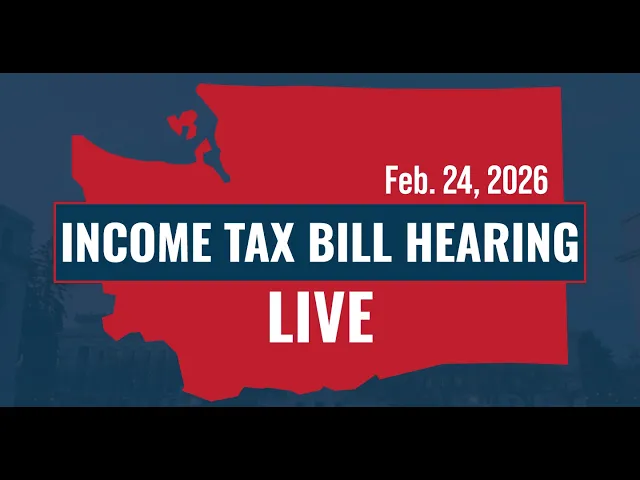
Good morning. Welcome to House Finance. Today is Tuesday, February 24th, and we are going to have a public hearing. It's going to be on Senate Bill 6346. Let's start with the staff briefing from Tracy Taylor. Thank you, Madam Chair, members of the committee. Tracy Taylor, staff to the committee. and gross substitute uh Senate Bill 6346 relates to taxes on persons with income with over a million dollars. Um I'm going to skip for for Brevity sake I'm going to skip background materials which are in the bill report and just give you a highle briefing. The details
are available in the bill report and I'm happy to answer questions with members individually later. uh beginning January 1st, 2028, a 9.9% tax is imposed on the receipt of Washington taxable income. Only individuals are subject to the payment of this tax and the first tax payments and returns would be due in calendar Year 2029. In order to determine a person's Washington taxable income, it starts with the federal adjusted gross income or AGI and incorporates several modifications to arrive at their Washington base income. These modifications are made for capital gains t and uh excuse me capital
gains and losses and for deductions of other taxes that were made at the federal level. In the case of a non-resident Individual, they will also allocate income that is attributable to sources or activities in Washington to arrive at their Washingtonbased income. This bill specifies that income is excluded from the federal AGI, including tribal treaty income, is also exempt from the state calculation unless there is a specific provision in this bill that requires otherwise. From the Washingtonbased income, there are three deductions and one u income increase That are applied to arrive at a Washington taxable income.
These include a standard deduction of $1 million per individual or in the case of spouses or do registered domestic partners, their combined standard deduction is limited to $1 million regardless of whether they file jointly or separate returns. The standard deduction is reduced for an individual who is not a resident for the entire year. The taxpayer may also deduct charitable contributions up to $1,00,000 per individual or in the case of spouses and domestic partners, their combined charitable deduction is limited to $100,000. Third, a taxpayer must add to their tax their tax their excuse me their Washingtonbased
income the taxpayers's distributed share of their tax expense incurred through a pass through entity making an election to pay the tax or making making the excuse me if the Entity makes the election to pay the tax at the entity level. Finally, a taxpayer may deduct the amount deposited in a capital construction fund that is to be later used for the construction, reconstruction, or acquisition of fishing ve v vessels if that contribution amount has reduced their taxpayers's federal taxable income for that taxable year. In addition, a resident may claim a tax Credit for income tax paid
to another state or a public uh subdivision of that state on income that is also subject to tax under this bill. A tax credit is available for taxes owed under the bill for any BNO tax or public utility tax paid on the same income that was subject to this income tax. A tax credit is also available for any Washington capital gains paid on uh capital gains taxed under this bill. Uh there are rules regarding the Allocation and aortionment of income to Washington. For residents, all income is allocated to the the state of Washington. For non-resident
individuals, income derived from sources within the state is assigned to Washington based on various allocation and aortionment methodologies which are addressed in the bill report in great detail. The bill also addresses the aortionment for non-resident professional athletes and non-resident Student athletes. Pass through entities such as partnerships and limited liability companies may elect to pay the tax at the ent entity level. The tax rate is 9.9% and the tax amount would be similar to the Washington tax liability for the individual owners. Beginning July 1st, 2030, sub individuals subject to the tax must make estimated payments to
the department of revenue under rules that uh are aligned With the federal estimated tax payment requirements. Estimated tax payments are not required when the annualized tax liability is expected to be under $5,000. Penalties and interest may apply to underpaid estimated taxes unless the estimated tax payments are at least 90% of the tax shown on the tax return or 100% of the tax shown on the previous year's return. Taxpayers owing this tax must file Annually on a return on or before the filing date of the taxpayer's federal income tax return. Individuals who do not owe the
tax are not required to file a return. Any person who knowingly attempts to evade the tax is guilty of a class C felony. Any person who knowingly fails to pay the tax, pay the estimated tax, make returns, or supply information as required under this bill may be guilty of a gross misdemeanor. Uh the bill provides that if a court of Final jurisdiction invalidates the new tax, the entire bill is null and void. Initiative 211 is amended to specify it does not apply to this new tax. All the new tax preferences created in the bill are
exempt from the automatic 10-year expiration date and the JARK review. And the bill specifies that the new tax is necessary for the sport of state government and its existing public institutions and also specifies that the department of revenue would continue Their implementation um work regardless of whether there is litigation. The bill distributes the revenues from this tax in the following ways. 7% of the revenues are deposited into a new local government public defense funding stabilization account. These revenues must be used by cities and counties for public defense services. There is a formula within the pro
provisions. 10% would be distributed to cities on a per rata basis based on the annual number of Misdemeanor criminal cases filed in the courts in each jurisdiction and the remaining 90% is distributed to counties based on a formula in the bill. The remainder of the new revenues would be deposited in the state general fund to fund tax policy changes within the bill. These policy changes include the bill extending the age requirement for the working family tax credit program eligibility to individuals 18 years of age or older regardless of the number of Qualifying children. This would
expand expanded eligibility would take effect January 1st, 2029. Second, beginning January 1st, 2029, grooming and hygiene products are exempt from the sales and use tax. Third, changes are made to the small business tax credit beginning January 1st, 2029. For non-service businesses, the BIS small business BNO credit is increased from $55 per month in the tax reporting period to $125 per month. For Service businesses, the small business BNO credit is increased from $160 per month to $375 per month and the BNO annual filing threshold is increased to 250,000. Fourth, the BNO search charge on businesses with
gross income exceeding $250 million is expired one year early. That would be January 1st, 2028 instead of January 1st, 2029. Uh finally, the retail services subject to sales tax under uh the uh and gross Substitute Senate Bill 5814 from last session are repealed except for advertising services and that would go into effect January 1st, 2030. There is a fiscal note in EBB. The net impact of the tax and all the tax policy changes in the bill would increase state revenues by an estimated 2.53 billion in fiscal year 2029 and 3.21 billion in fiscal year 2030.
the first full year of impacted collections. This bill would also decrease local revenues by an Estimated 11.6 million in the first four months of impacted collections for fiscal year 2029 and by 158 I'm sorry 150.8 million for fiscal year 2030. The department of revenue would have expenditures of approximately 9.7 million in 2527 and approximately 138.3 million in 2729. That concludes my remarks. Thank you so much. We're going to hear from our prime sponsor, Senator Peterson. Welcome to House Finance. Let's hear about your bill. Good morning, Madam Chair, members of the committee. Jamie Peterson from the
43rd district. I first want to thank Tracy for uh all of the great work and assistance. Uh I think rarely have there been bills where there was such good collaboration between the two chambers in advance on putting together uh what in this case is a very complicated uh bill with a lot of moving parts. Um, Madam Chair, I'm thinking this morning as I'm sitting here really about my kids Who are getting ready to uh go to Garfield High School in uh Representative Street's district. Um, and thinking about what kind of a future I want for
them in our state. I want a future in which there are wellunded public schools, in which there are is a wellunded uh university system coming after them. Uh, I want them to live in a world where there are not, uh, homeless people trying to find shelter on the street. Uh, I want them to live in a World where there's great health care available to everyone in our state. Uh, and that world is pretty hard to imagine with the uh, tax structure that we have right now. Last year, I think we ran squarely into the fact
that uh we have a broken upside down 100-year-old tax system that is just not adequate to meet the needs of our state in the 21st century. and we were backed into uh doing things to try to resolve our Budget shortfall last year that I think probably nobody in this room uh and nobody in the room across the street uh was happy with at all. Um, so really that began a process for me of trying to think about what could be a different way for us to solve this problem and that's how we got to the
uh to the millionaire's tax. Uh, and I've been uh really pleased to work with Representative Fitzgib uh and Speaker Jenkins on this uh proposal over the Last several months. Um and uh the basic point I think is to say our tax system ought to be restructured so that it is not the second most regressive in the United States. Uh you know just up from being the most regressive in the United States, but instead more fairly allocates the burden of all of those services that we want and that we know our constituents want um among the
people who live in our state. Um it is striking if you look at the map U some of our districts are going to wind up having a lot more to contribute uh to this process whereas there are other districts and I think some of each of those are represented on this panel uh where there aren't enough taxpayers uh even to register it would be confidential but uh the the bottom line from all of this is that if we move forward with this proposal we will have the people who are most able to uh shoulder the
burden of providing those Services doing more like their fair share. Uh and it'll allow us uh to reduce the burden on a lot of the other 8 million people who live in the state. And uh I guess as I wrap up, Madam Chair, that's where I really want to say that this committee has a very special role in that process. You are literally the only uh tax specialists in the entire legislature. Uh on our side, uh we do that as part of the general ways and means stuff. So we're working on the Operating budget and
the capital budget and finance. um here uh you now have a proposal that I think uh I hope will come out of the legislature eventually with roughly you know 25 to 40% of the money being spent on reducing the tax burden on uh lower and middle inome people and I think you are best placed to figure out how to allocate that uh I really encourage you to use your creative powers and uh think about the best way to put that package together uh And look forward to collaborating with you on that. But thank you for
the work that you're about to about to put into this and all the testimony that you're about to hear. Thank you, Madam Chair. >> Thank you so much, Senator Peterson. We're going to move into public hearing. Before we get started today, I do want to make a couple of announcements just to establish some rules of the road. Um, but before we even get started with that, I do want to make um a brief Announcement to call attention to something that you may have seen in the press. We have had uh it seems manipulation of our
public comment system following stakeholder reports of impersonation. Initial review indicates that there are over 19,000 duplicate records and over 200 people have been fraudulently signed in on the bill without their knowledge. This matter is being investigated further and I want to publicly acknowledge the damage that's Been done to this democratic process as this fraud has called in has called into question many of the signons onto this bill. Um I also want to alert our committee members as we go through public testimony. I'm asking for no questions um no questions of our testifiers, no questions of
our staff. If committee members have questions for staff or testifiers, they can communicate with them later. I want to do my best to get as many testifiers up Here as possible today. As we begin the testimony, we'll start with 90 seconds on the clock and as we move into the 9:00 hour, that will go down to 60 seconds. I do want to mention to all of our testifiers, I don't give you Okay. Um, I do want to mention to all of our testifiers that we are being recorded and live stream on TVW. Regardless of how
you participate, you must be recognized by the chair or the vice chair before speaking. As testifiers are called upon to provide testimony, the vice chair will call the names of the persons on deck. When the vice chair calls upon you to provide testimony, um remote testifiers will be promoted to panelists to give their testimony. Please click on the join panelist popup when it appears and turn on your audio and your video. Inperson in-person testifiers should approach the testimony table. If you are on deck, we have reserved seating in the front for You to sit. what
before you're being called up to the testimony table. All testifiers should clearly state their name and organization for the official record. And for my committee members, if for some reason you do not um did not hear the name or organization, you may ask a question to clarify that name or organization. I also would like all testifiers to clearly state in some manner whether they're testifying pro or con so that we can accurately capture it Given that some of these uh the sign-ins may not match your testimony. Ranking member Orcott. >> Thank you, Madam Chair. In
regards to uh your statement, uh I just want to uh say that, you know, we're concerned that uh you know, some people have taken advantage of the system. Um we are going to work with the majority party and with our staff to try and make sure our system is secure as possible so that uh it is a valuable tool uh for the public Uh as well as for the legislature. Uh, having said that, I I still think it's important to note that there's over 100,000 unique individuals who have signed in with concerns about this bill.
So, with that, um, let's get to the testimony. >> Thank you, Representative Orcut. Um, and just as an asterisk, we will, uh, we will be coming out with a final, um, hopeful number that removes some of those duplicates, uh, in the next couple Of weeks. With that, Vice Chair Street, >> we will start with the in-person panel of April Sims, Ryan Watt, and Klebsych. On deck will be Rob McKenna, who is remote, Mike Saltto, and Max Martin. Mike and Max, if you'd like to come up to on deck, that would be amazing. Um, Sims, please
proceed. >> Thank you. Good morning, Madam Chair, ranking member, and members of the committee. For the record, my name is April Sims. and president of the Washington State Labor Council, AFL CIO representing more than 650,000 unionized workers across our state here in strong support of 6346. Our tax code is broken. It's a century old artifact that has failed to provide a stable foundation for you all to build a state that Washingtonians deserve. This budget challenge is the latest in a series of disruptions that have pulled the rug out from underworking families just as we were
picking ourselves up From a previous crisis. Workers need stability and rei reliability in the public sector more than ever. Disruptive trade relations, corporate layoffs, and deep federal cuts put us at risk. Healthcare access is backsliding, grocery costs are rising, and the future of work is less secure. These are the kinds of problems our government should help solve, but without proper predictable resourcing, you simply can't. 6346 will help by taxing wealth At the extreme margin and will equip you with the tools to help Washington families. It's time for the wealthiest people in the history of this
world who call Washington home to pay their fair share. Thank you. >> Thank you, Ryan. Please proceed. >> Good morning, Chair Berg, members of the committee. My name is Ryan Watt and I'm the executive director of the Economic Opportunity Institute here to testify in strong support of ESSB 6346, the Millionaire's Tax. This bill is both foundational and commonplace. 41 other states already tax income. And like the working families tax credit, working connections child care, and many other state programs, this bill operates at the household and not the individual level. If passed, Washington state would raise
billions of dollars of revenue to fund K12 education, healthcare, and higher education. It would also give small businesses the largest tax cut in Our state's history, significantly expand a tax credit for working families, uh, and eliminate the sales tax on a wide range of goods and services. Despite what the signins for this bill might show, and I can personally attest to four fraudulent, uh, signins among my staff members, um, the people of Washington, including many Republicans, support this bill, and I strongly urge your support. Thank you very much. >> Thank you, Glenn. Please proceed. Uh
good morning, Chair Berg and members of the committee. Uh my name is Glenn Sitch. I'm a fourth year medical student planning to enter family medicine and a member of Washington Physicians for Social Responsibility. I am here in strong support of Senate Bill 6346. Wealth is one of the strongest predictors of health we have, shaping who we can prevent illness early and who enters the health care system only after Preventable disease has already taken hold. Chronic illnesses like diabetes and hypertension are often manageable conditions when people have access to quality health care and basic necessities. But
what happens when they don't? I have worked with patients who began rationing insulin and suffered severe diabetic complications resulting in amputations of toes and feet. I've also cared for patients whose blood pressure went unmanaged for too long, Ultimately leading to strokes that left them unable to speak or move one side of their body. Again and again, I watch patients struggle not with medical advice, but with affordability itself. Medications are skipped to save money. Appointments are missed while arranging child care. and daily stress makes prevention nearly impossible. In clinic after clinic, we treat the downstream consequences
of economic inequity while pretending healthcare alone can fix it. Passing the millionaire's tax is a choice to practice prevention at the level of public policy. This allows us to address the conditions that shape health pol health before patients reach exam rooms or emergency departments. As a future family physician choosing to build my career in our state, I know I will spend decades caring for the outcomes of decisions made in rooms like this one. I urge you to pass the millionaire's tax. Thank you. >> Thank you. Our next panel is Rob McKenna, Mike Sautello, and Max
Martin. Before they begin testimony, could we please promote the following panel of Jay Blumenthal, Hans Moulders, and Maria Elena Velasquez. Rob, if you'd like to proceed. >> Can a former attorney general of Washington testifying against the bill? Under our constitution, we can have a state income tax if it follows the rules for property taxes. It must be uniform And no higher than 1%. Washington's voters amended our Constitution in 1930 to comprehensively define property as everything whether tangible or intangible subject to ownership. Voters adopted the sweeping definition to subject intangibles like stocks, bonds, money, and income
to property taxes. Six times since then, Washington's legislature has sent constitutional amendments to the voters to exclude income from this expansive definition of Property. All six times starting one year after the Colin decision, voters rejected proposed amendments to allow progressive income taxes by wide margins, most recently with a no vote of 77%. Those legislators asked voters to amend the Constitution's definition of property because they and the Supreme Court understood its plain meaning. The Supreme Court reaffirmed that understanding in a ruling just three Years ago. If this legislature wants a progressive income tax, it should send
a constitutional amendment to the voters and not pretend the Constitution isn't clear unless every legislator who votes for this bill is prepared to explain why taxpayers don't have a property right to their own income. As you all know, it isn't the legislaturator's role or the state supreme court's job to rewrite our Constitution to override a decision the voters made and have repeatedly Reaffirmed. Thank you. >> Thank you, Mike. Please proceed. Hi, I'm Mike Satello and I'm with the Ethnic Chambers of Commerce Coalition. We started about 10 years ago when we felt it was important for
us to have representation through the other business chambers. About 2,000 members, primarily small business, uh, restaurants, I mean, you name it. We're all over Washington State, primarily in King County. And, you know, we we've Been, it's been a journey for us to watch what's going on here in Washington and and we see things happening. I mean, yeah, we've had to deal with a number of things in regards to homelessnesses that was brought up. I mean, we they're right in front of our stores. The crime is right in front of where we work. Have a hard
time keeping our employees. And now we're stuck with all kinds of things that are coming from the state that aren't very um tax friendly for us. We Pride ourselves on generational wealth. We pride ourselves on being able to give our children, our grandchildren that opportunity, whether it's within our own business or something related to it. This pretty much dissolves it. This is just another tax that's going to make us not able to to generate wealth in our families. It limits access to capital is there's a it makes a higher loan denial for us. It's just
something that we don't need. And we're asking this group To please don't pass this bill. This could be very damaging to 20% of all small businesses, emerging businesses or minority. You want to help minority business, don't pass this bill. Thank you. >> Thank you, Max. Please proceed. >> Chair Berg, Rick Member Orcut, members of the committee. For the record, Max Martin here on behalf of the Association Washington Business in opposition to engross substitute Senate Bill 6346. While this proposal is framed as targeting high earners, we're concerned about the real world impacts on small medium-sized businesses
organized like escorps, LLC's, and other pass through entities. In practice, attacks aimed at individuals would become a new tax on employers, including businesses that may have a strong year on paper, but need the cash to reinvest into their business or weather volatility. This is coming at a time when many employers are still Absorbing last session's operating cost increases. We appreciate the business tax relief included here, but we believe Washington could could be doing more to support small and medium-sized businesses, strengthen competitiveness, and expand economic opportunities. For those reasons, we respectfully oppose the proposal before us
today and look forward to working with lawmakers. Thank you. >> Thank you. Before we move to our next Remote panel, um could we please bring up Jeff Peralt in the on deck space and promote Steve Gordon and Brent Fry. Jab, if you'd like to proceed. >> Hi, first of all, can you hear me? >> We can. >> Thank you. Good morning, Chair Berg and members of the committee. My name is Jay Blumenthal and I'm testifying in strong support of Senate Bill 6346. I'm a lifelong Washingtonian. I've paid the state capital gains tax since its start
And I expect to pay the proposed state income tax in most every year. I got a job at Microsoft straight out of college and in short I made a bunch of money. I like to think that I'm smart and I work hard but mostly I was in the right place at the right time. I want to give just one example of the many ways that the rich get richer in inequity in Washington increases and that is how easy it is once you've made a fair bit of money to make a whole lot more money. By
the time I was 30, I could make high return investments simply unavailable to the vast majority of people. And these investments had some risk, but only that of losing a modest amount of money. My wealth meant that there was no real risk to the quality of me or my family's life, no scenario where I was going to lose my house, not be able to pay for health care, not be able to send my kids to college. Our economic system, including our state's upside down tax System, works extremely well for the already wealthy. I've heard it
suggested that the willing wealthy can just voluntarily donate to the state. Sure. And maybe 10% of them would do so. And we could likewise try to fund public schools or roads or the police with voluntary bake sales. And maybe 10% of us would buy cookies. It's not a serious suggestion. We need tax policy where all rich people, not just those who want to, are required to pay their fair share Into a system that works so well for them. And I'm very happy to do so. Please vote yes on Senate Bill 6346. >> Thank you. Hans,
please proceed. >> Good morning. My name is Hans Boulders. I own Chalan Hospitality Inc. in Leverworth and I'm testifying in strong support of 6346, the millionaire's tax. Let me be direct. The wealthiest people in this state, my wife and me among them, are not paying our fair share. And the result is that working families and Public schools are asked to make up the difference. When someone realizes a $2 million capital gains under this bill, they would direct roughly $100,000 towards teachers, childcare providers, and essential services. And the multi-millionaire would still walk away with $1.9 million.
If that feels like a hardship to anyone, we have seriously lost all perspective. For decades, the tax changes in this country have overwhelmingly benefit the top 1%, while The bottom 80% have fallen further behind. Meanwhile, we underfund schools and tell children there isn't enough money. There's plenty of money. It's just concentrated at the top who refuse to participate in the well-being of the bottom 90%. Less than 1% of Washingtonians would pay this tax. The other 99% would benefit from stronger schools and healthier communities. To my fellow millionaires, none of us built our wealths alone. Our
Wealth alone. We drove on public roads. We shipped goods through public ports. We hired graduates of public schools and universities. We benefited from a stable legal and financial system funded by taxpayers. Taxes are not punishment. They're the price of a functioning society. If we believe in opportunity, fairness, and in the future of our children, then it's time for those of us who have done extraordinarily well to continue accordingly. Pass this bill. >> Thank you, Maria. Please proceed. Good morning, Chair Berg, and members of the committee. My name is Maria Elena Velasquez, and I am pro.
A small 9.9% slice from earnings after $1 million is a very small contribution from the ultra wealthy, but it can make a huge difference to me and my students. A little about me, I'm a fourth grade general education teacher at Einstein Elementary School in Redmond, Washington. Of the 400 plus students in Our school, 25% of them receive multilingual services. I am proud to serve such a unique and diverse student population. Despite being one of the wealthiest districts in our state, Lake Washington has had to make several budget cuts. These cuts impact my classroom in harmful
ways that leaves students with unmet needs. For example, I started the school year with 32 students in my class. A class that large is incredibly tough to serve because the Range of needs is extreme. Student progress is limited when class sizes are that large. More funding would allow for smaller classes and better learning. Another way that budget cuts have affected me is that I no longer have access to instructional resources. This summer, our district's print center closed permanently. That means I don't have any way to print workbooks for the students during to use during class.
Additional funding would make it Possible for us to reopen the print center so that we can provide learning materials that students need during classroom instruction. Remember, 9.9% is a very small contribution from the ultra wealthy, but I've just told you how much of a difference it will make to me and my students. Thank you. >> Thank you. We have two remote testifiers on this next panel and one in-person testifier who I don't see and we don't see online. So, Jeff Peralt, if you're Here, please come up. Um, in the meantime, we will go to our
remote testimony. Steve Gordon, please proceed. >> Thank you. Steve Gordon representing concerned taxpayers of Washington in opposition to this bill. Our families operated businesses in Washington for nearly a hundred years. While marketed as a millionaire's tax, it directly hits family-owned businesses and farms and the investments we already make in Washington communities. The targeted income tax clearly violates our state constitution and nearly a century of Supreme Court precedent, which is curious since many supporting lawmakers question potential federal unconstitutional actions while overlooking long-standing state constitutional issues in this bill. Supporters wish to fix Washington's progress uh regressive
tax code that they claim but seem to overlook some basic math. Dollars paid budget, not Percentages. The tax collections from a 6.5% $100,000 sales tax bill provide a lot more dollars than a $10,000 sales tax bill. You can argue the fairness, but you really can't argue the math. Even more troubling, the state's largestly publicly traded corporations escape from this tax. Folks like Microsoft, Amazon, Costco, Starbucks, and others don't have to pay this, while family-owned businesses and farms do. In fact, the largest businesses receive a Half billion dollar tax break with the early sunsetting of the
BNO sir charge for large corporations. So, I urge you to uphold your constitutional oath, protect Washington employers and workers, and vote no on this bill. Thanks a lot. >> Thank you. Um before we go to our next testifier, let's call up the next uh panel so that they are ready. That consists of Molly Gallagher, who I believe is in person, so if you'd like To come take a seat, um Alina Stewart and Na Nathaniel Wither, who are remote, however, we don't see Nathaniel online. So, Nathaniel, if you are there, please accept the promotion. Um, in
the meantime, we will turn to Brent Fry. Please proceed. >> Thank you, committee members. Uh, my name is Brent Fry. Uh, I'm opposed. I'm founder and chairman of Terraclair. I've started four successful businesses in our state, including Smart Sheet, and Have employed over 5,000 people who've all been owners in these companies. We've succeeded because these people were incredibly hardworking. Their motivation and their choice to work hard and take risks was always for the proud promise that if we built something useful and innovative that someday there would be a large financial reward and that they could
move themselves and their families up the generational income scale. Washington state is taking Away this incentive from the very people that power our economy and they'll go elsewhere to keep what they've earned. Our employees now see that with federal taxes and Washington state's passed and proposed tax bill, they will forfeit over of what they've worked decades for. You get less of what you tax and you get more of what you subsidize. That's why California has 12% of the US population and 33% of the US welfare recipients. There's no reason at all to start a Business
in Washington state anymore. Our hard work goes to wasted spending. My company's actively shifting our operations away from the state of Washington and I'll leave as soon as I possibly can. Uh terrible shame. Please vote no. >> Thank you. Molly, if you'd like to come up, we will start with you and then move to Alina. Nathaniel still does not appear to be online. This panel will be followed by another remote panel of Michelle Williams, Len Zarelli, and Brett Fel. Please promote them. Please proceed. >> Uh, good morning, Turberg, and members of the committee. My name
is Molly Gallagher, and I am the coalition manager of the Direct Cash Coalition, a statewide group of over 50 diverse organizations. testifying in strong support of this bill. We believe that flexible, unrestricted cash is the best way to address the root cause of Poverty. To balance our state's upside down tax code, we need to raise progressive revenue and decrease taxes for working people through tax credits. The Working Families Tax Credit is the most effective spendside tool for maximizing tax fairness. We are pleased to see this bill expands the credit to return muchneeded cash to the
pockets of our state's lowest income residents, directly balancing the tax code by expanding eligibility for the working Families tax credit to all adults over 18. This bill takes a targeted step towards tax fairness. The average income of the seniors and young adults who would be impacted by this expansion is around $17,700 annually, which is not enough to meet basic needs in any county in Washington. Um, in contrast, the average income of the household who would pay the millionaire's tax is $3 million a year. The cash boost from the working families Tax credit is an important
component of our social safety net, but it cannot replace cuts to essential programs that serve largely the same population. Uh, we applaud this bill for expanding the working families tax credit, and we urge you to ensure that our state general fund has enough to adequately fund services like healthcare, child care, and food assistance. When the state funds the programs and services we all rely on, the working family tax Credit dollars can go further to help families thrive. Please support this bill and working families tax credit expansion. Thank you. >> Thank you. Alina, please proceed. >>
Good morning, Chair Berg, and members of the committee. I am here today to testify in support of bill 6346. My name is Alina Schwart and I live in Aotan County. I am a steering committee member of the direct cash coalition and was on the poverty reduction workg Groupoup steering committee. I have received the working families tax credit every year since it launched and strongly support the age expansion in this bill and taking this step to fix the upside down tax code. I am very grateful for this credit and use mine to pay my phone bill
for a year in advance for my husband and I. It takes one monthly payment off my list and I know it's taken care of so that doctors and schools and my children can always reach Me. I live very rarely where we will we are not there are not a lot of work options for seniors and disabled or recent graduates. Most of us live paycheck to paycheck and sometimes have to choose which bill to pay and which can wait. The elderly often have to arrange rides for health care and even to get simple groceries. Or youth
aging out of foster care do not have a lot of option either and are often turned out with no fanfare and nowhere to go except Maybe a friend's couch. extending the eligibility of the working family's tax credit could be a huge help. It could mean a deposit on a studio apartment, money they wouldn't otherwise have all at once to get into a place of their own. I worry about losing this support as kids get older and our eligibility changes. As our nest empties, I worry that we won't qualify in the future and eventually that will
mean we have to struggle each month to pay for our way To communicate with our family and other places. We need to be able to receive calls from our children will always >> Thank you so much. Elena, thank you so much. >> Um, thank you Alina. Our next testifier will be Michelle Williams followed by Brett Varel. Len Zarelli does not appear to be online. After this panel, we will have Gwen Goodfellow. So, if you'd like to come up and get situated, as well as Ian Muhammad and Julia Perez, who are Remote. Michelle, please proceed. Chair
Berg and committee members. I'm Michelle Wilms with the Associated General Contractors and we're here today opposed to this bill. Joining virtually joining me virtually, you'll hear from a few members of our association to to hear about the impacts that this bill would have on their businesses. This bill is described as a tax on millionaires, but in reality, it's a tax on businesses structured as LLC's, partnerships, and Escorps pass through entities. While the income from these businesses appear on the owner's personal tax return, in the construction industry, that is not many money sitting in their personal
bank, it's working capital. Construction is a low margin industry. On paper, a contractor may show more than a million dollars in income, but that does not equate to take-home pay in the W2 sense. It's it's income that is invested back into the business. It funds purchases of New equipment, tools, covers bonding, insurance costs. It supports payroll during tight cash flow periods and while contractors are waiting for payments from owners. It allows businesses to reinvest, grow, and employ people in their communities. This is not a tax on excess wealth. This is a tax on cash flow
that keeps small and medium-sized contractors operating. We please oppose this bill. Thank you. >> Thank you. Um Brett, please proceed. >> Brett Ferulo. I'm the co-owner of Northwest Construction in Belleview and I'm a fourth generation union contractor and I'm here in opposition to Senate Measure 6346. As noted, most closely held businesses are passed through entities, meaning the earnings from those companies passed to the owners on their personal income tax returns. However, the after tax money is then substantially reinvested into the business to help it grow. For my Company, reinvestment means purchasing construction equipment. More construction
equipment means hiring more workers. This tax is not an inconsequential measure that is immaterial to business owners. It's a diversion of money that would likewise be or otherwise be invested in those companies to support growth as well as adding a margin of safety during difficult years of which we are very much in a difficult year right now. This State needs healthy and growing small and medium businesses. Companies must grow to hire workers and they must invest in order to grow. Money directed away from investment will impact job growth. Thus, this measure will impact well beyond
the 20,000 families that are estimated to be subject to this tax. The result for a company such as mine will be less equipment possibly and slower hiring of union workers at family wages. Thank you for your time and I urge you To rethink Senate Bill 6346. Thank you. >> Thank you. Lind Zarelli does not appear to be online, so we will move to our next panel. Before doing so, um, if we could have the succeeding panel to our next panel, um, come up. We have Ryan Frost and Andrea Smiley who are in person. So, if
you come to the on deck stage, that would be great. And then Ryan Lickl, who is remote, please promote them. Gwen, please proceed. >> Thank you, chair, and committee members. My name is Gwen Goodfellow. They heard from Long View and I am a proud SEIU775 caregiver speaking in support of SB6346. Two of my clients are at risk of losing hours due to budget cuts. One is an ambulatory wheelchair user who after years in a nursing home following her parents' death finally learned she could live independently with the help of caregivers. These cuts would send her
back. The other is my son who has Schizopeffective disorder. when his hours were cut off before he was hospitalized within 9 months. I will not abandon my son. But I would have to take on more work to survive. And if my health fails, who steps in? Without services, people don't magically become independent. They end up in hospitals and institutions or worse. I hear that millionaires will leave if asked to pay more. People don't choose where to live Based on one tax line. They choose community, opportunity, and quality of life. Caregivers and vulnerable residents don't have
the option to leave. It's time to fix our upside down tax code and protect the people who truly cannot afford these cuts. Thank you. >> Thank you. Before moving to Ian, Julia Perez does not appear to be online. If you are, please accept the promotion. Ian, please proceed. Uh good morning chair and the members of the committee. My name is Ayan Muhammad and I am here today in strong support of the SB 6346. I am a proud member of SEIU 925 and I work with the family success center where I support families and childcare providers
across our community. Um I originally worked in finance but I chose child care because I wanted to make a meaningful difference in our children's life. Um, as someone from a refugee Family, giving back to my community is deeply personal. Child care is the work that makes all other work possible. Providers open their door early so parents can go to their jobs and keep our economy moving. Yet, the people doing this essential work are often paid poverty wages, and that is not right. Uh, I'm doing my part. Childcare providers are doing theirs, but for too long,
the wealthiest in our state have not done theirs. Working families and Immigrant communities should not be carrying more of the burden than millionaires. It is time for fairness, passing millionaire tax, and invest in childare. Investing in childare is investing in working families and in our future. Thank you. >> Thank you. Our next panel is Ryan, Andrea, and Ryan. Um, if you guys could come up as we wait for them to get seated. The following panel is David Carney, Tim Mackey, and Guadalupe Paretes. If we could promote David and Tim, who are remote in Guadalupe, if
you'd like to come get seated in the on deck area, that would be great. Ryan Nickel, please proceed. >> Oh. Um, thank you, Chair Burke. Members of the committee, for the record, my name is Ryan Frost. the director of budget and tax policy at the Washington Policy Center. Uh we oppose Senate Bill 6346. While 23 other states are cutting taxes, Washington is raising them at record pace. And despite that, somehow we are still facing annual multi-billion dollar deficits. In 2014, Washington had the sixth best business climate in the country. We now have the sixth worst,
which is the largest drop of any state. between the capital gains tax, the long-term care payroll tax, BNO increases, and other new taxes. The legislator is collecting tens of Billions of dollars in new revenue. Every dollar of that was spent, then billions more beyond that, culminating in last year's 12 billion shortfall in the largest tax increase in state history. Each round of tax increases has funded new permanent spending commitments that outpaced revenue, produced the next deficit, and became the justification for the next tax increase. Legislators and supporters of higher Taxes have been using terms like
fair share and regressive to justify new taxes for a decade. Not once have those new taxes resulted in meaningful reductions to the sales tax, the BNO taxes or property taxes. Our current level of spending and taxation is not sustainable and is actively harming our state and no amount of political messaging will obscure that fact. I urge no vote. Thank you. >> Thank you. We'll continue with in person Testimony. Ryan Le will get to you at as at as at as at as at as at as at as at as at as at as at as
at as as at as as at as at as as at as as at as as at as at as the conclusion of this panel. Uh Andrea, please proceed. >> Thank you. Good morning. Andrea Smiley here on behalf of the building industry association of Washington here opposed to this bill. The bill is described as a tax on millionaires. However, without carry forwards or income averaging for Pass through entities that becomes a tax on small business that has the power to destroy housing production and renovation. Construction, as you've already heard, is a capital intensive um endeavor.
Our members invest millions upfront in land, permits, materials, and labor, often carrying losses for years before a single home is sold. Income doesn't come in steady paychecks. Rather, it comes in one concentrated year when a project is completed. Taxing That one year without recognizing prior losses ignores exactly how construction actually works. In most states and under federal law, businesses can carry losses forward or or average their income. That's not a loophole. That's smart and basic tax policy. it. If we don't include those tools, we risk dis discouraging investment in housing at the very time that
we need it most. Thank you. >> Thank you. Uh remote Ryan, please Proceed. >> Hello. >> We can hear you. >> Hear me? >> Yep. >> All right. Perfect. Thank you. Good morning, Chair Berg and members of the House Finance uh Committee. Thank you for the opportunity to testify in opposition of ESSB 6346. My name is Ryan Lickl. I am the CEO of Western Refinery Services in Watcom County. We have 230 employees performing mostly civil construction and trucking services. Both construction and trucking is work that requires a lot of costly equipment. As an escorp, our
business income goes through the tax return of the owner of the business. It means that the money used for company growth and expansion, debt payoff and federal tax payments, etc. will be taxed by this additional 9.9% tax. With the addition of this tax, it will increase my overall Tax burden by 30% and will hinder our company's ability to grow. Please reconsider this tax. >> Thank you. Um, we will now go to our next before going to our next panel. Um, I'd like to get the the following panel up and ready. They are all remote. Jonathan
Lton, Britney English, and Ron Arp. Please promote them. At this time, we'll move to David Car. It looks like Guadalupe is not here. Oh, yes, please. Okay, great. You can come up, please. And then we'll go to our remote test. Yeah, in the front. Yeah, there we go. Please proceed whenever you're ready. Fire. As a Foreman. Good morning. My name is Guadalupe Paredes and I live in Pacific County. I work full-time and I'm a mom of three kids. I'm here supporting the millionaires tax. I'm also a volunteer with Firelands Workers United. In spite of all
the work I do, it's never enough. This year, I have all my kids in public schools, and parents know how it is. There's never enough materials or resources. I have to buy everything, books, uh, pencils, notebooks, posters, and things that are needed in art and in science class. All parents have to buy out of their own pocket because the resources in school are not there and it's even looming more because of more Cuts. Since we're a small district in a rural county, we've never had after school programs. They also closed one of the public libraries
in Raymond because of uh lack of funds. They say they don't have enough money to pay staff. We only have one library in that entire area. Meanwhile, mil millionaires are getting richer each day. And if the super rich would only pay their share of of taxes, we would not be facing so many cuts in Programs. How long are things going to keep staying like this? We work hard and we have a right to a dignified life. We want to breathe, but we can't breathe with everything we have to pay. >> Thank you. >> Thank you.
Uh David Carney, please proceed. >> Good morning, Madam Chair Berg and committee members. My name is David Carney and I'm a Washington Federation Of State Employees member from Forts, Washington here to testify in support of the millionaires tax. I work every day helping families in my community access the programs and services they need to keep above the poverty level such as cash and benefits. I took this job in 2020 believing that state work would be a path out of poverty and struggle. And at first that felt possible. But over the last 6 years, every single
expense, groceries, utilities, rent, even basic Services has gone up by 50% or more. My wages haven't kept up and neither has anyone else's. I know this because I see these families and these numbers every day. I live in a shed I built myself because home ownership is out of reach. I fix my own car, patch my own roof, and do everything I can to make ends meet. But the match just doesn't work anymore. Like many of my co-workers, I serve the public every day, but I can't afford the very life I'm helping others reach for.
I believe Washington can do better for its workers, for our neighbors, and for the future we all share. It shouldn't be about helping folks scrape by, but giving them a real chance to build a good life. That's why I'm asking you to support this millionaire's tax so working people can live with some dignity, stability, and hope for the future. Thank you for your time. >> Thank you. Um Tim, please proceed. >> Hello. Uh my name is Dr. Tim Mackey. Um So I'm here pro um the bill. Uh so I'm a biology professor at Cascadia College.
This is a community college in both. Um I'm also vice president for contingent faculty with AFT Washington. That's American Federation of Teachers Washington. So I teach biology at a community college. This is teaching students who are preparing for careers in health and science fields and they're coming to our community and technical colleges because what we offer is Quality instruction and low class sizes at affordable prices. Right now, our enrollment basically across the CTC system is up 7.5% over last year and yet last year our budgets were cut uh in this 1.5% in the same period.
This is creating a situation where we can't offer the courses that our students need. I'm going to say something a little bit controversial right now. Um economic growth does not come from the large s of The wealthy. It comes from my students getting college degrees with minimal debt or being able to upskill so that they can earn more money. If we're serious about economic growth in this state, we need a highly educated workforce, which means we need stable and well-funded community and technical colleges. Thank you. >> Thank you. It does not appear that Britney or
Jonathan Lton are are online. If you are, please proce please accept the promotion. Um, before we move to Ron Ark who is the other person on this panel, let us bring up Sam Hatson Beer to the on deck area as and promote Joel Ryan and Matt Lotion who will be part of that following panel. Ron, please proceed. >> Good morning, chair, ranking member in committee. Ron Arc, president of the business leaders group identity Clark County, speaking in opposition of the Income tax measure. I'm also supplying a le letter of caution signed by seven business groups.
The persistent introduction, expansion, and talk of more tax tools is hammering the competitiveness of Washington state. During this legislative session, we've been alerted to multiple Southwest Washington businesses and families preparing to change their residents and business location to a more predictable tax environment. This includes Construction, food, insurance, professional services, even philanthropists. Redomiciling is fast becoming a new specialty among business circles. Chasing away capital is no way to support our economy and tax base, create a million jobs, or build a million homes. We have significant concerns with this proposal. Marriage penalty, pass through revenue, the steep
rate, and the ease with which it will become an income Tax for everyone. It's not necessary to imple implement the budget. So, please do not pass or advance this bill. Thank you. >> Thank you. It looks like we now have Britney. Britney, please proceed. I apologize. Can you guys hear me? >> We can. Thank you. >> Okay. Um, thank you for hearing me today. This bill is I am on as con. >> Britney, if you could uh state your name for the record, that'd be appreciated. And if possible, turn on your camera. >> Yeah. My
name is Britney Engles. I am from the district 7. Um, apologize for my video. We don't have very good cell phone service here because that broadband bill didn't get passed. So, um, I am here. Uh, it seems that you are counting on citizens not to understand that this tax would necessarily be applied to all taxpayers, not just the millionaires. Seems you have duped the other people, but not all of us. The Lottery and cannabis money still haven't been accounted for. You can't be trusted to earn to use any more of our hard-earned money. You keep
passing bills that drive out jobs and businesses and wonder why our job and housing market are low. Our state is having a shortage, but that's due to the irresponsible leaders passing more bills that are at a cost to taxpayers and not addressing the funding issues. Taxpayers have repeatedly told you they don't want This income tax, and yet you continue to work against the very people you are sworn to represent. Do you plan to amend the constitution as well? This question has been asked multiple times. Nobody is giving us an answer. It clearly states that as
well as an RCW 190 says that personal income tax prohibition. So I don't understand why this body keeps passing bills that the people have repeatedly asked you not to Be passing. Um, if I can get some of those questions asked answered, that would be great as to why this isn't being put to a vote. Why the wording is specifically geared to make it to where the people can't vote on a tax that will be given to everybody, not just the millionaires. And I don't know why the people on this panel seem to think that it's
going to go toward education when >> Thank you. Thank you so much, Britney. >> Your time is up. Thank you so much. >> Thank you. Uh our next panel is Sam Hatenbeer, Joel Ryan, and Matt Lotion. Before we move to them, let's prepare the next panel of Todd Meyers and Sam Spiegelman who are remote and then Zack Kubin who I believe is in person. If you'd like to come up to the on deck area, that would be great. Sam, please proceed. >> Good morning, Chair Berg, members of the committee. I'm Sam Hatson Baylor, legislative director
at the Economic Opportunity Institute, testifying today in strong support of Senate Bill 6346. This is a modest um targeted reform that asks the very highest income households contri to to contribute a little more so that working families can afford to live in our state. And even with this change, a household earning $1.2 million per year would still enjoy the lowest effective state tax rate in the country amongst the 41 states with an income tax. In fact, that same household would Pay nearly $40,000 more per year if they live just across the border in so-called low
tax Idaho. Thanks to our large $1 million household deduction, Washington's proposal remains significantly more generous. Less than 1% of households in our state would be asked to pay this tax. households that earn on average enough in a single month to afford $160,000 down payment on a t typically priced Seattle home. Meanwhile, working families are Struggling to earn every month to cover rent, child care, and groceries. The revenue from this bill would put money back in the pockets of working people by funding child care, health care, and by expanding the working families tax credit. This policy
is modest for those at the top, but transformative for families across Washington. and compared to Idaho, it's still a bargain. I urge your support. Thank you. >> Thank you so much. As we move into the Nine o'clock hour, the clock will be set at 60 seconds. I do want to remind testifiers, please do not impugn the motive of anyone either in support or against the bill. And please do not impugn the motives of our committee members or legislators. Vice Chair Street >> Joel Ryan, please proceed. >> Hi, good morning everybody and good and to Chair
Berg and members of the committee. My name is Joel Ryan. I'm the Executive director of the Washington State Association of Head Start and ECAP. I'm here today in strong support of Senate Bill 6346, the Millionaires Tax. I support this proposal for three reasons. First, it'll help ensure Washington has the resources needed to maintain child care subsidies so parents can work and providers can remain open. Without new revenue, Working Connections Childare faces significant cuts that will reduce access for families and Lower provider payments. Second, this proposal makes our tax system fairer. In Washington, low-income households pay
about 13.8% of their income in state local taxes, while the top 1% pay about 4.1%. The millionaire's tax helps rebalance that burden, so low-wage workers and families with young children are not carrying the greatest share. Third, the bill applies only to income over $1 million and would take effect in 2028, Capturing only a small portion of the substantial gains high income households have received from recent federal taxes. Thank you for the opportunity to testify, and I respectfully urge you to support this bill. Thanks again, >> Matt. Please proceed. >> Good morning, Chair Berg and members
of the committee. I'm Matt Ocean. I would pay this tax and I'm testifying in strong support of SB 6346. Before retiring, I worked with Microsoft for Over 21 years where I became the global lab manager for product sports services. I started out as a debtridden student from a debt-ridden Washington family and it made myself into a wealthy person. But here's how I see it. I was wealthy even before I made my money. In addition to great parents, I and all the hundreds of people I hired at Microsoft benefited from good public education system. We had
public transportation. We had healthcare. We had clean water and safe Food. We had access to culture and recreation. We had safety and justice. We had all the things necessary to work hard and make a successful company. Now I'm given the opportunity to give back to the state that made me so that we can build better Microsofts and Amazons and Boeings. And I couldn't be more proud to do so. Why would I want to leave the best state in the nation, the state I helped build? Why would I expect this state which made me to who
I am today to Go without me paying my fair share? I'm from here. I'm proud of my state. I'm not going anywhere. and I'm ready to do the right thing to make. >> Thank you so much. >> Our next panel will be Todd Meyers, Zack Kubin, and Sam Spiegelman. Before we go to them, let's prepare the next panel of Filma Fontineia, Julia Gancherova, and Josie Tracy who are remote. Um, Zach, if you'd like to come up and Start, you'll be followed by Todd and then Sam. Good morning, chair and members of the committee. My name
is Zach Cubin, representing Americans for Prosperity in strong opposition. While marketed as a millionaire's tax, this proposal is an income tax on everyone with a $1 million deduction that can easily be lowered in the future. As a grassroots organization, we speak directly with voters across the state daily. Here's Some of what we're hearing. It's millionaires today, everyone else tomorrow. I'm not a millionaire. I own a small business and my business income shows up on my personal taxes. That money goes to payroll and keeping my doors open. The deduction is per household. That penalizes marriage. We've
rejected an income tax repeatedly. Why aren't officials listening? Lawmakers should take these concerns seriously. At the end of the day, public Policy should be judged not by its intentions, but by its results. Relying on a mobile and volatile tax base to fund essential services is risky. If capital leaves or recession hits, the shortfall won't disappear. It will fall on the very program supporters of this bill are trying to support. Thank you. >> Thank you, Todd. Please proceed. >> Good morning. Thank you, Madam Chairwoman. My name is Todd Myers. I'm the vice president for research at
the Washington Policy Center and I've worked in environmental policy for a quarter of a century at DNR and the Puget Sound Salmon Recovery Council. The greatest opportunity we have to leave our planet better than we found it with more salmon, fewer forest fires, and less pollution is to promote conservation technology. Washington is home to some great environmental innovators like Earth Ranger, which protects wildlife using AI and is funded by the Allen Foundation. Washington should be doing everything it can to welcome environmental innovators to our state. And as you just heard, we used to have the
things that welcomed innovators and create those. No more. These organizations are outliers. According to the Biden administration, Washington ranks 36th in the nation in green jobs. A state income tax would send a message that environmental innovators like these are not welcome anymore. To build a Conservation technology sector that will solve our most difficult environmental problems while creating great jobs and economic growth, the legislature needs to reject this destructive tax on environmental innovation. Thank you. >> Thank you, Sam. Please proceed. Committee members, my name is Sam Spiegelman. I'm associate counsel with the Citizen Action Defense Fund.
We oppose this bill because it violates the state constitution's express prohibition Against graduated non-uniform taxes that create arbitrary classifications. Last week, we published a memo by Rob McKenna in which the former attorney general noted, as he did earlier in this hearing, that the bill creates two categories within a single class of property tax at different rates. If passed, this bill will not survive even the most cursory constitutional challenge, let alone the robust ones it is sure to face from groups like ours Committed to ensuring that all branches of the state government do not take Ultra
Vera's action at the expense of Washington's voters. Those to whom the Constitution does confer the power to tax income via the referendum and amendment processes. In light of its constitutional defects and actual adverse impacts, we respectfully urge the House vote no. Thank you. Thank you. Our next panel will be Filma Fontineia, Julia Gonerova, and Josie Tracy who are remote. Before we move to them, let us prepare the following panel which is Karen Pulley, Sher Harris, and Michael Woody who are also remote. Filma, please proceed. >> Good morning, Madam Chair Berg and ranking member Orcut. My
name is Filma Fontilia and I'm a middle school teacher in the Clover Park School District. I teach in a K12 alternative setting where many students carry heavy burdens long before they walk through our doors. I'm Testifying pro on SB 6346 because our schools don't have enough resources. Educators understand that when students basic needs are met, their capacity to learn expands. A hungry or struggling child cannot fully engage in the classroom. Yet far too many students still come to school without this. And many stu many districts simply don't have the resources to bridge that gap. The
imbalance of our state's tax system is regressive. This mismatch places an Even greater burden on families who are already struggling, and it leaves schools and children paying the price. Our kids are resilient, but resilience should not be their only resource, and they deserve a state willing to invest in them. Please pass the millionaire's tax. >> Thank you, Julia. Please proceed. >> Hello, my name is Julia Gancherova. I'm from Ukraine. My family and I arrived in the United States in 2022. I'm here to Support SB6346 because we need new revenue to stop devastating cost to care.
I work as a caregiver for my mom. She's one of nearly 3,000 immigrants who will lost their access to long-term care this October simply because they are immigrants. When the war started in Ukraine, my family and I witnessed very bad things happen. We prayed and God blessed us. Finally, we landed in Spokane. Unfortunately, my mom's health Began to fail and I became her caregiver. I received just 30 hours a month to help her. It's very difficult to build your life from zero, especially when you are almost 70 years old like my mom. Her house is
destroyed and she doesn't have any chance to build her life anywhere else. If my mom loses her medicate, it will be a slow death. No doctors, no medication, no care. I'm asking you to support SB6346. This support is not solely for the Benefit of my mom but for the >> Thank you so much. Thank you. >> Thank you, Josie. Please proceed. >> Uh hello, my name is Josie Tracy and I'm a psychologist um and a member of Washington Physicians for Social Responsibility. We're an organization of health professionals dedicated to improving health access across Washington state.
We strongly support this bill. Um, our organization focuses on the upstream factors that influence Health outcomes, like having enough income to meet basic needs. And we know that people with the lowest incomes have some of the poorest health outcomes. Um, in our state for life expectancy, and this is 2025 data, there is a 14 12year difference between residents of San Juan County, which is one of our wealthier counties, and Pere where I was born, which is one of our lower income counties. 14 and a half years. Um, this tax asks for those with the greatest
Ability to pay to contribute just a little bit more so we can give tax relief to low-income families and fund critical social programs. We have a chance here to improve the health outcomes for Washingtonians who need it most. And so we urge you to pass this bill. Thank you. >> Thank you. Our next panel is Karen Pulley, Sher Harris, and Michael Woody who are remote. Before we turn to them, let's prepare the following panel, which Is Gabby Nazari, Vanessa Seedera, and Courtney Nomad, who are also remote. Karen, please proceed. Karen, I believe you're muted. Karen,
can you hear us? You're muted if you're speaking. Okay, while Karen figures out her technical issues, let's try Sherry Harris. >> Good morning, Chairberg and committee members. My name is Sheri Harris and I am the owner of our small business that Has operated in Seattle for 15 years. I'm here today with AGC, ACE, and a small coalition of small business owners who stand in opposition of this bill. This legislation would harm small businesses and directly impact our ability to survive and grow in an already challenging economic climate. I urge this committee to take the time
to understand the LLC business model and the tax structure it requires. A company may show over a million dollars in Income on paper, but that does not equate to personal take-home pay the way a W2 salary does. That income is the source of reinvestment and operational stability. The cost of doing business continues to rise. Keeping up with the cost of salaries, medical leave, insurance is very expensive. Purchasing equipment and materials have become significantly more costly. The income we report on paper allows Sher, your time is up. Thank you so much. >> Thank you. >> Thank
you, Karen. I believe you have taken yourself off mute. Let's try again. So Karen, it looks like you're off mute, but we still can't hear you. Um, is your microphone connected? If you look at the bottom right hand corner of your screen, there might be a microphone icon. No. Okay. Well, stay put. Um, keep working on the tech and we're just going To move on to the next person. Uh, >> Michael Woody, please proceed. Great. Thank you. Uh, greetings chair and members of the committee. Uh, thank you for the opportunity to speak. My name is
Michael Woody representing Visit Seattle and the meetings and conventions industry in Seattle and King County to share an economic concern and opposition related to ESSB 6346. Many states with income tax systems include a safe harbor for non-residents, Allowing individuals to conduct business briefly before income tax applies. This provides clarity and predictability for short-term visitors attending conferences and events. Washington's meetings and conventions industry is a major economic driver. Large events rely on bringing in speakers, exhibitors, and staff from outside the state without unexpected tax implications for short work periods. The lack of a safe harbor puts
Washington at a significant Disadvantage when destinations are compared for these large meetings and events. So, thank you for your consideration and for this understanding this perspective as you review the bill. >> Thank you. Um Karen, maybe third time's a charm. Can we try again? Unfortunately, we still don't have you. Maybe try leaving Zoom and coming back. We will circle back with you on the following panel um to see if we can get that going for you. Um the next panel Will be Gabby Nazari, Vanessa Sav Savad Savadra and Courtney Nomed. Before we move to them,
if we could get the pre the succeeding panel ready which consists of Anthony Mixer and Tim Iman who I believe are in person. If you'd like to come up to the on deck area. I believe some folks have sat in the on deck area which is that first row on the left. your room, right? Um, and then Eric Pratt, who is remote. >> Gabby, please proceed. >> Chair Berg and members of the committee, my name is Gabby Nazerie. I'm the government relations director at Pro-Choice Washington, testifying in support of a gross substitute, Senate Bill 6346.
The millionaire's tax is a key step towards making Washington's tax code more equitable and ensuring that the state is able to fully fund the programs that families rely on to be healthy. With our current upside down tax system, The state is constantly forced to make deep cuts to critical social programs, including reproductive health care. When these services are vulnerable, we harm Washingtonians ability to access the health care they need. In the face of relentless federal attacks on health care and major tax rates for the wealthiest in our country, it is critical that Washington state steps
up. Please pass the millionaire's tax and ask the individuals with the most in our State to pay their fair share to ensure Washingtonians have the resources they need to thrive. Thank you. >> Thank you, Vanessa. Please proceed. >> Thank you. Good morning, Chair Berg and members of the committee. I'm Vanessa Cedra with Northwest Health Law Advocates testifying pro because this bill would create a fair and sustainable funding stream to help fortify our state's healthc care safety net. 95% of Washingtonians have health insurance now Compared to 86% in 2010. But HR1 is poised to roll back
this progress and one in every 20tononians is expected to lose health coverage. Tens of thousands already lost affordable coverage on January 1st and more than 300,000 will follow. This bill is critical for ensuring that the state has the ability to respond to these cuts. We look forward to a time when we have a more balanced tax code, but Washingtonians requiring essential services need help Now. We'll need a bridge to get us to 2029 when 6346 would go into effect. Please bear this in mind as you make revenue related decisions. As this bill moves forward, thank
you for continuing to ensure that the proceeds go to the general fund. 20% of the state budget goes to healthcare, so retaining a robust general fund is essential. Please vote yes. Thank you. >> Thank you, Courtney. Please proceed. >> Good morning, chair and members of the Committee. I'm Courtney Normand with Planned Parenthood Alliance Advocates testifying in strong support of SB 6346. Our communities cannot thrive with an unstable upside down tax code that forces essential programs to compete for limited resources. When revenue falls short, services like birth control, abortion care, cancer screenings, and family planning are
put at risk and our healthcare safety net begins to unravel. This bill strengthens long-term Stability while protecting small businesses. BNO taxes would be fully that were already paid would be fully credited. Businesses business expenses would still reduce federal AGI, and most ordinary small businesses would not owe the millionaire's tax at all. Family-owned small businesses retain their capital gains exemption, and pass through entities can choose to have the business pay the tax to access federal deductions and credits. When the Wealthiest pay what they truly owe, clinics can stay open and families can rely on the care
they need. Thank you. >> Thank you. Our next panel is Anthony Mixer, Tim Iman, and Eric Pratt. Before moving to them, um, let's call up the following panel of Shaina Gabri, Po Leapai, and Emma Scalo if you'd like to come up to the reserved on deck area. Um, and we will try Karen Pulley again remote before we move to this panel. Karen, Okay, Karen is not online. and we will continue to try to accommodate you. In the meantime, um, please proceed, Anthony. I'm Anthony Mixer, representing myself, speaking in strong opposition. I recently read a Seattle
Times headline stating that the legislative majority are considering retreating on the estate tax due to concerns about wealth exodus. That raises a fundamental policy inconsistency. If capital flight is a Legitimate concern there, why is it not a concern here? It doesn't make any sense. Madam Chair, over 110,000 Washingtonians have signed in opposed to this bill while around 12,000 signed in support, and my calculations show that's an estimated 90 to 10% ratio against this proposal. That's a record-breaking level of engagement and should not be ignored. Once you build the mechanism for an income tax, future legislators
won't leave it idle. It's why voters Have rejected this tax 11 times. And history shows that there's a spending problem here, even with this year's operating budget, and we know the threshold will be dropped eventually. We can't trust you with this tax. The people said no, so please listen to them. Thank you. >> Thank you, Tim. Please proceed. Uh Timman from Kirkland. Shameless. Just two years ago, this legislature banned any kind of state income tax, and this Bill creates an income tax. Shameless. This bill blatantly bribes big businesses with billions to buy their silence and
keep them on the sidelines when there's a public vote. And these are just payoffs. The governor wants to make sure that most of the money is taken away from people who earned it to send checks to people who didn't earn it. These Bobby bribes are just theft by another name. Shameless. Jaime Peterson literally calling Supreme Court Justice Blatantly upholding an obvious unconstitutional bill. >> Mr. Iman, can you can you stop for one second? I need you to stop impuging members of this legislature. I will give you 30 more seconds, but what you won't do is
talk about a member of this legislature in an impuging fashion. Is that clear? >> Hey, it is very clear. How worthy is a proposal when it Requires bribes and payoffs in order to pass? I know we're told this is the way the game is played in Olympia, but it's not a game. You are taking money away from people. It's about jealousy. It's about envy. This is a covet bill. It is getting everybody in this room wanting to get other people's money. If Democrats want to give people in this room money, fine. Pull out your wallets.
Pull out your purses. Give them a credit card right now because if you want to >> Thank you, Eric. Please proceed. Good morning, committee members. My name is Eric Pratt and I'm here to speak in opposition to ESSB 6346. I'm from the 24th Legislative District and to be quite frank, I'm a little concerned for the state of Washington if a tax like this passes. Recent studies have shown that the failure rate for small businesses has been drastically high compared to some of the other states in our union. If I recall correctly Correctly, it's upwards in
the rate of like 40% inside the first year. I worry that the volatile nature of sort of this legislation regarding taxation and other regulation components that affect small businesses will make that even worse. Additionally, the larger income that surrounds small businesses will be will find its way to exit the state. So these small businesses who are fed by the larger incomes of larger pe income people and businesses will no Longer have that available to them. So I urge you to listen to the well over 100,000 people who signed in and the majority of opposition and
and do not pass this out of committee. Thank you. >> Thank you. Our next panel is Shaina Gabrio Leai and Emma Scalo. Before they proceed, let's Yeah. Cheers, Eric. Let's Let's prepare Lori Lane and Ron Doc Holiday for remote testimony. Shaina, please proceed. >> Thank you, Chair Bird and committee for allowing me to speak today. I am here for an advocate in representing um Fuse of Washington and uh Homeless Housing Alliance of Washington. My name is Shaya Garbrick and I live in Shelton, Washington. I am pro on SB 6346. I've lived through housing instabilities. I've
navigated systems that were supposed to help but were un Underfunded, understaffed, and stretched so thin that help came late or not at all. I've watched neighbors fall through cracks when lawmaker when lawmakers talk about light budgets. What that means in my community is fewer behavioral health services, longer wakes waits for care, and families being told to do more with less while they already have nothing left to give. While families are struggling to keep a roof over their Heads and access health care, a small number of people Thank you so much. >> Thank you. Uh po,
please proceed. Hello, I am Pole Pay with the Washington Low-Income Housing Alliance Pro on SB 6346. As someone who has experienced the brutality of homelessness and housing instability, I know what it feels like to be left out in the cold. No one should have to struggle to meet their Most basic needs. But unfortunately, far too many in our state face terrible choices every day between paying rent or paying for some other essential need like food or healthcare. And things are getting worse for many in our community as uncertainty increases together with ever rising prices. But
the millionaire tax finally offers Washington a real opportunity towards a brighter future. Asking households who are doing extremely well to pay a little more to Support their neighbors isn't radical. It's what's necessary in order to support and grow thriving communities where everyone has an opportunity to have their basic needs met. Please do pass, but please also reject amendments that seek more tax breaks for wealthy corporations and that reduce the overall amount going to our state's general fund. Thank you. >> Thank you, Emma. Please proceed. >> Thank you, Chair Berg and members of the Committee. I
am Emma Scalo here in strong support of the millionaire's tax. I'm the executive director of Balance Our Tax Code, a statewide coalition of over a 100 organizations across the state advocating for a better tax system in Washington. You've heard already about our state's upside down tax codes, but I will highlight how these recent federal decisions will only make our problem worse. The tax cuts under HR1 deliver massive and permanent benefits To corporations and the ultra wealthy while offering little long-term support and relief for working families while blowing a hole in our public revenue. The mayor's
tax is a critical step to correcting this imbalance and setting ourselves up to weather whatever federal instability comes our way. Um, it asks the wealthiest Washingtonians to contribute a small share of their extreme wealth to invest in public goods that we all share and our communities Depend on. So, we urge you to support 6346. Thank you. >> Thank you. Our next panel is Lorie Lane, uh Ronald Holidayiday, who does not appear to be online, and Jeff Pac. After them, we will have Cesar Carter Alexander, Sam McVidy, and Ivon Lopez. Lori, please proceed. >> Okay, can
you hear me? >> We can. >> Okay, thank you. My Hi, my name is Lori Lane and I'm from Buckley, Washington. This goes this bill uh I oppose it because it goes after the very people that make this economy possible and the emnity I hear from some I feel to be very alarming. These people have generously given their money to bless uh the lives of so many under them. My greatest fear is it of absolute corporate flight. And when they go, guess who? The tax will taxes will fall on us. Who can who really can
least Afford it? Honestly, I wish there had been more thought put into this bill. I really am not a uh I am alarmed and I ask you to give this the boot. That's all. >> Thank you, Jeff. Please proceed. >> Jeff PAC, Washington Citizens Against Unfair Taxes. # We the people are pissed off. The taxocrat solution to all revenue problems should not be yet another tax. Yet, here we are. Under the state's single party rule, you're going To do whatever you want to do regardless of our vote. $30 tabs, carbon taxes, parental rights, and many
more. Meanwhile, you ram down our throats the state's largest tax increase in history, done behind doors illegally locked to the public. Your statements to the press scoff at the people and the initiative they voted for about not winning an income tax. Contrary to Senator Peterson's statement, the cont the constituents support this. The 11 times We voted it down smacks otherwise. In the end, you've already decided what you're going to do. Nothing said here will sway that. My hope is that the fools that continue to reelect you will eventually wake up and realize this one simple
truth when this tax eventually hits them too. Why do you continually ignore the will of the people? Because that's what tyrants do. I'm done. >> Thank you. Our next panel, Cesar Carter Alexander, Sam McVidy, and Ivon Lopez. Before they go, let's prep our next panel, which I believe are in person, of Candace Bach, Josh Johnson, and Eric Lundberg. If you guys would like to come up to the staging area, that would be great. Cesar, please proceed. >> Can you hear me? >> We can. >> Okay, great. My name is Cesar Carter Alexander and I'm in
favor of the working family tax credit bill 6346 for one reason and one reason alone and That's because it lifts people out of poverty. Okay. As a as a member of the steering committee for the poverty reduction work group founded by uh former governor Jay Ensley, I can tell you now that I have personally used this tax credit to pay down credit card debt to do fixes to my home. And I think that it is actually helping me. It helped me actually put a little extra money in my savings and I was able to, you
know, get ahead as Opposed to just getting by. Okay. Now the unfairness that people are talking about is all subject because a constitution is a living document and they are meant to be changed with the times. I myself am in favor of a 2% income tax across the board for everyone. All right. Because not having an income tax. >> Thank you so much. Your time is up Cesar. Thank you so much. Your time is up. >> Thank you. Uh Sam, please proceed. Good morning, Chair Berg and members of the committee. My name is Sam McBy.
I would pay this tax and I'm testifying in strong support of SB 6346. I've lived in Washington for more than 15 years and have been fortunate enough to receive generous compensation for my work in tech at Google. Because of where I work, I know firsthand how important a good education system is to our state's economy. I want to live in a Washington Where everyone can get a good education. I have friends who volunteer at their kids' public schools, but still have to fight budget cuts. My husband spent the last 5 years serving high school students,
and we both believe deeply in a public education system that can serve all our students, no matter where in the state they live. Please pass this bill so that I and others can pay their fair share towards a better Washington. Thank you. >> Thank you, Yvon. Please proceed. Hi, good morning committee members. My name is Ivon Lopez. I am a community organizer with people's voice. We organize working-class people for a better economy in North Central Washington. I live in Wachi and I am here in support of the millionaire tax with the hope for an amendment
that adds more relief for working families. I am an aunt to a sweet 8-year-old boy. Every afternoon he depends on an afterchool Program to stay safe and supported because in my family adults are working two or three jobs just to survive. Our families are a constant motion of alarm clocks before sunrise, aching backs and hands worn down by work. While we are running just to make ends meet, millionaires are untouched by the fear of what happens if one paycheck disappears. Families like mine already pay more than our fair share. We even pay the price with
our bodies and our Mental health. The millionaire's tax can provide economic relief for working-class families and provide the funding our state urgently needs funding for schools and programs that keep kids like my nephew safe and thriving. I urge you to support the millionaire tax and push it to do even more for everyday people and small businesses. Thank you. >> Thank you. Our next panel is Candace Bach, Josh Johnson, and Eric Lundberg. They will be followed by Sylvia Santana Alvarez, Radu Simethia, and Melissa Russell who are all remote. Please promote them. Candace, please proceed. >> Thank
you, chair, members of the committee. Candace Bach representing the Association of Cities signed in other today and and want to express appreciation for the inclusion of funding for public defense needs. Um we appreciate u money being set aside for City public defense needs. However, we do expect those public defense needs by the time this bill takes effect, the funding to be available to balloon to about $80 million a year on their way up to probably over $160 million a year. So, we're asking for increased um dedication to those needs. Additionally, we're concerned about the sales
tax exemptions in the bill and how those will impact local revenues. Um the fiscal note indicates an over hund00 Million a year impact in 2031. We're asking that the legislature, if you move forward with those sales tax exemptions, that you mitigate the loss of local revenue. Thank you. >> Thank you, Josh. Please proceed. >> Uh yeah, my name is Josh Johnson. Uh I'm one more of more than 100,000 unique signers against this bill. Look, we're being told this is a millionaire's tax, and that's not the way the bill is written. This is an income tax
on Everybody in Washington with a million dollar standard deduction. A standard deduction is not an exemption. Everybody understands this from your federal taxes. You can get up to a $31,000 standard deduction, but that doesn't prevent the federal government from taking money out of each and every one of your paychecks and then at making you ask for it back at the end of the year. Look, the Senate has already lock rejected an amendment that would lock in The million-doll limit. If this were truly a millionaire's tax, it would be written into the operating language of the
bill, not just the fluff of the intent section. I ask you to oppose this bill. And as an uh the opposition, we welcome any investigation into the fraud that may have happened on the signins and we want to see what happened and who poisoned that. Well, >> thank you, Eric. Please proceed. >> All right. Thank you. Uh Eric Lick here. For five generations, my family has been paying taxes here in Washington State. And I think we need to be honest about what this hearing this morning truly is. It has been proven multiple times that this
is the most unpopular bill in Washington state h history. Regardless of how testimonies are stacked and alleged duplicate registers are tallied. If this bill passes the committee, it will be exposed what we already know and that this hearing was just theater. We Are not here today to beg you or convince you not to pass this bill. We are here to test you to see if you truly believe that your power supersedes the will of the people. If we are proven correct, which I hope we are not, then our democracy and our republic are gone. And
what we have truly entered is an authoritarian state. And to the authoritarians, the people are just peasants who fund the rule and reign of the elites. Thank you. >> Thank you. Our next panet was Sylvia Santana Alvarez, Radu Cementia, and Melissa Russell, who are remote. They will be followed by Shawn Graham, Randy Barry, and Danielle Filipot who I believe are in person. If you are, please come up to the staging area. Sylvia, please proceed. >> Good morning, Chairberg and members of the committee. My name is Sylvia Santana Alvarez and I am a business owner as
well the executive director for Triumph Life Center, a nonprofit serving teenagers in Scadget County. So, I see our economy from both sides. Every day I work with young people full of potential who face barriers like education gaps, mental health challenges, and limit opportunities. When we don't invest early, the cost shows up quickly. When we do, lives change as well. Pairing these investments with the working families tax credit ensures the families I serve actually feel the support. It's A critical way to make our tax system more balanced and responsive to real needs. To me, fairness means
recognizing that none of our can succeed alone. Strong communities create strong businesses and this is a meaningful step towards share poverty. Thank you. >> Thank you, Radu. Please proceed. >> Thank you committee members. My name is Rodu Smith. I'm testifying pro on behalf of schools out Washington. As you know, our state has the second most regressive Tax system in the country. Our reliance on excise taxes make it so that Washingtonians with the lowest with lower incomes pay proportionally more in taxes than our richest residents. This is not only unfair, but it also makes our state
more vulnerable to fluctuations in the macro economy. We have a lot of funding needs and right now we're experiencing devastating cuts to services and supports across the board. This tax is not intended for the Average Washington family. It's for the wealthiest among us who make over $1 million in a calendar a year. They can afford to pay it and their quality of life will not change much. Please pass this bill and set our state up for a brighter future. Thank you very much. >> Thank you, Melissa. Please proceed. >> Thank you, Chair Berg, and members
of the committee. My name is Melissa Russell. I've been a health unit I I've been a health unit coordinator at Evergreen Health in Kirkland for 14 years. I'm a proud executive board member of SEIU Healthcare 1199 Northwest and I'm here in support of the millionaire's tax. I'm already seeing the impact of higher health care costs in my work and I'm very concerned about the federal cuts to Medicaid and healthc care coming our way. Patient co-pays have gone through the roof this past month. Like for the pregnant woman I recently triaged whose doctor sent her To
our hospital for her acute high blood pressure. She nearly turned around and left when I had to tell her her co-pay was $550, staying only because I could set her up on a payment. I have no doubt she will not be the last I will see consider or who does forego care due to the cost. I do my part to keep our health care intact and not just as a health care worker. Last year, I voted to increase funding for our public hospital and so Did many of my neighbors. working people are doing our part
for each other. >> Thank you so much. Thank you so much. >> Thank you. Our next panel will be Sean Graham, Randy Barry, and Daniel Filipot who should be here in person. Please come up. Uh before they go, let's prepare our next panel of Lilianne Bayeros Aid Stephanie Torres and Reverend Bob Feny who are remote. Sean, please proceed. >> Good morning, Madam Chair, members of the committee. John Graham with the Washington State Medical Association representing the state's physician community signed other on the bill advocating for inclusion of dedicated funding to address healthcare access and affordability.
Uh you all are aware of our ongoing budget priorities increasing investments in the state's Medicaid system including uh Medicaid rates for care delivery as well as mitigating re Recent BNO tax increases uh on independent health care providers and physicians that cost uh ultimately patients more than hund00 million per year. We hear broad support from many of you for addressing these uh priority issues. We also regularly hear that constraints in the state's budget do not allow them uh to be addressed. Uh so we know that this is an important issue not only for physicians but also
legislators, patients. Uh we see this Manifest across a number of bills in any given legislative session. We feel that it would be a missed opportunity to not uh take the chance in this uh legislation to address healthcare access and affordability in a dedicated manner. Thank you. >> Thank you sir. Please proceed. Uh, good morning. My name is Randy Barry and um I have a rare disease called myioitis. And um I'm not here asking for a handout. I'm asking for the Legislature to do the right thing here. Uh your legislators, you're um are to faithfully and
impartially discharge the duties of office. You've taken an oath to do that. Those powers to perform those duties are derived from the consent of the governor, including people like me with rare diseases. You do not have the consent of the governor, and you've admitted us omitted us from the process. This is state sponsored piracy and it Violates the will of the governed and the constitution. The people have repeatedly rejected an income tax. Two years ago, the legislature printed the law no income tax initiative. This isn't the pirates of the Caribbean. Your oath is not a
guideline. It's not a pie crust. It's an oath. The legislature should adopt should follow the code, honor the bill, stop the bill, and restore the people to the power to the people as required by the constitution. Thank you. >> Thank you. It does not appear that Daniel Filipot is here. So we will move on to the next panel of Lillian Bestrosay Torres and Bob Feny. Before we do that, um if we could prepare the following panel of Andrea Ray, Scott Aron, and Lisa Olsen. If you'd like to come up to the staging area, that would
be great. Uh Lyn, please proceed. Good morning, Chair Berg and members of The committee. My name is Zillian Bayister. I'm the executive director of the Latino Community Fund of Washington State, testifying in support of SB 6346. Our community is made up of working families, small and micro businesses, youth leaders, and workers. And our communities deserve to access real tangible benefits like education, health care, and food assistance. Instead, what we see is families working to not even receive the bare minimum. We see it Every day. families having to commute long distances because they can't even afford
to live where they work. Workers struggling to feed themselves and their families. And at LCF, we're asked weekly for rental assistance. Corporations and those with the most wealth should pay their fair share. Workers should not bear this brunt. By correcting this imbalance, this asks everyone to pay their fair share. It begins to fix an unjust tax code by bringing real Resources through the working families tax credits, reductions to BNO taxes for small businesses, and lower sales taxes on essential goods. We urge your support for working families and for small and micro businesses across Washington state.
Thank you. >> Thank you. I please proceed. >> Hello members of the committee. My name is Ad Stefani Torres and I'm a fellow with Progresso Latino Progress testifying from Yakimma in district 14 In strong support of SB6346. Every day I see families in our district struggling because essential programs such as child care, healthcare, and education have been cut or are at risk. At the same time, Washington's stack system asked the most from workingclass families and the least from those with the highest incomes. The imbalance is hurting the people we serve. The key point I want
you to remember is this. Over 95% of the people in district 14 Will not pay this tax, but they will benefit from the investments it makes possible. SB 6346 only applies to incomes over 1 million and the revenue goes directly into the Washington future fund to stabilize critical services. A Yakima family we work with recently lost childcare assistance due to the funding cuts forcing them to reduce work hours. Families like theirs feel every cut immediately. A small tax on million-dollar incomes could prevent These losses. I urge you to support SB63. Thank you. Uh thank you.
>> Thank you. The next panel is Andrea Ray, Scott Arone, and Lisa Olsen. Um before we move to them, if we could ready our next panel of Erica Hall, Lupita Suarez, and Deb Wilson, who are likely all remote. >> Oh, sorry. I I skipped Bob Feny, please proceed and conclude that panel. >> Oh, sorry. I missed one remote testifier Before you start. Uh Bob Feny, please proceed. >> Thank you. Can you hear me? >> We can. >> Good morning, Chair Berg and members of the committee. I'm Reverend Bob Feny and I'm a pastor in Spokane.
I'm here to speak in strong support of 6346. I support this tax because keeping Washington a great place to live requires mutual commitment from all of us. For those who are referring to the Marriage penalty, I would just say that in my experience, marriage is a decision made by two people who love each other based on their commitment to each other. And while economic realities certainly impact families, the benefits of better funded schools and social programs and health care to support families far outweigh these imagined drawbacks. To me, it feels disingenuous to oppose something with
measurable outcomes for the vast majority of working Washington Families over the imaginary dilemma faced by a few. If we view if we're viewing marriage or living in Washington as solely an economic arrangement, I'd argue we'd we've already given up on it as a meaningful expression of mutual commitment. Families should be able to thrive in Washington. If you're here for the tax breaks, you're here for the wrong reasons. Please pass 6346. Thank you. >> Thank you. Please proceed. Ma'am, >> thank you, Chair Berg, and members of the committee. For the record, I'm Andrea Ray representing the
Washington Hospitality Association and the thousands of restaurants and hotels located in every district across our state. Signed in today as other on 6346. We appreciate the goal of long-term budget sustainability and addressing the regressive tax structure in the state, as well as the engagement we have had With solution findings so far this session with leadership. Today, we want to continue to highlight our top concerns and its impact on hospitality employers operating on very thin margins and highly seasonal revenue. As currently drafted, the layering of a new state income tax structure on top of existing BNO
tax creates a compounding burden that does not account for revenue volatility in tourism and convention-driven businesses. We are Especially concerned about the treatment of pass through entities and multi-state operators without clear safe harbors or income averaging provisions. We respectfully urge continued consideration of adjustments including meaningful BNO offsets and protections for seasonal businesses. Thank you. >> Thank you. It looks like Scott and Lisa are not present or online. So we'll move to our next panel of Erica Hall, Lupita Suarez, and Deb Wilson. Is Erica in Person because she's also not online? Before we move to Lita
Dev, let's prepare the next panel of Paul Juel, Artum Pizaruk, and Sarah Garrett, who should be in person. If you are, please come up to the on deck area. Lupita, please proceed. >> Oh, there you go. Thank you. Uh, Miss Burke and community. For the record, my name is Lupita Suarez and I'm a child care provider and a foster mom in Monachi and a member at SEIU 9205. I strongly support SB 6346. At Lupita's daycare, the children arrive early in the morning to learn how to read, count, identify colors and shapes. Their parents know they
are in safe, loving, and high quality environment during the day. Estimated millionaires tab will generate 3.7 billions annually which will fund critical services like public education, early learning and child care, healthcare and other services Washington Family rely on. Child care programs run on narrows margins. We have to carefully budget and make sure we can cover costs such as staffing, materials, food for the program as well as for our own families. We are doing our part for our local communities. It is time that you act and make our state fair so that everyone has a fair
opportunity by paying their share. Please pass the millionaire tax which will allow our test code and pay the child care to fix Among other services people like me rely on. Thank you. >> Thank you Deb. Please proceed. >> My name is Deb Wilson. I strongly support this bill. I'm from Aberdine. Speaking for Firelands Workers United, funding essential public programs should not fall only to those of us with the least. Multi-millionaires and wealthy corporations pay far less in taxes than the rest of us. They can pay their share to support the needs of the many. We're
Getting priced out of Washington. Prescription drugs are overpriced, making it a decision between rent and my husband's ability to breathe. This lack of medication can lead to emergency department visits, which are far more costly than one or two preventative medication costs. This bill is a chance to protect our future and prevent cuts to health care in years to come. corporations and millionaires should contribute to government programs for Everyone. Daycare, health care, healthy homes, and more. Washington state has the opportunity to even out the tax inequalities in our Thank you so much, Deborah. >> Thank you.
Our next panel will be Paul Juel, Artum Pizaruk, and Sarah Garriot. They will be followed by uh Phipe Rodriguez Flores, Emily Vignanic, and Nancy Torres Corona who are mostly remote. And Emily, if you'd like To come up. Thank you very much. Paul, please proceed. >> Thank you. Thank you, Madam Chair, members of the committee. Paul Juel on behalf of the members of the Washington State Association of Counties testifying other today because we have members on both sides of this issue. But where our members are united is in our struggle to fund the state's constitutional responsibility
for effective council and public defense criminal cases. As such, Our primary interest in this bill is the revenue earmarked for local public defense. For decades now, counties have pointed to the state's failure to properly fund the right to public defense. And counties are currently paying 95% of those costs. The new standards adopted by the Supreme Court reducing the number of cases a defender can handle annually are likely to triple those costs by 2036. We provided you with additional testimony on this issue Via email, so I won't get into greater detail today, but we do look
forward to further discussion regarding state assistance with public defense for local governments. Thank you. Thank you. Artum, please proceed. >> Howdy. My name is Ardum. I'm the son of Leo Pesaruk. I speak for my household and opposition to this bill. The underlying issue with this bill mainly is that it is greed disguised as good. Um the reason being is because it Doesn't adhere to our constitution. If there wasn't if there was an issue within the constitution, then I wouldn't be opposed to this. But given that doesn't follow the constitution and the processes that are set
in it, which makes it so we can't have graduated taxes, then it is just nothing short of greed. We find in Isaiah 10, woe to those who decree unrighteous decrees, who write misfortune. But the good news is this, with our Lord's Savior in Jesus Christ, we can seek good and not evil that we may live. So the Lord God of hosts will be with us as you have spoken. Hate evil, love good, establish justice in the gate. It may be the Lord God of hosts will be gracious unto the remnant of Joseph. All hail Christ
the King. That's all. >> Thank you. Sarah, please proceed. >> Good morning, Madam Chair, members of the committee. My name is Sarah Garriat. I'm a fourth generation Washingtonian Raising a fifth, the youngest of whom is 14. My husband is a general contractor and we own a small contracting business. And for reasons that have already been spoken that I won't go into, we definitely oppose this bill. Uh, additionally, I am very highly interested in education as well. And currently, Washington State students are funded at around $19,600 or more per year. And yet, student outcomes continue to
decline. Where Washington state has seen a decline in fourth grade reading since 2015 with scores at their lowest since 1994, Mississippi is surpassing Washington in early reading achievement despite lower per pupil spending. Our schools don't need more money from millionaires. They need fewer unfunded mandates from Olympia and better leadership with focuses on academic proficiency, not pronouns and protests. Please vote no on this very unconstitutional bill. Thank You. >> And I'm going to remind um you know what? So I've counted no less than four outbursts. So the next thing that'll happen if I hear another outburst
is we will adjourn. So, if we could please keep this to ourselves, keep it to the testifiers and keep the committee room quiet. Vice Chair Street. >> Thank you. The next panel will be Felipe Rodriguez Flores, Emily Vanek, and Nancy Torres Corona. Uh they will be followed by Adrienne Jones, James Chu, and if there are other people who are in person and wish to testify con on this bill, please raise your hand. We want to make sure that we get through. Yes, sir. Uh please come up. One of you please come up. So we'll have
a panel of three. Um and then we will continue to get to the rest of the folks who are here in person um before we go to remote. So Adrien Jones, James Chu, and it looks like we Have one of our other three up there. Great. We will try and get to you guys. Thank you. Um Felipe, please proceed. >> Good morning, Chair Bergen. Committee members, I'm Felipe Rodriguez Flores here as a Woopsy member in Ellensburg, and I'm grateful to work for DO and climate and health. I love where I work because we protect people's
health through food safety, clean drinking water, disease surveillance, and so much more. But I've watched many talented and Caring public servants lose their jobs to budget cuts in the past 2 years. And now we face yet another round. It's heartbreaking. Our public health system never fully recovered from the great recession and Washington's tax system made our recovery slower than other states. Now co emergency funds have ended and layoffs are back. Proposed cuts will hurt us and the people we serve. They endanger state and local programs that protect families from Lead, toxic chemicals, and air pollution.
And they'll unevenly harm low-income residents, communities of color, and rural towns like mine. as B6346 will help balance our unjust tax system and finally give us stable funding to save vital public services. Please support this bill. Thank you. >> Thank you, Emily. Please proceed. >> Berg and members of the committee. My name is Emily Vanic on behalf of the Washington State Budget and Policy Center and strong support for 6346. I'd like to focus my testimony on the parts of the bill that reduce the overall impact on small businesses. First, this bill provides a 100% credit
for BNO taxes paid to the state of Washington, directly reducing taxes owed. Second, there is a full exemption for the sale of qualified family-owned small businesses carried forward from the capital gains tax. Third, the Millionaire's tax is based on households federal AGI, meaning that ordinary small business owners can factor in their expenses and costs. This reduces their federal AGI, subsequently their Washington base income, and ensures the millionaire's tax applies to net profit. Fourth, if someone elects to pay their pass through business income via their pass through business entity, they have two key benefits available to
them. First, a credit for the share of pass Through business income reported. And second, a highly beneficial 20% deduction from their federal tax return. These parts of the bill work together to ensure that this tax applies to just one under 1% of Washington households, just 20,000 households. We urge you to pass this bill. >> Thank you. Nancy, please proceed. Hello members of the committee. My name is Nancy Torres. I live in Yakama, Washington, District 14. And I'm here as A community member to testify for Senate Bill 6346 because I'm in favor of this bill. For
many years, a lot of people in my community and myself have felt the impact of these taxes like cell tax and property tax which have hit lower income houses the hardest. And I feel if this pel bill does not pass, many families and my community may continue to face underfunding schools, limited sources, and high higher financial pressure, Which which many which may lead many families and communities without support and resources they need to grow and thrive. So, I believe that adding this bill can help reduce taxes and financial pressure for many communities and families. by
generating a new system that will tax higher income earners and will allow the state to lower certain taxes. And I hope that this bill will help allow funding for public School healthcare and community programs that will help. >> Thank you so much. >> Thank you. Um we will now move to Adrien Jones, James Chu, and one of the other people who is here. Khan, would you please come up? And then if we have other folks who would like to testify, con and here are in person, please come up to the staging area and we will
make sure to get your testimony as well. Adrien, please proceed. >> Good morning, everyone. I'm here with my big long speech, but apparently nobody understands how income tax works. The top earners already pay 37% and now we're asking them to pay 9.9. That's almost half of your income towards taxes. Not only that, they pay higher um housing tax. They pay luxury taxes. They're paying gas tax. They're paying capital gains tax. They're going to leave this state and we're going to be left with politicians and people that Are low income. All the people that are making
really good money for this state are going to leave. Every day I drive by a hotel that King County bought for $11 million and it's been vacant since 2021. We don't need more taxes. We need Washington state to learn how to budget. They need to stop making it rain with our tax dollars and learn to budget. >> Thank you, ma'am. Could you please state your name for the record? >> Adrien Jones. >> Thank you. Um, would either one of you like to proceed? >> Good morning, Chair Berg and committee members. My name is Ryan Juel
in Con. I'm a builder and remodel. I'm not a millionaire and I'm not a bot. Uh, while you may have the legislative votes in favor, you do not have the strength of Washington voters. We do not support this violation to our constitution. We know that the law is good when used correctly, for the law was not intended For people who do what is right. It is for people who are lawless and rebellious. Our constitution is clear on this matter. Is this 1%? No. Is this tax uniform? No. Does it benefit hardworking Washingtonians? No. We do
not have an income problem. We have a spending problem. Please revisit spending and don't chase off employers with a stick of economic demise. Some of the most vulnerable people in our community members get the crumbs generously handed Out by our state's overreach through inefficient programs. Many of these community members are enslaved by system sold as social justice. You know this bill is bad. I know this bill is bad. Washington voters know this bill is bad. I urge you to reject this and never revisit it again. >> Thank you. >> Thank you, >> sir. Please proceed.
>> Good morning. My name is Onheim Ragum. I Graduated from the University of Washington. I'm a United States Marine Corps veteran. I don't I'm not affiliated with anybody and I don't have a political affiliation. On the other hand, I do see that HB6346 is blatantly illegal, blatantly unconstitutional. I see this absolute nonsensical term of millionaire tax being passed to us as simply a messaging tactic akin to the Patriot Act. Okay. Why do I think it's a lie? Pretty Simple. Uh Representative Larry Sper out of Kirkland said, "Why should we uh when asked why we should
trust that it's going to remain on millionaires and millionaires alone?" He said, "You shouldn't. What about uh over in Jamie Pederson, the Senate majority leader asked when it uh related to a pie crust promise easily made and easily broken. And yet you hide behind a necessity clause ensuring that it can't go to a referendum to the people. And then Lastly, you also make sure that the millionaire tax would remain in on millionaires in perpetuity was surely rejected. Since a lot of the people here are actually speaking on behalf of education, how about something a lesson
that I learned when I was in elementary school? If you give a mouse a cookie, he will want a glass of milk. If you give them a millionaire pass, they will want it on 500,000, 100,000, and then the rest of us. >> Thank you so much. >> Thank you. Do we have any other folks who would like to testify? Con here in person. >> Have you signed up? >> Okay. And could you state your name so we can make sure that you're on the sign up list? >> My name is Lynn Heisy. Ma'am, if you
could speak into the microphone, it help us hear you. Thank you. >> My name is Lynn Heisy. I'm from the 24th district, and I strongly oppose this bill, legislators, and some that say it's tax the rich. It's really taxing job creators and driving them and more investment and capital formation right out of our state. It's a million It's the millionaire's tax now, but we know there's nothing to prevent it from lowering the threshold in the future to include all. Because this bill has an emergency clause, voters cannot overturn It with a referendum. With the overwhelming
opposition to this bill, as legislators, you are here to represent us, and a vote for this income tax is to not represent us, but to rule us. I love Washington state, but I see our state government driving the wealthy, retirees, and average citizens out of our state with overspending, overregulating, and overt taxing. >> Thank you so much, Linda. >> Thank you, >> ma'am. Please proceed. >> Um, I'm a resident of Washington state. I am a small business owner who is about ready to Oh, Diana Benois, thank you. Um, I'm going to close my doors because
um, for the last three years I'm seeing the economy plunge here. Um, I'm in a rural community. We, um, need UPN North dollars um, from visitors. It's not happening and it's devolving. Uh, taxation in Itself is a negative. Um, it stunts growth. It is a job killer. Um, and I oppose this bill very strongly, as do uh many of your constituents in my area, uh, uh, Lewis County. Thank you, >> ma'am. If you could, uh, stop by the desk and give them your name on your way out, uh, we would appreciate. Thank you. >> Thank
you. >> Thank you so much. That's going to Conclude our public testimony. For those online um, who are not able to testify, you are welcome to submit written testimony, announcements for the committee. The amendment deadlines for this bill is a little bit different. Amendments must be requested by 12 PM tomorrow, which is Wednesday the 25th. You must have requested your amendment from OPR by 12:00 p.m. tomorrow for uh released to the EBB. Amendments must be released to the EBB by 12:00 p.m. on Thursday the 26th. So, your amendment must be online by Thursday the 26th
at 12:00 p.m. Seeing no further business before the committee, we are adjourned. Democrats will caucus.