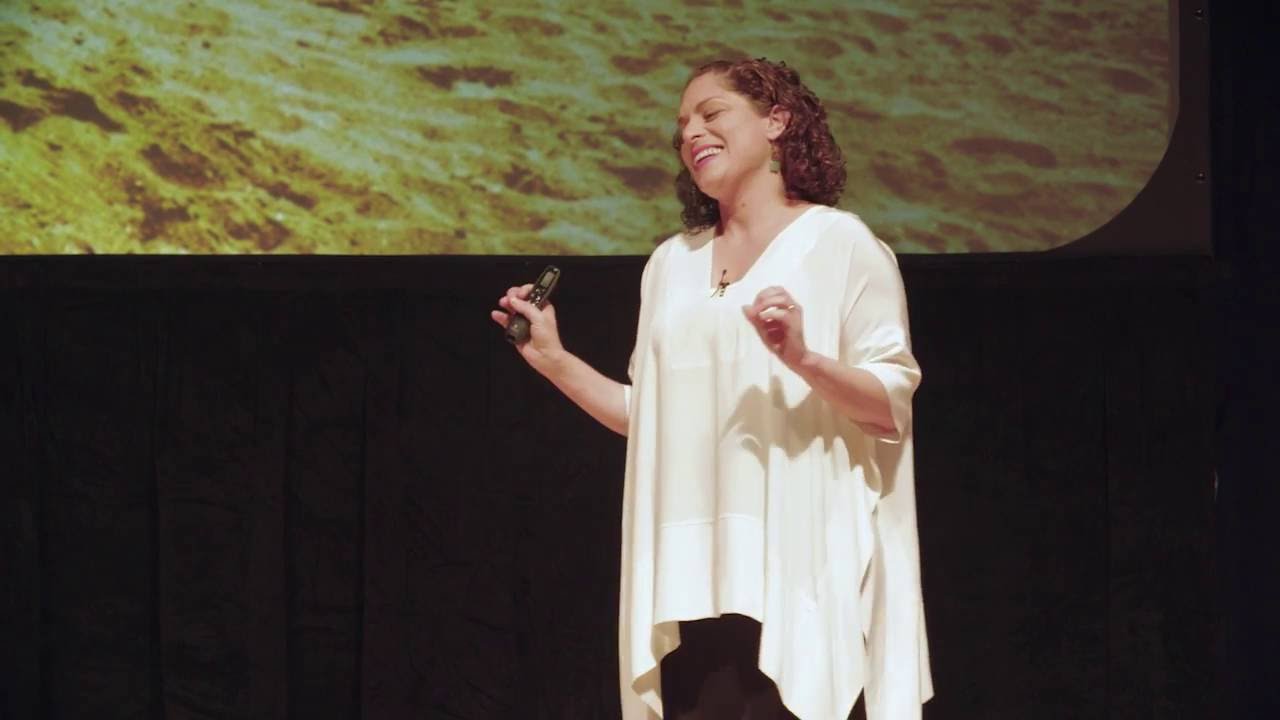
Transcriber: Nadine Hennig Reviewer: Elisabeth Buffard Ladies and Gentlemen, what is it that you are seeing here? Can we dim the lights for that? Is there something that you see?
Mud. A cow. The Earth from above.
Nothing. How many of you are seeing actually a cow? Oh, that's pretty good.
The other ones are probably thinking: well, the cows must look different where he comes from. (Laughter) I want to give you a small hint. Aah!
The cow is quite obvious now. Right? Actually it's pretty much the same if we talk about the future of leisure time.
The future of leisure time is absolutely obvious. We have this old saying in Germany that sometimes you do not see the forest because of all the trees. Well, that's not true, I mean, things are obvious and it's the same with leisure time.
People have certain needs, we are all humans. We like certain things. We like to spend our time with other things like chumminess, for example.
And that we sure do not change our behavior just because we have new possibilities. A change in behavior needs time, and time is very, very limited. What does this number mean to us?
8,760. It's the number of hours we have each year. Now the big question is how are we spending this tremendous amount of time we are having?
Are we spending it working? Are we spending it doing something we like during our leisure time? Or is there maybe something in between?
If we divided this time, we could divide it into three sections. The first one, of course, is working time. When you are full-time employed, you work about 20 % of your time each year, 1,618 hours to be exact.
You have 29 days of vacationing and you are sick for 7. 6 days. Then we have this big huge field which takes about 55 % of your time.
Well, it's not working time but it's not leisure time either. It's something in between. We call it "obligation time.
" There you do actually things because you more or less have to do it. Take sleeping for example. In average, you sleep for 7 hours and 14 minutes.
That's about one third of your lifetime, you're not awake. You are in your own bed. Or take the time that it takes to get to work, the time to clean yourself or to clean your house.
The time you have to take care of someone else. That also takes time. And, of course, we have this big fusion between work and leisure.
I mean, when was the last time we really turned off our mobile phones on the weekend? When was the last time that we did not write an email, or read an email while we were on holidays? Or when was the last time that we went out for a beer with a friend or a colleague and skipped the topic work totally out of our conversation?
So, work is always there. That's not then pure leisure. The time that is left, that actually is leisure.
Leisure time can be defined when you do something without having to do it. It's freedom of choice. It's not easy to simply put an activity into this field.
Think, for example, when you are visiting your relatives. Is that leisure time? (Laughter) Or for women it's normally leisure time when [they] go out shopping.
Is it for all the men? I'm not sure. With sex, it's the other way around.
But that's a different story. (Laughter) Let's fly back in time and have a look how the development of leisure time actually took place within the last 50 to 60 years. If we go back to the 50s, the average working time was 48 hours or six days a week.
No surprise that relaxing was very important when you had time off. Apart from that, [there] was the decade of the baby boomers. So the family really was at the center of the life, playing with the kids was the most common leisure activity.
The third most popular leisure activity was looking out of the window. (Laughter) (Applause) An activity that's not too common in our days. In fact, already in the 60s, of course, the television exchanged this looking [out of the window].
The 60s are also the decade - the television is just one simple example - where a whole consumption wave went over [West] Germany. We had the first cars, we had the first vacuum cleaners, the first dish washer, the first washing machines, the first TV's - all that popped up during the 60s. The 60s are also the only decade where culture activities were ranked under the top ten.
People went to the museums, they went to the theaters, because they were not too much other things to do. The 70s are known as the golden decade of leisure time. We had a growing population with a growing income and a growing amount of leisure time.
So, no surprise that a new industry developed in our country. Before that, we basically e. g.
had no amusement parks in Germany. The 80s were different in many ways. Take, for example, sports.
It was the only decade where sport was in the top ten. Main reason for that, of course, was Boris Becker and Steffi Graf. They won Wimbledon, and many Germans thought they could be tennis pros as well.
Also music was very popular. Some of you may even get the connection between a tape and a pencil. (Laughter) (Applause) Of course, the biggest influence during the 80s [were] the private TV channels.
It's always interesting when I ask my students at university: "Since when do we have cable TV or private TV channels in our country? " Most of them look at me and say: "What do you mean? There have always been private TV channels.
" And when I tell them: "When I was young we had three TV channels and we had the national anthem at midnight and then we had the test screen until the next morning" (Laughter) they look at me and go like: How old is he really? (Laughter) Of course, it was the year 1984, the Orwell year, when the private TV channels went on air. By the way, 1984 was also the year when the Chaos Computer Club published its first study about the future of computer, and the public was able to buy computers, Commodores, 64, Schneider, Atari - they went into the stores in the year 1984.
Typically characteristic for the 90s is of course the telephone. Suddenly, the telephone was not just a tool to exchange information within 8 minutes for 23 Pfennig at that time. There was suddenly a bridge to one another.
People were really talking to one another. It was not that the people met, they were simply talking to each other on the phone. It was also the decade when new target groups developed.
Remember the double income, no kids? Of course. The "best ager", the "golden ager" -- we are all aware of them.
But how about the "Skippies? " Does anyone remember the "Skippies? " School kids with income and purchasing power.
(Laughter) Very, very popular during the 90s - not that popular anymore. And of course the last decade, we have dedicate that decade to the new media: internet, computers, mobile phones, smartphones -- all that popped up within the last ten years. So how about the present?
How are we spending our time that we have? If we look at the top ten, television is still the undisputed champion. It really doesn't matter if you go into different age groups, if you look at the education level of a person, the income level, if he is married or not, if female or male - it doesn't matter.
Television is always ranked number one. Then you see that the old medias are still very popular: listening to the radio, reading the newspaper, and of course, kind of social individual activities like spending time with your family or with your partner, or simply thinking for yourself. No doubt that the new media is really having a big influence.
Take e. g. the number that the internet and the PC gained about 40% within the last five years.
So, 40% more users within a very short period of time. What still worries me if we talk about the internet is of course this kind of digital gap that we still have in Germany. I call it the "Users" and "Losers.
" Take for example education and age. If you have a good education, it's very likely that you can be online. But if you only have a low education, only one out of three has the chance to go online.
Now the problem is not that do not have access. Nearly every school has access by now. The big challenge or the big goal to look to is of course media competence.
The people have to be able to make use of this new tool. If we talk about the age groups, no doubt, it's only going to be a few more years until the young generation will be using the internet as frequently as the television. For my age, in the middle of life, I am not so sure.
They are two big influence factors. One, of course, is work. The moment you start working, you do not have the time to be online all the time.
You do not have the time to play video games all night long, or log on to your Facebook profile. And the second thing, of course, is, the moment you are getting married. The moment you are getting married or you have kids, your priorities in life simply change.
Suddenly consumption and leisure time are not as important as they used to be. The family is at the center of your life. But back to my topic: The future of leisure time.
We ask the easy and very profound question: What would the people like to do more often? As you see upfront the so called "3 S": Be spontaneous, have more sex and sleep in - maybe even a combination of the three - have spontaneous sex and sleep afterwards, but that's another story. (Laughter) (Applause) But apart from that, we would only see that social individual activities are the ones that people are looking for: having more time for the family, more time for their friends, more time for their team mates, for their neighbors - even for their grandparents.
So, it's very interesting that the actual habits of the people are totally different from what they are looking for. If we talk about the media: Only one out of five Germans would like to watch more TV. Only 24% would like to use the internet more often.
So that's very interesting. The big question is: How will the future look like? Will it be like that?
Family or peer group or friends doing things together during their leisure time - and maybe even being outside. Or will it be like that? That they are outside - (Laughter) - but still are just connected to themselves.
Now, don't get me wrong, I love the internet and I love the TV. I mean, the TV is offering us a lot information, it's entertaining us, and of course, it's relaxing. Most people really come home from work, sit on the couch and just watch TV.
Or the internet, I mean, it's giving us unlimited information - more information that you can find in the biggest libraries of the world. It's giving you a 24/7 possibilities to go shopping. You have like this virtual umbilical cord to stay in contact with your family, with your friends, even with people you may lost track off.
But of course, all of this takes time. What do the Germans normally do if they have this feeling that time is really running away through their fingers? Well, they do three things: They do the activities faster, less accurate and they combine things.
Take, for example, television. Most of us are not just watching television. We are eating, we are drinking, we are talking on the phone, we are ironing our [clothes] for the next day.
We are doing so many things. The majority of German school kids are doing their homework in front of the TV. But that's another story.
So let me end my talk with three thoughts what I think will be important for the future of leisure time. Number 1: Maybe we should start excepting less from technical development and more from ourselves. (Applause) Second: Maybe we should care more about our quality of life and not just about our standard of living.
(Applause) And finally: Maybe we should not just think about what the future will look like but rather how we want the future to be. (Applause) I hope you all see the cow by now and thank you very much for your time, I guess.