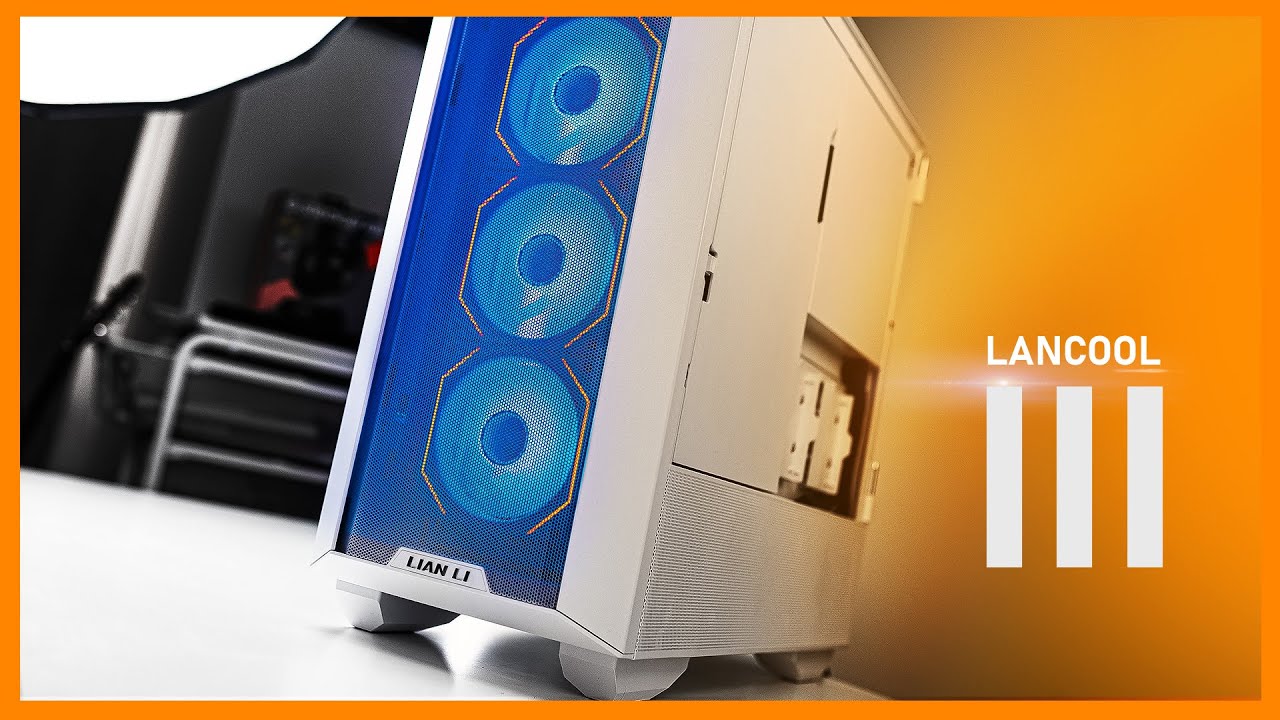
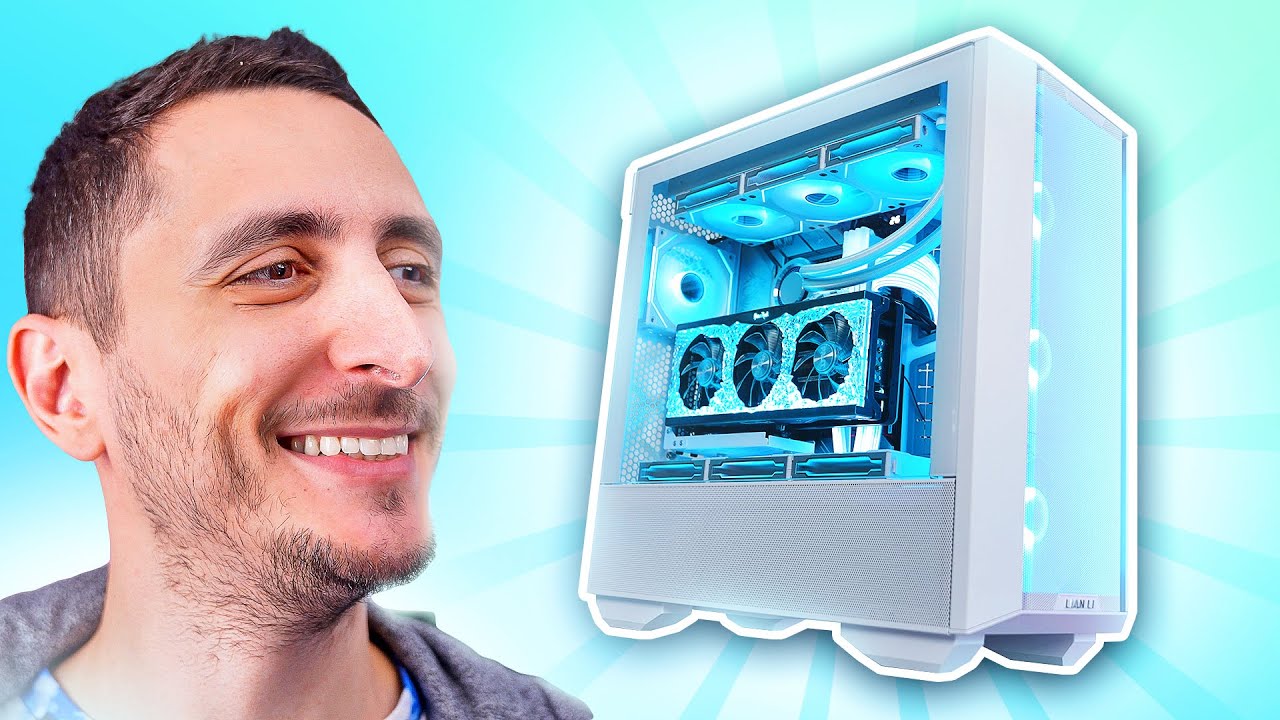
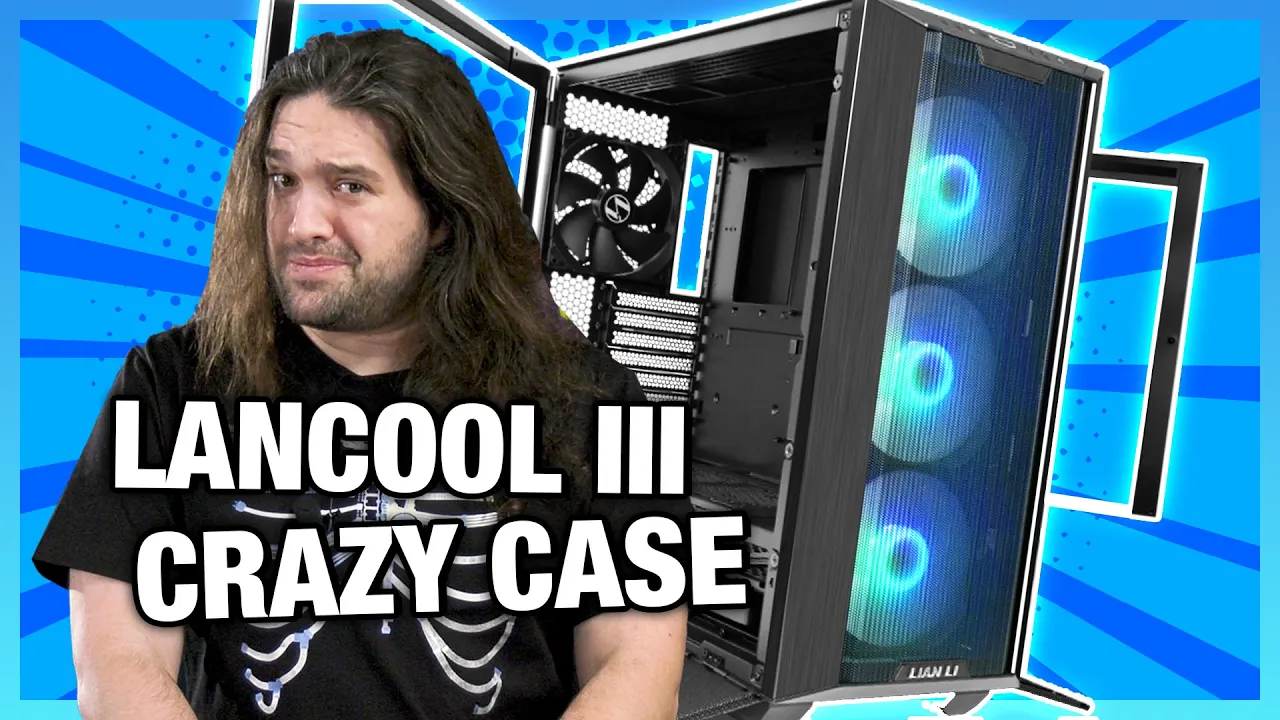
[Music] today we are reviewing a very mechanically complicated case this is the liam lee lancole 3 it's 150 to 170 and it has a lot of mechanical gimmicks or features depending on how you look at them like cable covers right here this one's actually there we go that one's magnetically secured this one over here and then the doors that open with a lever on the side instead of something like say a pull tab which would be much cheaper but also much less interesting so we're gonna be looking at this today comparing it to other competing cases in the same 150 price class we'll be looking at thermals noise and everything else in between for an objective analysis of the language iii before that this video is brought to you by evga's x570 dark motherboard the evga x570 dark is a high-end motherboard for am4 cpus built around extreme overclocking and tested heavily by evga's kin pen the x570 dark has a uniquely rotated socket and ram layout 90 degree rotated cables for ease of installation and management and tons of troubleshooting features to make building testing and overclocking easier check out evga's x570 dark high on the motherboard at the link in the description below so for the case today pricing's pretty simple in that it just goes up depending on whether it is rgb or non-rgb and then there are white and black models as well we have both of them here today that we're going to look at for whatever reason leon lee has decided to solve one of our longest standing complaints with the landcool series they go back believe it or not as far as a landcool one and it was officially called the lancole one so the only it was revealing its hand very early that it was going to make a lot of these the lancole wand lancole uh ii led into a lancol2 mesh which was largely created after criticism from our review of the land quality non-mesh which sucked thermally but was very interesting otherwise and they made a lot of improvements with it the mesh was actually a pretty good case uh so the thing that they solved with this we need to go get the lancome 2 mesh to demonstrate it was one of the mechanical features of the case so our case hallway has a landfill right here okay we can go look at this our biggest complaint for this case which was otherwise very good was simply that getting into the main compartment where your computer is where you're going to build the system required opening these bottom panels not a big deal it's like one extra step but it did seem a little bit superfluous uh and that's that's been solved now so that's why this exists and uh now these can be opened independently of the others now opening this does bring me to a couple points so this is only a mesh case now they've seated the fans very far back here which is interesting because it increases the surface area that the fans can pull air through when it's smashed right up against the mesh normally you lose some of the performance there's a little bit more of an effect from the impedance on the fans as they try to pull air in and you end up in a basically a pressure situation as opposed to just more purely a flow situation and on the side here where they've gone with mesh on both of these sides the one on this side of the case is completely unobstructed and the one on the other side of the case you could remove all these drive mounts if you wanted but if you want all the extra drive mounts it is not really mesh it's kind of mesh and looks only uh because you do end up obstructing a lot of it but yeah it's also on a side where the airflow is not that critical because the power supply is cooled from underneath anyway as for the rest of the exterior both of the main side panels are transparent glass with cables behind the motherboard tray almost entirely hidden from view by the two metal covers that you're seeing this is similar to the lancole 2's arrangement but with one key difference the covers of the lancole 2 could be screwed down while in the landcall 3 they are only magnetic whether or not you like the covers is a matter of opinion i actually don't mind them patrick doesn't like them but they're almost mandatory here because the side panel is held on with magnets that will pop open if the cables push outwards so that's why they're there making the covers magnetic as well makes them bad at their main purpose which is holding cables in place ideally with some force and the force part doesn't apply here opening the cable covers then kill management is pretty good thanks to the size of the case although installing a full set of four three and a half inch drives would change that by filling up the power supply shroud liam lee has pre-installed several extra long velcro straps which we have mixed feelings on the left side works well for keeping i o and rgb cables tucked out of the way but the length of the straps on the right side is unhelpful the bar with cable cutouts at the edge of the motherboard can be adjusted back and forth which we found actually necessary to get our video card installed it'll depend on the card you have though liam lee could have just designed this bar in a way that didn't need adjustment in the first place though now the main benefit of this bar the one down here moving is really just that it can support water cooling components like pumps and reservoirs and you can move it around slightly to adjust for them which would maybe get you out of some trouble if you mismanaged how you were planning to route your tubes and you needed maybe an extra half an inch of slack or something one way or the other but otherwise that's that's really it it's that and accommodating the gpu but again you kind of circumvent the accommodating the gpu problem if you just design the bar differently but then you lose some of the cool water cooling support and features for more mechanical stuff on the back side here the two ssd sleds on the back of the motherboard tray are spring loaded here so you can mount either with just the spring or there's an optional thumb screw that goes in to secure the ssd like if you're worried about it during transit or you're just nervous about not securing it with anything else like that for example was was sub-optimal for securing things being completely open at all times not great but but you can use the thumb screw probably should now these are the primary two and a half inch mouse but there's a total of 12 mounting locations available or eight if four three and a half inch drives are installed the case ships with two hard drive cages under the power supply shroud one of which can be removed to allow the other's position to be adjusted and both cages can have an additional drive sled mounted on top both are included in the accessory kit that mainly ships with this lanley is not selling hot swap back plates this time for the lancole 3 and that was a feature that added maybe some value to the lan coil 2's lower side panel doors as for water cooling support the front radiator mount is removable and reversible as it is in earlier land cool cases but there's now a spring-loaded latch to hold the mount in place screws can optionally be used as well the handle is directly under the front i o and we found it can get caught up in the wires which may be another reason to swap the i o to the bottom of the front panel and that is something you can do it's a supported feature to move the i o around although if you move it to the bottom of the front panel you might restrict your clearance if you have a longer usb key or something like that the top rated amount isn't toolless but it is still removable the quantity of mounting points make it extremely versatile but it also means that there's only a five centimeter strip of fully open space in the center of the mount the case can mount 360 millimeter radiators at the front and on top of the power supply shroud mounting fans or radiators here eliminates the use of the bottom most motherboard expansion slots and requires moving the shroud top to its forward position reducing clearance for the front mount although there's still enough ventilation on the lower side panels to make this a surprisingly viable option we'll talk about that in the thermal section later lee lee claims that the top mount fits four 20 millimeter radiators but installing one may make the top tray non-removable and may require downsizing or removing the rear exhaust fan the lancole 3 has excellent radiator support overall but we would suggest a 360 millimeter maximum there are some other fit and finish issues than the usability things we've talked about so this isn't the biggest deal in the world but we did have one loose hinge on our review unit you can fix this on your own because there's two screws back here it's just a phillips head driver to fix that loose hinge problem it shouldn't ship that way it's it's hard to dock too many points because it's fixable but it's still sort of a attention to detail or qc oversight and on a review unit which is never really a great sign now for other stuff the front panel is a little bit on the barbaric side for it's removable so first to get it off we have to open everything up and once we've opened everything up the method chosen for removing it is grab and yank nzxt would be proud here if we can get nzxt's tweet on the screen just yank hard that was less bad than last time i did it so that's removal of the front panel it could be i guess the thing the thing we were getting at with this is it's not abnormal to remove a front panel that way but with a case that is this advanced with all the different levers springs and gadgets that it's added for all this extra flair uh it probably will be winning best mechanical design in our awards show this year but even with all that they haven't done anything to advance the removal of the front panel so it's not something we normally pay attention to but it really sticks out on a case like this that's overhauled everything else mechanically and with how you interact with the case and that brings us to the next fit and finish issue which is that for this so this is the reversible uh fan tray which is actually really useful and it's something we've liked been around for a while on cases but this thing it's by the way another spring-loaded part of the design is right here and we'll get a shot of the inside of that as well but when we remove it on one of our two cases they have installed some of the standoffs or glorified washers if you will upside down so on the white one you can see that all of them have the sort of washer side down against the frame so that's two out of two here and then four out of four that are installed that way and if we go over to our other case so on this one you can see that the washers are installed a little more haphazardly where we've got them at different orientations for each of the washers so half of them are on one way half are on the other way mechanically in terms of how they actually work and perform it didn't really affect anything it all works the same way it's just another really small qc or attention to detail issue where they've changed it between the two cases and between the eight screws so none of those three things are major issues it's just really small attention to detail that's the kind of stuff we look for and it does lend itself to a judgment when we get to the conclusion on how much attention a manufacturer is paying to the product overall gives us an idea for their qc processes as well as far as removing the front panel there's several reasons for it one of them is swapping the fans or removing the lower side panels or just access in general now the fans again are seated further back in their stock position and this not only helps the airflow like we talked about earlier or at least in theory should when we'll see in testing but it also provides a more diffused lighting look to get a wider spread of that light and make it look less concentrated on singular leds liam lee has also taken steps to protect the magnets in the case from chipping which was a problem we saw in the original lancol2 and complained about in the lancol3 all magnets are inset and fixed with screws so that none of them can contact the surfaces they ultimately stick to after removing a couple we have a newfound respect for the process that was required to thread these tiny metal screws through the magnets the lower side panels are fully ventilated with mesh to provide that airflow path to the fan mounts on top of the power splash route this can benefit the gpu as well although we'll look at that and the case ships with one of the panels again sealed off with that removable plate and it fits three two and a half inch drives okay so enough of my section for now we're gonna throw it over to patrick to talk about some of the leds and other features on the case then we'll come back to me for thermals and acoustic analysis let's start with the front i o these are the rgb control buttons here we've got the standard color and mode buttons if i hit mode it cycles through some of the built-in lighting modes if i hit color it cycles through seven big ten colors this is a combined audio jack we would generally prefer to have separate jacks for headphones and microphone it's a little more flexible but if you have a four pole headset this will work in this port and you know normal headsets and mics will work in there as well two usb type a ports these are color matched to the rest of the case and a usb type c port so if we pop open the side of the case here there are a total of three five volt three pin argb headers that can be used to hook up additional items this is obviously the rgb version of the case the non-rgb version doesn't have the control buttons on the front because it doesn't have an rgb controller it doesn't have these extra headers here it does however have a plate that mounts right here that you could put your own third-party rgb controller on which is a nice touch i kind of wish they included it with this case as well but you already have a baked end controller there's really good attention to detail throughout this case for example leon lee here that has put some extra effort in and put these metal tabs on the side and what that does is when you install these slot covers normally if you installed one of these without something below it and then you tried to torque down a screw on top the slot would rotate with the screw all of the fans rgb and non-rgb have the leon lee logo molded into the back most of the cases steel in glass and plastic but these front handles right here are aluminum uh you can't really tell in the white case which is kind of a shame i think it's maybe hard to anodize in this color but on the black case it's brushed anodized black aluminum some of the features that you might not think about like the uh the screws for the pcie slots um those are silver the usb ports those are white all of the magnets and screws holding the magnets are silver here and the black case they're painted black the rivets are silver here black in the other case all of the fittings here these rubber grommets are gray here they're black in the black case so you can see in the accessory kit it's kind of ridiculous everything is color matched except for the hard drive cage screws so unfortunately all of the cool add-ons and tricks and gimmicks that leon lee has packed in here as well as the steel construction and these thick aluminum rails and these glass panels make this a very heavy case empty with the accessory kit and it's straight out of the box it is almost 15 kilograms 14. 9 which is just over 30 pounds we have not actually weighed it with the system inside yet but it's heavy enough so that when i pick it up i can actually feel a little bit of flex in the feet of the case now the bottom of the case isn't unusually flexible but the case itself is so heavy that if you lean it on its edge or move it sideways a little bit you get this disconcerting feeling that the bottom of the case is moving all right so that was about 15 kilograms empty and full 20. 25 kilograms so building a system in this case you're going to want to build it near where it's going to stay because i would not want to carry this up the stairs all right that'll do it for my section uh i'll throw it back to steve to cover the thermal and noise performance of the case on to thermals and noise our testing focused on the lancole 3 rgb which is theoretically not the highest performance skew due to slightly lower maxima rpm of the three front fans versus the non-rgb model we ran our standard test suite but added an extra torture test using the non-rgb fans to see if they make a difference baseline for the cpu torture test with all stock fans was 42 degrees celsius above ambient and although swapping in the non-rgb fans resulted in a rounded 43 degree average the actual difference is well within margin of error all variants of the lan coil 3 are equipped with four 140ml fans and with that kind of brute force cooling the difference between 1600 rpm with the argb fans and 1800 rpm for the unit fans is negligible at least for the cpu removing the front panel had no discernible effect on cpu temperature the resistance offered by the mesh front panel is again offset by the brute force of the airflow compared to the mesh 2 at 44.
6 degrees the lancol3 is a few degrees better outside of error and similarly it improves about 3 degrees over the 215. all of these are a big upgrade over the landcall 1 and the pre-match lancole 2. the meshland cool 2 happened as a result of our review and the results are closer to the new 3.
the lancol3 beats everything on this comparative chart except for the fractal torrent which includes the lancol2 meshes already above average 45 degree result corsair's 5000d airflow is priced similarly about 150 and runs at 48 degrees over ambient allowing liam lee a meaningful lead the cooler master half 500 also runs a few degrees behind as does the once chart-topping p-400a liam lee is well positioned here in the same torture test the gpu averaged 53 degrees celsius above ambient which was also unaffected by swapping in the non-rgb fans removing the front panel did lower temperatures down to 51 degrees but that's a minor difference especially considering that the cpu was unaffected the land coil 2 mesh ran at 49 degrees posting better results than the lancole 3 with our test configuration and the case layout the 215 was similar to the landcool 3 but technically better comparatively the lancol3's gpu cooling isn't bad but it definitely doesn't match up to its cpu cooling the half 500 ran at 54 degrees so about the same as the lancol3 with similarly priced 5000 d cases performing lower compared to the lanco the torrent the td500 and the p500a all outperform the new competition average gpu temperature and fire strike testing rounds to 54 degrees celsius above ambient but the difference from the original torture test result is within margin of error the removal of the cpu as the heat source didn't improve gpu temperatures indicating that the strong front-to-back airflow is able to keep pace with hot air exhausted by the components the lane cool 2 showed improved gpu thermals in this test with a 47 degree average putting it further in the lead with the p500a leading much of the lancol3 lancol3's performance so far can be explained by its four stock fans so we can use this standardized fan test to see how the chassis itself stacks up against other lancoles the lancol3 purely as a chassis ends up at 43 degrees and right alongside the 215 and the lancol2 mesh this shows that the fan count and type or placement are affecting the performance between these more than the case design itself the torrent compact remains a chart leader for standard results but leon lee is right near the top and not far from its closest competitor and of course you'd use something like the normal torrent with its included fans with all four cases set to max speed and the rgb case variant we measured a noise level of 48. 7 dba putting it alongside fractal's torrent sku as one of the loudest cases we've tested reducing the noise level to our 36 dba threshold required setting fan speeds to about 38 in bios and we control the cpu and gpu for this this is a more extreme reduction than usual with a resulting logged rpm of approximately 1000 for each fan these fans can run fast and loud it's worth building a custom fan curve with lower speed settings when you're below critical temperatures the performance difference between the maximum 16 to 1800 speed and those used in our normalized testing at 1 000 is barely anything average cpu temperature climbs from 42 to 45 degrees celsius above ambience and average gpu temperature climbs from 53 to 54. it's absolutely worth the reduction and noise for this and it proves that the landcool 3 can perform well even without forcing air through at max speed the lancol3 shines in comparison to other cases on the noise normalized chart although the gpu temperature still isn't as impressive as the cpu so wrapping up then first of all on the nice side on the positive side lanley has actually done a very good job by including all kinds of mechanically complex elements you got the doors the lower doors they really like doors on this case there's let's see there's the outside door there's two inside doors and there's a bottom door so we're up to four doors for one side i couldn't make i couldn't use any more rhyming words uh same thing on this side for the most part than the two cable covered doors this is mechanically interesting as well where it's got its own spring-loaded mechanism in here that uh pushes in to actuate this spring on the inside so there's a lot going on and laylee gets credit from us for executing all of that in a way where nothing has failed so that's good to see there were a couple fit and finished problems we talked about removal of the front panel is not impressive it's not different from what we normally see and that's sort of the problem with this one but not really a big deal thermally it did great acoustics were about what we would expect for this case and that leaves us with things like pricing and competition so and concerns i guess we'll start with concerns our main concern with this is really just in some of the mechanisms where it's thrown case there's multiple angles where with the front panels not on it okay let's try this again the main thing we're concerned about is with the door opening mechanism where right now it works really well but all of this all the stuff we're talking about even though it's really cool and it works well today we're worried about how these all require a pretty tight tolerance for everything to work smoothly and with multiple either years of use or lots of usage cycles so you only go through so many for a review to be fair you only open it so many times when you own it too but with enough cycles we are a little concerned about something breaking or with the alignment of the panels being just off enough that it no longer meets those tight requirements and you might get just a less than desirable experience with it so that's one of our concerns long term today it all works great though and the way this works is really simple where you just have a this component that punches a lever in there that breaks the magnetic bond for the panel it's pretty simple so even though we don't know how magnets work still today we have people researching this right now by the way they've been working on it for years let's just say with the magnet research i wouldn't title my video am i wasting my money i would title my video i am wasting my money so we're all on the same page with the magnet research so anyway that's the downside to think about competition uh other cases in the same price class historically at least fantax p 500a it's a great performer but it's dated and it feels it the p400a especially p 500 p 400a are similar in in many ways but uh the p500a is the newer and more expensive of the two and um we think that compared to this it feels dated another one will be the corsair 5000d or the 4000 d on the much cheaper side and those are good cases the 5000d is a great competitor to this one is much simpler and how it physically works and it does well thermally for the 5000d airflow but the landcall 3 outperforms it in most of our testing so even there this has an advantage uh other options something like the cooler master h500 the new version of the half 500 whatever it was called that came out recently following the much cheaper previous one would technically be a competitor but we couldn't really recommend it at the price point when it launched and we certainly don't again something that cost similarly and is much more interesting and better you can always go cheaper too and check out something like the fractal pop air which we actually liked a lot and was in the 90 to 100 range the fractal torrent on the other end closer to 200 190 200 is a personally uh subjectively i think a step up an overall quality um and feel it drops all of the sort of mechanical gimmicks and elements however you want to look at them and just focuses on one thing which is lots of air volume and it works well the torrent compact is in there as well so those are your options to look at for competition we think this case overall does well thermally and we have a few concerns for longevity of some of the stuff in here that's normally the trade-off for things that are different and unique and bordering on gimmicks but it does work well right now today last bit i want to throw in so this is one of the few cases where patrick and i didn't fully agree on our viewpoint on it throughout the process until the end where when i saw it from the beginning i was like that's pretty nice case looks good i hadn't tested it or worked with it yet but it was on the bench and um i thought it looked pretty good he was like i'm not so hot on this case and as he continued working on it that turned into i don't like this case and then we got to the end and he said it's starting to grow on me and here's where things changed when we review cases and most products we try to isolate ourselves from the price of the product until the last moment when we're making judgments on value because that helps us remove bias from the testing and the writing process about things like the features and the thermal or acoustic performance so we can look at those in a vacuum then we add the price back in it's like uh you're you're baking a cake and you need to sprinkle in a pinch of price i don't know anyway that's what we do without the cake part there should be cake but uh when we got to the end of it patrick had worked on this thing the whole time where we were both estimating this to be in the 250 price class thinking that that would be very high but appropriate for something with this many things strapped to it to say look shiny and at 150 to 170 it seems actually pretty good it's competitive so i would then take all that and put us as relatively positive ish the ish or asterisk is um that we've still got some concerns long term for it but they did pretty well overall so that's it for this one thanks for watching as always subscribe for more you go to store.
gamersnexus.