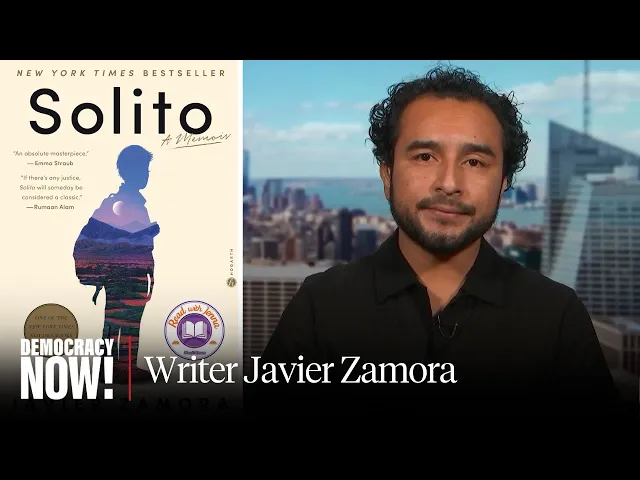
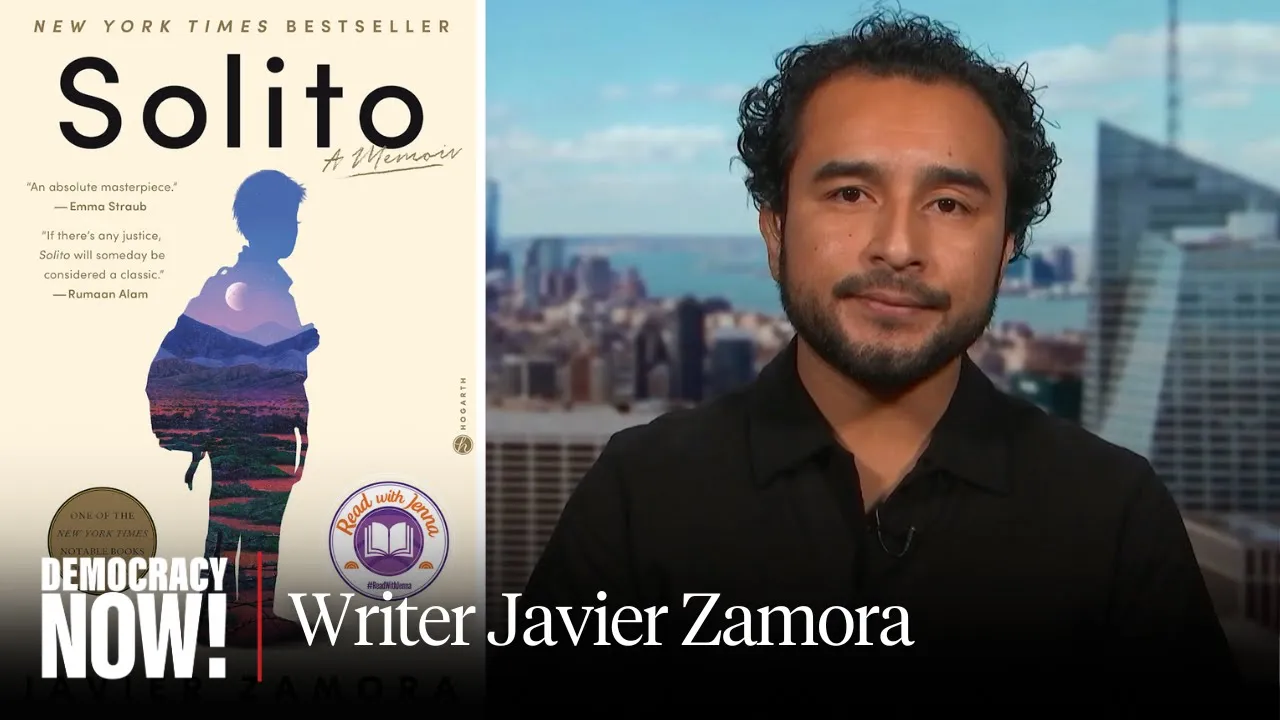
this is democracy Now democracynow. org The War and Peace report I'm Amy Goodman we turn now to Javier Zamora he's a Salvadoran poet and writer whose New York Times best-selling Memoir Salito tells a story of his own Odyssey to the United States as a nine-year-old boy from Salvador across Guatemala Mexico eventually through the Sonoran Desert he traveled unaccompanied by his family by boat by bus and by foot after a coyote abandoned his group in Oaxaca Mexico Javier made it to Arizona with help from other migrants I asked him to talk about where he was born in El Salvador and how he ended up coming to the United States well I was born in 1990 in the small fishing rural Village of El Salvador called and you know I was born during wartime and because of the Salvadoran Civil War that started in 1980 and in 1992 my dad fled in 1991 the war ended but the war didn't end at the same time so my mom left my country in 1995. having I was left at the care I'm only interrupting for a moment because before you take us on that Journey um if you could expand more on when you said your father left you're talking about a country where the U.
S backed the military in Salvador a well-known for killing thousands of Salvadorans can you give us a picture of what that U. S policy meant because I think that is what is so absent from so many discussions as people now try to make their way to the United States you know at one point only Israel was getting more money than El Salvador in the 80s and we're talking millions of dollars a day and before the U. S got involved the left was winning and what the left wanted was equality women's rights and education and because of those asks my dad was a leftist and he was a head of a co-op one of his older brothers was disappeared by the military in 1980 and the violence was everywhere and because of those reasons and because of his ideological leanings he had to flee in 1991.
um and same with my mom you know it is still difficult in my country in 2023 and also in this country being a woman there's a lot of gender-based violence and because of you know we uh talked you were talking a lot about um sexual assault and that is everywhere and those were that was a huge reason why my mom also fled the country and so you were what one year old I was one when my dad left and I was five when my mother left being raised then by your grandparents and talk about them deciding for you to take this journey and how you traveled you know um the moment that my dad left he would uh we would communicate via letters and phone calls when my mom left it was the same thing and what they both told me uh was that they were going to come back and we have to remember that in the brief period of time El Salvador had peace and that was it it lined up with my childhood 1993 until 1999 was perhaps the most peaceful moment in my country's timeline and but in 1997 you know people were beginning to get shot in my hometown and my parents changed from we're gonna return to El Salvador to you're gonna come be with us in the United States and so from seven eight and nine I knew that I wanted to be reunited with my parents what kid doesn't want to be and wake up next to his parents and so I didn't really understand how I was going to get here or how dangerous it was for me to travel the 4 000 miles that I did but what I did know is that I love my parents and I really really wanted to be with them so you went with your grandfather from Salvador to um Guatemala yes um um so my dad my dad my grandpa accompanied me all the way to a Border Town Called tekuman which is still a very major Crossing hub and from then on he gave me over to the coyote Smuggler and I wasn't the only one with him I was part of a larger Group of Seven other immigrants and he The Smuggler was supposed to bring us to the United States in as little as one week from Guatemala and of course that doesn't happen and then your grandfather leaves and talk about how you traveled on from there and the massive danger I mean you almost didn't make it to the United States if you could then talk about going through to Mexico and what happened you know I still don't know why um my trip took the turns that it did but the plan was for me to cross the a river uh from uh Guatemala into Mexico that was the original plan but I have done some research and already in 1999 The Mexican government was militarizing the southern border and this is also continuing to happen now um and so because of that militarization the coyote thought that it will be easier for us to cross into Mexico if we took a 22 hour boat ride from Guatemala to bypass Chiapas and land in Oaxaca and that is what we did but when we were supposed to get on the boats there were news that three boats had capsized and immigrants died and this is still happening in the southern borders and people as people are trying to get over here so that was my Fiasco and like number one when I was so close to death as a nine-year-old I didn't really understand it as such what I understood was that I was I couldn't swim and that I was scared of sharks and I was scared of the night so those were my fears in reality I was very close to death on that boat and that was my first day in Mexico and when we land we also face a checkpoint which still happened daily all over uh Mexican states against Central Americans and other immigrants and because of those checkpoints in 1999 we were dragged out and robbed by the Mexican military then from then on it was weeks until we we meaning the group of six other immigrants until we figured out how to make it to the Sonoran Desert in the U. S Mexico border so talk about crossing the border and what it meant to be in the sonaran desert I mean you have obviously a very different experience right now living in Tucson Arizona but what the um what it meant to cross and then to be there to survive in the hot parched desert you know similar to the boat I as a kid my nine-year-old brain didn't I think subconsciously I knew how close the danger I was but in the front and um of my brain I was like oh look at this weird plant called a cactus and I'm really thirsty I don't have food but if I keep on walking my parents are at that finish line so that's how I understood this as a nine-year-old all the adults Around Me by that point that we made it to the U. S Mexico border it wasn't only the six there were immigrants from Ecuador they were immigrants from Cuba there were immigrants even from Brazil at that time who we all joined together in a group I want to say 50 plus and each try which it took me three tries to cross the Sonora Desert we suffered a lot you know the first time we were apprehending by border patrol and I spent two two nights or one night because I I blocked my incarceration of um I blacked it out and so I spent either 48 hours in detention and you know we hear about the effects of detention I spent less than three days in there and I still suffer PTSD from those few hours that I was there and that was only my first try across in the desert the second time we ran out of water and we ironically were rescued by a border patrol agent after we needed to get water from a ranch and we were released back into May into Mexico and finally the third time we finally made it let's jump forward to how you do convey this how you became a writer but first tell us how you met your parents how you saw them in the United States and then who influenced you how you came to be a writer through all of this trauma you know I left El Salvador on April 6 1999 and I finally met my parents on June 11 1999.
and I opened a door in Tucson Arizona which ironically is my home now um and I see two Shadows and I recognized my mom because she left me when I was five years old and then I see this man behind her and I knew how my father looked or what my father looked like from pictures but pictures and reality are two different things and so he was a stranger and I think that's a metaphor for how I felt um after not being around him for eight years and it took us a few uh I want to say months until I got comfortable with not only my dad but with my mom being in this country and I had to live um with the fact that you know we were all undocumented from 1999 until I'm 21 years old I don't have papers and I can't return to my homeland and I think that fact is a huge reason why I became a writer and it was in high school that when you know when Google becomes Google that I Google Salvadoran writers and the first name that comes up was Roque Dalton who is a leftist a writer who wanted to create a better El Salvador and I started reading his work and what really impacted me was that spoke like us and he wrote like us meaning the rural Salvadorans not the elite Salvadorans who wanted to replicate uh Spain Spanish but he wrote like the people and I hope that in my both my poetry and my prose I am in tune with our kaliche which is Salvadoran slang and that's all I wanted um when I was 13 14 15 years old and I was searching for Salvadoran books um and I hope that my book now could speak to another nine-year-old Salvadoran Guatemalan Honduran kid who has immigrated uh or is thinking of immigrating to this country this is democracy Now democracynow. org The War and Peace report I'm Amy Goodman as we continue our conversation with Javier Zamora the Salvadoran poet and writer his best-selling Memoir Salito tells the story of his own Odyssey to the United States as a nine-year-old boy from his home in El Salvador I asked him how he became a writer after surviving that nine-week Journey um surviving the United States as an undocumented person with perhaps the main reason um why I became a writer and it was almost like a chance encounter you know as a only child and a child of immigrants and immigrants and immigrant myself my parents always wanted me to be a lawyer even an accountant or an engineer you know um to them I think I just needed to go to college in order to make money um and and so writing was never in the cards um for me but thinking back you know this is before Facebook and you know we were very poor enough so we didn't have a phone line so our main means of communication with my dad when my mom was still there like I would write him letters as early as four years old and once my mom left I continued that and I think that was my practice into my eventual writing life but being in this country you know it took a chance Encounter of a local poet um by the name of Becky fowles to go into my high school and teach us about uh Pablo Neruda and I never I had heard of Pablo Neruda because my parents are nerds and they had his recordings at home but I'd never seen his name in classrooms up to that point and what the poet chose to do was focus on Spanish and English side by side and for some reason that was all I needed for me to begin to want to be a writer and from then on you know I volunteer with a local organization called 826 Valencia that got started by Dave Eggers Dave Eggers becomes the very first writer living writer that I meet and then I go to college but I don't go to college to become a writer I go to college wanting to be a historian but on the side I'm writing um and I'm taking um you know elective for uh in ethnic studies and English in the English Department and that's when I encountered June Jordan's work and and her idea of that poetry is for the people and that is the program that I take at UC Berkeley which is poetry for the people and all of this kind of convinces me that perhaps writing can be a thing that I can do as an undocumented person at the Salvadoran immigrant and these becomes a foundation and the tools that I have and eventually that I have to write my first book of poems and now a memoir and Javier though writing of course can be such a cleansing experience you have gone through so much trauma in your life even when you just read news reports of what's happening on the border do you find yourself experiencing post-traumatic stress disorder and how did you deal with this trauma as you grew up in addition to writing anger you know I was anger is often the first emotion that you have when you don't have the other word for it and for myself that anger began in Middle School you know I didn't know why I felt this way but I did know subconsciously I felt different than all the other children um I think it's as a nine-year-old 10 year old you have no conception of what it means to be documented and undocumented and I think at 16 and 17 I began to see those concrete results of me just being me but the world viewed me as less than because I didn't have papers I didn't have documents so my life got a little bit more complicated and writing becomes that thing in which is for lack of a better term free therapy but it's not therapy and so once in 2011 which is when I'm 21.