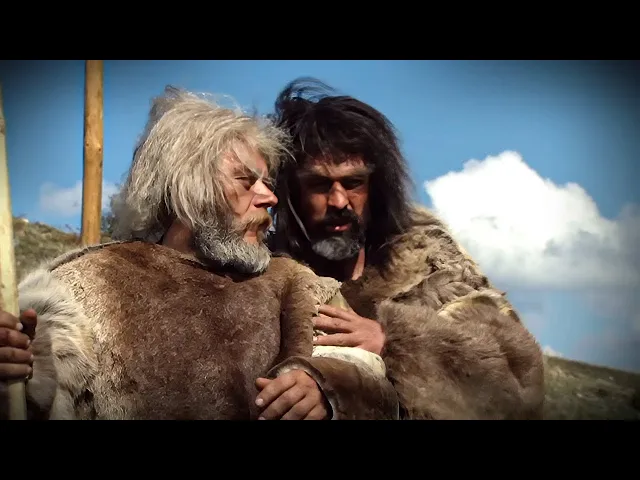
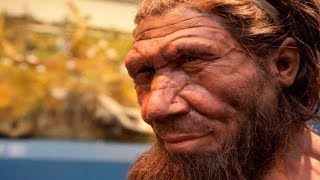
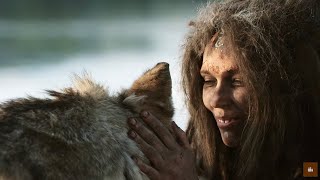
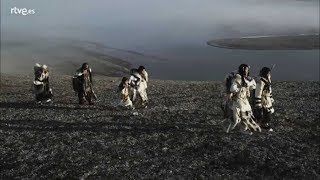
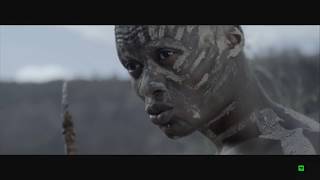
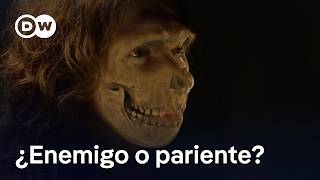
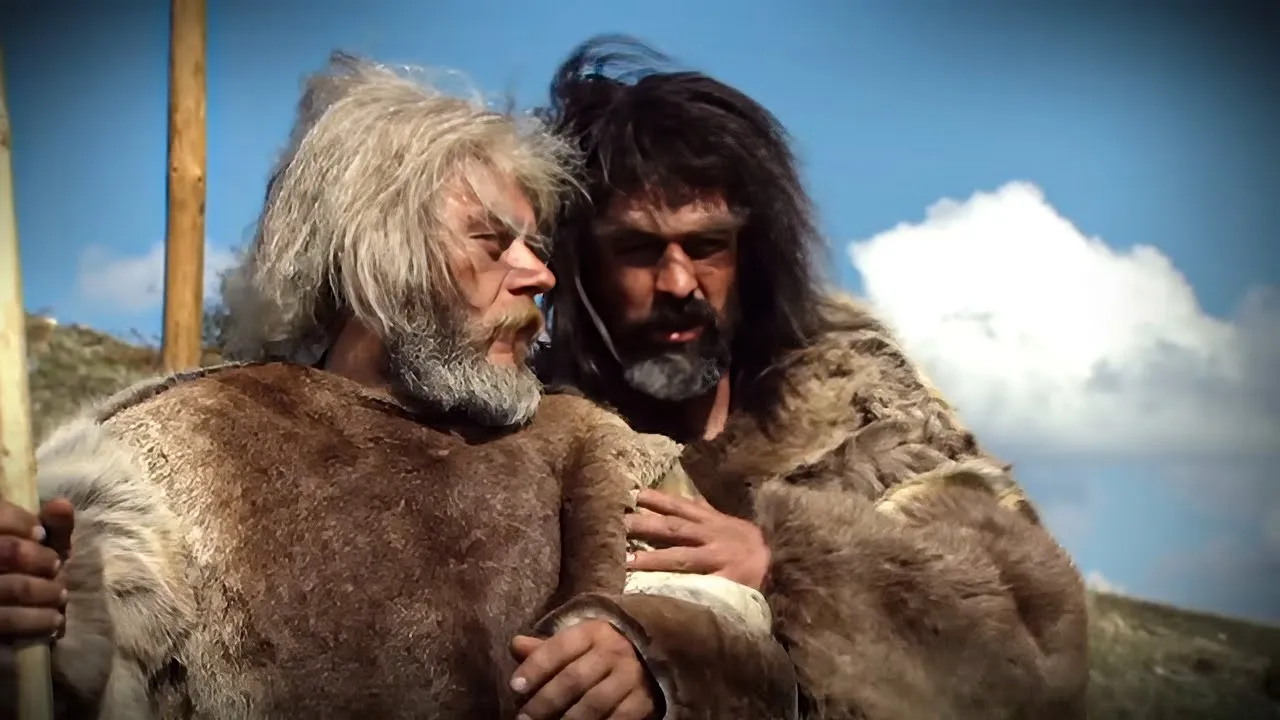
During the Stone Age, 40,000 years ago, the whole of Europe was inhabited by Neanderthals. Proud hunters, they don't know any human beings other than themselves. Suddenly, strangers appear in their hunting grounds.
They look different and are different. Modern human beings. The beginning of the end of the Neanderthals.
What went on between the Stone Age people and our ancestors? Did they fight or mix? Did they even have children together?
How much of the Neanderthal is present in us? Who had sex with whom 30,000 to 40,000 years ago does not interest me. They could do as they liked.
I'm interested in what influences me today. The Neanderthals, a myth worldwide. They were strong, they survived in a harsh environment.
They're our closest relatives, our brothers from the Ice Age. Their life and death has baffled researchers. The Neanderthals survived for 300,000 years in Ice Age Europe, and we haven't existed for anywhere near as long as that.
The question is, why did they disappear? The Neanderthals were the only other human beings with whom we shared this planet for a couple of thousand years. Learning more about them would mean learning more about ourselves.
One of the questions that I've been asking for too long now is, why were modern humans able to spread and by one mechanism or another, become the dominant form of human biology in a short time compared to geologic timescales? It was still over a period of 10,000 or 20,000 years. The Neanderthal genetic code riddle.
An international team of scientists is unraveling the mystery. Researchers from the Max Planck Institute for Evolutionary Anthropology in Leipzig, Germany, are the first to have decoded the genome of an extinct human being. The dream of a lifetime has come true for the Swedish geneticist Svante Pääbo.
We started working with Neanderthals before '97, and five years ago, decoding the complete genome was still a dream. We've been working on it for three years. We had the data over a year ago, and we evaluated them over the year.
Now we're ready. We can dare to say something about them. Johannes Krause, a passionate researcher, has been involved since the beginning.
Decoding has posed the greatest challenge so far to the team. We constantly had to establish new methods and other technologies. We had to use various methods, and it was a rollercoaster ride.
There was a lot of excitement and tension, because expectations were very high. The central question, have any Neanderthal traits survived in us? The regional museum in Bonn.
The world's most famous bones are in this case. They are the crown jewels of German archaeology. Ralf Schmitz is the custodian of this treasure, the first Neanderthal to ever be found, whose name was given to a whole species of humans.
Archaeologist Ralf Schmitz knows these bones better than anyone else. His professional life has revolved completely around them. Neanderthals.
This prehistoric human, who existed 42,000 years ago, lived to be about 40 years old. Only 16 bones have survived down the thousands of years. Is the key to unlocking the secret of the Neanderthal genome hidden in them?
He's the most famous German of all, but he is a European. He's the only species of human to have ever developed in Europe. If there's a form of human being which represents Europe and Europeans, then it is indeed the Neanderthal man.
The story begins in a quarry near Düsseldorf, Germany, in 1856. It's a hard day for the workers. Hacking away at the stone and shoveling in the blazing heat, they come upon bones and thoughtlessly tip them down the slope.
The world would never have heard of Neanderthals if the quarry owner hadn't been curious. Are these the remains of a cave-dwelling bear? Having a passion for fossils, the quarry owner orders the workers to look for other bones.
A skull comes to light that the world had never seen before. Strange, what can it mean? These bones were found in Neanderthal, a romantic spot on the river Düssel near Mettmann.
Until the middle of the 19th century, the Neanderthal was a beautiful, intact and natural landscape. Steep chalk cliffs, up to 50 meters high, towered above both sides of the Düssel. This romantic narrow gorge was first called gesteins and later renamed Neandertal after Joachim Neander, a writer of hymns.
The Neander Valley, 200 years ago, when it was still pristine. In one of these caves, the Neanderthal was probably laid to rest by his tribe. Prehistoric humans sought shelter in a narrow valley with majestic cliffs towering above, through which flowed the Düssel, just as it does today, 40,000 years later.
An ideal that inspired painters and poets, today would be a nature reserve. Then came industrialization, and the lime from the Neander Valley became a much-desired raw material for the ironworks in the Ruhr area. Thousands find work in the quarry.
This is the end of the Neander Valley. No one yet has any idea what the quarry owner's discoveries of bones might signify. [German spoken audio] This is the best-known fossil in the world, and it's the fossil which made us realize 150 years ago that other forms of humans, distinct from us, had indeed existed.
At that time, nobody believed in the existence of prehistoric human beings. Only Johann Fuhlrott, a teacher, understands immediately that these bones came from a Stone Age human. Did Neanderthals actually exist?
The scientific elite argue bitterly over this question. The greatest opponent to this theory is the most renowned doctor of his times, Rudolf Virchow from Berlin, the founder of pathology. He examines the bones in great detail and comes to a conclusion with serious consequences.
They come from a sick, modern human who was deformed. The bones of a sick human? Virchow's words shaped the cliché of the dumb Neanderthal, which persists even today.
It is so deep-rooted. The hunched posture, the dull expression in the eyes, and club in hand, it's a distorted picture. It's a character assassination, 40,000 years later: the Neanderthal is a hairy savage who is more ape than human, brutal and stupid, a Stone Age halfwit, inferior to us in every way.
A sensational find in Croatia in 1899 distorts the picture even more. Johannes Krause visits the caves in Krapina, where the most Neanderthal bones have been discovered. Based on our current knowledge of the Krapina site, we think that we have between 75 and 80 individuals, based on dental samples.
If you study postcrania, your information might be different. The find in Krapina gives rise to a gruesome suspicion. Did the Neanderthals living here exclusively consume animal meat?
The traces on bones suggest something terrible. Some people argue for cannibalism so that you have accommodation, because this was a place where they performed cannibalism. Why cannibalistic behavior?
We don't know. It could be ritual or starvation. -Krapina is quite an unusual sample.
-There are also cut marks on the bones. So it seems like they were somehow butchered. Yes, there was butchering.
They didn't respect the dead. There are also burnt bones. The idea of cannibalism was well-known for the Krapina sample because of this fragmentation.
Many bones are just split, broken and fragmented. In his office in Zagreb, in the Croatian Natural History Museum Radovcic shows his German colleague the carefully guarded evidence, one of the largest Neanderthal collections in the world, with hundreds of bones. Some have been so maltreated that there can only be one explanation, says the researcher.
This box has many split longitudinal bones. If you consider this bone, some think it's good evidence for splitting to extract marrow. This is evidence for cannibalistic behavior in Krapina.
Along these bones, at some points, you'll also find different cut marks, as if done to remove soft tissue. There are many long bones like this. Were the Neanderthals from Krapina really brutal cannibals?
Other researchers have their doubts. They discovered mysterious marks on one of the skulls, a row of notches at regular intervals. They cannot be a coincidence.
There are many scratches here. They're narrow and dense. Someone was trying to mark this specimen, this person who just died.
This is unusual behavior for Neanderthals. We don't know its meaning, but it could be evidence for symbolic behavior. The suspicion alone was enough.
The alleged cannibals from Krapina ruined the Neanderthal's reputation for good. Such a monster was not suitable as a role model, an ancestor, but more as a horrible example of evolution. In Nazi Germany, the law of the jungle ruled.
It was said that the steel-hard Aryan had annihilated the inferior Neanderthal. A school book of the time talks about the crude Neanderthal, who was inferior to the nobler race. In Hitler's Germany, there was no place for Neanderthals.
The Nazis treated Neanderthals with disdain. Neanderthals didn't fit in with the Nazi's ideal of race. We should be glad the original specimen has been preserved.
Because of this, the Nazis closed down the first German Neanderthal museum. Its modern successor, located near the site of the find, is a great crowd-puller nowadays. The Neanderthal myth, from ridiculed club swinger to Stone Age superstar.
What an astonishing career. The image we have of our closest relatives has changed dramatically since they were first discovered. Scientists worldwide want to know who they were and how they lived.
However, most of all, what have they got to do with us? Neanderthals moved swiftly and completely upright through their surroundings. They probably had alert, intelligent eyes or they would not have survived.
They used fire, wore clothes, and were able to speak. They were highly intelligent Ice Age hunters, living as the Inuit do nowadays on the edge of the Arctic. That's how they should be seen, then you're on the right track.
Today we know that Neanderthals were social beings like us, that they were real human beings, our mirror image. They were skilled hunters, who honed their skills over generations. Only so could they have survived in the harsh environment.
Initiation into hunting was an important lesson in the life of a Neanderthal. They were faster, more muscular, and stronger than any modern human. At today's Olympics, the Neanderthals would win most of the gold medals.
The fascination with Neanderthals is shared worldwide. The American, Erik Trinkaus, has been a proponent of this thesis for years: we mixed and had sex with the Neanderthals. I've always thought of the processes involved in evolution of Neanderthals and modern humans, and their interaction upon meeting, in terms of populations, in terms of the messy, complicated dynamics of populations, and gene flow, exchange of mates and having offspring, between these populations is a natural part of populations.
That's how I view the world. Erik Trinkaus is one of the world's foremost experts on Neanderthals. At his excavations all over the world, he has come upon skeletons which could be from a mixed race, Neanderthals and us, but the evidence was missing.
Genetic engineering methods had not yet been developed. That's the allure of Neanderthals. They're very close to us, they're almost us, but they're not quite us.
They are our mirror image, and at the same time, they are other human beings. Neanderthals had refined techniques at their disposal. They obtained color from various stones and made spears, which are in no way inferior to modern instruments.
They obtained the fuse, the tinder, to make fire from fungus growing on trees. They were particularly skilled in working with stone, razor-sharp scrapers and spearheads made by Stone Age master craftsmen. They also deserve our respect.
They lived in a harsh time and a dangerous landscape, with technology and overall cultural elaboration considerably less than ours. They survived under those conditions for hundreds of thousands of years. We tend to put down the Neanderthals, consider them primitive, stupid, whatever.
I would make a bet that if any one of us, and I include myself in this, were suddenly placed back in a Neanderthal society and had to make a living, we might last a few months, maybe. Back in Leipzig, scientists at the Max Planck Institute are busy analyzing the Neanderthal diet. In the isotope laboratory, minute particles of Neanderthal bone are examined.
The result: the prehistoric human diet was completely different than ours. It was because there was one thing that they needed more than anything else: meat, and plenty of it. Neanderthals were super predators.
Imagine a group of lions living in a territory. These lions would need a lot of kills. They'd need to catch animals to survive.
They'd die if they don't kill enough animals. This craving for meat drives them on. They are always out on the hunt, roaming through vast areas to get enough prey.
Sometimes they hunt harmless deer or reindeer. However, Neanderthals are not afraid of close combat with dangerous animals, such as mammoths or bears. They hunt in groups, knowing how to overcome and kill an animal.
It must have been spectacular. Let's imagine a group of Neanderthals trying to catch a young rhino. It's something we have difficulties in even figuring out, because we know they didn't have many weapons to kill from a distance.
We know that they had things like wooden spears, but it looks like most of these weapons were used from a short range. The prey often needed to be hauled for miles back to camp. There was good reason why the Neanderthals were more muscular than us.
The animal would be taken apart in front of the cave. If you depend on meat and do not exploit other sources of nourishment, you will be vulnerable if stocks of game diminish or there are extreme changes in climate. Is this a reason for their disappearance?
Extinction is a normal part of evolutionary history, and one day we'll disappear too. It's interesting to find out why the Neanderthals survived for so long. …and why they became extinct.
Using the most modern methods, anthropologists at Max Planck Institute in Leipzig seek to uncover the mystery. The jawbones of a mere child of eight were found in a cave in Belgium. This is a particularly valuable find, as fossils of young Neanderthals are rare.
The jawbones open a window in time into the growth of Stone Age hunters. The naked eye is not enough. To get more information from the fossil, it is scanned three-dimensionally.
This reveals even the inner structures. From the resulting data, something never seen before in history of science has been created, a virtual Neanderthal. In the virtual reality room in Leipzig, French scientist, Jean-Jacques Hublin, observes the digital rebirth of a Neanderthal.
He invented this technology, which has been connecting prehistory with high tech since 1992. In this way, he discovered a surprising difference between humans and Neanderthals. That's an interesting and important specimen.
It's important to look at fossils like this one, a mandible of a Neanderthal child, and to evaluate the speed of development of these people. Here we have a mandible with a second molar, which is already erupted, and a third molar which is building up inside the mandible. By modern standards, this individual should be about 12 years old.
However, if we look at internal microstructures of the teeth, the lines in the enamel like the tree rings in a piece of wood, which helps us to evaluate the time of development, we find that this individual was only eight when they died. It means that Neanderthal, at least regarding dental development, grew up faster than we do. This means the Neanderthals had a shorter childhood.
They had much less time than our children to learn survival skills, such as hunting. On the other hand, they were able to look after themselves much earlier. There are also other differences between humans and Neanderthals.
Looking at the skeleton for the first time, it's evident how different both kinds of humans are. Jean-Jacques Hublin compares two skeletons. Would we recognize a Neanderthal at first sight?
If you would meet a Neanderthal in the street, what would look the weirdest is their face and head. They had a big head with a large brain like ours. However, the face was projected in front of the brain case.
They had a receding forehead, which is a major difference between a modern human and a Neanderthal. They had strong brow ridges above their large orbits. Their face projected forward, lacking a prominent chin.
However, the real question is, what are the differences in here? Although Neanderthals had a large brain like modern humans, we know that they developed this brain in a different way in terms of speed, shape and internal organization. We'd like to know what this implies in terms of the way the brain works.
Neanderthals were fixed in their ways. They adapted to their environment perfectly and hardly changed their way of life over thousands of years, in contrast to modern humans who were innovative and evolved. [German spoken audio] We assume that Neanderthals lived in groups of perhaps 20 people.
The total population can't have exceeded 20,000. Neanderthals of the later period lived in a Europe different from the one we know today. During the last ice age, 39,000 years ago, the South was covered in dense forest.
In Central Europe, there were mainly conifers. In the North, tundra. Scandinavia was an inhospitable semi-desert, crowned by an ice cap.
Though few in numbers, the Neanderthals populated a vast region, from Spain to Western Siberia. They left traces everywhere. Each point indicates a site where finds have been discovered.
The most famous one is located in Neandertal, Germany. The world's first Neanderthal was discovered here. Ralf Schmitz is determined to find the rest.
He excavates the legendary spot, 150 years later. The greatest adventure in his career. It gets interesting once we enter this area.
The actual area of excavation lies a few meters under the surface. It's protected by several layers. Twenty meters above us was the grotto where the original Neanderthal bones were found.
The rock face and cave were totally destroyed by the extraction of lime. The sediment from the cave must've landed at the bottom of the valley in the 19th century. The chance of still finding original Neanderthal bones depended entirely on whether the earth from the caves had been transported out of the valley in 1856 or not.
A scrapyard covers the area they want to excavate. However, despite the obstacles, work begins in Neandertal in the autumn of 1997. Did the researchers select the right place?
Weeks go by without any significant find. Sackfuls of earth are cleared away one by one and sifted by hand. Not even the tiniest particle should be overlooked.
It's laborious work. Shortly before the end of excavations, there is a shimmer of hope, a piece of bone. Is it a bone from a human being?
We cleaned this cheekbone, and it became evident that it wasn't just any old piece of bone, but a human cheekbone. We compared it with a plastic modern human skull and saw that the bone we'd just found was larger. It was immediately clear that this is a Neanderthal cheekbone.
Bone by bone, the skeleton was completed. Fifty further fragments are added. From the cheekbone, we can guess how the first European might've looked.
It is like a jigsaw puzzle. The most important ones are those which fit the original skeleton. The very first one that we try is a small fragment from the left thigh bone.
If you look at this thighbone near the knee joint, you can see that tiny pieces are missing. This happened as the laborers at the quarry struck the bones in the earth with their spades. It was a great moment in the history of archaeology when the bones made a click.
I felt sick with excitement. I almost fainted, because this was of such importance. This would prove that we'd rediscovered the original site in the Neandertal.
The key to cracking the Neanderthal code is in Leipzig. A team of international scientists, led by Svante Pääbo, has developed revolutionary techniques to sequence ancient DNA. We worked on animals, cave-dwelling bears, mammoths, et cetera for a long time.
When we realized that it worked, we tried to get hold of Neanderthal bones. Then we finally got support from Ralf. Ralf Schmitz, the custodian of the original Neanderthal, placed an upper arm bone at their disposal.
Specimens were taken from this. The meal was drilled out of the bone and examined. Would the extract contain enough genetic material to crack the Neanderthal genetic code?
It would be a stroke of luck, after 40,000 years. It's always important that DNA has been preserved in such a bone. Only 10% of the bones that we examine contain DNA.
The chances are good, because the Neanderthal upper arm is not only well-preserved but also unusually well-developed. What's the reason for this? This man had suffered a fracture in the elbow joint during his youth.
For the rest of his life, he was restricted in the use of his left arm. To a certain extent, he was disabled. This can be clearly seen because the left upper arm is decidedly thinner than the right one.
If I lay them side by side, you can compare them yourself. As a disabled person, he was cared for by his group for 20 years. This says more about Neanderthals than 10 million stone tools would.
Neanderthals were not only brave hunters but also caring human beings. Wounds and broken bones were a fact of daily life. They took care of each other in the tribe, because survival depended on each and every member.
They were able to take care of serious injuries. That means Neanderthals must've had basic medical knowledge. The daily search for food was a dangerous business.
Some people have compared the pattern of injuries and fractures to those found in rodeo riders. It's the same. So it looks like they were physically confronting the animals.
The mortality of adults was also high. This is also likely a key factor in Neanderthal demography, the high risk of dying young. Neanderthals had little chance of reaching their 40th year of life.
Their final resting place was always a cave. The tribe made sure that the body was protected from carrion-eating animals. They laid out their dead on their back, or sometimes curled up on their side, in a position almost like sleep.
We don't know if they believed in gods or an afterlife. There are some indications of burial rituals and cults of the dead, but it isn't possible to be more specific after 10,000 years. However, one thing is clear: these were human beings, and they mourned their dead.
The question now is, how different were they? What kinds of differences? To replace one species with another, you don't need huge differences between the two species.
The team in Leipzig hopes to answer a lot of questions by decoding the Neanderthal genome. Why did they become extinct? Why did modern humans survive?
The attempt to extract the genetic sequence from a bone specimen of the original Neanderthal is successful. It is the first from an extinct human. In my opinion, our primary interest in the Neanderthal genome is not the Neanderthals themselves, but rather our own history, the history of modern humans, because the Neanderthal is our closest relative.
Then came the setbacks. There isn't enough material from the original Neanderthal to go on, while the other bones are contaminated. When working with Neanderthal DNA, human contamination is the greatest problem we have.
Humans and Neanderthal are closely related. This means that if I contaminate the DNA from the bone extract with human DNA, I can no longer differentiate between the two. The bones pass through many hands, and each one leaves traces behind.
At first, this seems to be an unsolvable problem for geneticists. The search for uncontaminated bones begins across Europe. We examined a lot of bones, only to find perhaps five which had enough DNA and little contamination, making them suitable for the project.
The gene hunters find what they are looking for in Croatia. The trail leads to Zagreb, to the time-honored Academy of Arts and Sciences. Johannes Krause, at the very place where lies the key to cracking the Neanderthal code.
Safe in a glass cabinet, the precious fossil lay unrecognized in a dusty drawer for decades until the team from Leipzig arrived on the scene. We carried out a genetic analysis of the bones and found Neanderthal DNA in a lot of them. This means we were able to get DNA from all the bones that you see here.
So the Neanderthal DNA has been preserved for thousands of years, and we examined these bones to see if they were suitable for the project. They are. One of the bones contains a lot of information.
The researchers talk about a golden bone. It has proved to be the most suitable. It's only very slightly contaminated by human DNA in comparison with the other bones.
In this box here, we have the bones that gave us the key to the Neanderthal genome. On the way to the site where the bones were found. It's located 30 kilometers north of Zagreb in a dense forest.
Accompanied by two Croatian colleagues, Johannes Krause pays a visit to the Vindija cave, one of the most important Neanderthal sites in Europe. Generation after generation of Neanderthals lived in this cave until they became extinct. This site has some of the youngest Neanderthals ever to be found, certainly the youngest Neanderthals anywhere in this part of Europe.
They lived during an interesting time, what is often referred to as the biocultural change or switch from the Middle to the Upper Paleolithic, a period roughly between 40,000 and 30,000 years ago. This was a time when some groups of anatomically modern people, people like us, were living in some parts of Europe. This cave was extremely popular with prehistoric humans.
Thirteen layers of finds are discovered, most of them containing remains of Neanderthals. I think it's wonderful just to imagine that Neanderthals once lived in this cave. We are standing in the very place where another form of human lived and found shelter, 30,000 years ago.
It's an amazing feeling to know that Neanderthals definitely lived here and left their bones, however they may have come to be here. It could be that hyenas dragged them in. The researchers reached the innermost part of the cave.
It could have happened here, Neanderthals and modern humans encountered each other. Did they mix? Some people believe that this can be read in the bones.
There are people who believe that Neanderthals were interbreeding with some groups of anatomically modern humans when they first came to Europe. There's also a possibility of even older contacts with various other groups of people, certainly. It is a question whether we can see this in the gracility or some morphological features of India, which is a question that we often refer to when we study these fossil bones.
There is much speculation about the bones. It could have happened in the area around Vindija. The first rendezvous between Neanderthals and modern humans.
However, genetic researchers say this couldn't have happened in Croatia. If there had really been extensive mixing in Europe between Neanderthals and modern humans, then there should be more DNA in Europeans today than in Asians today, and that is not the case. We find the same Neanderthal DNA in Europe as in Asia and South East Asia.
Back in Leipzig, the bones from Vindija advance the sequencing of the Neanderthal genetic code. With their help, the researchers even hope to be able to read the whole genome. To be able to understand the message from the Stone Age, it is not enough to examine the genes from prehistoric man alone.
To understand more, for example, about their ability to speak, a comparison is needed between our extinct closest relative, the Neanderthal, and our closest relative alive, the chimpanzee. The great apes share 99% of their genes with us. Six million years of evolution separate us.
In these six million years, both chimpanzees and humans have accumulated about 20 million genetic mutations. This altogether makes the difference of roughly 1%, so we are indeed closely related. However, apes can't speak.
The geneticist, Wolfgang Enard, is carrying out research on the chimpanzees at the zoo in Leipzig. When a gene for language was discovered in England in 2001, Enard recognized it was missing in apes. Could it be one of the genes for language which made such a crucial difference between us and our closest relative in the animal world?
Our difficulty is that, when we have one gene by the scruff of the neck, where we think that something important happened in human evolution, we can't examine it directly. We can't change this gene directly in humans or chimpanzees. So we must have some kind of experimental access to it, for example, using the most important model organism we have, which is the mouse.
In the mouse, we can try out what makes the diverse variations of the gene different. In the end, a mouse is also very similar to us. Wolfgang Enard wants to know what happens when a language gene is implanted in a mouse.
It's true that the mice do not begin to speak, but they do change, and in very distinct ways. We're one step further and see that this change somehow affects the mouse's brain in such a way that we think we can relate it to some language-relevant characteristics. We examine it further in order to define it more exactly.
However, we've taken the first step. It does something to the nerve cells and to areas of the brain which are responsible for human language. [German spoken audio] The ability to speak is a quality that stands out in human beings.
The mouse model proves that the newly discovered language gene must play an important role in speaking. While Wolfgang Enard is investigating the rodent squeaks, the team around Svante Pääbo finds the same gene in the Neanderthal. The mouse does squeak a bit differently, and there are changes in the brain.
These are certainly important, and we shared these with the Neanderthals. The first part of the Neanderthal code has been cracked. It was cutting-edge technology that made the final breakthrough possible.
This technology has made it possible to determine 100 million DNA sequences at one time. That's a million times more than the older machine could determine, and so we were able to produce as much data as we needed to decode the Neanderthal genome. Finally, after 13 years of scientific work, it has been achieved.
The Neanderthal genome has been decoded. The result is sensational. They mixed a little, and there's a bit of Neanderthal in us.
However, how much? The researchers answer this question by also examining modern humans. They compare the Neanderthal gene with the genotype of men and women from five different parts of the world.
The result is a further surprise. The distribution of the Neanderthal inheritance varies throughout the world. The most astonishing thing about the results is that we find this small contribution in Europeans and Asians, but not in Africans.
It seems to be something that Europeans and Asians have in common, a small part of the Neanderthal genome. This is a revolution. Until now, the opinion was that we were different from the Neanderthal.
The great mystery: how could Neanderthals contribute to areas of the world which were never inhabited by Neanderthals? The most probable theory: mixing with Neanderthals happened early, with ancestors of the Neanderthals from Croatia whom we examined. The most likely area for this is the Middle East.
It begins in Africa, 500,000 years ago, early hominids separate into different lines, the ancestors of anatomically modern humans and the ancestors of the Neanderthal. The early Neanderthals migrate, settle to the east, and spread across the whole of Europe. Around 100,000 to 50,000 years before our time, modern humans also migrate from Africa and mate with Neanderthals.
On their triumphal march across the world, they carry a tiny part of Neanderthal DNA in their genetic pack. They spread it to regions never inhabited by Neanderthals. To put it in a nutshell, Neanderthals are indeed our ancestors, we are family.
Neanderthals are us, and I think it's wonderful that something remains of these fascinating Ice Age hunters. Neanderthals disappeared 28,000 years before our time. Humans carrying their genes returned to Africa.
It is only south of the Sahara that Neanderthal DNA is not found. I'd like to think that the general public would be pleased to know that we have a bit of Neanderthal in us. They were tough and durable people.
They lived in very tough circumstances. They survived for hundreds of thousands of years. I'd be proud to know that I have Neanderthals among my ancestors.
We have a lot of things in common with the Neanderthals. For example, excavations across Europe have revealed that, like us, prehistoric humans decorated themselves with color made from clay, and yet they were different. In what ways are we different?
What makes us so unique? A good example is why Neanderthals didn't produce any works of art. I still can't explain how Neanderthals were our equals in all areas of life except for their lack of artistic production.
Modern humans are the first to bring art to Europe, 40,000 years ago. Can this difference be identified genetically? In a clean room, Johannes Krause makes a Neanderthal gene sequence visible to the human eye.
By cracking the Neanderthal code, researchers now hope to be able to uncover humanity's last remaining secrets. We can move beyond questions of gene flow and who was having sex with whom in the Pleistocene. We can go on to questions of biology, behavior, adaptation, and maybe from this, we can get a better handle on what it might have been in terms of modern human biology that made that pattern.
That modern human biological pattern finally becomes the more successful one. Modern humans are successful because they can communicate better. Over thousands of years, the Neanderthals hardly changed at all.
However, we are flexible. We can guess what another person is thinking, we can think in symbols, but we are also aggressive and do not give space to other species, nor to other human beings. With the Neanderthal code, we now have a key to some of the most important questions about ourselves.
Comparing and knowing more could be important to even understand and solve problems of future of mankind. The real mystery is why was one species, our species, so successful? Why is this species so invading?
How did it manage to cover the planet and be so successful and numerous. The Neanderthals were skilled in so many ways. They survived for thousands of years in the harshest of conditions, putting up with swings in climate and ice ages.
They could cope with nature until something happened that they were not prepared for. To think that a natural cause would lead to the extinction of the Neanderthal just at the time when modern humans migrated to Europe, after 200,000 or 300,000 years of this kind of up and down in the population would be an incredible coincidence, that it happened just at the time when modern humans were coming. It's the beginning of the end when modern humans appear in the land of the Neanderthals, 40,000 years ago.
They replace the Neanderthals in their hunting grounds. They reproduce much faster. The number of prehistoric people diminishes.
They are driven back to the boundaries of their original homeland. Their culture is lost forever. Their craftsmanship, skills in hunting, and solidarity in the tribe is doomed.
However, today we know more than we have ever known about our extinct brothers. This Neanderthal puzzle gets more and more colorful. They will keep us supplied with interesting material for at least 50, if not 100 years.
The Neanderthals disappeared from Earth nearly 30,000 years ago. We modern humans now dominate the planet alone, but a bit of Neanderthal has survived in each of us, even till today.