[Music] [Music] professor isn't morglo thanks very much for joining us the floor is all yours thank you chiang kai thanks everybody it's my pleasure uh to be able to join you all beat via zoom and i'm gonna make a short presentation for about uh 15 minutes and then we can open it for q a all right uh so i'm going to talk about remaking the postcode world but focusing on one defining challenge for the future and uh what's going on okay defining on one divided focusing on a defining challenge for the future and actually highlighting
that the problems long predate the covet pandemic i'll show you some data from the us but the patterns are similar for the rest of the industrialized world including the uk which i'll mention as we go along so here is what i think is exhibit one in showing something fundamentally wrong in the market economy of the last several decades what i'm plotting here is the growth of real wage bill total payments from the private sector to workers in the u.s on the left you see a remarkable pattern of growth in pretty much every decade and every
five year period the private sector wage bill is growing about two and a half percentage points faster in real terms than population translating into more than two percent a year real wage growth for workers on the right you see a sea change first the wage bill growth from the paris sector slows down and then it flattens out from the late 1990s onwards this has had fairly sweeping consequences not least the sharp decline in the share of national income going to labor over the last 20 years but even more consequential has been the effects of the
slowdown in labor demand for wage inequality so this is a picture you may have seen before but it neatly summarizes something very striking if you look at the period before the mid-1970s here i'm showing it from 1963 onwards but it goes back to the 19 late 1940s you see a period of broadly shared prosperity the real wages for 10 education demographic groups distinguished by education and gender are all growing at about two percent a year during these decades however as you can see from the fanning out of these curves the top continuing to grow but
the rest stagnating or actually going down you have a much greater inequality both among men and among women starting sometime in the early 1980s late 1970s the inequality that has built up as a result of this as you can see is very large but even more troublesome for its social implications has been the decline in the real wages of men so as you can see here uh workers with high school degrees those that are shown in orange or high school dropouts those that are shown in red have experienced significant real wage deterioration so much so
that people who are high school graduates today and their parents with high school graduates they're actually earning much less than their parents these trends are of course not unrelated to the social and political turbulence that we are experiencing at the moment such a complex phenomenon has many causes globalization the decline in the bargaining power of workers but much more important in my research is the changing nature of technology economists have long thought of technology as an engine of economic growth and have conceptualized it as something that makes workers more productive ultimately benefiting all types of
workers that however has no bearing on how we should really think of historical technological processes which don't really take this simplified form if you look at for example the beginning of the industrial revolution in the brit in britain which you know many of these industrialization drives have started from you see things like spinning and weaving machines that weren't making workers more productive in a direct way but actually were replacing tasks previously performed by workers same thing in the mechanization of agriculture same things in machine tools same things today with robots and algorithms so for that
reason a much more uh informative way of understanding what technology is doing to the labor market and hence get a better sense of how the labor market is changing it's to distinguish what we call automation technologies that displace workers from the tasks that they were performing and the same thing is done also by offshoring so i'm putting the two together here together with other technologies that create new tasks new occupations new functions and thus reinstate labor central into the production process on the left we do that decomposition for the four decades following world war ii
you see another remarkable pattern that somehow miraculously the displacement effects of technology are completely counter balanced by its reinstatement effect it's not the name in the same technology machine tools in manufacturing were replacing workers and creating displacement but other technologies both in manufacturing and non-manufacturing were creating new opportunities for labor and as a result you see the thick blue line in the middle is hovering around zero there is no relative movement against labor and that's the reason why labor demand grew at the same rate as productivity that two and a half percent growth that i
mentioned in the first slide but again a huge change on the right the dashed line representing automation and displacement accelerates the black line corresponding to reinstatement slows down significantly and as a result their combine effect is now heading south in the form of that thick blue line and that's responsible for that sizeable slowdown in private sector wage bill that i showed you this is of course abstract it sort of puts together what's going on across different sectors so let's get a little bit more concrete to give you a bit of a better sense so let's
look at a quintessential automation technology robots so robots are absolutely transformative for modern manufacturing they have been documented to have very clear productivity benefits uh german south korean japanese and today even american manufacturing in especially heavy manufacturing wouldn't be feasible without robots so they increase productivity they increase firm profits but what do they do to labor well if we were in this world where technologies automatically benefit labor we should see that places that are adopting more robots should also increase their labor demand on the contrary both for wages and employment the effects of robots is
negative so here i'm showing it across 722 u.s local labor markets approximated by commuting zones you see a very negative relationship between employment in the private sector and adoption of robots or exposure to robots but more importantly perhaps just to imprint this in your mind this relationship is very well showcased although it's not driven by the industrial heartland of the united states the detroit toledo cleveland etc so those are the places that were at the forefront of robot adoption and they've been at the forefront of the decline in employment and wages for workers and it's
driven by exactly the blue-collar workers that are being replaced by uh by by robots now of course robots is partly the past united's kingdom united states have less than 10 of their workforces working in manufacturing but the future is much more defined by ai is ai different yes ai is a broad technological platform it doesn't need to be used for replacing workers it can actually be very fruitfully deployed for creating new tasks making humans more productive such as what we are experiencing now and ai-based technology zoom is enabling me to speak to you from thousands
of miles away but for recent research that i have done with pascua restrepo joe hazel and david otter shows that so far the adoption and use of ai in the us has been driven by exactly the same business model that has led to the excessive automation and has replaced workers substituted algorithms for humans and has not benefited workers on the whole why this bias towards automation why are we doing so much automation today at the expense of these other types of technologies perhaps our innovation possibilities have shifted well my research indicates that's not really a
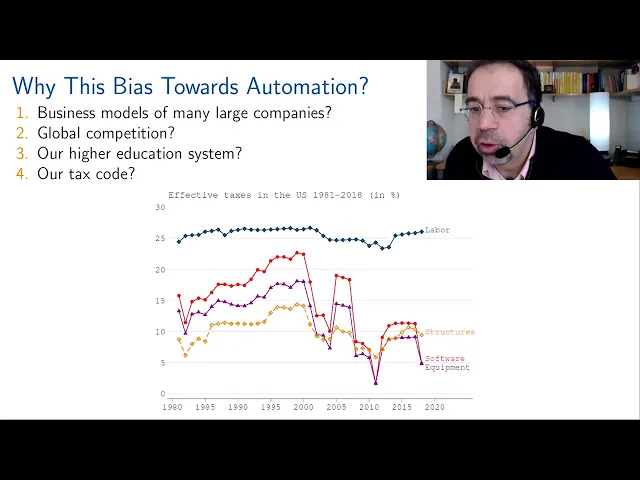
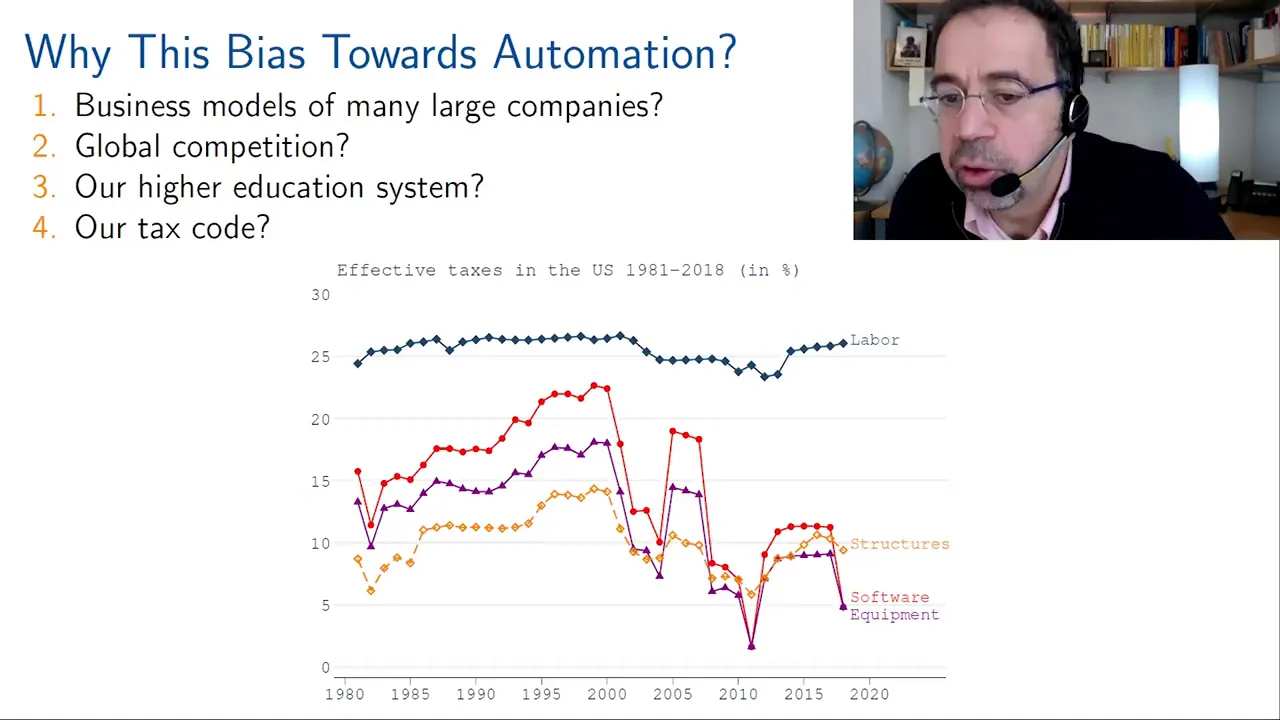
satisfactory answer there are many reasons for companies to go more in the direction of automation and we can pinpoint a few of them new technologies are driven by very large companies such as google facebook amazon netflix and their business model is very much centered on substituting algorithms for workers global competition has created very powerful motives motivations for companies to reduce costs and automation is part of a suite of measures that they're taking for that but also government policy has explicitly encouraged excessive automation here is one way of looking at that i'm showing you the marginal
taxes faced by labor and different types of capital in the u.s labor has always been taxed more than capital uh because of payroll taxes and federal income taxes around 25 but that gap was small in the late 1990s as software was taxed above 20 and equipment capital was taxed about 15 but since then uh the the taxes on capital have come down very sharply mostly because of depreciation allowances that have enabled firms to write off all of their investments from their tax obligations but also because many companies have shifted their tax status and are not
paying corporate income taxes and so on so as a result labor continues to be taxed at more than 25 percent capital especially capital involved in automation and uh uh is is taxed by less than five percent at this point you might say fine you know there are all these disruptions that automation is creating but our future depends on it you know we have to invest in whatever technology is best and that's what these companies are doing and in any way even if some workers are being harmed by it as a society we are benefiting unfortunately
that statement that belief is wrong on both accounts first of all as i have indicated there is nothing preordained about about the path of technology my emphasis that there are very different types of technologies going to displacement versus reinstatement and we are making choices about which ones to push forward is very much centered on this belief and this evidence that we decide the future of technology but even more misleading or misplaced turns out to be our comfort that we are getting great productivity benefits from these new technologies uh actually i was gonna show you that
this is not a u.s phenomenon i'll let me come back to that in a second uh and uh and uh and here i'm showing the headline measure that economists use for understanding how much productivity benefits we're getting from new technologies total factor productivity how much our capital and labor are becoming more productive and routinely pretty usually we was to get we was we used to be we used to get tfp growth rates of about two percent sometimes even above three percent a a decade in the past that meant that our productivity was increasing so much
that uh gross domestic product per person was increasing even without investing more in capital and labor well no more despite the fact that we are hearing about new technological breakthroughs and we're seeing new widgets and digital innovations every day actually this is one of the most disappointing periods in terms of productivity tfp growth it's now hovering around 0.5 percent this is not a u.s phenomenon for example the productivity slowdown has been true in the uk and france in scandinavia less in germany because of the export boom but it's very very common across industrialized nations the
changes in the automation and the implications in terms of employment patterns is also very common and here is one way of seeing that i'm now draw plotting the evolution of the middle class occupations in the middle third of occupations in terms of wage which covers assembly blue color uh other sort of production works as well as clerical and sales occupations and you see that those occupations which are at the crossfires of automation have declined everywhere in fact they have declined even more in the uk than in the us so automation is something that's affecting all
industrialized nations and in fact actually emerging economies as well and we can talk about that in the q a there are a number of interesting issues in that context that to be considered the wage implications have been different because in places like france or scandinavia better protection for low paid workers meant that real wages for law education males have not fallen but other changes are very similar covet is said to exacerbate all of these trends because now companies are saying because of social distancing and vulnerability to the virus they're taking more steps towards automation 75
percent of companies say they have already done so or are planning to do so in the near future but as i have indicated none of this is pre-ordained the future does not need to be fully automated of course we need to adopt robots of course we need to adopt algorithms that automate certain routine tasks but the problem isn't that we are adopting these technologies but we are adopting only these technologies we are developing only these technologies so the future can be one in which we have a more balanced portfolio of technologies that includes those that
help humans make humans more productive that empower humans and that's what we are not doing how can we do it i think nothing short of a major institutional overhaul would be sufficient to do this in particular this is what i call welfare state 3.0 new responsibilities for the state some of those are complementary but distinct from what i'm talking about even if you don't agree with me on technology we have to combat rising inequality climate change pandemics but i think much more central and something that wasn't part of the conception of the early welfare state
uh designers and advocates is that the state now needs to play a more central role in the regulation of technology this means that we cannot just trust the private market the unfettered market to be making the decisions about which type of technologies to employ where the future direction of ai will go and there are very good reasons for that in economics we tend to think that the government should interfere in places where that intervention is consequential not in small things but in things that outweigh the cost of intervention and also in places most centrally that
have externalities technology is the quintessential example of things that have generate externalities and those who use or deploy or create those technologies don't internalize them fully and we have examples going back to world war ii internet sensors antibiotics and most recently renewable technology where the government has played a central role in the direction of technology so it's not nothing new but we have always done it in an ad hoc match manner without a a a a a clear road map a clear mandate and a clear consensus from society so that i think is has to
be the next step of a welfare state however while i feel fairly certain that from an economic point of view this is warranted there are political questions that need to be asked and those relate to the balance between state and society this is something that already uh came up very centrally in the debates about welfare state 1.0 the defining document of the british welfare state the beverage report when it was uh circulated in 1942 that was uh embraced with great enthusiasm by the british people and may have actually contributed to the enthusiasm that people or
the efforts that people make towards the war effort but there were many critics and among chief among them was this gentleman a recent emigre from austria teaching at the lsc frederick hayek who wrote on the basis of his concerns an essay and then a book which became one of the most important books of 20th century economics and political science the road to serfdom hayek's concern was that if you put such new responsibilities on the shoulders of the state such as social safety net minimum wages national health insurance aid to families with dependent children aggregate demand
management all things called by the beverage report that will create an administrative state that will be so powerful that it will create a second road to serfdom or a new type of totalitarianism just like the one that he had fled from austria this actually turns out to be very appropriate for me to sort of link to the new book that i wrote when published in 2019 with james robinson the narrow corridor where we try to provide a very simple but we think hopefully uh powerful framework for interpreting evolution of state society relations and how this
impacts democracy liberty economic dynamism and in 30 seconds we can summarize the framework of that book with this diagram which simplifies everything to down to two factors power of the state which means the repression capabilities of the state as well as the capacity of the state to provide public services to resolve disputes and understand and regulate society and power of society collective action traditions norms democratic participation things that non-elites do in order to participate in politics and of course also often direct the energies of the state or resist the incursions of the state into their
domain throughout much of the history we were here where societies and norms and customs were strong states and hierarchies were weak then we were much of the history was spent here where you can see the china as an emblematic case where the state is very strong high capacity but high repression capability as well which then ultimately makes uh society prostate and unable to contend for power but when state and society are balanced which happens in this narrow corridor epidemic with the book then the situation is very different it is in this corridor that we argue
true liberty democracy emerges but even more interesting for my purpose here that in this corridor the evolution of state and society politics and economics is very different as shown by these trajectories that are going up what that captures which we try to represent with the analogy to lewis carroll's red queen is that because society and state are both competing and cooperating they're locked into a race just like in the red queen so each has to run faster to keep up with the other and that's the reason why they're both getting more and more capable more
and more powerful over time what this means for hayek's concerns is that when we put more responsibilities on the shoulders of the state the only option wasn't to go out of the corridor a type of concern that hayek had but we could have another happier outcome which is that society increased its ability to participate in politics democracy deepened free media civil society became more capable and as a result we kept that more powerful leviathan in check better shackled and that's exactly what happened in britain labor governments came and went when they did excessive nationalization they
went but the conservative governments did not undo the welfare state until taxer that's exactly what happened in scandinavia germany france and also to some degree in the united states so therefore the solution in some sense if it were feasible would be to put to demand the necessary additional responsibilities from the state but also make sure that our democracy functions better that i think is not a luxury because we have to try to deal with the pernicious effects of an unbalanced technology portfolio that's going to get even worse in the decades to come but the question
is whether we can prove hayek wrong again because we are not just suffering from lack of good jobs inequality declining labor demand but we're also suffering from a weakening democracy so i think that's a good point for me to stop and get into the questions and answers and the discussion thank you thank you thank you um professor asimov for very fascinating presentation for your work since you've written the book the naro corridor um so picking up on your presentation on ai and automation your most recent 2020 paper is just presented one of the conclusion that
you said ai is currently substituting for humans in a subset of tasks but it's not yet having a detectable aggregate labor market consequences do you think it is still too early for us to reach to that conclusion when you reach into that conclusion what are the potential limitations that you have in your mind so you for ai absolutely i think when we talk of ai most of its effects are going to be in the future however you know the the patterns that i showed you are driven by other types of automation technologies that's why i
emphasize robotics that's very distinct from ai and also non-ai software automation so uh my co-author pascual restrepo and i have done a similar analysis for example relative to similar to the one for robots but not it's high quality in terms of the data and the variation but it it sort of indicates that software automation has had very similar effects to robotic automation so ai is a new technology platform it can continue what software automation has done or it can also do many of the things that we were hoping that it could do greater empowerment of
humans more abilities to access and process you know information for humans so that we can be better productive uh better adaptable workers so i think that's one of the reasons why i think this is a critical time for us to redirect the technology that we have available because i think this is the time where this new technology platform will start being deployed so how are technological change today different from centuries ago where we had the machinarization for agricultural production and what kind of distribution effect would that have on emerging economies and developing nations well i
think mechanization of agriculture is an extremely important episode and i think it needs to be restudy because there is one narrative about the mechanization of agriculture which parallels the misleading narrative that i see sometimes about today's technologies that oh they are great and they will ultimately automatically benefit all of us well mechanization agriculture didn't do that for two reasons for two very distinct reasons that we need to understand first of all it created a lot of hardship uh you know in the united states at the beginning of the mechanization of agriculture more than six fifty
percent of the people were employed in in in agriculture so uh in the course of about four decades that number was down to 10 so there was a huge dislocation and the people who lost their jobs in agriculture often did not reach their even meager levels of existence survival that they had in agriculture second overall employment actually did very well during that period but there was nothing automatic about it it wasn't somehow that people who lost their jobs in agriculture went and became carpenters no what happened was that at the same time as the mechanization
of agriculture uh fortuitously the us economy for instance and i think the same thing in the uk economy started creating new tasks new occupations new industries for instance the manufacturing sector became completely revolutionized around the same time if you look at manufacturing plants uh in uh at the uh uh uh in the middle of the 19th century or late 19th century you see very low productivity plans that are just focusing on production workers assemblers or or or or line workers and that changed completely in the first few decades of the 20th century you had the
growth of non-production and clerical workers and engineers in production plans they both provided uh support for production workers but also increased the efficiency of the production process greatly reducing waste improving designs improving the ability of the the the different parts and then that was combined and became really powerful with the electrification of the of the factory system so all of these things were not automatic they were because we made innovations that were critical for humans to be at the center of the production process and firms leaped on these new technologies and used them effectively that's
what we're not doing today thank you thank you for also this question on the future of the economy and technological change um but you're most well known among our audience for the two books that you've co-authored why nations fell and the narrow corridor so i want to reset our conversation move to the beginning of your academic career you completed your master's degrees in econometrics and mathematical economics and a phd in economics from london school of economics and your doctoral thesis was a micro foundation of macroeconomics so how have you shifted your research from the start
of your career to what you are doing and researching now well i think my research has shifted many times but i think the motivating questions remained broadly similar i was attracted to economics when i was in high school because i wanted to study economic and political development which i thought were very connect closely connected and i thought economic science would be about these issues little did i know i went to the university of europe which was wonderful i loved it and i learned a lot there but what i learned was pure state forward economics with
very little political aspect issues of political power democracy institutions largely or completely absent from that picture so uh so the first few years in my graduate studies and uh i i look i worked on those sorts of the more sort of neoclassical end of that economic growth unemployment human capital technological change but my sort of uh interest was always at the intersection of economic and political development and and then starting towards the end of my phd i went back to thinking about more of these institutional aspects and then a lot of the rest of my
career has been a back and forth or weaving of these themes of technology unemployment wages inequality together with the more political social aspects of the economic development process as you said back then the kind of big picture question about the long-run development of the nation of economy were not popular and how has the discipline of economics changed throughout your academic career i think there were always many people interested in in those questions sometimes in the fringes of the profession but yes i think economics in the 1980s and early 1990s was undergoing a technical revolution better
empirical work better theoretical foundations by game theory information economics that had started in the late 70s but really picked up speed in the 1980s and i think these were very important and other issues more institutional were left on the side but i think there are many things you can complain about economics uh the economics profession as as many other uh uh you know disciplines in social science and outside social science it has an insularity it has uh it sometimes uh may get onto fads or we may not have the answer to all of the questions
but it is actually a fairly open discipline and and i think uh you can see that from the fact that once people started doing more on political economy or the same thing on more behavioral economics both of these fields and more recently social economics have really taken off and have become mainstays of graduate education and uh and and and research in journals so so i think uh it it is because it's an empirical discipline if you can speak to the empirical questions that are central and bring new aspects new angles to that i think that
has a chance of taking off thank you speaking of the discipline being open um what role do you see yourself playing open up the academic discipline to the wider public especially writing popular books in the area where populism has thrived what impact do you think your ideas have had and do you think you've struggled to break out what people might call a elite or neo-liberal bubble well i think there are those are two separate questions chiang kai but i'm happy to answer both of them i think the first one you know regardless of you know
neoliberal bubble or not i think academics you know have as a collective not as an individual but as a collective responsibility to speak to the people it's completely okay for some academics to do completely abstract things that don't talk to anybody even non-specialists within their field that's completely fine but if a complete breakdown of a discipline and the public takes place that's very dangerous so there is a useful role for some academics to do both research and dissemination of ideas to a wider audience and sometimes people may just focus on the dissemination to the wider
audience as well so i thought that certainly after the first 10 years 15 years of my career it was very important for me to play a role in that dissemination and i have written the books that you mentioned such as the narrow corridor and why nations fail and i also write op-eds or essays for popular outlets uh such as new york times foreign affairs and so on for the same reason and and i think it's been a very rewarding process for me for two reasons first of all uh you know writing why nations fail with
my long time collaborator with james robinson has been completely transformative to us you know we had done a lot of the academic research by putting everything together and trying to distill it to the core ideas that were sort of uh stripped away from the uh uh uh from the technical language uh was very very useful for us to understand the holistic picture and and it's also been very rewarding because it's had some modest success that people have gotten to know some of the ideas that have engaged with the with the with with the key issues
so i think those are very very rewarding for me as a person and i think they are useful for the profession for many more people to do so and many more people have started doing so now of course then the question becomes you know what is our responsibility in terms of the ideological bent or the aspects of the social implications of the research that we are conducting and how it this relates to policy etc i think that's a very complex issue you know uh if you go back to the 60s and the 70s some of
the most influential work speaking to the lay audience were things like capitalism and freedom or free to choose by milton friedman or the road to serve them by hayek so they had a very very free market extreme free market agenda but i don't fault them for it i disagree with them but i don't fault them for it that was their deeply held view and it's completely okay for them to push that deeply held view i think uh however uh what the economics profession can be a little bit guilty of is that we sort of swallowed
the friedman hayek view hook line and sinker and went along with it perhaps far too much especially the sort of the shareholders revolution the economics profession giving cover to selfish uh excessively disruptive managers who wanted to line in their pockets or just look after the interests of a small group of shareholders at the expense of society workers etc i think those are not caused by economists but economists may have may have slightly helped it on the margins so as a result i think uh sort of many economists now grappling towards a new sort of vision
where i see you know my calls for welfare state 3.0 being part of it i think is a useful thing you know we don't we are i think almost all economists that i know uh who are you know respectable researchers and are active in these areas we are all committed to a market economy but that doesn't mean that we are committed to unfettered markets uh and and large corporations doing whatever they want so what type of regulation where does that regulation come from how do you get its institutional and political foundations when what are the
things that we should focus the regulation i think those are very difficult questions my call for it was that you know we should really uh broaden our vision of regulation to regulation of technology and also trying to put that in a political economy foundations along the lines of the narrow corridors framework well thank you for sharing your experience i'm sure there are useful takeaways for our members who want to pursue a career in economics moving on to the actual substance of your books um why nations fail is such an encapsulating question and in a simple
way your answer to the question is institutions political institutions how do you view other competing reasons to the question uh well look social science is multifaceted nothing is monocle that's for sure but my belief has always been that it's also very fast frustrating for an author who you trust and say i'm going to give you my 20 hours reading your book says well anything can happen x matters y matters z matters everything matters i think that's just you learn nothing from that so i think in the same way that i i disagree with but i
appreciate you know hayek pushing a particular point of view james robinson and i decided we want to push a particular point of view so we wanted to push what we believe to be the most important thing but not the only thing institutions since then you know our research and our writings have broadened and we have we have sort of started trying to incorporate into a more satisfactory framework some of these other ideas but i do you know even though the white nations fail was written you know in 2009 2010 so more than 10 years ago
now i stand by its main uh claims which is that you know a simplistic view of national cultures or religious cultures doesn't explain uh economic growth it doesn't mean that norms don't matter that those are central for the narrow corridor and some of the recent work we are doing and obviously cultural elements shape how you construct institution but understanding uh why south of italy is poor relative to north of italy because the southerners have bad culture or understanding why the u.s is rich relative to mexico by saying you know americans have anglo-saxon culture whereas mexicans
have hispanic culture those are not very useful nor is it useful in some sense what is sort of a default position of many economists which is that you know uh many policy makers don't have good economics education they make by policy mistakes and our job as economists is to teach them better economics of course there's that's true that's why we are all in uh uh uh very much committed to sort of better education but but many times policymakers do do adopt policies that are disastrous for their countries not because of ignorance but because they have
political reasons for doing so either lining their own pockets or by adopting policies that look after the interests of certain groups they can keep their power and also geographic factors again i think are extremely overblown as determinants of long-term economic development again all of these factors matter geography matters you're not going to have a club med in the in antarctica and you're not going to [Music] have an economy that's diversified when you have you know so much oil as kuwait but but but but geography is not destiny and nor is culture and nor is uh
some sort of ignorance of the politicians then um how do you address the question of endogenicity if the good political institutions explain economic growth and economic prosperity what explains the good political institution in the first place i think that's a great question and and it's been something that's been at the center of my work because that's that's a that's a critical issue and it's one that was a stumbling block for much of the literature but the way i look at it is golf is half full how hefty first a half full part is that what
you describe is actually a very simple but very powerful way of thinking of the historical evolution of institutions you know what i was trying to capture in the narrow corridor that corridor area in some sense is these feedback dynamics you have better institutions in this sense in this case in terms of states capacity and ability of society to keep those politicians accountable and that feeds on itself and creates not just better economic outcomes better liberty but also leads to yet even more better institutions so those feedbacks are very interesting they're central for our historical understanding
of how things have evolved but the glass half empty is that of course that from an econometric point of view it makes it hard to get to the bottom of whether you're actually looking at causal effects and that's what a lot of the literature has attempted to do you know there are many sort of uh interesting attempts to look at it some of it based on my own work is to look at historical accidents that have kept things that are not institutional constant but have triggered different institutional development paths so that would be an iv
type of approach or zeroing in from the national to the more local you can look at things like regression discontinuity such as in melissa dell's work looking at whether two places that are nearby but have had because of historical accident different institutions they have had different economic and political development paths so there are a variety of different approaches that one can adopt and i think the weight of the evidence is that when you do that you see the impact of institutions both economic and political but when you look zero out when you zoom out and
look at it from a higher level you see those feedback dynamics as being important for history as well thank you i appreciate this answer um i also i'm aware that with uh we're constrained by time limit so i'll move on to a couple of my final question focusing on your book the narrow corridor which is full of original and fascinating concepts which you're explaining your presentation the concept of narrow corridor but then there's also the red coin effect there's also the paper level um and this is also full of historical researches and case studies two
case studies stood out to me the most is one case of america and the case on china so i want to begin with the two biggest cases yeah so i want to zoom into the case of america money have fun in the past four years the trump presidential has kind of showed the evil nature of america a nation with disintegrating institutions with vast inequality and social issues that plagued the country's state ability you have also warned us this in the foreign affairs article you've written earlier in the year how do you predict the future of
america especially on this day i appreciate you coming with us and the inauguration of joe biden is happening at the same time yes i'm missing the inauguration uh look since you you know raised refer to the narrow corridor let me first say something about that uh you know in some sense uh our the the chapter on america in the narrow corridor was in many ways the hardest to write because in some sense it's the most complex story i think uh it is a clear case of a country that has behaved many in many ways like
it's in the corridor with both state and society participating in politics but on the other hand has had so many weaknesses and so many problems that you know acts almost like an exception in some respects some of those many of those go back to the compromises that were made at the founding as all of you know most importantly about slavery and giving lots of veto power and and and ability to affect things to southern states and southern state elites and i think two consequences of of this have been particularly transformative for u.s political development one
is that not just black citizens but all low advantaged people have suffered because the wings of the federal state when it came to fighting poverty uh and protecting disadvantaged citizens were clipped from the beginning and second the federal state had a very uneven development weak in some respects but then also not very tightly controlled in other respects because it could develop its competencies and powers such as the sources security services on the side and i think what we see in throughout the 20th century is the interplay of these weaknesses together with reforms and efforts to
make it better and the last four years were really extreme examples of these weaknesses coming to the fore but not out of nowhere i think trump and uh and and and his allies however uh unethical and unscrupulous they were they were actually voicing concerns that regular americans had lack of economic growth falling behind economically and the cultural sort of uh problems that they were having but what that turned into in the hands of trump and his allies is that it weakened federal bureaucracy even further it uh eliminated many of the protections for the weaker citizens
and racism was part of that but i think it's just the icing on the is is the tip of the iceberg in that respect and it also started a process of unraveling both the norms and the institutions that have kept the us state society relations in a more even kill so i think all of these things made trump's presidency extremely dangerous and i think they fit with the narrative that we have in the narrow corridor even though as i said the the u.s chapter is the most complex one in that respect the future look i
think i'll say two words on it first of all we've averted disaster another four years of trump i don't think this republic's institutions would have survived it so we have a rejuvenation a chance to a rebirth but i don't think it's going to be an easy process i think biden harris is as good a team that you can hope for to be at the helm of this but i don't think they can do it unless they recognize the problems and i think the problems are very much related to the speech that i gave today we
really need to create good jobs and to create good jobs we need to boost labor demand especially for non-college workers and that cannot be done unless we redirect our technology and that cannot be done unless we find a new institutional framework for the future and on top of it there is the cultural polarization uh the fact that you know the agenda of the democratic party which in many ways i agree with is so disruptive to the the the the and and and the and the and the community existence of perhaps 40 percent of americans so
how do you bridge those things you know how do we at the same time protect minorities but make sure that this doesn't become a more aggravating factor for 40 of americans that polarization of course got much wider during trump because he purposefully tried to exploit it but but unless we find a way of dealing with that again trump won't be the last american populist thank you thanks professor for your answer and i want to squeeze in some uh audience questions and one of them is kind of a question i want to ask on china in
your book you argue china's this particular license will ultimately fail to move the country to the far from the world economy how would that happen and the did the copy pandemic accelerate or slow this process though i have no doubt that the corvette pandemic has slowed that process down you know china you know my view of china hasn't changed all that much from the time we wrote for in why nations fail that china made its biggest advances when it started making its institutions more inclusive but still because it's political institutions are especially very extractive it
is an example of extractive growth and ultimately it will run into problems and the problems would be more of the inefficiencies ossifying more of the control of the communist party leading to greater inefficiency and and loss of momentum amplifying conflict on the other hand i must say that you know it is easy and we have probably done it too to underestimate china china has been perhaps the most successful macroeconomic policy experiment both in response to the financial crisis and the pandemic in both cases there are blemishes you know in the case of the pandemic the
fact that china did not warn uh the world and hidden formation and manipulated information including on the vaccine but on the macroeconomic front and and organizing things it was very successful for the global financial crisis yes sure government banks became even more problematic but you know again china did very well so i think i don't expect china to buckle down and and and fail in the next five years or anything like that and there's one more wild card that complicates things which is big data and ai china because of its commitment to ai and willingness
to sort of not recognize the limits of privacy and data use and data collection has an advantage in some of these technologies will they undo some of the other disadvantages that we point out in the two books i don't think so but again they complicate the future they complicate the dynamics and if america fails that would be yet another uh sort of boost to chinese prestige and chinese dominance which will help in many different ways so so i think the the the future is is is very unclear but i i remain committed to the view
that innovation in china with the exception of this you know use of data is going to become more and more difficult because of its political system and you see that in the chinese universities chinese universities have gone many many steps backwards over the last six seven years because of the inevitable clampdown of the xi jinping administration and i say inevitable because you cannot have an extractive political system together with a free thinking university system where criticisms flow left right and center so i don't see what's going on with the chinese universities as a surprise it
is the continuation of the political despotic system and and but it also means that science and and innovation and free thinking are going to suffer thank you just follow up on this question i've got two remaining two remaining questions for the next couple of minutes um the first one um it's about what is the idea you proposed as opposed to a bipolar world do you propose something like a quadripolar world with four different forces competing and trying to restrain the rise of china and the final question is from a member um judge commander from san
antonio's college about how well africa survived or thrive during the age of technology and automation well actually those two are very connected and let me answer both of them at the same time so i advocated a quadripolar world but not to contain china that would be the wrong reading i think it's more to control the dangers that we are facing and make best use of the opportunities that we have and technology was central in my mind together with climate change and that responds to the question about africa you know i talked about the potential cost
of automation technologies for us and western workers but the costs are much greater for emerging economies for africa for latin america why because these economies still depend on labor they are capital and technology scarce and labor abundant and so ai and other technologies going more in the automation direction is a classic inappropriate technology so they need to be at the table in order to have a say about the future of technology that's going to be so defining for them and in order to have a say on climate change that again is going to be more
relevant for them given their geography than for say scandinavia but also europe needs to be there as a separate entity because europe just being a tale of the united states is not helpful and we have seen that in issues such as controlling google facebook amazon europe for a variety of reasons both because of their greater ease with regulation and also because none of these companies are european have had a more principled approach and also on data privacy so i think those diverse voices being heard everybody being at the table would be good for future global
politics and global technology thank you thank you for answering all the questions that we have and one hour has gone past really quickly and i would like to thank you on behalf of everyone from the union for spending time with us thank you my pleasure looking forward to seeing you on a different zoom meeting with the members who followed it to ask you some further questions perfect thank you thank you [Music] you