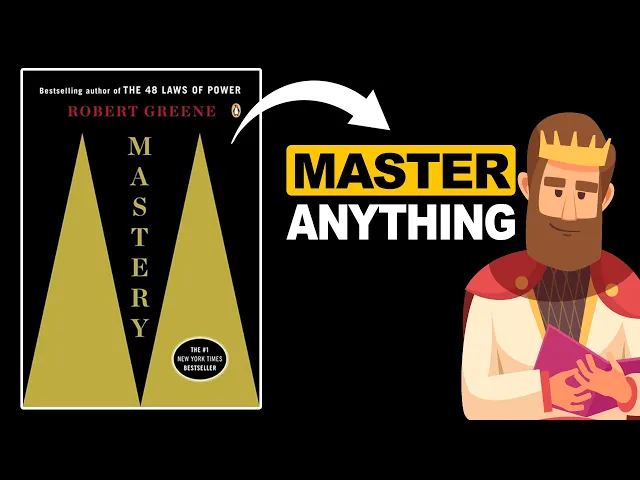
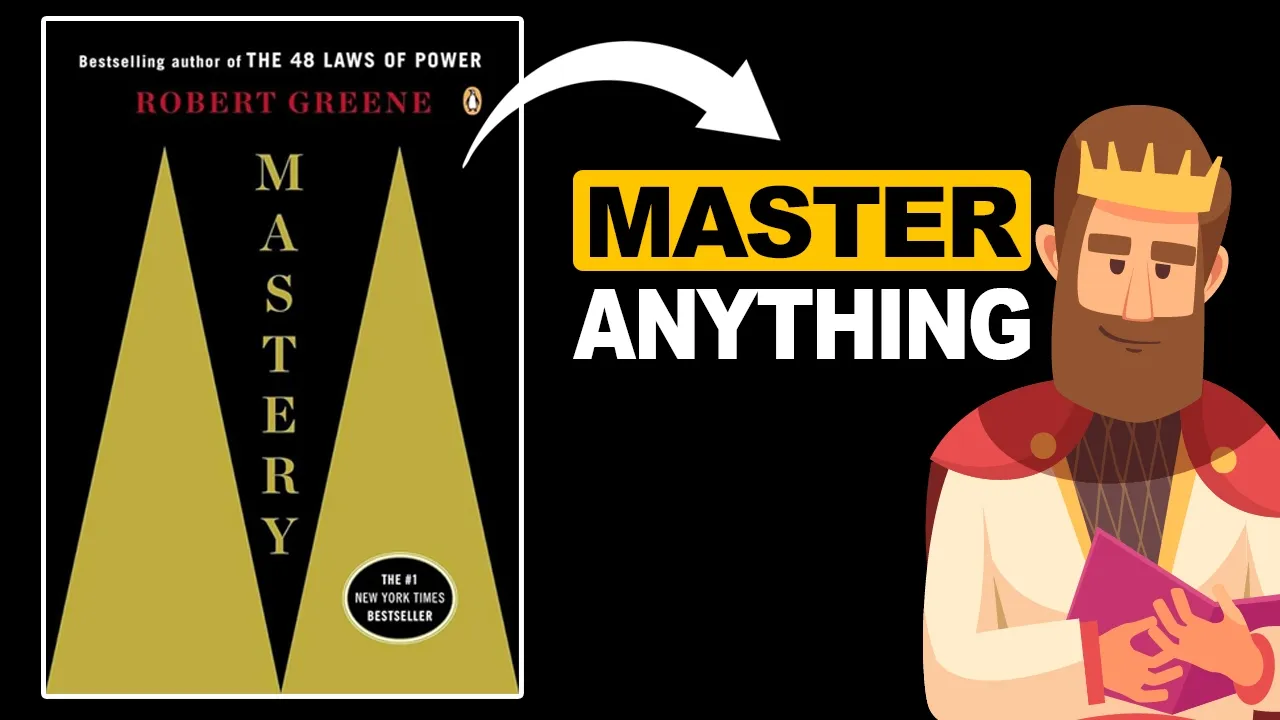
the book Mastery by Robert Green is all about the journey from beginner to reaching the Pinnacle of expertise and fulfillment in your field in today's video we'll break down Green's Masterpiece for becoming a master not just in skill but in self-awareness and understanding the world around you by the end you'll know exactly how to start on the path to Mastery harnessing your potential to achieve lasting success and deep personal fulfillment we'll cover what it takes to move through the three stages of mastery apprenti ship where you build a solid foundation the creative active phase where
your Unique Style begins to take shape and finally Mastery where your impact becomes truly meaningful picture this here's Sam a graphic designer who's constantly switching projects hoping each new skill will be his big break but he never reaches any true expertise then there's Sarah a musician who has dedicated years to mastering her craft embracing the failures and hard lessons along the way Sarah's journey is what green teach embracing the process making sacrifices and building a legacy to help you on your own Journey grab a free step-by-step blueprint designed to guide your first steps toward Mastery
just click the link below and I'll send it to you let's get started chapter one discover your life's task you must be true to yourself and the greatest way to be true to yourself is to find your calling Robert Green opens Mastery by emphasizing that each of us is born with with an inner force that guides us toward our life's task the work we are meant to accomplish true Mastery comes not from chasing external rewards like fame or money but from deeply aligning with this inner calling green insists that the path to Mastery begins with
identifying a career or craft that resonates with your core nature something that feels more like a calling than just a job people who love their work always go further because they are motivated from within this reminds me of a Nota from the subtle art of not giving a f who found purpose even in the harshest conditions green provides seven key strategies for discovering and pursuing your life's task first reconnect with childhood passions look back at your early interests for clues about your true calling childhood often reveals unfiltered strengths and passions that can guide your long-term
professional path second find your Niche Mastery requires depth not breadth focus on a specific field where your passions and opportunities intersect allowing you to excel through intense dedication third avoid the false path don't chase careers just for money status or parental approval these external motivations can lead you away from True Mastery choose a path that resonates with your genuine interests fourth Mastery takes time green revises the famous 10,000 hours rule by stressing that it takes at least 20,000 powers to truly Master a skill for someone driven by Passion this time feels like exploration rather than
drudgery fifth blend work and life Mastery is not about separating work from life it's about merging the two the more your work reflects your true self the more fulfillment you'll find in it sixth let go of the past if you're stuck on the wrong path don't be afraid to Pivot green emphasizes the importance of flexibility don't feel trapped by past choices seventh find your way back throughout your journey you may stray off course but even if you do it's always possible to return to your life's task keep recalibrating your direction as you grow in addition
to these specific strategies green outlines three overarching principles that shape your approach first revisit your childhood reconnect with your inner inclinations your true calling lies within you look back at the interests and patterns you had as a child untainted by external influences like parental pressure or societal expectations this self-awareness forms the foundation of your life's task second identify your Niche enlarge your concept of work once you've reconnected with your inner voice the next step is to apply this understanding to your career think of work as an extension of yourself not just a means to make
money if you see see work as just a way to make money you'll waste a significant portion of your life instead think of work as an integral part of who you are your career should feel like a natural expression of your Deeper Self when your job aligns with your deeper interests even routine tasks become opportunities for growth third pursue authentic interests view your career as a journey not a straight line Mastery is not about following a predetermined rigid path it's a dynamic ever evolving process your path to Mastery will not be straightforward start by choosing
a position that aligns with your inclinations even if it's not perfect as you move forward you'll discover new directions or opportunities that excite this continuous process of adjustment helps you refine your direction as you gain experience and eliminate what doesn't fit chapter 2 the ideal apprenticeship in the apprenticeship phase you must be humble and observe absorbing the Knowledge and Skills necessary to reach Mastery the apprenticeship phase is where practical learning takes place this phase occurs whenever you switch careers or acquire new skills and it's crucial for Mastery however it's filled with dangers like insecurity emotional
distractions and self-doubt so how do you create the ideal apprenti Ship by fully immersing yourself in learning and seeking out challenges you build the skills and resilience needed for Mastery the goal here isn't money or status but transforming your mind and character Comfort won't push you toward growth but difficult environments and mentors will these roles should force you to grow and provide feedback that pushes you beyond your limits step one deep observation the passive mode the greatest mistake you can make in the initial months of your apprenticeship is to imagine that you have to get
attention impress people and prove yourself these thoughts will dominate your mind and close it off from the reality around you you start by quietly observing who is doing well in the field absorbing everything focus on learning the rules and strategies by watching those who Excel step two skill acquisition the practice mode first it is essential that you begin with one foundational skill you must avoid at all cost the idea that you can manage learning several skills at a time you need to develop your powers of concent ation and understand that trying to multitask will be
the death of the process second the initial stages of learning a skill invariably involve tedium the pain and boredom we experience help build the focus necessary for True expertise step three experimentation the active mode once you've gained enough skill start applying what you've learned move from following the rules to breaking them creating your own works and gaining hands-on experience the strategies Robert Green outlines for completing the ideal apprenticeship emphasize the importance of proactive engagement and a willingness to embrace challenges first value learning over money during the apprenticeship phase your primary focus should be on learning
not on earning green advises mastering the art of living on little to give yourself the freedom to immerse deeply in the learning process sacrificing money now will pay off later in Mastery second keep expanding your horizon Horizons the moment you start feeling comfortable or settled it's time to disrupt your routine always push yourself into new and uncomfortable situations that challenge your current Knowledge and Skills stagnation is the enemy of Mastery third revert to a beginner's mindset one of the most dangerous mindsets is believing you've mastered something in reality Mastery is a lifelong journey you must
approach every task even familiar ones with a sense of humility and curiosity constantly looking for new things to learn fourth trust the process Mastery doesn't happen overnight it's a slow and deliberate process that requires patience and focus on long-term growth fifth move toward resistance and pain we naturally gravitate toward the parts of a skill we're good at avoiding areas of weakness green strategy is the opposite focus on your weaknesses and push yourself to tackle the most challenging aspects of your craft growth occurs where there's discomfort and resistance sixth learn through failure failures are your best
teachers analyze your mistakes and use them to refine your skills seventh combine the how and the what a true Master doesn't just understand the technical aspects of a skill the how they also grasp its deeper meaning and purpose the what avoid superficial learning eighth Advance through trial and error the path to Mastery is rarely linear experiment with different roles and techniques especially in your 20s avoid the rigidity of a fixed career path that limit your growth ninth avoid the rigid path green warns against locking yourself into a singular career trajectory too early those who do
often face career dead ends or burnout by midlife instead a wide- ranging apprenticeship in your youth will keep possibilities open and allow your career to expand as you grow older chapter three absorb the Master's power the mentor Dynamic a mentor is someone who sees more talent and ability within you than you see in yourself in the journey to Mastery few relationships are as transformative as that of the mentor and protege a mentor serves as a FASTT track to master offering their hard-earned wisdom and experience to dramatically speed up our progress by working closely with someone
who has already walked the path you bypass many of the mistakes and dead ends that you would encounter on your own mentors offer you you focused attention challenge you in the right ways and give you immediate realistic feedback which accelerates your learning curve dramatically to learn effectively requires humility not just admitting that you don't know everything but cultivating a mindset that allows you to fully absorb the wisdom of those more experienced this mindset holds immense power and once absorbed can be adapted to your unique character and goals the right Mentor will connect with your life's
task pushing you toward your true potential but once you've internalized their teachings you must move beyond their Shadow the ultimate goal is to surpass your Mentor taking their knowledge to new heights through your own creativity and Brilliance Robert Green explores effective strategies to strengthen the mentor Protege relationship ensuring it is productive balanced and conducive to growth here are the key strategies choose a mentor who matches your needs select a mentor who can address the gaps in your education or experience whether you need guidance confidence or the freedom to explore independently find someone whose strengths complement
your weaknesses be cautious of mentors who may unintentionally replicate negative patterns from your past such as overbearing parents instead seek a mentor who challenges you while fostering growth gaze deep into the mentor's mirror mentors often provide critical sometimes uncomfortable feedback while this may be difficult to hear it is essential for your growth the more you open yourself up to their honest realistic criticism the faster you will progress use their feedback to refine your skills and strengthen your confidence welcome this feedback as a mirror that exposes areas for improvement transfigure their ideas the goal is not
to become a copy of your mentor as you absorb their lessons start to personalize and adapt their ideas to your own style eventually you must move beyond their Shadow and surpass them taking the knowledge further than they did create a back and forth Dynamic a healthy Mentor Protege relationship is a two-way street while it's important to respect their guidance you should also assert your needs and engage in open communication this back and forth Dynamic ensures that the relationship evolves over time and that both parties benefit from The Exchange chapter 4 see people as they are
social intelligence is the ability to see people's motives understand their emotions and anticipate their actions Robert Green emphasizes that intellectual Talent alone is not enough for Success you must also Master the subtleties of human interaction in Mastery green cites a study from Malcolm gladwell's outliers which followed High IQ children throughout their lives despite their intelligence many of them ended up no better off than their peers with unskilled jobs and lower life satisfaction this illustrates that raw intellect is not the sole predictor of success social intelligence is equally important without this crucial skill even the most
talented individuals can fail to reach their full potential the challenge of social intelligence in many cases the greatest obstacles on the path to Mastery aren't technical challenges but the emotional strain of dealing with others their resistance manipulations and hidden agendas when we get caught up in office politics personal conflicts and social drama it drains the mental energy we need to focus on our craft at the heart of the issue is our natural tendency to project our own emotional needs and desires onto others which clouds our judgment this creates unnecessary confusion and conflict green argues that
social intelligence is the antidote the ability to see people as they truly are without our personal biases social intelligence is a form of emotional intelligence applied to understanding and navigating the behaviors of others emotional intelligence refers to recognizing and managing your own emotions while empathizing with others social intelligence goes further by helping you read and respond to to the motives desires and intentions of others when honed this skill allows you to move Beyond self-absorption accurately interpreting the actions of others in real time by seeing through surface Behavior you can avoid manipulation reduce conflict and build
more productive relationships according to Green social intelligence involves mastering two types of knowledge on the one hand specific knowledge of human nature this is the ability to read people on a personal level Discerning their unique character values and motivations to truly Master social interactions you need to sharpen your ability to see people as they really are not as they present themselves indeed words can be deceptive so pay attention to subtler cues like body language facial expressions tone of voice and eye contact these non-verbal signals often reveal people's true feelings whether they're excited nervous or deceptive
on the other hand general knowledge Beyond individual traits you must also understand Universal patterns of human behavior green calls these Universal patterns the seven deadly realities which are rooted in our psychology and can significantly influence social dynamics mastering this general knowledge allows you to anticipate and navigate common pitfalls in human interactions here are the seven universal patterns Envy humans are naturally inclined to compare themselves to others whether in terms of money status appearance or intelligence standing out too much can provoke Envy which often leads to hostility early in your career it's wise to blend in
until you have enough influence that Envy won't undermine you conformism groups tend to pressure individuals to conform even groups that celebrate diversity are uncomfortable with those who deviate Too Much from the norm as it threatens their colle I values learn to balance your individuality with outward Conformity until you have enough power to assert your uniqueness rigidity people often respond to complexity by retreating into habits and routines seeking comfort and familiarity while you must accept others rigidity you should resist this tendency in yourself stay open-minded Embrace change and continually challenge your own assumptions to maintain personal
growth self- obsessiveness people are often focused on themselves in conversations direct attention to their interests and concerns to make them feel valued this will make them more likely to support your goals laziness most people want to take the path of least resistance even if they claim to Value hard work be cautious of collaborators who seem eager to partner up they may be looking for someone to do the hard work always assess their true motives before agreeing to work together flightiness although we like to think of ourselves as rational emotions heavily influence our decisions people's behavior
can be inconsistent because of their emotional swings so understanding this can help you manage relationships more effectively passive aggression rooted in the fear of direct confrontation passive aggressive behavior often arises when people feel insecure or powerless instead of engaging in direct conflict they may Express their frustration in indirect ways recognizing this Behavior early on helps you address underlying problems without getting caught in unnecessary conflicts Robert Green outlines several strategies to develop and strengthen your social intelligence first speak through your work rather than getting caught up in office politics or social drama focus on your craft
let your work speak for itself by consistently delivering highquality results you'll naturally distinguish yourself and earn respect without engaging in distractions second craft the appropriate Persona creating a Persona is an essential aspect of social intelligence it's not a deceptive act but rather an acknowledgement of the various roles we play in different social contexts consider your persona as a theatrical performance you can consciously design it to be intriguing mysterious and engaging a well-crafted Persona draws people in and allows you to manage social interactions more more effectively third see yourself as others see you self-awareness is key
to social intelligence we all possess social flaws whether we talk too much are overly critical or take offense too easily take the time to reflect on past conflicts and consider how your behavior may have contributed to them acknowledge your social flaws and adjust how you interact with others the more you understand how others perceive you the better you'll be able to navigate social dynamics fourth suffer fools gladly recognize that foolishness is an inherent part of human nature both in yourself and in others everyone has moments when they let their egos or short-term desires overshadow their
judgment instead of allowing yourself to become frustrated by foolish Behavior adopt a mindset of acceptance view such individuals as a natural part of life akin to rocks or furniture by embracing this perspective you can tolerate their Antics with a sense of humor reduce in your emotional investment and trying to change them this Detachment frees you from unnecessary conflict and allows you to maintain your composure chapter 5 awaken the dimensional mind once we have mastered the basics and absorb the rules of the game we must transform ourselves into a creative active thinker this phase is where
you push Beyond conventional limits and allow your mind to explore new ideas and possibilities but here here's the challenge what stops creativity isn't a lack of talent but mindset anxiety insecurity and the fear of failure often lead to conservatism making us stick to what's safe to achieve Mastery you need to push in the opposite direction rather than settling for what you know broaden your horizons explore new Fields experiment and view problems from multiple angles this is how you develop what Robert Green calls the dimensional mind a mind capable of seeing reality in all its complexity
the goal is to awaken your dimensional mind to think beyond the constraints of your skill set and continually grow and evolve this creativity will Elevate you from someone who merely follows the rules to someone who redefines them Mastery lies in continually evolving expanding your understanding and challenging what you think you know step one the creative task to truly Unleash Your creative potential the task you choose must carry an obsessive quality much like your life's task the key to Mastery lies in where you direct your energy your emotional commitment to the task will determine the outcome
when a task ignites your passion and pushes against conventional Norms it will keep you emotionally engaged with the long haul green warns against comfort and security if you need life to be simple and safe this kind of task will make you anxious then When selecting your task keep two crucial elements in mind it must be both ambitious and grounded in reality it should stretch the limits of your abilities while remaining within the realm of possibility step two creative strategies to keep your mind flexible and open to new ideas green offers five core strategies first cultivate
negative capability learn to embrace uncertainty avoid rushing to find easy answers creativity thrives when you learn to sit with ambiguity second allow for Serendipity step outside your comfort zone explore new areas of interest and remain open to unexpected insights avoid jumping to conclusions keep a notebook on hand at all times to record ideas as they surface third engage in the current immerse yourself deeply in your work allowing a dynamic exchange between your thoughts and reality the deeper you immerse yourself in this process the more you access insights that transcend everyday perceptions fourth alter your perspective
challenge yourself to view problems from various angles shift between the macro and the micro consider what's absent as much as what's present ask how instead of what and examine the anomalies that don't fit the usual patterns fifth revert to Primal intelligence engage your senses break away from purely verbal or rational thinking use visual tools diagrams or models to deepen your understanding step three the creative breakthrough tension and insight the illusion that we have endless time to complete our work is a subtle enemy it weakens our focus and diffuses our attention making it difficult for the
brain to operate at its peak to jolt your mind into higher gear it's essential to work with deadlines whether they are real or self-imposed deadlines sharpen our focus and drive the brain to make the necessary connections for Creative breakthroughs after prolonged periods of intense Focus there will inevitably be moments of high tension when this occurs the best thing you can do is step away whether it's taking a break focusing on another task or even going to sleep in these moments of release the mind will often generate a breakthrough the solution seemingly Out Of Reach before
will reveal itself as you push through the creative active phase you'll face emotional pitfalls due to internal challenges and obstacles that threaten to derail your progress but being aware of these traps can help you avoid them complacency one of the greatest dangers on the path to Mastery is the illusion that you have arrived always remind yourself of how vast and mysterious the world remains and how little you truly know this awareness will keep you humble and motivated to push your limits true Mastery is a life lifelong process conservatism success in the creative active phase can
lead to a creeping sense of conservatism where you begin to favor comfort and predictability over creativity and risk instead make creativity your goal not comfort and continually challenge yourself to innovate only by embracing discomfort will you ensure continued growth dependency during your apprenticeship you relied on mentors and authority figures for guidance and approval As you move into this phase you must break free from this dependency trust your own judgment and resist the temptation to seek constant validation from others true Mastery requires independence of thought and action impatience Mastery is not achieved overnight and impatience can
sabotage your progress the best antidote to impatience is to develop a pleasure in the process itself embrace the discipline and repetition required for true growth grandiosity as you gain recognition you may be tempted by feelings of grandiosity believing that public attention or fame is the ultimate reward however such external validation is fleeting and a distraction from the real work your primary motivation must come from the work itself and the Mastery of your craft this attitude is the only defense against the traps set by your ego inflexibility it's crucial to master your field inside and out
understanding its rules and boundaries yet Mastery also requires the ability to question and challenge these boundaries don't let your thinking become rigid stay open to new ideas and approaches constantly evolving as you progress to reach the heights of Mastery you must engage your mind in an ongoing creative process green offers nine strategies to help you cultivate it the the authentic voice after years of absorbing the techniques and conventions of your field true Mastery comes when you find your own voice anyone who spends a decade refining their craft will inevitably give birth to something uniquely their
own the fact of great yield a master is a supreme Hunter always on alert for the fact or detail that will lead to profound discoveries it is better to pursue a few rare and Elusive facts that may yield great Insight than to after many ideas that only bring trivial success mechanical intelligence true creativity lies in Superior craftsmanship your focus should be on maximizing the potential of your materials and your idea natural Powers creativity is best nurtured through focus and patience give yourself open-ended time to explore and develop a wide understanding of your field the open
field to create something new you must carve out a space for yourself in the existing order of things by innovating and creating new forms you attract a fresh audience often finding yourself in a position of power and influence the highend keep your project connected to something larger than yourself whether it's a deep philosophical question a societal issue or a Grand Vision your work should always serve a higher purpose The evolutionary hijack the essence of creativity is adaptability as the environment changes so too must your thinking you must see creativity as something fluid never static adapting
and transforming as you gather more knowledge and insight dimensional thinking take a holistic approach to your work rather than being in a hurry to find Solutions slow down and look at your subject from multiple angles assume that all parts of a problem interact and cannot be entirely separated alchemical creativity and the unconscious true creativity requires a deep exploration of the unconscious mind this involves recognizing and reconciling the contradictions within yourself and examining the contradictions in the world around you the tension between opposites between light and dark certainty and doubt fuels the creative process draw on
this to create something profound chapter six fuse the intuitive with the rational the intuitive mind is a sacred gift and the rational mind is a faithful servant we have created a society that honors the servant and has forgotten the gift accessing a higher form of intelligence in this chapter green explores how mastering intuition is not an innate skill but one that comes through deep immersion and dedicated practice in one's chosen field as we journey toward mastering any field we develop a powerful Synergy between intuition and rational thought unlocking a higher intelligence that allows us to
anticipate Trends make Swift decisions and innovate beyond the ordinary as we internalize the complexities of our work intuition grows stronger it's like seeing patterns that others miss this intuitive feel when fused with rational thinking sharpens our abilities and gives us an almost instinctive grasp of the Unseen forces at Play this is how true Mastery is achieved Robert Green outlines practical approaches to cultivate master in any field connect to your environment Primal Powers the ability to deeply connect with your surroundings is one of the most Primal and Powerful forms of Mastery by immersing yourself in your
environment you can harness natural forces and turn them to your advantage your brain is wired to detect subtle signals by becoming attuned to these you can move fluidly within your field responding intuitively to changes and opportunities play to your strengths Supreme Focus progress comes from aligning with your natural talents like swimming with the current working with your strengths allows you to move effortlessly toward Mastery resist the urge to create unnecessary resistance by trying to be someone you're not transform yourself through through practice the fingertip feel Mastery comes from layering simple skills on top of each
other until they become second nature each basic skill must be internalized and automated freeing your mind to focus on higher level tasks in the final stages when no more simple skills remain to be learned your brain will have absorbed an extraordinary amount of information now deeply ingrained in your nervous system this fing finger tip feel allows for an instinctive almost effortless Mastery internalize the details the Life Force to master a craft you must absorb the finest details until they become part of you it's not about mechanical repetition it's about feeling the life force of your
work making each action an extension of your deep understanding widen your vision the global perspective to stay ahead in any field you need to see beond beyond the immediate by adopting a broader strategic Vision you can anticipate challenges and think several steps ahead of your competition submit to the other the Inside Out perspective in social interactions Mastery comes from seeing the world from the other person's perspective this ability will minimize misunderstandings allowing you to navigate human interactions with greater empathy and skill synthesize all forms of knowledge the Universal Man Woman true Masters are Universal thinkers
they draw on Knowledge from multiple disciplines synthesizing ideas and perspectives to gain a more profound understanding of their craft by connecting ideas from different fields you can spark fresh insights and stay ahead in your own domain [Music] d