American English American English [Music] American English webinar series leash American English webinar series you you welcome everyone to the first webinar in American English webinar series 7 brought to you by the American English team at the u.s. Department of State in Washington DC let's begin this series with a look at this great photo that shows teachers in the Tsar Mila poodle viewing group from Pokhara Nepal participating in a webinar during series 6 we love to see teachers learning during the webinars and exchanging ideas so please share your webinar viewing photos by emailing them to American
English webinars are at BL programs org we may feature them in the next webinar and thank you to everyone who sent in photos during series 6 I'm Lauren Whittaker part of the American English webinar team also known as moderator Lauren and you'll see moderator Heather in the chat box here to help you during the webinar we'll help will be here to assist you as you participate during the webinar series here you can see the series 7 schedule we have great topics lined up for you on grammar media literacy and teaching business English our next session
in two weeks on September 20th will be on ideas for subtle correction during speaking tasks with Elizabeth Eckford our webinars are each 60 minutes long webinars are often related to a theme done on the American English website the teachers corner section from the website shown here features resources and lesson ideas related to the month's topic the theme for September is teaching beginners the way for you to participate is by typing in the chat box as many of you are already doing the chat box is where you can ask questions or make comments related to today's
topic we may not be able to answer every question during the session as there are often hundreds of teachers participating however there is another place to ask questions after the session is over the Neen community for teachers which we'll look at in more detail momentarily the presenter will also ask you poll questions these multiple choice and multiple answer questions will appear on the screen for you to sir unfortunately some people may experience technical problems during the webinar we will let you know if we are having a global problem if you do lose sound you can
follow along with the caption pod at the bottom of the screen if refreshing your internet browser doesn't correct the problem each webinar series consists of six webinars during the series webinars take place every other Wednesday participants who attend at least four out of six webinars receive an e certificate from the regional English language office or local US Embassy after the series ends to ensure you are eligible for the sifrits certificate we will ask you to submit your attendance at the very end of the webinar at the end of the webinar you will click on the
internet link we provide so that you can submit the requested attendance information we hope many of you are already being community members but if you haven't registered yet please do join us it may take up to 72 hours for your name registration to be approved especially at the beginning of a new series here you can find resources and discussion questions related to each webinar as well as all of the webinar recordings and featured materials the Ning is also where you can ask presenter questions after the webinar and live chat with your fellow community members and
before I introduce our webinar for today I'd also like to announce that American English is launching its first MOOC massive open online course for English language teachers it begins on September 25th and for more information and to register for free visit WWE teacher org backslash MOOC check out the teachers corner on the American English web site - and now for today's webinar connecting reading and writing and grammar teaching a functional approach today in this webinar we will explore the teaching grammar from a meaning-based perspective feature key components of a functional approach to grammar teaching analyze
how words and sentences produce meaning and enter practical activities for connecting reading and writing to grammar teaching it is my pleasure to introduce today's presenter Lottie Baker Lottie Baker is an assistant professor of curriculum and pedagogy at the George Washington University where she directs graduate programs in English language teacher education she has been a u.s. Department of State English language fellow and English language specialist in Southeast Asia Lottie has taught ESL in the United States at the primary secondary and community college levels she also holds a master's degree in education with a specialization in ESL
and a doctorate in curriculum and instruction welcome Lottie you hi thank you for the introduction Lauren welcome and thanks for joining us it's great to be here to talk about grammar it's such an important topic as long and mentioned this webinar is titled connecting reading and writing and grammar teaching a functional approach let's see what some of your ideas are about teaching grammar in the lobby before the webinar some of you responded to a few polls you indicated how much you agreed or disagreed with a few statements about grammar teaching the first statement was it's
important to learn all of the grammar rules before reading and writing long text it looks like the results are mixed about half of you agreed with this statement and half of you disagreed with this statement the second statement was grammar teaching means correcting students errors here it looks like the majority of you disagreed about 60% of you disagreed with this statement and 35 or 40% of you agreed and then last grammar is not that important in the communicative language teaching communicative language teaching CLT and it looks like most of you disagreed with this statement so
75% of you disagreed with this statement and you think that grammar teaching is important in communicative language teaching and that's good to hear because grammar does play a role in communicative classrooms there are different ways to think about each of these statements and there's no one right answer these are just good statements to think about after the webinar I encourage you to return to these statements and see if your opinions have changed any get warmed up with a quick chat about grammar we'll do a little Free Association thinking so you can type your response in
the chat box first what do you think about when you hear the word grammar don't think too hard about this but just write what you think of in the chat box so let's see I see rules rules challenge challenge difficult boring writing difficult a set of rules accuracy tenses for them structure okay parts of the language parts of speech memorizing okay now let's change it up and think about what do you think your students think about when they hear the word grammar some similar ideas right necessary boring I see boring a lot here a difficult
difficult boring yeah stressful boring so these are some negative words here that we think of when we hear the word grammar a functional approach in grammar which we'll talk about in a minute can often shift or change these negative perceptions and help us see grammar as important to communication so this brings us to the goals for today so just like in our teaching with students starting with goals is a good way to focus on the topic and get the most of our time together so for the next few minutes or so we will understand grammar
from a functional perspective we'll identify three functions of grammar and by functions I need tasks or jobs that grammar does and third we will explore classroom applications of functional grammar before we go further I always think it's important to understand new teaching methods in the context of other approaches that we use a lot of effective methods are only effective because they build on things we are already doing so for grammar teaching one traditional method is called grammar translation let's try the hand raising tool can you raise your hand if you have heard of this method
I've seen lots of hands oh yes many many of you have heard the grammar translation method great great and this also shows me that you know how to use the hand raising tool nice table you can lower your hands now okay grammar translation methods focus on the translation of written documents so the focus is not placed on communication a lot of grammar learning with memorizing rules in order to translate so while this approach is not bad we can add some different methods to help students apply grammar and communication now we are shifting or transitioning and
how we use language more and more of us teach language to communicate with people can you raise your hand if you use the communicative approach or we can say communicative language teaching you might see CLT sometimes for communicative language teaching oh I see mini hands oh that makes me so happy yes wonderful wonderful yes excellent so you can lower your hands now the communicative method shifts from focusing on knowing about language to actually using language to communicate the functional approach to grammar is a way to teach grammar and teach about language while still communicating and
using language to communicate in that one of the pre reading articles by Karen Adams she gave some good ideas about using grammar and communicative settings she talked about ways students use grammar structures to talk about their lives or things that they've done for instance and then you also read about language awareness and the other pre reading article and this is another good example of how to communicate grammar in the communicative classroom and language awareness students notice different grammar structures in the English that they hear or that they read and some of the activities we'll talk
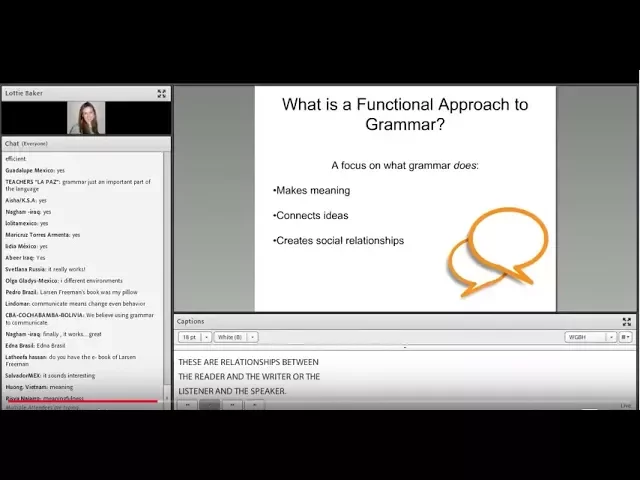
about today are similar where students notice how grammar is used to make meanie so what is a functional approach to grammar a functional approach focuses on what grammar does and why we use grammar rather than just how to make certain forms and structures when we think about what grammar does the jobs or the functions of grammar we can say that grammar does three main tasks these are makes meaning or expresses ideas connects ideas and creates relationships or creates social relationships and these are relationships between the reader and the writer or the listener and the speaker
so grammar does all three of these things together so why is using a functional approach important in English teaching here are some reasons why it might be a good idea to try this approach first it connects grammar to meaningful concepts and we know that meaningful learning sticks and our students minds more so than rote learning or memorization second it fosters critical thinking so I believe American English recently had a series of webinars on the importance of these higher thinking skills third a functional approach can integrate all four language skills so reading writing listening and speaking
so we can talk about the grammar that we read and write and we can also analyze the grammar that we use and speaking fourth a functional approach promotes discussion and this goes along with using speaking and listening because we have students talking about language and lastly it's a great way for us as instructors to understand language at a deep level and this is true for both native speakers like myself who might use grammar English grammar unconsciously so to speak and sometimes have a difficult time explaining it to learners but it's also true for some of
us who have learned English via traditional methods and can answer how to form certain sentences or structures but not necessarily why so remember I said grammar does three big acts or tasks simultaneously or at the same time first grammar makes meaning or expresses idea second grammar connects ideas or links ideas together and third grammar creates relationships what I'm going to do is explain to you a little bit about each of these three functions and then describe some ways you might integrate this into the classroom first let's talk about how grammar makes meaning by make meaning
I mean express ideas or thoughts this might seem like the most obvious task we use language to show to tell about our thoughts but how exactly does language make meaning when we think of the functional approach we can say that language makes meaning through big chunks meaningful chunks of language I'm going to share with you a few terms that we use for these chunks first language makes meaning through participants and participants are the who or the what is performing an action in a sentence participants are often nouns or noun groups second processes and processes are
the what are the thinking the doing the feeling or the being actions and these are often verbs and third circumstances when we're how are the processes occurring and this is often seen in prepositional phrases so you might ask how is this different than how we normally think of parts of speech like nouns and verbs and prepositional phrases I will show you an example here's a sentence that I wrote about my favorite activity this is something we sometimes have students write about their favorite activities so I write my favorite activity is hiking in the mountains and
if I were to analyze this sentence using a more traditional analysis with parts of speech it might look something like this where identify the adjective and noun the verb the prepositions this for some students might seem like a lot and kind of messy let me show you how it would look from a functional perspective using the three terms I mentioned here I have the whole phrase my favorite activity as one participant then the process is is and then another participant is hiking and then in the mountains goes together as a circumstance so this is not
necessarily contradicting our traditional parts of speech analysis but it's a way of looking at parts of sentences and looking at them in meaningful chunks let's have you to identify the parts of a sentence using these three big terms these three big chunks so here the sentence at the poles Thank You Lauren many students like to play games and English class so which phrase indicates participants many students like to play an English class are none of the above Oh excellent excellent excellent it looks like everyone everyone chose correctly almost everyone chose correctly a mini students so
together that works together as those two words as the participant let's look at the process can we go to the there we go which front which phrase excuse me which phrase indicates the process so many students like to play games in English class many students like to play in English class none of the above yes like to play excellent and again we're taking chunks of language rather than breaking it word by word and then lastly what about the circumstance which phrase indicates a circumstance many students like to play games and English class ah yes yes
it looks like most of you have it see the letter C in English class goes together as this circumstance in this case the circumstance describes where the students like to play English king a games great Thank You Lauren we can go back to the presentation now all right thank you so we can ask students do the same thing and identify these meaningful chunks too and then we can connect these chunks to how they make meaning in the sentence this can be called a close reading analysis to do this as a teacher you will first select
a short passage and it's a good idea to select a passage or a text on a topic that is familiar to students or that students have some background knowledge about you might use pictures or visual supports if it's something new so that they understand the topic second help students identify the three parts we talked about participants processes and circumstances this will take some practice so you will want to model this many times first and third focus on each part and ask questions about the meaning for instance you can ask why did the author choose to
use this language or how does it contribute to the meaning of the text this sounds really complex some of the information I am telling you but some of this you can even do with beginners if you use small small pieces of language or short sentences to help students recognize the participants the processes and the circumstances one activity that you can do to really help students understand the meaning of the text and help students recognize how words contribute to the meaning is that we can have students change sentences so to do this first the teacher will
rewrite the text with blanks so again you'd select a sentence that you think students understand already and then rewrite that sentence with blanks I'll show you an example in a minute then you have students fill in the blanks with different participants or different words depend on the blank third you discuss how the different words change the meaning of the text oops and I changed the meaning of the text now let me show you an example so here is a sentence this sentence says the young baseball players from Venezuela are playing at the Little League World
Series this is a sentence that comes from a new story from voice of America's learning English some of you may have used this before I noticed in the mean we had some discussion about authentic materials and voice of America's learning English is a great place to find authentic materials that are appropriate for different levels so this sentence is from a longer article about the Little League World Series which is an organization for baseball players for young baseball players like this in the picture so to do this activity with the changing sentences with the blanks we
might change the word young and write a blank instead the blank baseball players from Venezuela are playing at the Little League World Series so what could we write instead of young trying to write in the textbox whatever and excuse me the chat box what are some ideas what are some other words we can replace for this word young that might change the meaning of this sentence talented old energetic handsome hungry great old cute famous yes and see how this changes the meaning of the sentence if we say the handsome baseball players from Venezuela are playing
at the Little League World Series we really change the participant here by changing this one term so this is a way to help students understand the importance of how this participant can change the meaning of the sentence to extend this idea even further you can write a sentence with the same structure but on a different topic again you can have students complete the blanks and change the meaning of the sentence here's an example the topic is different you see I have the blank teachers from blank are working in the classroom so you can have students
write different words and have different ideas about this sentence so depending on how you write these the participant you change the meaning of the sentence oh and I see some ideas here already the committed teachers the English teachers the ESL teachers the beautiful teachers from Bolivia that's someone from Bolivia the hard-working teachers enthusiastic teachers from Mexico great great thoughts ok if you want to make this even more advanced you can do this kind of activity with a longer passage I'll show you an example can we go to the polls thanks Lauren so this is a
longer passage about a pigeon which is a kind of bird that you see in this photo I'm going to read the passage and then as I'm reading can you list the participants that you hear in the textbox in the chat box one familiar urban dweller is the pigeon long ago it was called a rock dove because it lived in the rocky cliffs along the coast of Europe today it flourishes all over the United States and the nooks and crannies of our cities I see lots of great great ideas here Rock the pigeon pigeon familiar urban
dwellers yes there are many different different correct answers it it is an example right because it that is a participant so this is a great way to show students how an author can refer to the same concept pigeon using different terms it's also a great way to focus on vocabulary so we could look at this term urban dweller together or been dweller and think about what does this mean and break it down for students and say well urban means city and dweller means someone who dwells are someone who lives so urban dweller means someone who
lives in the city and we can talk about how the author describes the pigeon as living in the city just by using this participant let's look at another another example can you list the processes in this text what processes do you notice so remember these are things that are doing or being yes lots of being processes and by being I mean where it's like is or was to be words yes was called yes lived lived flourishes that's another vocabulary word that you can talk about with students flourish is meaning there are many of them it
flourishes all over the United States great okay and lastly let's look at the circumstances can you list some of the circumstances in this text with circumstances so remember circumstances describe when or where about when or where the processes happen and they're often prepositional phrases yes in the rocky cliffs long ago today yes excellent I like this passage first circumstances because you can show students how the author if you notice he uses long ago as one circumstance and then in the next sentence he uses today so he really contrasts those two sentences with long ago and
today and so you can point that out to students again this is a longer passage and it's more advanced so you might not use this passage or a long passage like this with beginners but you can start having students from the very beginning analyze of language for participants processes and circumstances even if you look at short sentences okay let's go back to the presentation okay thank you thank you line okay so next we're going to talk about the second function or the second job of grammar so first we talked about how grammar makes meaning or
expresses ideas second we're going to talk about how grammar connects ideas so how does language or grammar connect ideas so when we talked about making meaning we said that language makes meaning through participants processes and circumstances so when we talk about connecting ideas we're going to use the term cohesive devices this sounds like a big term but the word cohesive means connect or stick together so cohesive devices help ideas stick together or connect ideas here in this table are some examples of cohesive devices I really like this chart because it shows the terms we use
to connect ideas with the meanings of the term so for example in the first row the terms and and then furthermore all of those terms mean in addition and the second grow though terms but instead however on the other hand these are words that we use to contrast or to compare and contrast and so on you can return to this chart later on after the webinar to refer if you would like I think it is a great reference for us and for our students and when we write and read an activity you can do to
help students recognize these cohesive devices is simply have them identify these devices so this is the way this works first the teacher selects a short passage again you want to choose a text that students understand so something on a topic that's interesting for students and something that they have some background knowledge about then you can have students identify the cohesive devices you might have them use a chart like the one I just showed you to support them and help them get ideas of different cohesive devices and then lastly the students can write or document these
cohesive devices and a chart and explain their importance so explain why they why what meaning the cohesive devices adds to the sentence let me show you an example here is a paragraph about learning new languages as I read it you can write in the chat box different cohesive devices or different connectors that you see so learning a new language is challenging for many adults because they are busy however language learning routines can make a big difference for instance students can review new vocabulary every night before bed another idea is to listen to the news and
the language they are learning oh I see lots of great ideas and the chat box great however for instance because however another excellent another idea yes I'll show you what this sentence what this paragraph looks like with a cohesive devices underlined and then the next step is you could have students write these cohesive devices and a chart and reflect on what they mean think about what each cohesive device means so I'll show you what I mean so here for instance we have the word because and this word because shows that it provides a reason that
learning a new language is hard in the next row we have the word however and this shows it's a contradiction so we start talking about how language learning is hard for adults but then we introduce a new idea that's different so this really helps students pay attend to these words pay attention to these words and analyze how they are chair they are linking or connecting the sentences okay another activity you can do with connecting ideas is called sentence combining and this activity was in the pre reading articles from the forum from the forum magazine so
some of you may have read this and some of you may be familiar with this activity so to do this activity first you take a text composed of short sentences this might be a passage from an authentic text a real-life text it might be is passage from a text book or it could be student writing and in fact student writing is an ideal or good for this kind of activity because beginning students writers tend to use shorter sentences second you can group related active related ideas so help students look at these short sentences and group
the sentences that go together or that are about the same topic third you combine sentences using connectors or cohesive devices mu this word connectors and cohesive devices to refer to the same thing and then students can explain their choice their rationale for their choice of connectors so why they chose the word because or why they chose the word and and when you do this activity it's often helpful to have a chart like the first one I showed you with the cohesive devices and their meaning so it gives students an idea of different choices of cohesive
devices they can use and remember there's no one correct answer really the goal of these activities is discussion about language and heightening students awareness of language let me show you an example here are some sentences about my pet I like to use this example with students because students often write about their pets at least in my class so my pet Chihuahua is cute he is small mini chihuahuas bark a lot my dog is calm he does not like strangers he is still nice to the neighbors so one way this sentence might that this paragraph might
look with connectors or with cohesive devices is my pet Chihuahua is cute and small even though mini chihuahuas bark a lot my dog is calm however he does not like strangers nevertheless he is still nice to the neighbors yes and there are many different ways that I could have connected these sentences and I see in the chat box I see some different ideas too which is great and again this is why I like having students use that chart as a support because they can see different ideas of different cohesive devices and try them out and
then they can talk about why they selected certain words this also helps them when they're reading because they can think about why the author chose certain words to use let's the you try to combine some sentences can we go to the polls Lauren okay so I'm going to give you some sentences about the morning and then you see on the bottom of the screen there are some cohesive devices with the chart to help you think about it so look at the first two sentences says the morning is the best time of day it feels cool
outside so if we group those two sentences together which cohesive device would you use to combine the first two sentences because however for instance and the morning is the best time of day it feels cool outside hmm looks like many of you are almost 80% selected a because some of you also said and and some of you said however I think there could be more than one right answer here I think either because or and works well because these sentences go together the morning is the best time of day and it feels cool outside you
could even use however the morning is the best time of day however it feels cool outside for someone who does not like the cool weather if they might use however so it really changes the meaning of their sentence this is how powerful some of these cohesive devices can be okay let's go let's do ask another question about these sentences which cohesive device okay so can okay here we go sorry head which cohesive device would you use to combine the last two sentences so the last two sentences say the streets are not quiet in the evening
many people are leaving work so we could choose because however for instance and yes I tend to agree because it looks like 85 86 percent of you chose because a I think that is a good a good option here although and could work too the streets are not quiet in the evening and many people we're leaving work yes yes yes Oh again I want to emphasize that the goal of this activity isn't necessarily to come up with one right answer but to talk about language and about how these cohesive devices can change the meaning and
can connect together sentences in different ways great job okay let's go back to the presentation okay Thank You Lauren so we've talked about two different functions or tasks of language we talked about how language or grammar makes meaning and we also talked about how language connects ideas the third topic where the third task or job that grammar does is grammar creates relationships and so when I say create relationships I mean relationships between the reader and the writer and the listener and the speaker so even when we're reading books we are engaging in a relationship with
the author and the kinds of language are the kinds of grammar we use can define the type of relationship so just as I shared with the other two functions that there are certain tools or certain ways that grammar carries out these functions there so for instance when I talked about making meaning I said that grammar uses participants processes and circumstances to make meaning and then when we're talking about connecting ideas we talked about cohesive devices and how grammar uses cohesive devices to connect ideas so when we talk about creating relationships we can talk about modality
and as many of you may know Rodela t4 first are the probability or obligation that things happen so we can use modality to also create relationships between the listener and the speaker there are different way to express modality many of you and I see here in this chat box great many of you are familiar with modal verbs so things like must could may whoops must could make and should these are commonly taught and they're very important we can also express modality though through other words as well so we can use adverbs so things like maybe
perhaps arguably or we could use modal mount so possibility we could say it is a possibility that it will reign or requirement it is a requirement that you do your homework and so all of these terms express either probability or obligation and they also we can use these terms to create relationships or establish relationships between the speaker and the listener a great place to find examples of Moodle language is in advice columns some of you may have heard of Dear Abby columns in the United States or in England they call these agony aunts can you
raise your hand if you have advice columns and newspapers where you live I'll show you an example here in a second oh look at all of these hands great looks like many of you have many of you have examples of these in your in your country where you live great okay you can put your hands down you can lower your hands Thanks so in these advice columns readers of the newspaper can write in letters and ask for advice and then a columnist someone who writes for the newspaper will respond and give advice so here's an
example someone writes Dear Abby and Abby is the name of the person who gives the advice that at the newspaper so she Dear Abby my friend is always tired and sick because she does not eat healthy foods how can I help her and then in the bottom this is Abby's response she says I think the best approach would be to talk about this with your friend tell her that you are concerned about her health and you might suggest that she eat more fruits and vegetables it is essential that you also eat healthy to show support
so this is a great example of some motor language and you see I underlined and bolded some examples of modality here and you see how it's not just the Moto verbs although we do have might might suggest but we have phrases that go together to make modality as well so one activity we can do with these modal's modal words is called a modality scale to implement this activity or to do this activity what you need to do is first you can have students underline the terms of modality like I showed you just now in the
passage from the Dear Abby response second students can sort the phrases that they underlined on a continuum so from gentle or uncertain to more firm in certain and then third students discuss their rationales behind their sorting and they explained why they thought one term was more firm than another term and this is where there's no one right answer again there's many different answers and but the idea is for students to be thinking about language and thinking about how language makes certain statements more firm or more gentle this is also a way with this modality that
you can see how the reader or the speaker or makes a relationship with the listener by how strong the language she uses so I'll show you an example using the modality language that we saw in the Dear Abby column so here you could be your modality scale and we have at the bottom uncertain or gentle and then here at the top we have very certain or affirm and here are some of the terms the modality terms from the Dear Abby column so we have I think the best approach would be you might suggest that tell
her that it is essential that this is my opinion of how these terms would fall on the modality scale but you could argue different ways and you might have students have different opinions and that's okay the idea is to have them talk about this one way to do this activity and involve more tactile or touching and movement is to cut out these terms and have students actually manipulate or move move these terms on the scale you can also have students move around the room and you know assign each student a term or modality term and
move around the room and a scale from uncertain to very certain so these are some activities that might be good to get students moving and engaged with grammar so let's have you try with this idea of a modality scale let's go to the poles so I know many of you have beginners and we talked about more making some of these activities appropriate for beginners so if you if you're beginning to teach modal's you're just beginning this process you might just look at the modal verbs so you could sit ask the question which modal belongs on
the uncertain or the gentle end of the scale and you can choose all that apply so there might be more than one could should must or might all right I see people are selecting the first one could and the last one might yes I tend to agree those two are definitely more uncertain and the middle two should and must are more firm and so if someone were to tell you that you must do something it's usually it's a sign that that person is in authority or is has has authority over the topic great okay let's
look at another poll so this one okay which model would lie on the very certain or firm end of the scale so let's flip it around and see okay great yes yes I agree yes must must should yes definitely definitely I think must is probably the one of the most certain or firm terms and then let's look at one more oops one more there we go which option belongs on this uncertain or gentle end of the pole so this one might be one that's more advanced for students because we're using larger bits of language so
you could say you might want to leave early to catch the train you must leave early to catch the train it's advisable to leave early to catch the train so which one do you think belongs on the uncertain or gentle I see so we have you might want to leave early yes yeah I agree that that's probably on the more uncertain or gentle and it's advisable to leave early is also more I think more gentle than the second option you must leave early and this also shows these three different ways of telling someone to leave
early to catch the train you would tell someone how to catch the train in different ways depending on your relationship to them so if you are a mother seeking your true friend you might say something a little different you might want to catch the train okay thank you let's go back to the presentation oh okay yeah thank you all right sorry about that sound um great so you can do more activities with this modality some other ideas are that students could ask as advice columnist and write answers so for the advice column that the example
I showed you a few minutes ago you could have students pretend they are Dear Abby and write their own answers you can also have students take on different roles so for instance a parent or a friend and give advice and so you could say you could ask students to say well how would you respond to this person if you were their parent or if you were their friend and then once they do this you can compare their student their writing with the actual response that that is in the newspaper and a dear Abby's response and
then you can discuss the language choices again this activity may be for more advanced students but this is something that you can work up towards and you can do the same and you can even do the same idea if you talk about smaller pieces of language and talk and just begin to speak with students about how they would use different modality words depending on who they are talking to okay so to summarize we talked about a lot of information and some of it was pretty complex we said that grammar or language there's three big tasks
are three big jobs so first we said that grammar makes meaning so expresses ideas that's what we do with language and then we said we can really look and analyze this by using this close reading analysis so this close reading is similar to parts of speech but looking at it in bigger chunks so looking at the participants of processes and the circumstances this is this close reading analysis the second task we talked about was connect ideas so this is the second task or the second function of language and we said one activity that you can
do to help students connect ideas or focus on this function is sentence combining and have students look at cohesive devices or connectors and put together sentences in different ways and thirdly we talked about creating relationships so relationships between their reader and the writer or the listener and the speaker and yeah we talked about modality as one tool that we have in grammar to create relationships and then activity you can do with modality is the modality scale looking at different examples from for instance advice columns which is an example of authentic material or any any other
kind of language you can group the modality words on a modality scale so lastly just some tips to remember these are things I've mentioned and throughout the last the last little bit but just to remind you so first whenever we teach grammar and a func from a functional perspective using text it's important to select reading examples that are about topics that are familiar to students or that students have some background knowledge at the beginning of the webinar many of you said that students thank grammar is boring so we want to choose texts and books that
is interesting and engaging for students and if students don't have background on the topic we want to build that background using pictures or images or discussion and video and only after we build all of that then we can start analyzing these sentences and looking carefully at the grammar next it's always important to connect the grammar forms or the grammar structures to meaning so a lot of times we can spend a lot of time really focusing on how to make the forms and practice that how to to form certain structures well when we do this it's
important to focus on the meaning and say well why are we making these forms how is this grammar contributing or making meaning in the text third it's good to focus on discussion and remember often there are more than one right answer there is more than one right answer and part of the goal of this of this functional approach is to have students think about language and talk about language and again this promotes some of this critical thinking and also gives students an opportunity to use language and practice speaking and lastly it's always important to start
with noticing new grammar forms and text and then gradually begin using them and writing and this takes time it's going it doesn't take just one day to teach to teach grammar as you all know so to gradually begin noticing different grammar structures and text as students read and then have students use them in their writing and you can use supports like that changing sentences or the filling in the blank at the beginning to help students use this grammar in their writing so I hope that you can try out some of these activities and your please
visit the Ming and please visit the Ming and describe how it works for you I'd love to hear from you and talk more thank you thank you so much Lauren and head there for moderating and Thank You Lodi for sharing that overview of using the functional approach to teaching grammar in the English language classroom along with explaining those practical ideas for connecting reading and writing to grammar teaching and we'd also like to say a big thank you to you our audience for your active participation today we'd also love to see you register for the e
teacher MOOC that we discussed in the introduction and join teachers like you who are teaching grammar communicatively and we'll show more information on that shortly and now it's time to submit your attendance remember that