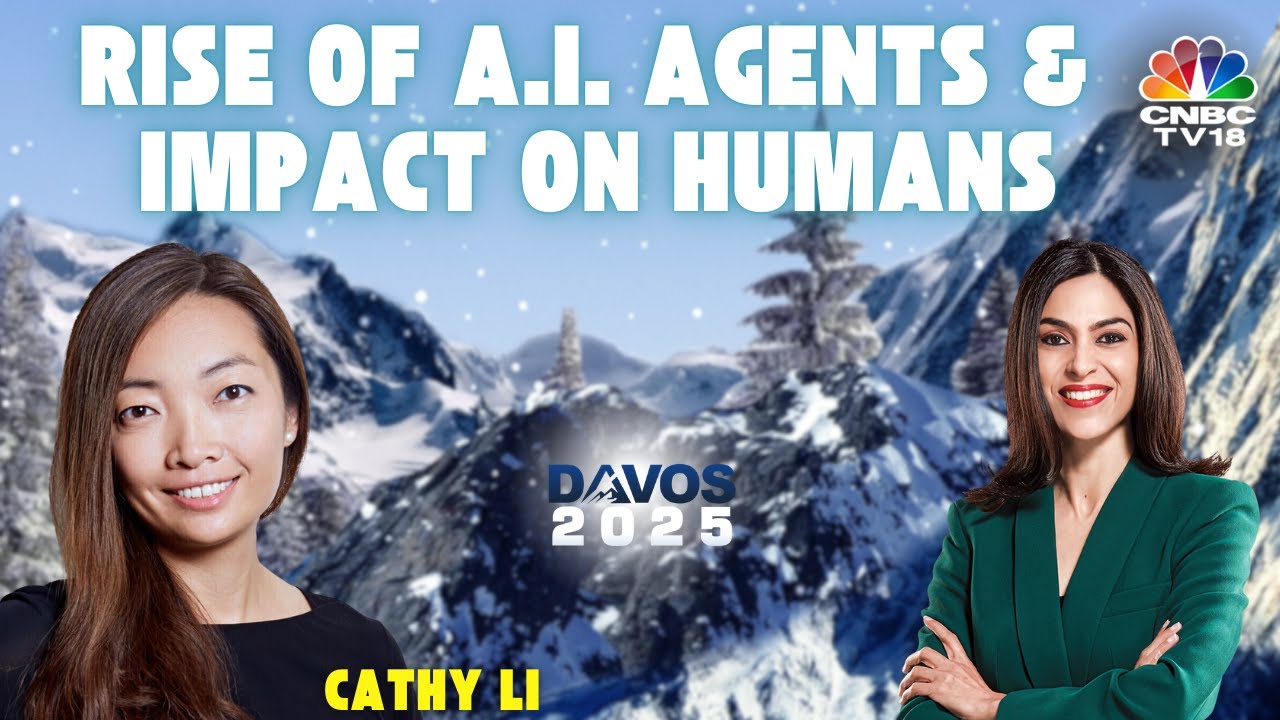
[Music] it's a bright and cold morning here in Davos and we are absolutely thrilled to have with us one of the biggest voices globally in artificial intelligence Dr Andrew Inc founder of deeplearning.ai managing General partner at AI fund and co-founder at koser that's a lot of things Andrew but thank you very much and welcome back to money control at Davos uh I want to start by asking you Andrew you know since the last time we spoke there have been so many developments um in AI this morning I saw a news report which said that open
AI has possibly achieved a breakthrough you know in doing PhD level work with their AI agents or super agents um Mark Zuckerberg of meta said recently that they might not need Engineers anymore to WR quote are we moving too fast along the AI curve because you know this seems to be displayed in white collar workers first you know I think there is no way practical way to slow down AI but I think there's a lot of work ahead of us to make sure that everyone is lifted up and we don't leave people behind I think
for a nation like India what I would say is Lea frog Le frog Lea frog the nature of work is changing and in the future I think almost everyone not just software Engineers but also marketers recruiters journalists uh would be like used computers much more powerfully than was ever possible for so to anyone worried about your job I say learn to code take control of it because in the future the ability to direct computers to do exactly what you want will be one of the most important skills and so I don't think AI will replace
people but people that know how to use AI will replace people that don't so let's let's make sure as many people as possible are those that know how to use AI should people really learn to code anymore because there's one view that why should you learn to code anymore you can just you know key in a prompt in you automatically get whatever program you want so it turns out that to get a little bit technical um writing in English or or some of the language prompts it works a lot of the time but not all
the time and so now and for I think quite a long time people that know how to code would really get computers to do much more than people that don't understand at the deeper layer how the computers actually work so for example I know how to code reasonably well but I code much less because I get the AI to write a lot of my code but if I didn't know how to code I would able to do much less with computers in fact some of the studies seem to show that um AI cystic coding is
giving a bigger boost to people that know how to code than people that don't know how to code right um Andrew are we reaching the limits of scaling laws in AI or is there significant room for improvement so the um lemon is getting harder and harder to squeeze with every generation stealing laws get a bit harder I think there is more juice in that lemon it is worth you know maybe one or two more squeezes but in terms of AI progress frankly I'm I'm not worried because with have multiple fronts by which AI is advancing
not just scaling laws but also um agentic workflows where you can get an AI to not just BL tell the response right away but iterate and think for a long time before giving other response and so I find that the set of tasks that AI could do it grew a lot because of scaling laws just more computers bigger data but now we have other paths as well very promising to keep on expanding the set of task AI could do right um Andrew you know everybody's talking about agentic Ai and AI agents um how soon will
they be economically viable and with the rise of agent AI systems capable of reasoning and planning um you know what key breakthroughs are needed to make AI agents truly autonomous and widely Deployable in business and research I think they are already economical um and increasingly widely deployed I feel like one of the interesting dynamics of AI is um SE Capital had a article on the $600 billion doll problem or question which talked about with all the capex Investments and gpus and data center build that was when with pay off and I think that's a problem
or question that the foundation model trainers uh training very large models have to answer I'm optimistic they'll come of a good answer but it turns out for building applications on top of these Foundation models if someone else has spent billions of dollars training the economics really works out because with a handful of Engineers you can often build a prototype or build something deploy it and something a lot of businesses certainly at AI fund I see a lot of businesses get Roi very quickly from a very modest investment right um you know you've said before that
India's AI opportunity lies at the application layer but within India there's a debate should we build llms should we focus on application are we letting go of the opportunity in building foundational models why do you think India should focus on applications and what specific applications should India prioritize to maximize economic impact so I think India should do both but the large very large majority of the focus should be on applications so um India has so many talented people so many great companies it has the resources to both train Foundation models and build applications um but
one interesting thing about Foundation models is the cost of training them Falls rapidly over time so models that were cutting edge you know two three years ago now many research lab can can train and so the modes are not very strong we'll see how it evolves but that's true maybe right now um but almost by definition the only way for the businesses training Foundation models to to kind of work out and do well is the application layer turns out to be even more valuable because we need the applications to generate even more revenue for them
to afford to pay the technology companies um so I think in India there I think that the nature of work is transforming and um this is not just software engineering although that is transforming too but maybe your your your reporter Shandra so my team at d. I have a journalist uh that just this week um showed me his code on GitHub his code that he wrote to create websites screen rsvs and fact to him articles that he thought maybe we should take a look at covering so I'm seeing people in all walks of life journalists
marketers Recruiters on and on and on able to use computers to become much more powerful and I think India with very strong stem education a lot of tech penetration lots of software services so kind of a lot of IT services there actually a pretty good position to help many people in many different walks of life learn enough about computers to to play Big role in this transformation of work right um Andrew you know as AI compute becomes a geopolitical weapon how should companies countries uh navigate uh companies and countries navigate the US China AI decoupling
us has also placed um controls on export of AI chips which could have an impact on you know emerging economies like India um what's the solution here yeah I think with the um the outgoing uh Biden ations recent uh um uh declare inar uh tier two in terms of the privatization of access to gpus candidly I don't think that's good for the US or for India um I feel like what the um export controls on chips have done for the most part is um uh incentivize the US's competitors and adversaries to invest a ton in
building um their own independent capability and it's not really slowed others down that much only a little bit so I feel like um I think it is unfortunate to state of the world uh I hope that um uh you honestly I think India and the United States feel like they're natural allies um uh I've really LED working with many friends from India I wish I I I really hope for contined improvements in how the US and India collaborate right it's a big day today for the us because of you know the inauguration of trump in
the White House what impact will this have on AI going forward will it you know take us to the Forefront will there be more focus on uh semiconductor Manufacturing in the US creation of jobs it's still too early to say um I know people have very strong feelings about the incoming president but I think in Silicon Valley the widespread feeling is that this will be more business friendly um I feel like uh parts of the outgoing Administration felt like it was um hostile to Tech even hostile to American tech companies to a level that I've
never seen before in my career and so separately from many other issues which are important issues I feel like a more business friendly environment uh will allow more Innovation allow more things to flourish great final couple of questions what are your go-to AI apps or chat Bots or apart from kosa which I'm sure you will tell us about oh uh I use honestly I actually use multiple of them um I use uh open the eye cloud um I actually use quite quite quite quite a large number of them I use quite a few agentic work
work flows and also caught up things myself uh recently my team released an open source AI Suite to help developers use multiple large language models and and simultaneously and make it more easy so I feel like um it's good to have a suite of AI tools right do you think the last year has sort of determined the winners in the AI race because we've seen Deep Mind make breakthroughs um anthropic do well and openi so do you think you know these three have sort of emerged uh among the multitude of players that we saw the
foundation I would say that they definitely um uh have strong positions oh I should say V's version gem 2.0 was uh was really impressive um uh but I think it's too early to call it probably because the cost of training Foundation models Falls rapidly over time so it'll be interesting as these businesses continue to grow whether you know to what extent um they built more defensible modes I know that open eyes chat GP the consumer business is a wonderful business but training Foundation models because of you know uh uh Nvidia and AMD and others driving
down the cost of compute um I think it it gets easier and easier for many others to train GPD four class models and so I think it'll be interesting to see how the business Dynamics evolve right final question Andrew what would your advice be today to an 18-year-old who's you know who wants to choose a discipline but also wants to choose a discipline that will not be disrupted by AI or you know it will be disrupted by AI but his or her job will be secure I think the world is changing quickly I think one
of the most important skills in the future will be to be tell computer exactly what you wanted to do and this would be a useful skill in I think pretty much all professions certainly all white collar probably many blue collor professionals as well so that 18year old I I would say go learn computers go learn to code because um if you're worried about AI take control of it and be one of the people who directed to do what you want and that will set you up to be in a much better position for the rest
of your career on that note thank you very much for talking to us wonderful talking to you as always thank you San [Music]