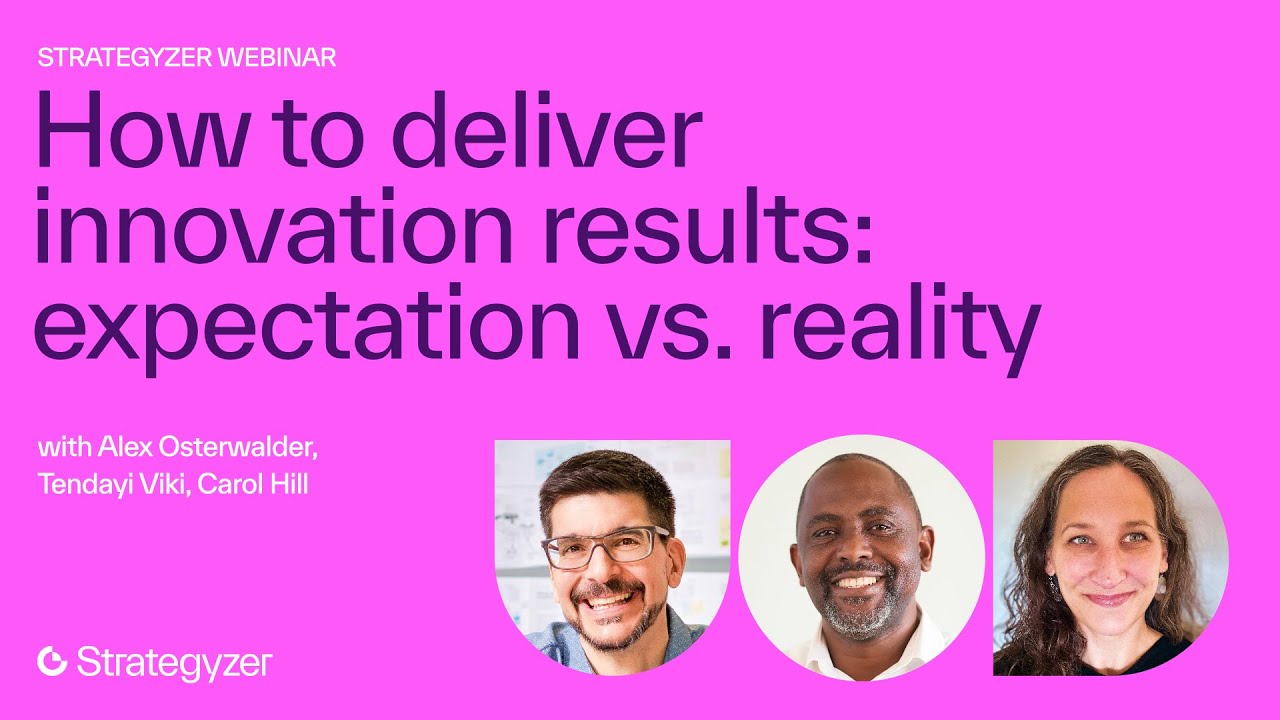
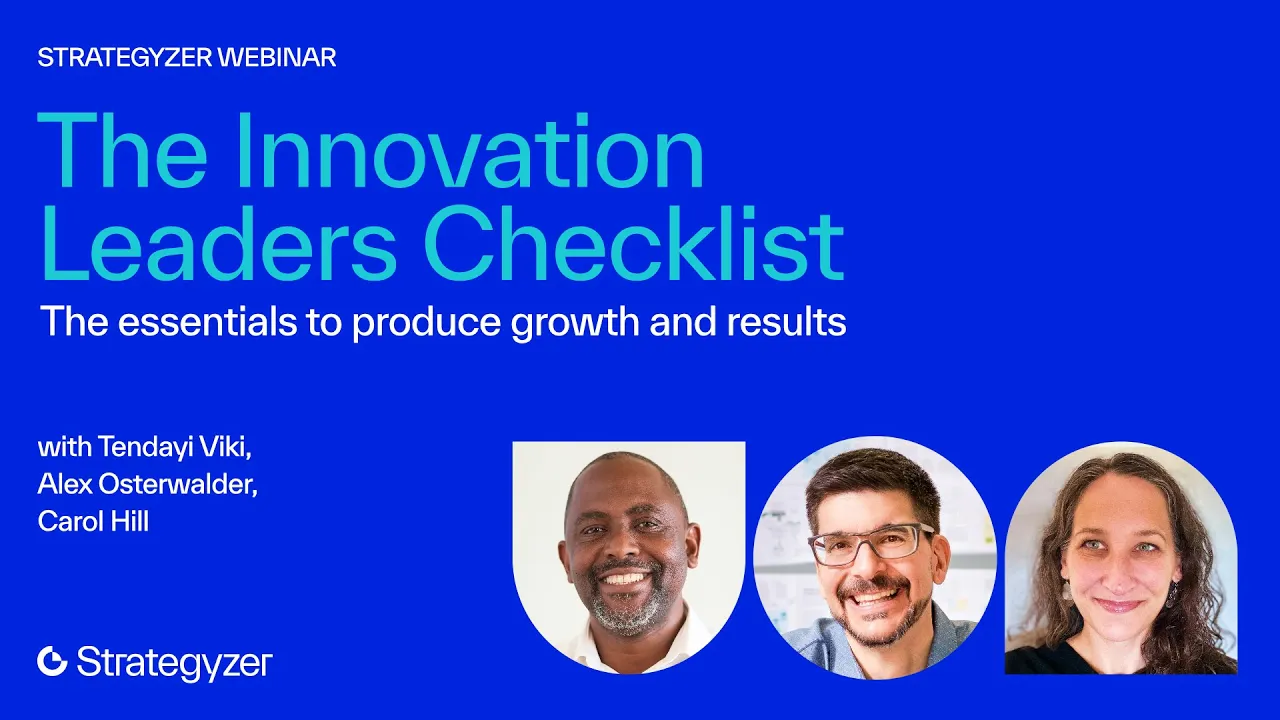
Our webinar today is all about the innovation leaders checklist. Um, and we're going to be talking to you about uh people process and portfolio in a different order. Um, so we have with us today, as you can see, um, Alex, founder and CEO of Strategizer, Tendai, Vicki, uh, partner, um, at Strategizer, and myself, Carol Hill, um, program director um, at Strategizer.
As I said, we're going to start with a mentee, tell you a little bit about the checklist that we've prepared for you today, and then Tendai is going to talk to you about the people side of things. Um, Alex is going to take on the portfolio, and I'm going to look at the process, and then we'll leave some time for Q&A. Glad to be here sharing this content with everybody.
I think it's it's really important where as innovation leaders to start thinking about, you know, what do we want to focus on in terms of the checklist to know that we're actually doing great work and also to know that the work that we're having is is having the kind of correct impact. And so in order to create this checklist for innovation leaders, we came up with three categories. One is people, the other one is portfolio, and then the last one is process.
I'm going to dive deeper into people and then I'll hand over portfolio to Alex and then process will be done by um Carol. So here's some of the questions that underly the checklist that we're kind of trying to create. So under people, we really do think that we need to be thinking about whether innovation is at the right level on the organizational chart.
But beyond just being at the right level on the organizational chart, we also need to think about whether we're seen as legitimate. So right level on the orchard gives us you know the right status within within the business but are we also seen as the right people to actually do this work and then finally as part of like building this sort of buy in do we actually have champions within the organization that support the the work that we do. And then when it comes to portfolio one of the things that's most important is to make sure that we have clear guidance for the kinds of innovation that we want to do.
We also want to make sure that we have the right portfolio mix to match our context and and growth ambitions. So I know that as strategizer we were quite popular for talking a lot about transformative in innovation but we're also quite focused on making sure that companies have the right portfolio mix a balanced mix there and Alex will tell you more about that and then whether or not you have an innovation tunnel or funnel right tunnel is every idea that goes through keeps going a funnel is you know things that don't have traction eventually stop which is something that Carol will then pick up on when she talks about process right um are are explore an exploit project managed differently? Um do you have clear criteria for making decisions on on on on projects or you know do you make decisions to kill projects that are not making progress?
I think that's something that's that's actually that's actually really really really im important. And so that's kind of like what we're thinking about as we as we as we do this work. And so I'll jump in straight into the people part of the conversation.
What is the role of the innovation leader when it comes to this particular conversation, right? Um I I I'm going to go through these these these three questions, but I believe that an innovation leader has two jobs. Two jobs that have to happen at the same time.
The first one is to make progress on the innovation ideas or the innovative ideas or the projects or whatever it is that that you're working on. you need to be making progress and actually showing success and and traction to the rest of the organization. And in my experience or in our experience, we find that this is what attracts a lot of people to the job.
They're really attracted to this idea that you get to work on cool stuff and you get to make progress and have an impact on the world. Unfortunately, that's only half the job. The other half of the job is to grow your reputation within the company.
So, the other half of the job is relationships. You have to be building the reputation of your innovation function, your innovation team. Um, it's almost like politics actually.
You have to be sort of engaged and and doing the work to to do to grow your your your reputation. If you're doing the kind of work that allows you to sort of grow your reputation within the business and you're building the right relationships, you you will have positive answers to the question of whether you're being seen as a legitimate part of the business. And the cool thing about being seen as a legitimate part of the business is that it unlocks your ability to work on more cool stuff.
The less and less legitimacy you have, the less and less permission you have to do cool stuff. And so this cycle is like a virtuous cycle. As you as you make progress on your ideas and you grow your reputation and you're being seen more and more as a legitimate part of the business, you then get to work on on cool stuff.
And the reason why I say this is I'd like to introduce this concept to you and I and I've spoken about it before. Alex calls me a total nerd for using this kind of language. I'd like to introduce to you the concept of idiosyncrasy credits.
And idiosyncrasy credits is a is a psychological term that was coined by Edwin Hollander where he talks about how much permission do you have to be different? Um, there's this Homer Simpson sequence where his his uh his white shirt is caught up with one of B's socks in the in the washing machine and it comes out pink and then Marge is like, "It doesn't matter, Homer. You can wear that shirt to work.
" And then and then Homer's like, "No, I can't, Marge. I'm not popular enough to be different. " Right?
And so that's the fundamental question that goes with this is, "Are you popular enough to be different? " And and what does that mean? The way you build idiosyncrasy credits is you build it by having by the rest of the organization having an accumulation of positive impressions about yourself and your team and the work that you do.
And the more and more positive impressions you have especially around contributing to the success of the organization, if you're viewed as a as an as an insider, right, you you you have far more, you know, credibility. And then what you can do is you can turn around and spend those credits on working on cooler and cooler and and and cooler stuff. And and what happens with a lot of the innovation teams that we work with is they don't spend any time building up their credits, right?
I think the toughest thing is when you get when when when when you're introduced as like we're hiring Alex offer, he founded a startup and now he's going to drive our innovation, right? And everyone in the company like we don't know that guy. he doesn't have any idiosyncrasy credits.
And then you start to get that resistance that that that innovation leaders often get. And so you got to do this balance of like building relationships, building your credibility, sometimes even working on non-transformative innovations, efficiency innovations, helping the company solve problems until you build as much credibility as you need to then maybe transfer that credibility to do more and more more and more interesting stuff. And so we're going to go back to Menty.
And if you could spotlight Alex and not me right now. Um, well, I want you to think about the syn singy credits you have or your leader has and and think about like, you know, how many do you think you have? I'd love to see this.
So, how do I Oh, I need Yeah, share. You need to unshare. And while we're looking at the voting, um, I talked to a a leader of a big business unit recently and that's where actually stood the I understood the concept in reality by way the ide was saying that if you hire a leader to do innovation that's in their, you know, they're in their 30s, they don't have the clout and, you know, it's it's kind of difficult for them.
However, you know, they might want to go for the bold thing. When they're 40, they have a little bit of clout, so they might have some idiosyncrasy credits, but they're too afraid to ruin their career. Like, who wants to go in innovation?
There's very few companies where you can make career. However, if you're 50, that's what his words, right? He said that's when you have a lot of credits, you built like a brand, etc.
or whatever you did, and you know, you might not become CEO, so you're going to go for a bold big job. And I really love that because it's often the contrary, right? Where people hire somebody from a technology company and then think, okay, that's going to be enough to do innovation, whereas it's a completely different job to run innovation within an organization or growth, right?
Or the strategy and growth role. So I found that interesting. Yeah, exactly.
I mean, it's really hard to drive change as a total outsider. You have to build some kind of level of trust that you know, people can actually trust in what you're talking about. And so and and what happens as well, Alex, right, is I've seen innovation leaders burn idiosyncrasy credits like just the way they approach conversations, the way they engage with others.
So I've actually seen people burn their credits and then they're starting from minus 55. Meanwhile, innovation is already minus 55 by itself as a topic, right? And so it's a real struggle to then sort of sort of push that boulder uphill.
So, so that's something that I I believe that folks should should be thinking about. And just looking at um if you could spotlight Alex again there just looking at people's responses there. It's fascinating.
It's kind of like 50 half and half in terms of the idiosyncrasy critics that they're saying that they have and I think it's actually higher than I thought, but it's pretty good. Yeah. What one one of the things I'm curious for both of you, Carol and Tendai, with the clients you work with, you know, very few, I think, at least those that we see still call themselves rebels or pirates, right?
I think that thing is gone because I do think people understand that it's not a good way to actually build this idea credit. Is that is that just my impression, Carol or Tender, or is that era gone where people think, you know, they need to call themselves the disruptors and pirates and rebels? Yeah, I mean I I I see it a a few times every now and again, but not not as much anymore, right, Carol?
It it it doesn't really work, but I think that's like Alex's way. Is he still here? Of just a little bit of a burn to you, huh, Tai?
But yeah, no, I you have to you you can't really be a rebel, can you? And still Pirates in the Navy is fine, right? Pirates in the Navy is fine.
Okay, cool. Yeah, it's actually better than Yeah, it looks good to score the people here. Oh, cool.
Thank you everyone. So, let's move on to um now a little bit of content. So, if you could spotlight me back and then we can move through.
Okay. So, let's see how you can build some of these credits. Right.
So, I do believe that and and the research shows that the highest status people in the company have some leeway to lead, right? They have some leeway to do things. So you know sitting at the right level on the orc chart is something that that that that actually matters.
And so when we talk about this we often talk about the ideal ORC chart which we kind of took from Pingan where you know the the CEO has a co-CEO um that then also is responsible for driving for driving in innovation. So Pingan Peter Ma appointed Jessica Tan to be to be the chief entrepreneur and so you have this almost like equal status between innovation and running the core business. I think this is like a you know this is the ideal scenario right the typical scenario that we often see and my slides are not moving.
The typical scenario that we often see is when the person driving innovation is reporting directly into the CEO which is what we saw at Shriber one of one of the clients that we that we work with. So at this level you can really see that at least innovation is being seen as a central part of the business. So that signaling is the first thing that needs that that kind of has to happen.
And so I remember having a conversation with the head of HR after I'd given a keynote and she was saying to me, "Thank you for your keynote. I was just preparing a report for my CEO where I was recommending that innovation be put under marketing, right? " And I like, "Okay, yeah, don't don't do it that way.
You want to call it out and and kind of have it have it stand alone. " And so as part of your checklist, it's, you know, where is innovation sitting in the in the in the in the or chart right now, just because you're sitting at a certain place in the orchart gives you status, but it doesn't give you legitimacy. And Alex, it took me a while to understand this distinction.
Like it was a kind of a struggle in my head because I know you and I have had a lot of talk about putting innovation in the in the in the right place, but actually status is not the same as legitimacy. like people can get given status and still not be viewed as as legitimate. Um and and in fact the research and we know this from experience people really resent people who exercise their power without legitimacy.
And another thing that I've learned in exper from from experience is that inside companies people don't have to fight you to resist what you're doing. They'll just slow walk the thing. So you'll say we need to talk to customers and then they'll say okay well for you to talk to customers you need to get legal and compliance approval for yada yada.
then you put your thing over there and because they don't see you as legitimate, they'll just go, "Okay, we'll get to this soon, right? " And then they'll just sit on it, right? So you so so you're not so you're a high status individual, but you're not getting momentum.
You've just got this passive resistance going on all the time that makes the the work of innovation quite tedious. And that's why you really do need to build those idiosyncrasy credits. You can imagine a few of our colleagues, Alex, right, that have the right relationships, have been in the organization for a long time.
They're in their 50s. They've led a few divisions. they've grown a few parts of the business and now they've been appointed to do innovation.
They have status and legitimacy and so it's it's easier for them for them to for them to actually do the work. So that's a fascinating distinction that that you need. So that's why we often encourage people to think about how they can get buy in, right?
Because getting buyin is not the same thing as making people do stuff, right? Because getting buyin is is a is a combination of of two things. The first thing that you need is that people have a positive evaluation of of the work that you're doing and they accept it as a legitimate part of what's happening inside the business.
And then they also are willing to participate. They're willing to actively contribute to the work that you're doing by advocating for it to others or actively contributing to to success time, resource, energy. If you cannot get these two things, it's really difficult from a human being, from a people level to actually drive successful innovation within within the organization.
So that's a piece of the checklist which is do you do you actually have buy in and this is like kind of like new work that I've been working on with a lot of feedback from from Alex cuz if you take those two dimensions what what it does is it actually creates a 2x two where if you have people that don't like what you're doing and don't want to participate they're going to resist right and then if you have people that don't like what you're doing but have to participate they're going to be complying and and and sometimes you see compliance work, work, work, work, work. But as soon as those people get a a a chance to not do it, they'll take it straight away, right? And so that's why some of these changes that we're trying to do don't don't stick.
And then sometimes you get people that like what you're doing and they're willing to publicly endorse it, but are not willing to actively contribute. And that's another one of those Carol, right, where we're like having these meetings with these leaders, they're saying, "Yeah, yeah, yeah, go do that innovation. " And then they won't ever actively help you do do anything, especially when you when you when you when you run into problems.
And so what we're really looking for is this kind of buyin, right, where you where you get both. And that's the that's that's the difference between prisoners who comply, opponents who resist, just supporters who endorse, and champions who actually buy in. And so that leads to the last question of of this checklist, which is do you have champions that support your work?
Right? Because I do believe that from a from a people level, every one of these transformations that we've worked on, any one of these innovation programs we've worked on, you need a small group of champions to help you. If you cannot get a small group of champions, it's hard to get traction that actually lasts, people that evaluate the work positively, accept you as legitimate, advocate for you to others, and actively contribute to your to your to your success.
And in the in the research work that I've been doing, Jeffrey Moore and and a couple of others, anything from like 5 to 15% of people kind of willing to kind of help you is a really good kind of margin to to kind of dance around to at least start start the the process going and and start getting um start getting traction. And so set up. So talk a little bit about portfolio and I am actually going to apply it also to strategizer.
So we go to the you know second set of questions around portfolio. Every company has limited resources. Very few have unlimited resources.
So you want to channel them into the right things. I remember Tendai say saying you know let a thousand flowers bloom is not a good innovation strategy. And I really do believe that you know it it's not good.
Like we do invest based on evidence but you also need to evaluate strategic fit which could be very narrow could which could be very broad but if you don't know where you're going if you know the CEO leadership doesn't have a vision about the future but anything goes and the person who framed this the best way if we just take strategy in general for a second is our friend Roger Martin. So he likes to say if you look at the core strategy choices and then ask you know if I make the opposite choice without looking stupid then it's a strategy. So people who say we want the best you know we want great products like great quality products well the opposite would be we can make shitty products that's not a strategy then today it's just a ticket to compete that you have some you know great stuff.
So I really like this framing and you know Roger Martin would say that 90% of companies don't actually have a strategy at all. So we're pushing the boundaries going down to innovation strategy. So beyond this strategy smell test.
Is it a good strategy? Is it is it an absent strategy? We're going to look at modern strategy making.
And we worked with actually one of the big um um wealth funds in in uh in uh in the world. And what really resonated with them was this idea of modern strategy making. And when we say modern strategy making, it is about giving direction, but it's giving an overall direction and then a specific direction for your existing business and your new business, which as you know we call explore and exploit.
So we use the portfolio map for this where you have a portfolio of existing businesses or brands or products and you have a portfolio of new things that you're exploring. And somebody by the way was actually was asking well what about product management? Is that like you know innovation or how does product management fit in all to this?
Generally the product management we see is really you know about improving the existing products you have and there's nothing wrong with that but product management and innovation are often either disconnected or just not related. So um to start as an example very briefly one that we like to use quite a bit is Pingan because they had a very clear guidance where they said where they want to play long-term what kind of financial performance philosophy they want and they gave directions on you know kind of the key resources that they needed. So they used and we described this a little bit in the instit aspirations and then they had a guidance.
So really nice how they actually framed this so that they could act on the strategy for the existing portfolio and the exploration portfolio. So they were in three four business units and they said we're going to also now play in five different arenas generally financial services, healthcare, real estate, smart cities and they said we're going to invest in five different technologies and this is quite a while back. And they also defined that they're going to reinvest a lot of the profits um into uh exploration and they hired the infrastructure to do that.
And that actually allowed them to really build some completely new businesses. And we've been talking about this quite a bit, not always in the context of guidance. It helped them move from the top 500 companies in the world to the top 50 depending on the year they were navigating between 50 and 20.
um for the last decade. So what does this mean in terms of guidance? First guidance is they were willing to take some risk but more specifically what it meant is that they had an overall strategic guidance for both portfolios which was we're going to play in five arenas.
We're going to build on five major technologies, the ones I showed you, and we're going to invest 10% of our exploit profits, returns into um the new business. Then they specifically uh came up with an exploit guidance and with an explore guidance. So one of the things if we look at exploit was well, we need to improve the customer experiences.
we need to more traditional one cut costs and with AI I think that's a big theme because we can reallocate a lot of people into different areas um and cut costs in some areas they said we need to strengthen risk management because they're with in banking and insurance and the last one boost efficiency but here's where it gets really interesting in their innovation guidance they said we need to explore new business models and we just started to work with a big luxury brand where that is still very difficult for them to explore new business models and not just you know stay in the space they're in where they have highly tailored KPIs then they went even further and they said we need to become more like Alibaba and less like an insurance or banking company less like UPS or credit Swiss Credit Swiss doesn't exist anymore always a you know a bad Swiss joke but they were just incapable of innovating and then transcend industry boundaries so not focus on finance, specifically banking and insurance, but actually build a health company. And the last one, users first, not clients first, which when you're in banking and insurance is actually a big thing to say because they're selling contracts, opening accounts, you know, lending money. Here they said, "No, no, we're going to acquire users first and then ultimately over time some of them are going to be clients.
" So that's this idea of guidance. Now, that's for a very large company. Let's look at a smaller context strategizer.
We're not the size of a pingan, right? So we from the start when we were a startup you know over a decade ago we had some guidance. This was more our ambition.
We wanted to build a software company. So we built an iPad app to test and experiment and at the same time we started running master classes which was immediate exploit to finance the um kind of technology business. So, we did iPad, but because we knew that's not going to work, you know, long-term transactional business, we invested all of the money from there and from master classes into a web app.
Now, later on, we said, well, okay, that's something there, but we are not going to be able to do just this. It didn't grow fast enough. So, we saw traction in consulting and e-learning.
Those actually if we fast forward to two 2015 became real businesses and that's kind of where we were in 2015. So it grew elsewhere where we wanted but then in 2021 we said we do want to go back to recurring revenues. We do want to become a technology business.
So what we said is we're going to run all of our programs on our software. So we merged those two and that was specifically because we want to shift to recurring revenues. So we started to explore first by investing into you know people who would do just exploration that was not the product team product team was improving the platform for our core business started with coach community ah the way we tried it back then didn't work so we had to try something else what actually emerged was this idea of innovation programs where people would go through a structured program on our platform with or without our coaching and they pay for that.
So, we followed that guidance. We continued that um and we learned that we could sell this to teams for a $10,000 price tag. And what emerged was actually large companies and smaller companies.
In the large companies, even the coaching we did, we integrated into the invoice the $10,000 price tag. So, you can see how that clashes with software, even though it wasn't the same. You have two items there.
300 versus 10,000 doesn't make sense. So because of this guidance of programs, we retired software and we're actually coming back to something like that because we have a bit more diversified kind of pricing. So programs is something that we invested in that is now exploit and we identified two segments.
smaller ones who could do this on their own and the bigger ones who want the consultants to come in and help them at least for a while until they become autonomous and they can scale this. But then what we realized was you know innovation is great but the market is very shaky is very limited. So one of the things we actually did is we said we're going to go further because what we can really see is that people like the program aspect as I showed before they like to learn applied track progress and then get results and with the tools we have you know they realize well we realized well they we had clients that were doing this for marketing and for sales etc.
So that was our new guidance this year, beginning of the year where we pivoted towards this idea of a library and that's what we're experimenting now and of course you can be part of this experiment. So since the webinar is free I'm going to ask Jerry to just quickly put up a poll free stuff you got to finance it somehow. So we are going to ask you you know if you're interested in this kind of stuff to to uh sign up.
So well I'm going to go further into kind of the second and third aspects while you know we can reach out to you if you're interested in this program library uh stuff. So next one is what we often get asked is well what about the mix of your portfolio in particular when you're a bit larger you know you're a large theme or you're a large company where do you want to invest or what's the mix because people often ask us how much should I put in efficiency innovation sustaining and transformative and then some academics they say well you know it's 70 uh it's 20 and it's And personally I always have to laugh a little bit because you know there is no truth. So if you are in a fast growing business and you have a really strong sense that you're not going to get disrupted is actually a waste of time and energy to put anything in this and this.
So you can be 100% efficiency. There is no right or wrong. It's all called strategy.
Now generally the reason why this is still a good topic is most companies you know have 99% here and they have nothing here and they improve their existing business small while it's getting disrupted. So I like to say they more efficiently die. That's a wrong strategy.
But I'd actually say then they would have to put 30% here. Right? If you're the Nokia, you know, you should have done that before.
So I don't really believe and I you know Tendai and Carol let you jump in. I don't believe in a very specific mix because every single company in every single arena is different. So there is no right or wrong and we get asked this question quite a lot.
Now I'm going to show you just the last question and then hand it over to Carol for concrete stuff on you know process. Do you have an innovation funnel or tunnel is an important question for innovation leaders on their checklist because it's all about you know um um effective capital resource allocation here. I'm also going to take a smaller company Swiss one Laura Star.
We just chatted about Laura Star with Carol before. Well, what do they do? They make high-end or they used to focus entirely on high-end um irons with steam for you know kind of the the top market around the world.
global company and then at one point they said we're going to diversify into handheld steamers. So they made a little bit of a mistake when they started. They invested in the product first, technology first because they love technology, have a great research department, even though it's a relatively small company, but they were smart enough to say because we were in contact with uh Mike and Julie's parents who you see before who are today cos and we said you better, you know, figure out the right business model for this because a handheld steamer could be to iron your, you know, um suit when you travel, but maybe it's to disinfect your home because you're worried about your children, right?
When there or there's COVID hitting or you could sell it or rent it to hospitals. So, they actually did look at 14 ideas, but they didn't explore all of the ideas. They did a bit of a brainstorming, but very quickly they went to um test three different kinds of business models.
one more mass market, one more, you know, hotel industry, one more health. And ultimately they picked one to start with. And the one that they picked was positioning the Iggy not as a steamer just to kind of iron your clothes or your, you know, in a handheld way, but really to disinfect your home.
And that was just about when COVID started. But what they learned over time, they continued iterating because innovation doesn't stop is they realized they're not in the panic, you know, arena. They're more in the health arena.
So they launched Laura Star uh Aura, which is really about um giving, you know, a healthy environment, but also a scent to your home. And this was surprising to me is actually when they launched the uh Whoops, sorry that was a bit fast. When they launched the the Aura, they had this thing here which is out of wood, no chemicals, but it's actually a refill.
So, it's the first time they really shifted from a transactional business model to one with recurring revenues. So they always kept in mind that they wanted to go that direction even though it wasn't explicit kind of innovation guidance but it they it was in their mind because we worked on business pattern business model patterns with them. We're going to look at process and I'm going to say I love a good process.
The checklist as we've just mentioned I'm going to go through three questions. Um the first one are explore and exploit projects managed differently. Do you have clear criteria for making decisions on projects and do you make decisions to kill projects that are not making progress?
Um we have uh many of you probably know Rita McGrath. He's got um a quote here around innovation theater and it um hints towards the the fact that we need some process especially around what happens after ideation and this is often u something that that organizations can struggle with right everybody loves to come up with new ideas and start the process but then what actually happens after you have these ideas how do you make those decisions and how do teams know what to do afterwards even if I had these ideas how would I know which one to go with. That might be one of the questions you have.
And how would my teams know what to do next? So, Bosch asked themselves um the same question or some of these questions or similar um and they came up with um a process for for doing this. And for the teams, the teams were clear in phase one.
They're going to be focusing on uh the customer profile um understanding who those customers are, the jobs payments and gains. They'd get three months, €120,000 per team, including salaries, I should say. Phase two would look more at the value um map itself.
Um what kind of value are product and service are you offering and testing that? And then phase three would be looking at validating the business model itself. You're probably looking at the these figures going, "Wow, that's a lot of money.
" Um right, but let's come back to that in a moment. Um and so the other thing that they did here was that they decided that they need to have a process for killing some of these ideas. So that they started with 214 teams.
Um and those were based on 214 different ideas that were all interesting but unvalidated. And at by the end of this process where the teams were going out and testing in a very structured way, um, focusing on the right things at the right time, by the time they got to to phase three, they had 19 businesses with ideas that were validated, business models that were validated, products that were validated with their customers. So, as I was saying, you probably are thinking that's a lot of money.
There's no way we can deal with that um that kind of investment in these times, right, in the VUA world. um it's really volatile. We all know that there's a lot of uncertainty and ambiguity and everything's getting more and more complex with AI and different technology that's coming on board as well.
So um maybe what you are thinking um is that you need to be focusing more on efficiency at this point um in time and that's okay, right? I think um Alex you mentioned that before. A lot of our clients do a lot of efficiency.
We want to ensure that we have a balanced portfolio. Um, but it's still okay to do efficiency innovation. Um, right?
But whichever kind of innovation you're focusing on, it's really important to note that leaders as leaders, you can't just pick the winners by looking at an idea, right? You need to create those conditions for the winners to emerge. And how do you do that?
We have something called the business design test loop. I don't know how many of you are familiar um if you've been working with us at all at strategizer I'm sure you've seen it um but it basically looks at um ensuring that you are um working through an iterative process so that you're ideulating your prototyping by mapping out your business model value proposition canvas um assessing that and then making a decision as to whether you're going what you're going to be testing um and whether you have what you need to start testing and doing that as soon as possible Right? This doesn't take a long time to map out, but you go round and round this um this loop or these two loops so that you're continually um checking your assumptions, testing those with your customers, and then learning from it and making decisions based on what you find out, right?
What kind of evidence you have. So, um we say design like you are right and test like you are wrong. Um and some of those um different things that you might be looking at are similar to what we looked at before, right?
So the customer profile, the value map and the business model canvas. Organizations like Bosch and other other folks uh you yourself might be looking at sort of a lean process. Um which is similar, right?
You're going to be looking at customer centric research. You're going to be doing rapid prototyping and MV MVP development. You're going to be looking at what your rough value proposition might be.
and you're going to continuously go through an iterative process um where you've got customers at the center. But whatever you're doing, it's really important to note that activity on its own is not what you want to be measuring. You want to be looking at progress.
So great, I know I worked with a team who kept shouting, "We've been uh we've run 50 tests. Full stop. That's it.
That's my evidence. I've run 50 tests. I've talked to 50 customers.
" That's brilliant. But actually it doesn't tell you anything about how much evidence you now have or how confident you might be in um the uh tests that you've run. So you need to reduce the risk by going out and doing tests and you need to get um an amount of evidence that shows whether you can support validate or invalidate your idea or your hypothesis.
Right? And even more important to look at the strength of the evidence, right? So we'll look at that in a moment.
But as leaders, this is probably um you've got two two options here, right? You're going to look at that evidence. You're going to either you're going to see that there's no evidence or maybe weak evidence or strong evidence or somewhere in between.
And then you need to make a decision. And hopefully your decision is not just one based on your gut feeling, but based on the evidence that you are shown by the team. So what that would look like if you're starting from uh with a new idea um as as a leadership team, you're going to be funding teams.
iteratively, incrementally giving them more and more um funding as they come back to you and give you more evidence about how much risk they've reduced based on the testing that they've done. Okay. Um I just saw a quote saying, "Is it me or is Carol making process exciting?
" Sorry, that was really exciting for me to hear. Nice. Thank you.
Okay. So, um so as you're going through this, you've got um you're starting with uh customer profiles. um and your customer segment really understanding what the jobs pains and gains are and then you're moving towards value map and looking at the the products.
So what are the services or products that you're you're um delivering and then looking at validating the business model canvas, right? So super simple and if we just take a couple of examples from organizations who have made changes um that may be more in the efficiency side of things. So, if we look at this example here, what if we change the customer segment from rugged outdoor men to busy women on the go?
Um, I don't know how many of you have uh have a Stanley Cup or interested in Stanley's, but I love this story. I don't actually own one. My daughter wishes I did, but I love this story because what they did was they basically said, "Look, we need to we've got this cup.
It's been working for us for however many years. Uh, we know how to produce it. We have all our channels in place.
we've got the business model sorted, but actually what if we just made a few small changes and thought about women um who could use this and how we might change that. Um and and so with a few small changes, they managed to make $650 million over three years, right? So marketers take note.
Um another example, what if we change the value we provide to the customer? So going from helping anyone to perform to helping anyone feel like an icon. Um, and here we've got some Nike Air Jordans.
I don't know how many of you have one. I had a great friend in the eighth grade who asked us all to contribute to her birthday present so she could get a pair. They were incredibly expensive back then.
Um, but there you go. So, so they they changed they already know how to make shoes. They know what shoe sizes people have, right?
There's a lot of things that are the same. They're just looking at how they're making people feel or what the the actual job is there. Um, what if we change something else in the business model?
So, um, if you are thinking about buying at an optitionians or try at home convenience. I don't know how many of you are familiar with Warby Parker. It's hard to say.
Um, but they'll send you the frames for free. You can try them on on at home and then you can send them back if you don't want them, right? Um, so they've changed um the channels and the way that you go your customer relationship actually with your your customers as well, but also where you go to to get these.
So I'm going to try to quickly finish up here, but how can I gain better customer insights than you might be thinking, right? Um, is it really difficult to do? And I saw a couple of questions earlier around who should be doing this and how do we democratize things?
Well, this is one thing that um I think uh we're trying to help people with and that is making interviews easy, right? So, we have guided customer profile interviews on on our platform um with an AI assisted mini coach quick and easy analysis um which is really simple to do and and that's one way you can go out use the customer profile go out and run some tests quickly get some analysis and start to move on. Um we also have card sorting interviews where you can look at features and get a response from your key customer segments as to which features are most important uh through ranking.
And we also have something called value scene interviews um which is helping to un make sure that you understand what the value is um with the moment of need today and tomorrow. Okay. So how can we assess the level of evidence?
I'm going to quickly finish up here. We have a project scorecard. I think many of you have probably seen this before.
Um, and it's a really simple way to help you look at desiraability, feasibility, viability, adaptability, and also some strategic fit as well. So, it basically looks at the level of confidence you have based on the type of evidence you have going from no evidence all the way to uh irrefutable evidence. And it shows you the difference between the level of confidence you have based on say evidence or do evidence.
Right? So what people say and what people do are very different. Right?
So um great for teams to be doing this themselves, assessing themselves and then also for leadership teams to be asking about that evidence and and ensuring that they're rating this as well based on which stage you're in. Uh whether it's phase one, two, three, discovery, validation, acceleration, or whatever you might call it yourself.

![Niebezpieczne związki Rafała Trzaskowskiego. Wojciech Sumliński [Expert w Bentleyu]](https://img.youtube.com/vi/4WFj252Jbrc/maxresdefault.jpg)