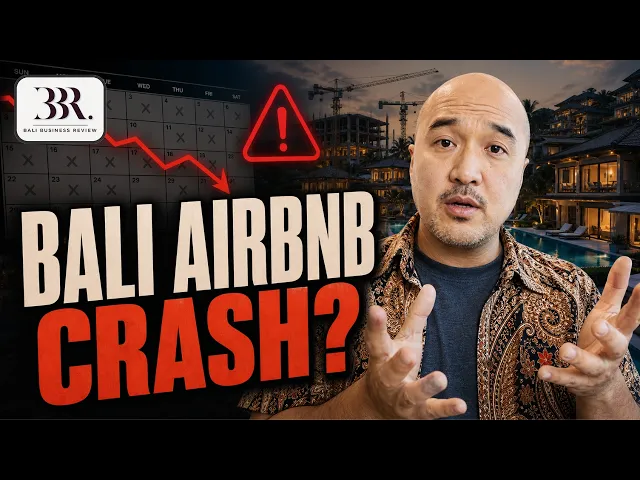
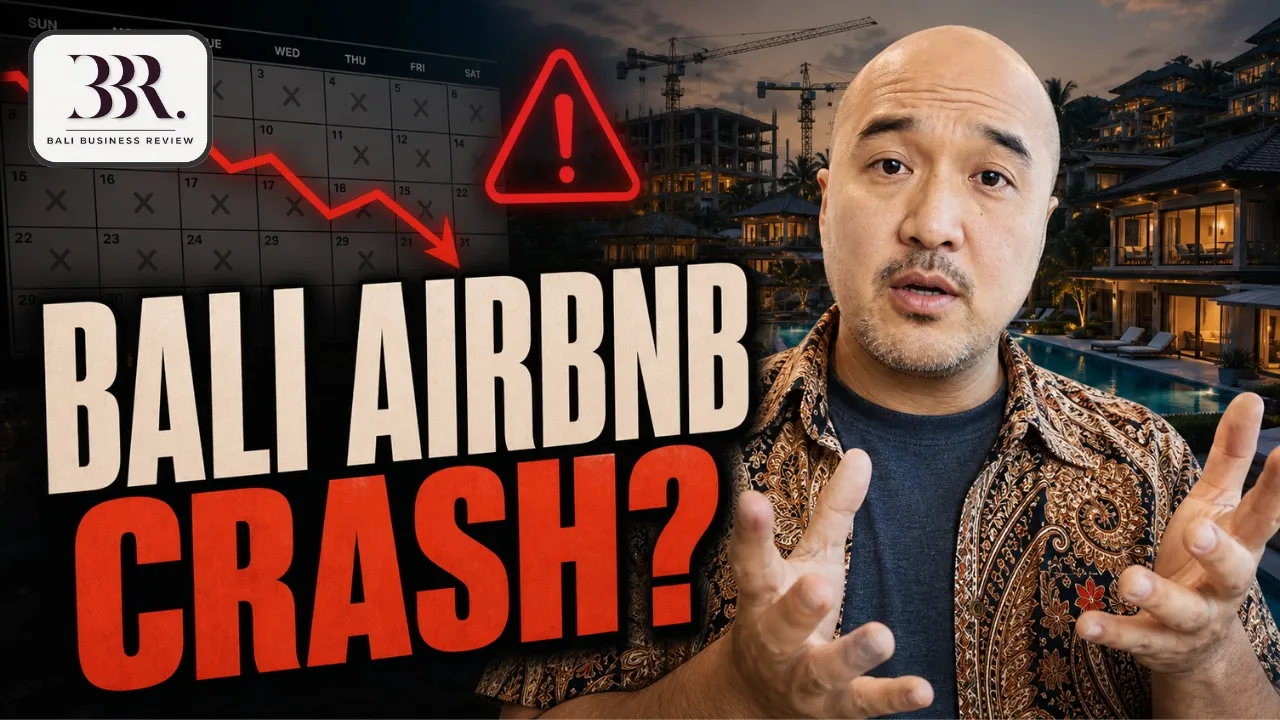
So when Chinese people don't travel to Bali, then the empty hotels and the empty villas and the empty developments become essentially then all competitive to essentially try to find the remaining travelers. So that means prices will most necessarily drop. Today we will discuss topics related to our previous video, which cover market turbulence in Bali's properties rental market.
Alongside with me, here's CEO Fukutvista, who has a decade of experience in hospitality management, and it's also former manager of Airbnb Indonesia, Ching Choyang. Hello, sir. How are you, sir?
Hi, how's it going, Rehan? Good to speak again about the market conditions here in Bali. Yep.
We already discussed about market turbulence in its previous video, and how is it going, sir, about market turbulence right now? Is it better or getting worse, sir? Okay, let's take a minute to pause and define what market turbulence is.
So if you watched my previous video back in December, we talked about essentially at the end of the year, we'd already been seeing trends happen across the Bali property market here, where the supply is increasing faster than the demand. A lot of it is due to the acceleration of more and more units that are arriving to the marketplace, because larger and larger batches are being released into the market at the same time. Now, this has some impact on types of investments.
It has obviously impact on short-term rentals, long-term rentals, and property sales. So let's take a look and examine how market turbulence is affecting different segments. So I'm here in Ubud right now, which is one of our favorite places, and also it's one of the busiest places in Bali.
It's a common destination in which most travelers will essentially intersect. Some people like a beach holiday. Some people like, let's say, a holiday with nightclubs.
Some day people like to surf. But one of the most common things that we see in Bali is that everybody wants to visit Ubud. Ubud is, I would say, the centerpiece of mostly most travel circuits.
Most travelers would agree that a trip to Bali without seeing Ubud is incomplete. So by being here in Ubud, you can get a good picture on what's happening on the ground in terms of the demand side. And if you look outside right now, actually, there's some traffic.
There's visitors here. I'm sitting in this cafe called Fold at the moment, and I see that there are a lot of young people. There's some people who are clearly residents here.
They're doing some research on their computers. There's Russians. There's French.
There's English speakers. There's people who don't talk at all over there and just work quietly on their laptops. But there's other pictures across different markets in Bali that I've taken a look at over the past week where it does not reflect.
One of the areas that's significantly lower in terms of activity is Canggu. We can actually take a look at that particular marketplace by examining the traffic. So if you take a look at the traffic situation going to Canggu, what you'll notice is that it swells and it relieves at different periods of the day.
So essentially, if you take a look at, let's say, the swell time is during the commute hours between about seven to nine in the morning. And those are mostly workers going into Canggu to go to work in the restaurants, cafes, and all the different retail businesses in Canggu. And then there's another swell at around between about six to eight.
That's when people usually go home. Midday, there's another bump up in spike in traffic due to guests checking in and checking out. Checkout times typically in Bali are sometime between 12, 11 to 12.
And check-in is about two o'clock. So that's when you have a lot of visitors moving across the market. They'll be traveling.
So examining these particular insights, what we've been able to see is that the traffic conditions are softening in Canggu. It's very light. And the reason for that is the cost of running the operations happens to be a lot on your labor.
And you'll see swells and traffic depending upon the amount of daily workers being set in to particularly participate in working in different restaurants and establishments. So based on that proxy indicator of looking at traffic, you can have a pretty good idea of this. Business owners don't pay for daily workers when there's no guests.
That's pretty simple to understand. So as a result, the traffic will go down. So based on that, we can see that demand for let's say that would affect short -term rentals the most because essentially these daily workers are mostly serving short-term rental guests.
For long-term rentals, I would say the proxy indicator are your more established establishments, cafes, co-working spaces, gyms. These are places that people who are residents would regularly attend. And by our recent, we have basically people who patrol the market every day.
They are looking to inspect properties, but they're also looking to find new properties, new construction sites. But they've also reported softening attendance and occupancy in the particular areas where long-term residents frequent. Once again, these would be gyms, co-working spaces, even Western supermarkets.
These are also softening. From the ground in Bali, it looks like essentially the supply is raising and essentially the demand is shrinking. So that's not good.
That's indicating that essentially the market turbulence is most likely going to get worse. However, there's a few other macro indicators that I think are also fairly important to consider. One of the major macro indicators is Chinese travel.
So right now is just a few days past Chinese New Year. And this is probably one of the weakest Chinese New Years I've ever seen in over 20 years here in Bali. So I have been working here in hospitality for over 15 years now, but I've been living here since 2005.
So one of the weakest Chinese New Years in terms of the number of inbound Chinese travelers coming here. And why is that a problem? It's a major problem because China is 1 .
3 billion people and they're about four hours away from Indonesia, maybe five hours, depending upon China's a big country. So when Chinese people don't travel to Bali, then the empty hotels and the empty villas and the empty developments become essentially then all competitive to essentially try to find the remaining travelers. So that means prices will most necessarily drop.
So when prices drop for short-term rentals, that also affects then the sale prices for investment properties as well, because the major inbound destination or major inbound demand group isn't drawing up as much. So that's going to essentially hurt the seasonality. As a long-term trend, I am beginning to see that Chinese travelers seem to avoid global travel.
It's not just something that's happening to Bali. It's something happening to Europe, North America, other regions where Chinese travelers have essentially been frequenting. Chinese travel before COVID was meant to actually overtake even Australian and other traditionally large demographics coming to Bali, but that probably will not be the case long-term wise.
So that's not good. Russian travel has softened up a bit. I think essentially, as we're seeing pushback now from the Indonesian government towards Russian investment, and we're seeing essentially some friction with that.
And I think Russians are feeling discouraged to come to Bali and they're feeling more encouragement to travel to other parts of Southeast Asia. Concurrently, we're noticing a rising trend of Russian travel choosing Thailand in particular to focus on. Part of the reason is that prices in Thailand are a bit cheaper.
Also, they're a bit more welcoming. And I think, let's just say the Russian travelers probably created the situation that made their own economic situation unbearable, which was that they were always willing to be the highest bidders. And so over time in Indonesia, what I guess supply learned was that you create a special price category for Russians.
Because of their tendency to, as a group, overbid for product, I guess they price themselves out. They made the prices so invariably expensive such that future Russians eventually saw less and less value in coming to Bali. So we're beginning to notice some tapering off there too as well.
If you're watching this right now and you have any feedback whatsoever, if you see that I'm wrong or just full of shit, I don't really know what I'm talking about, or I'm just trying to improve my own situation as a property manager, call me out on it. I'm welcoming to all feedback. I'm prepared to answer any difficult question.
I have a, ask me anything for our regular property owners who do actually work with our company at Boca Vista. And maybe you can teach me something. But for the past 15 years, I have seen that I have a pretty good track record on getting these particular things right.
And that's why we have a successful business here. And we're able to build a YouTube channel. Okay.
All right. That's pretty much then the, I hope I have the nuts of it. And hopefully this is a good discussion that will lead to more discussions.
And we look forward to talking with our audience again, every month. We'll be back again to talk about February and to see if we were correct in our predictions. We'd like to probably bring more data and analytics to this discussion too, as well.
So that our audience can see some of the facts and figures that we're drawing. Thank you very much. Okay.
Thank you. Thank you so much. See you guys.
Okay. See you guys. Have a nice day.