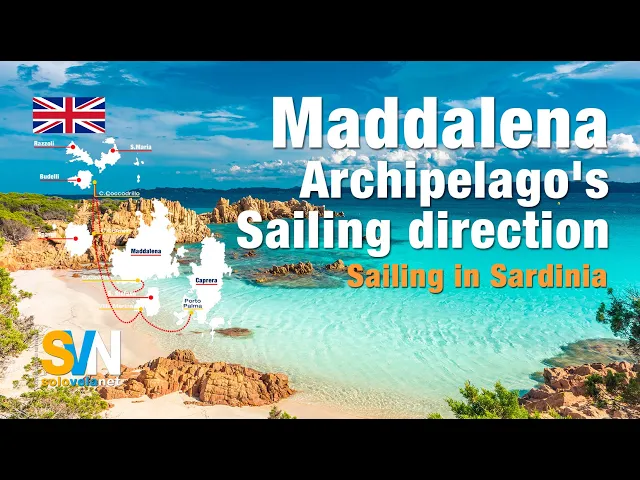
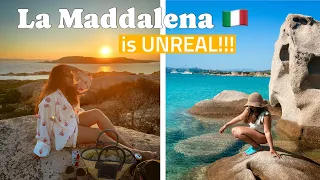
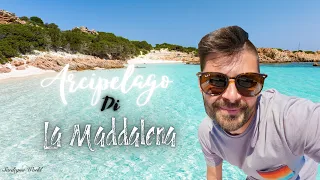
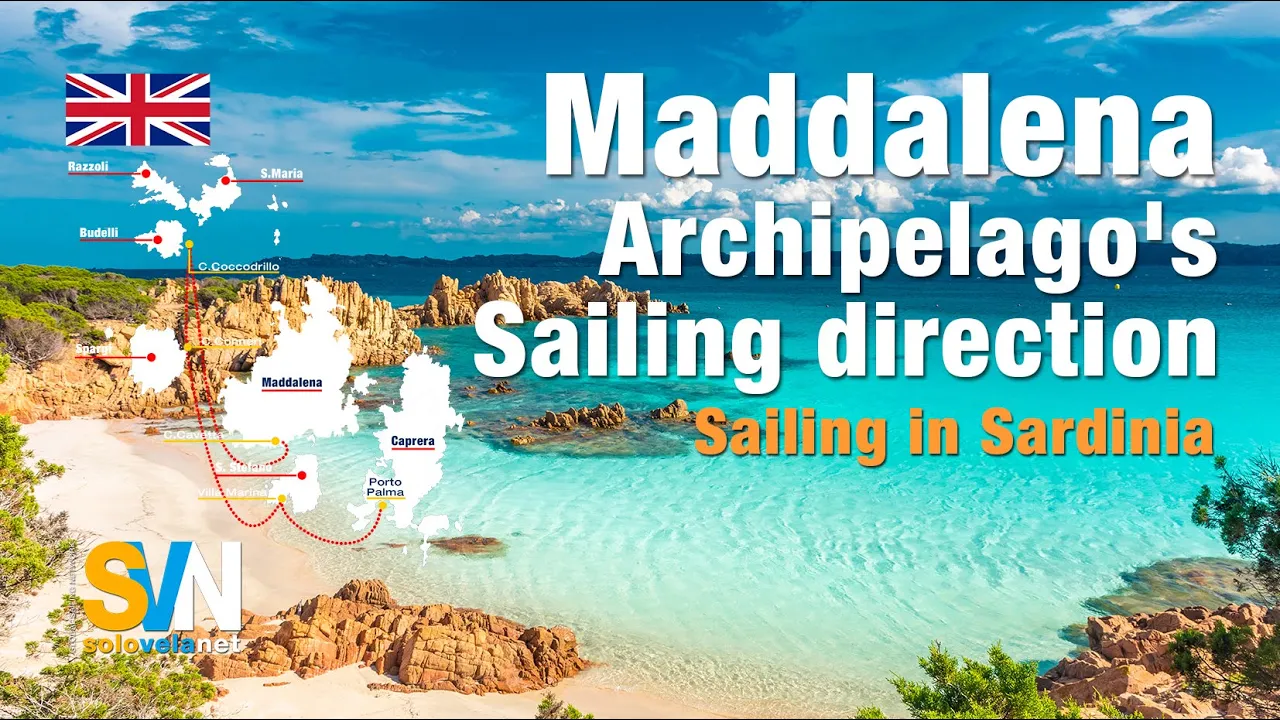
We have the documents,, let's go to the boat. I will show you some really beautiful places, absolutely incredible. We are going to visit the archipelago of the Maddalena.
Follow up. We are at the start of a beautiful day that promises to be quite warm and we have just arrived at Marina Cala dei Sardi, the greenest Marina in Italy, property of the NSS Yachting group. We are here to shoot an installment of our "Sailing Directions Videos" series.
We'll take two boats from the NSS Charter fleet and sail for a couple of hours north of here to show you one of the most beautiful places in Italy, the Maddalena archipelago. We will visit you beautiful bays, pristine beaches, great harbors and also tell you things like the winds and possible dangers. , and finally we will take you ashore to see the things you can visit on land.
So follow me, it will be quite an adventure. We are on the eastern side of the island of Caprera. We chose this side for our first stop because today there is a strong westerly wind.
There are 20, 22 knots with gusts of 24, 25 knots, but, as you see, in this bay, which is called Cala Portese, the sea continues to be perfectly flat. On the eastern side of the island, we have already been to two bays, Cala Coticcio and Cala Brigantina, that Simona will now tell us about, and then we will talk about Cala Portese where we are right now. Simona go ahead.
Let's start with Cala Coticcio. It is located on the northeastern side of the island of Caprera. Beautiful bay.
Nicknamed Tahiti Beach because the color of the water is a fantastic emerald, because of the white sand. All three bays are mostly sandy with a few patches of seaweed. Cala Coticcio is protected from the west to the southeast, however be careful, only go there on good weather days, which is not what we have today, because although no waves come in there, the wind can get funneled through the mountains and turn the boats around up to 100 degrees, so you would need lots of room around you to stay at anchor, but in that bay there is seldom much room.
Consider that in summer there are really a lot of boats here. Now we are in June, it is the perfect time to come to the archipelago, as you see there are very few boats. But between July and August the boating density here is really high.
Now, shall we want to talk about Cala Brigantino? Cala Brigantino is located in the center of the eastern side of the island of Caprera. Very nice bay, pretty, however very small.
It has room for three, four boats, no more. It is a small fjord, so, the more you enter, the more protected you will be. As a shelter, it is protected from the winds from north to south.
Inside it is very shallow, two and a half meters, three meters. Eight meters just outside the bay. So be careful about how many boats there are, if possible it's better to have a line ashore to avoid turning.
Finally we have arrived here, at Cala Portese. Cala Portese, as you can see, is a very large bay with several beaches and also a second bay, back there a bit hidden where you can be more secluded. In the beach that is on my right there is also a very nice cafè, ideal for a pleasant break ashore.
Simona would you give us the nautical features of this roadstead? Cala Portese is very well sheltered from the west, so with a strong wind fom the North-West or the west, it is the only bay I would recommend for the night of the three we have seen. It is sheltered from the north-west all the way to south-east, it has a depth of about 3 meters inside the bay, a little bit more outside, where there are between 6 and 8 meters.
Sandy bottom here too, a few patches of seaweed so pick your sand patch to drop anchor. In addition to being sheltered you have two anchoring options: this is the small bay that Maurizio mentioned before, should the first bay be full you can anchor here as well, or you can choose one of the buoys of the maritime that there are about a dozen of them. The buoys, are free, quote unquote.
Why "quotes? " Because to enter the park you have to pay a ticket and you pay it with the Italian App called. .
. . Pagopa.
Pagopa, perfect. However, if you haven't had time or don't want to rack your brains on how to do it, you can safely arrive in the park and wait for a park raft and buy your ticket, if and when it comes. When it does arrive you get the ticket directly with them with a minimal surcharge.
Charter boats, most charter boats, such as all NSS charter boats, have this ticket already included in the charter price, the charter company pays it so you don't have to pay anything at all, you come here and you have your buoys for free. Having said that I would go and see the last cove in this part of Caprera, which moreover is also the most sheltered one of all, and that is Porto Palma. Let's go to see Porto Palma.
We have reached the end of the day. We have shown three bays. But on the first day of sailing you will probably not be able to see them all, because if you leave in the afternoon from Cala dei Sardi, it will take you almost two hours to get here, so on the first day you can go to one roadstead.
But we have shown you three, and now we are showing you a fourth so that you can choose the one the will be your destination on the first day. We are now in Porto Palma. Porto Palma is important because it is one of the most protected bays in the Maddalena archipelago.
Here we are perfectly sheltered from all the northernly winds, right Simona? Yes, that's right. We are south of Caprera, so bay protected from all but southerly the winds, but as you see the mainland of Sardinia is really close to this island.
So the fetch is very short. Exactly. The depth of this bay is very shallow, this, together with its width, is its characteristic.
Depth ranging from 4 meters near the coast, to 8 meters right in the middle of the bay. The bottom is a mixture of sand and seaweed, it is a good holder, but be careful when giving anchor. Go backwards and make sure the anchor has dug in, because otherwise you might risk tripping the anchor because of the seaweed.
This is because part of the bay is mud. Pretty hard mud. But we also have mooring fields.
We have the mooring fields. The ones of the park have yellow buoys, not to be confused with the orange ones behind us which belong to the Caprera Sailing Club instead. This is also the home of Centro Velico Caprera one of the best known sailing schools in Italy.
It opened in 1967 in the footsteps of the Glénans sailing school, which is still considered one of the best schools in the world. They are very well organized, they have both cabin cruisers and many dinghies. Onee special feature they are very proud of is that they have no professional instructors.
All their instructors are alumni of the school, including professionals, entrepreneurs, doctors, who decide once a year to dedicate two, three, even four weeks, to serve as instructors here at the Caprera Sailing Center. Having said that, how about we call this a day. We will go and prepare our dinner, relax a bit.
But we will see you again tomorrow for another day's itinerary with many more surprises in store. See you tomorrow, then. It's been a long day, we need to rest a little.
I agree. Listen, earlier I heard you talking on the phone in English, you speak it very well. Thank you.
It's actually among the first things they asked me when I applied from NSS, because for them it's essential we know English very well as a second language and then possibly another foreign language as well. Yes it is true. They actually want all their crews to speak some other languages so that they can work with their foreign clientele.
Yes. What other language do you speak? I speak English, I lived abroad a couple of years between Australia and New Zealand, but I also speak Spanish.
I speak German, besides English, I think it can be an important language to use in this area of work. Yes, there are many German tourists. I think our break will be short-lived, though; we have to think about our Italian guests.
I agree. Day two of our week in the Maddalena Archipelago. We left this morning from Porto Palma and arrived here on the island of Santo Stefano at Cala Villa Marina.
From here we continued on. We did Cala Granara on the island of Spargi, then we went to the island of Budelli, and we will start our talk to from there, from the island of Budelli. Would you describe what we saw in Budelli?
We were at Cala Coccodrillo, or Crocodile Cove, exactly east side of the island. A bay perfectly sheltered from the north-west and west, even when the wind is very strong, with a depth ranging from 3 to 15 meters. Sandy bottom closer to the beach.
More rocks and seagrass as you move away. This is the closest point to the famous Spiaggia Rosa, the Pink Beach. If you want to visit Pink Beach you can go ashore with the tender, there is a small headland dividing this cove from the beach.
Stay on the headland, do not go further, because the beach is a natural reserve and cannot be accessed. Perfect. From Budelli, on this journey of ours, we arrived on the island of Spargi and went to visit Cala Granara, a fantastic natural spot.
Can you give us some information on Cala Granara? Cala Granara is also very beautiful, classic colors of the archipelago as previously in Budelli. Cala Granara has a depth ranging from 3 to 15-20 meters with an entirely sandy bottom.
The cove is protected from west to north, even when the wind is strong. Due to its beautiful colors, Cala Granara like Budelli, is visited by many boats, so be aware that in peak season there will be many people, but the amazing color of the water alone is worth the stop. And in Cala Granara you will find a surprise: wild boars.
There are many wild boars that often stroll peacefully on the beach, and we saw one of them. We leave Cala Granara and return to our starting point, the first cove we saw this morning, Villa Marina. A peculiar cove because unlike Spargi and Budelli there are never many boats here, simply because it lacks that emerald green water as.
We show it to you because the day you are tired of being among dozens of boats this is a place where you can come and find some peace and privacy. Can you give us some information on Cala Villa Marina? The bay faces south, sheltered from all winds, it is only open to the south but even then the fetch here will be minimal due to the presence of Sardinia right in front of us.
Be careful, when entering and exiting always stay well in the center due to the presence of rocks some of which are close to the surface, right at the entrance of the bay. Inside, in the center we will have a depth of about 15 meters, and on the two sides, about two, three meters. The bottom is mixed sand and mud, the same as we saw in Porto Palma, which is why the color of the water here is not emerald but a little darker.
The seabed is still a good holder, but if you decide to swing at anchor stay in the center; if you go to the sides, especially if you stay the night, put a line ashore. Around the entire cove you will find rings embedded in the rocks. They can help you secure a line ashore.
The rings were once used to moor ships going to the granite quarry. When you go ashore with your tender you will find a pier, if you want you can use it for mooring. Ashore you can walk down a path that is found on the right for about 100 meters, you will come to a square where you will find a huge statue in three pieces, it is a statue that when finished should have been 13 meters high.
There is a half bust with a sailor's hat, it is the bust of Costanzo Ciano, the father of Galeazzo Ciano, a very important figure in the fascist regime. When he died they wanted to make a big statue of him, but on July 25, 1943, Benito Mussolini's government resigned and the next day they stopped working. After Cala Villa Marina, we proceed to the the port of Cala Gavetta where our second day in the Maddalena ends.
Let's go. Good morning. Today is the third day of our itinerary but as you can see, unfortunately, the weather is not very good.
There are almost 40 knots of wind outside and especially in the sky there is no sun, there are clouds. What do you do on days like these when you are on a boat? One of the things you can do is stop and visit things on land.
We are going to do just that today, choosing two things to see ashore. The first is a visit the town of La Maddalena. Shall we go?
I didn't remember the town being so nice. Not only is it very pretty, but it is also very well-maintained and also peaceful. For tourists there are a main street and a few alleys.
Right, a couple of squares, not much else. But you can find everything from typical small stores, local handicrafts, and, of course pharmacies, the post office. And also many restaurants.
Those are mever lacking, restaurants and bars. There must be a lot of hustle and bustle here in the evening because with all these places where you can eat and drink. I saw that there are also two ports.
Yes. One, the one where we are moored, which is Cala Gavetta, this one in front of us and the other one, behind us, at the end of this road, Cala Mangiavolpe. In Cala Gavetta we have a concrete jetty while in the other ones we have two floating jetties.
And there is a gas station, plus electricity and water for each berth. Maurizio, shall we tell our viewers about that second dock that has been added to Cala Gavetta? Of course, we should.
In August 2021 they opened Cala Balbiano, which is located just before the entrance to Cala Gavetta. And now, the two bays together, managed by the municipality of La Maddalena, can offer as many as 140 berths. After seeing the village of Maddalena, with its little alleys and old buildings, which is very nice, if we still have time, and we still have to stay at the dock because of the weater, another thing we can do is to take a cab and go to the island of Caprera.
Yes, by cab. Between Caprera and Maddalena there is a bridge that connects them. So we’ll go to Caprera and visit the white house, the house where Giuseppe Garibaldi lived for a good 26 years and where he died.
It's a very nice place, very interesting, and the house is still as it was in 1882, when the hero of two worlds died. There is his furniture, his wheelchairs, his uniforms, so many things that are part of Giuseppe Garibaldi's life. There is his tomb, but most of all there are his boats.
Interesting to see is a boat that started out as a rowboat and that Garibaldi modified into a sailboat, because he didn't want to go to sea with other people, he wanted to go alone and he wanted to do it under sail, because Giuseppe Garibaldi before anything else, was a great sailor. When the wind dropped below 40 knots and settled around 28-29 knots, we left Cala Gavetta, went up the island of La Maddalena and arrived here in the north of the island, at Cala Spalmatore, a cove really very well protected from the west wind. In fact, as you can see, the cove is perfectly quiet when it is really very windy outside.
When we arrived, we were met by Michela and Armando, who are the two people who run the mooring field in Cala Spalmatore, a field with 18 buoys, and they helped us by letting us attach a buoy at the bow and a buoy at the stern of our catamaran, so we are perfectly safe. Now Simona will give us some practical information on Cala Spalmatore. The bay in the northeast of the island of La Maddalena.
This bay is quite wide, however by a local ordinance you cannot anchor, so your only possibility is to get one of the 18 buoys that can moor boats up to 60 meters, so even very large ones. The service is very good; if you come with a catamaran they also put a buoy at the stern in addition to the one at the bow, while sailboats instead swing around. The service, as Simona said, is great: they even supply you with water.
They extend a hose from the wharf, come here with the dinghy and fill your water tanks. But not only that. If you want, you call them and they will do your shopping for you: order what you want, when you arrive you have the provisions ready to be loaded on board.
And last but not least, one thing that is really essential in this area, garbage disposal. Yes exactly, because there are very few places where you can leave garbage, actually only here on the The Maddalena; so besides the three docks that we saw at the port that we left this afternoon, here is another place where you can leave it. Now we are going to go ashore and eat at a very nice farmhouse that is a few hundred meters from here, and tomorrow morning we will tell you about it.
Simona, we are tanked up. Perfect, thank you. One question: have you been going around with the Solovela.
net crew for a long time? No, it's been about a year or so. We've already done six or seven videos together, and they call me every time they have to do a video with NSS because we get along.
Does Solovela. net only rely on NSS Charter? No, not only to them.
But Maurizio really likes working with NSS, he says they are very well organized. Which is true. And then they provide him with everything he needs whenever he needs to do something.
I can see that because I also get along with NSS. Anyway, I'm going to prepare an aperitif for the guests who are coming. Will I see you later?
Absolutely. The fourth day of our itinerary begins with strong winds. Not that the other days it was weak, we always had between 22 and 35 knots, but today already in the morning we are around 40 knots, so it promises to be a very windy day.
The wind has turned from east to north. Fortunately in Cala Spalmatore things are very calm so we are able to stay at the buoy without much trouble. Last night, as we told you, we went to eat nearby, 300 meters from Cala Spalmatore.
Actually, it was not a farmhouse as I had told you, it’s a restaurant called "l'Agriturismo”, that is “The Farmhouse”. What counts is that we ate pretty well, but the really remarkable thing was the "porceddu," a "piggy" perfectly cooked Sardinian style, really good. Try it.
Now we are going to try to sail out of Cala Spalmatore. The cool thing of this area is that even with so much wind there are never big waves, even today out there will be a meter, one twenty tops, and less when you find shelter behind an island. So let's go out and see if we can find any sheltered bays to show you again on this fourth day.
We finished our fourth day of the itinerary and, as we announced this morning, we went to see some bays. We visited three, which we will now tell you about. But before I do, I want to remind you that to get much more information, beyond what you find in this video and to review the information Simona one each bay, you can download our article "The Maddalena Notebook.
" The link is the description page below the YouTube video or in the first featured comment. Do it, because it is very useful, if you plan to come and see the Maddalena archipelago. And now we go to see our bays.
The first one we saw is a really exceptional bay, which actually is not really a bay but a body of water enclosed between three islands, Razzoli, Santa Maria and Budelli, which people call “the piscine” or “the pools. ” It is a place that will definitely amaze you because of the color of the water. Simona do you want to tell us about the pools?
Simona – The place is in the middle of these three islands, it is actually called "Manto della Madonna," but everyone knows it as the pools and his has this great emerald water you. At the Pools we have a depth ranging from two to 10 meters in the middle of the bay. It is exposed only to westerly winds.
The bottom is mixed sand and grass, but if look you’ll find a sandy spot because there are many of them. Wherever the water is emerald there is sand. Go there, it is a beautiful place but be aware that it is very busy, so you will never be alone.
Maybe at night after sunset there will be some peace. Remember also that this stretch of water is really very close to Budelli and in Budelli, as we saw the other day, there is a park buoy field, so you can also use the buoys that are there. Leaving the Piscine, after a few minutes of sailing we arrive on the west side of Razzoli, one of the three islands surrounding the Piscine, and there we find Cala Lunga, another really special bay.
Simona, Cala Lunga. Very beautiful place, inside it’s all rocks. The atmosphere inside the bay is really special, I hope you like it as much as I did.
We have a depth inside ranging from 5 to 10 meters, mixed bottom, again sand-weed, look for sandy spots if possible. It is open naturally to east and south-east,, sheltered from the rest. And so we also visited Cala Lunga, another place definitely worth seeing.
Here in the archipelago you will be spoiled for choice among all the places to see each day, so don’t try to see them all. From Cala Lunga we head to the open sea again, and off to the eastern side of the island of Spargi where we find Cala Conneri, another very interesting place where it will be very pleasant for you to spend the night; unfortunately, not for us who had to come back here. Shall we talk about Cala Conneri ?
This is also a very beautiful bay. In the middle it has a small promontory that divides the bay in two, so in fact there are two bays, but the characteristics are the same, the only difference is that in the northernmost bay you don't find sand ashore but stones, while in the southern one you the beach is sandy. It is perfectly protected, an excellent shelter for strong north-westerly and westerly, so go there safely.
Sandy bottom near the beach, then rocky as you move away, with a depth ranging from about 3 meters to 20 meters depending on how far you anchor. Very blue water, beautiful, the classic water of the archipelago; being in Spargi, you may find several boats perhaps just passing through, however, the bay and its colors are worth the stop. After Cala Conneri we returned to La Maddalena.
After three days of very strong wind tonight we expect some undertow, so we preferred not to stay in the roadstead, but to come here to Cala Mangiavolpe. The other day we took you to Cala Gavetta which is definitely a more sheltered place. With the fourth day over, we will see you tomorrow morning to start the fifth day of our itinerary.
As we predicted at the beginning of the video, we had a week in which it was definitely not easy to do the kind of work we are doing. There were days when it was totally cloudy so we couldn’t shoot and a wind ranging between 25 and 40 knots. Today, on the other hand, it feels like the first day of full summer, absolutely clear skies, the wind has dropped to 20 knots, the sea unfortunately still rough, because in the past few days there has been really a lot of wind, but here it is!
Look what a day we have. And on this day we made another tour to show you three more roadsteads. We started this morning with the island of Spargi, where we went to see Cala Corsara, a really very beautiful bay that our skipper will now tell us about.
Simona you’re up. We are in the southeast of the island of Spargi, a very large bay, with no less than four small beaches. Watch out for two rocks in the bay: one a little bit to the south, very clearly visible, and the other one at the water's edge a little bit to the north, which is close to the line of the buoys that signals the no-access area in front of the beach.
Bay with beautiful water, the classic blue of the archipelago, a depth ranging from about 3 to 10 meters, mostly sandy bottom, and we are sheltered from all northern winds. We leave Cala Corsara and return to La Maddalena, north near Cala Spalmatore, where we stayed the other day and here we find Cala Stagno Torto. It is not among the most beautiful bays we visited but it has a peculiarity, it is sheltered from all southerly winds.
Today we want to show you a couple of bays that are protected from those winds, bays that in the past days we could not show you. It can always come in handy, in case you come here and find southerly winds, to know a bay where you can go and take shelter. So Stagno Torto sheltered from the southerly winds.
Simona. Stagno Torto is a very large bay, so it can provide shelter for several boats. Beware of some rocks inside the bay, some visible others below the water surface and, most importantly, they are not marked in Navionics, so be careful, especially if you arrive in this bay at night.
The seabed is between 3 and 10-12 meters and is a mixture of sand, seaweed and rocks. We are well sheltered from southerly and easterly winds. It can be a good alternative when all the other bays are very crowded, at least it is peaceful.
If you want there is also a jetty so you can go ashore, a beach equipped with umbrellas and deck chairs and a bar that is open in season, now it is closed, and the road from here that leads you first to Porto Massimo and then to the village of La Maddalena. We leave Stagno Torto, head on to Caprera and arrive in this really very beautiful bay. This is also sheltered to the east and is called Cala Napoletana.
Can you tell us about Cala Napoletana? We came from the island of La Maddalena, so no problem, but if by chance you are coming from south of Caprera and you are coasting going north, watch out for a dangerous shoal that you find just nearby. Do not pass between the shoal and the shore, the Navionics says three meters but go wide, it’s much safer.
Once inside the bay we are well sheltered from all the easterly winds, we have a depth ranging from 2 and a half meters to 10-12 meters, mostly sandy bottom, very nice bay. Really very beautiful. One peculiarity.
We today when we arrived, we came from the north, we came to this area and we thought that the bay was not very sheltered, it didn't give us that impression. But as we rounded this headland, we found instead an absolutely sheltered place. With this we end our fifth day.
We are going to take a break and get ready for the night. We’ll see you tomorrow for the last day, when we will return to Cala dei Sardi. But before we reach our final destination we will stop for one last bay.
We have just returned to Cala dei Sardi. On the trip from the Maddalena archipelago to Cala dei Sardi, we wanted to stop for one last swim and we chose the VIP bay, the one where you find lots of mega yachts, a bay that is less than a 10-minute boat ride from here, Cala di Volpe. So Simona for the last time and last bay, to be patient and tell us about Cala di Volpe.
Simona – We are of course in the northeast of Sardinia, in a really very large bay, open only to southerly winds. It is shallow, in the center of the bay the maximum depth is only 15 meters and much less as you get closer to the sides. There is a mixed sand and seaweed bottom, lots of buoys for super yachts, so in season it will definitely not be the quietest place because there will be a coming and going of dinghies, maybe jet skis and water skis, however, for one last swim it is ideal.
Very good. And with that we have definitely concluded our itinerary in the Maddalena archipelago. I hope you enjoyed it and found out some interesting stuff.
If so let us know, give us your like. Remember that if you want to get a whole range of technical information, such as the phone number of the mechanic, the refrigerator man, the buoy field, with Armando and Michela, whom we met in La Maddalena, download " The Maddalena Notebook," the article you can find with the link in the description, below the video itself, or in the first featured comment. The first in the whole series of comments.
Do so because it is a very interesting article. I thank Simona for her great patience and professional skill. I also thank NSS Charter because they are the ones who made this video possible by providing us with the boats and the people we need to sail them.
All that remains is for me to give you an appointment to the next video of SVN solovela.