Fortunately, I have my key. So, all right. So, as you can see on the NYX strip. Oh, wait. on the NYX strip. The front month is 969780 is the April contract. That's a front month contract. Um, so it costs less money to buy oil right now than it does if you buy the April delivery contract. There's a premium for the April delivery contract. And that's because obviously there's a that gives you an idea which way they're hedging. They're hedging that in April it will be harder to get oil, not easier. So, um, hang on a
second. All right. And how long will this thing last? Well, May is very tight. May is expensive. June, July, August, and look how many contracts are trading per day. Oh, I'm sorry. It's not that's not per day. That's a Here's the volume per day. Notice $400,000 400,000 contracts trading per day. There's only 300,000 contracts open. Every single contract is rolling over today. That is insane volumes of trading of churning churning churning contracts. And that makes it all more expensive, too. Things don't get back to normal until next year. And that's not even very normal, 75.
But you can see by the volumes, 102,000 contracts traded today for December at 7778. So oil prices are through the roof. And Trump just said something, but it didn't help. I don't know what he said, but Trump just said something that didn't apparently help. We're waiting on the Fed and we'll take a look at um the um petroleum status report. I'm just trying to piss me off cuz So, crude oil inventory 6.2 million barrel build from last week. Um, gasoline inventories dropped by 5 million barrels, but they're still 3% above the 5-year average. Uh, distillate
fuel decreased by 2.5 million barrels and it's below the 5-year average. Um, and you always want to look at all other oils. All other oils, which is not in the headlines, are up three million barrels, too. So, the net is a build on oil. But look at what we're doing. This is what's pissing me off. In this crisis, we exported 5.2 million barrels of oil, not oil, petroleum products, refined products. We exported 5.2 million barrels out of the country per day. Now, we're still exporting 5.2 2 million barrels per day out of the country. 35
million barrels per week we are exporting. So the straight of horm by the way is 20 million barrels per day. And so we're taking we are exporting two days worth of the straight of Hormuz's total traffic. You can see why I'm getting pissed, right? Um, It's such a disaster. So, refining capacity wise, we're at 90% capacity in the refineries. Um, they're they're doing they're producing as much as they can. We are turning around 20 21 million barrels of oil per day is being of of petroleum per day is being turned around in the refineries which
is a stunning amount and um let's see what else. Uh the money oil was 67 last year. Now it's 98. So it's up about 50%. Gasoline was 190. It's up about 50%. 50% for gasoline from last year. Heating oil $2 $4. Now it's up 100% heating oil. Uh diesel fuel 217 100% increase in diesel fuel. This is a cost of shipping and the cost of trucking and the cost of lots of things that we do in this country. Also also assume that aviation fuel is up in that range too. So the airlines costs are doubling.
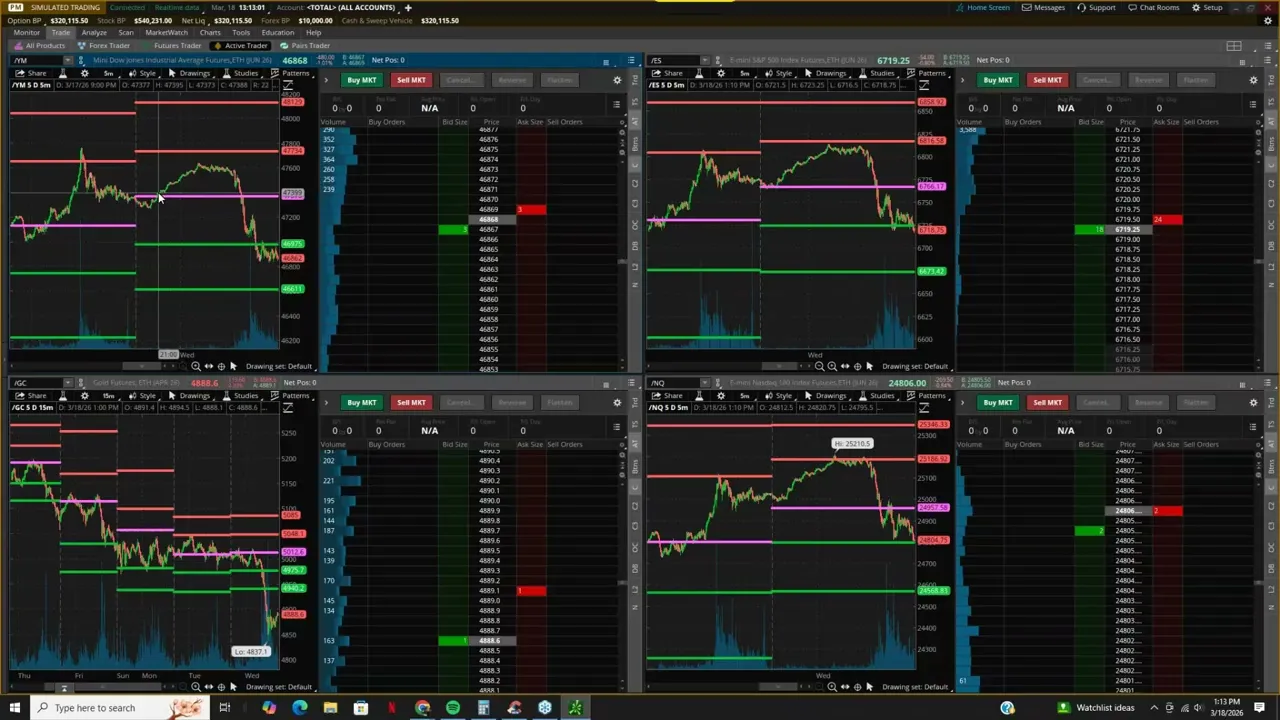
Now interestingly it turns out the airlines are benefiting from an amazing well they immediately add sir charges to their tickets and they're benefiting from a huge amount of people who are booking tickets while they're before they get too expensive. That was unexpected. Frankly, overall, I don't know if I can zoom out a little bit, but look at what the Dow did today. We closed here yesterday. It was a decent day. We went up in the overnights, except that when we came into the market in the morning, we fell from 476 in the morning to 468.
So, we're down 800 points since the open or or since the pre-markets and we're at the lows. So, it's not a good day. Things are not going well. Gold crash, that was interesting. And of course, Here's what CL just did. Now, what did Trump just say? What the heck? Why is this not working? Oh, it's just a uh Trump just said something on TV and I calmed down a bit, but the markets are not responding. Can you tell me what he said and what the market is or should be? Let's see how up to date
Bodie is on this news. Well, the Jones Act only allows allows foreign vessels to m move fuel in and out of the United States. I'm not sure how that really helps. Foreign flagships move fuel between I just said that it doesn't it's well it helps because it moves gasoline to the east coast and the and the east coast has a problem getting gasoline in the situation. This comes on top of messaging he's willing to wave certain oil related sanctions and similar comments last week. Um equity risk much more cautious even when oil pulled back shortly.
Bum what the effect should be. The Jones Act plus hints of sanction relief and guaranteed tanker escorts is mo modestly bearish for cur mildly supported for airline shippers and consumers. The war with Iran is still on. Homes traffic is still Constrained. Policy signals are inconsistent. Um so the equity markets are treating this as a headline wiggle. And the thing is Trump, which is a funny thing to say because it's it's hard to imagine he had any, but Trump is losing all credibility as he does nothing but lie. Everything he says is a lie. So when
he says something, it doesn't matter if it's true. Nobody believes him anymore. Because now he's saying, "Oh yeah, this won't be long. Couple of weeks, we'll be done. Blah, blah, blah. But they've been saying that for two weeks, three weeks already. This is what this is day 19. So we're well into our third week and there's not much end in sight. Um, you know, he's kind of stopping the slide, but this is not good. This is ESNQ. What's missing? So, there's the down. So, it's not pretty at all. Our oil is 97. Uh, Grand Oil
is getting close to 110. Bitcoin is down almost 5% today. People are just going to cash. So, you know, and that brings us back to where we're supposed to be talking about. Should we be going to cash? We're kind of hitting the point of no return on this war where even if they do even if they have a ceasefire and the straight of home rules opens up, we've already created a um a 20day times 20 million barrel shortage of oil, 400 million barrel shortage of oil. Even if they they even if everybody increased their capacity
and everything went back to normal today and we produced the world producers. I mean, if they produce 5 million extra barrels of oil per day with no shipping issues, no problems at all, then it would still take um 80 days. It would take three months just to get back to normal. Even if we went into over production, which is not going to happen. It's very unrealistic, but that's like the the most ridiculously optimistic view possible. Means that for 90 days, oil will remain constrained. Inventory levels will be low. It will take time to fill the
strategic petroleum reserves back up and so on and so forth. We're talking about The next entire quarter is shot and that means inflation will skyrocket and so on and so forth. But keep in mind that's if all of a sudden everybody finds an extra, you know, if the world finds 5 million more barrels of oil to produce, even if they had the spare capacity, turning it on takes time, getting up to speed. The there's a cost to extracting the oil that would have to be laid out up front, so on and so forth. So now
it's more like 180 days and 180 days takes us all the way into into quarter 4. So essentially 2026 is shot to hell. Now we're already crossing the threshold where 2026 is unreoverable. Um and and and now the there's a positive. Oh, let's get back to the chat. So, poor uh poor clown daddy was was crying in the chat room. And I I sympathize. So, let's find what he just said because he was right. And I I worried about that this morning. I was actually thinking about that. You know what? Whoa. Where's the thing? What?
Oh, I'm not signed in. This is always happening. WP admin. Ordinarily, you know, I try to keep things in global perspective and we mostly try to find stocks. But this is different. This is a huge crisis. This is possibly World War II. And what then is my responsibility? And I have to figure I have to look at the entire picture and I have to try to figure out what should we be doing. So, Clown Daddy said, and rightly so, all this back and forth is making my head spin. I'm having trouble following all of the
posts and determining whether you are wanting to go to cash, sell things, keep things, what direction we're going. I don't want to be caught like a deer in the headlights, but by not doing anything, if we should be, but I also don't want to go in and out either. Neither do I. And this is, you know, I mean, I'm just sharing and I understand it might be overwhelming. I was considering that this morning as I was putting this Report together with the roundt team and I was saying, you know, this is a lot of [
__ ] And I was hoping that by going over everything and and and honestly honestly in a situation like this where we're on the verge of war. Well, I mean I mean we're in a war, but in a situation like this, you every day you you need to know what's going on and you need to get it in context, not just say, "Oh, today we bomb this." That was what happened in Vietnam. It became like uh you know, the war went on for years and years and years. And after a while, it's just like, well,
today this many people died and this many bombs were dropped and blah blah blah. and and it was just it was all out of context. Everything became out of context. So you had no frame of reference for what was going on in the war because it had been going on so long that you're just giving daily reports like it's a weather. And yeah, you can get used to anything and the market will get used to anything and it will be like the weather after a while, but certainly not this early stage. So, so I I
try to give you like a skimable version of what's going on. Now, I'm up at 4 in The morning reading the actual articles that go into making these things. You know, 100 200 articles in the morning that I go through. And by the way, when I say reading, here's the thing. You know, I should write a thesis paper on this one day, but this is the advantage of being an expert in things because when you read constantly and a lot, what happens? Well, most articles that I read are uh background back, you know, you read
the article and it's like background background, new information, uh somebody's take on it, and then background background or or summary of the article I just read. So, it doesn't I don't have to read the whole article. I can skim it really quickly and just find the new parts or the or or things that have changed or the or or the interesting perspective. That's why sometimes in the um in our news feed, which I don't know how many of you actually ever look at, and these are the articles I think are worth reading out of all
the ones I read, but in our newsfeed, which goes on and on and on, and you can go to Flipboard. We have a whole magazine on Flipboard for this stuff. Um, but all these articles are the are the meat of what we're basing our discussions on. And I read all those. Those are the ones I think are worth reading. And sometimes you might see two or three articles about the same thing. And that's because They have two or three perspectives that I I think are worth listening to. Even if they're completely the opposite, I still
think you should read both sides of it. Um, but generally they're the, you know, like of the things I read in the morning, these are the best ones. Um, or the afternoon or whenever I happen to read them. Uh so so what I'm saying though is that because I am constantly reading about the war and the bombing and the this and the that I know when I see new information that's worth talking about or when it's just you know a rehash of things we already know and I've taught my I taught the AGIs that too.
So they're very good at coming up with brand new information and that's why when they write their morning report. So you know this is a summary of what's going on here. The first thing off the round table this morning is I started printing these which is the uh the overview of where we are as of this morning. Then Gemini organizes the AGI round table and they all come up with their own different perspectives, but these are all fresh and new for the most part. They very little rehashing of what's already gone on. And then there's
a secondary report that is absolutely just brand new stuff that nobody's talked about yet. And that's the important stuff. I mean, that right there is what you should absolutely be reading every day. you can ignore everything else but if you don't read that then you're missing out because we have distilled hundreds and Hundreds of articles into this is what matters today but even then um then I came in I wrote a few notes after what they said and um and I said hard to imagine the Fed is going to help or what or what Pal's
going to say there's going to be any help and anyway so the point was oh then I then Robo John Oliver commented on what I was talking about and get and again overview overview overview because we're making a massive decision here. This isn't like do we buy Loheed Martin or not or is or is Exxon still a good price. This is our whole portfolio. Do we do we tear it to shreds and give up and start from scratch again? Because because essentially the reason is because we can't tell what's going to happen next. We don't
really know where what the market's going to do for the next 30 days. So if we don't know, then we're better off being in cash than guessing. We can always make money, but only if we have the cash to invest. And so this is a big critical decision with a huge amount of information. And I apologize that I'm going over it over and over again, but I'm doing that because I don't know either. I don't know what the right thing to do is, and I want to try to get this right. But given the information
we have so far, Given what's going on today, things are getting worse and not better. And it's not tragic to go to cash because you can always buy the stock again. I could always buy all the stocks. I always take the same freaking template and just buy everything the same. I won't do that, but I could. So going to cash is not some final definitive giving up on the market move. We could change our mind in two weeks. But the weird thing is that the market is only down not even 5%. Should we be panicking
out at 5%. Even today, the Dow's down 1% today. Oil went flying up and the Dow's only down 1%. That's so weird. But how do we manage it? What do we do? So anyway, the news was so bad today that I asked, what is this one? Oh, this then the this is other news that I'm reading besides the stuff that we talked about. So, I wanted to put in some other things. Um, oh my god, there's a lot of reading today. Um, and you know, Trump orders Anthropic out of of the systems. Anthropic follows the
order and turns off, you know, and takes Off their software. And now they freak out because they were still using it and and now the Anthropic took it away in the middle of them using it. and they lost projects and things that they've been working on because everybody's been using Anthropic. Everybody in the government's been using Anthropic and now they just decided to switch to GBT without giving any time, without a grace period. This is a freaking nightmare. All these people are idiots. So, we had the oil thing that we got at 10:30 and then
I said, "Look, I asked the Roundtable Consulting Group for a bullish case and here's the bullish case." Obviously, if I'm thinking of pulling the plug, I need somebody to say, "What's the bullish argument for the stocks?" So, unless something changes, this is a cor this is going to be a correction. Correction meaning 10 to 20% down on the markets. So, if you think you're in if you think you're feeling pain now, double it and then double it again, possibly. Um JP Morgan's desk. Oh, by the way, when you're in a crisis like this and JP
Morgan Goldman Sachs tell you, don't sell yet. And and we went through this in 2008. In fact, the video I used to refer to in 2008 was a video of uh John Stewart making fun of Kramer because all During the crash, he was like, "Bye bye bye. Oh, this is oversold." Bear Sterns is oversold. Uh you know, you know, Morgan Stanley's over every like he's talking about all these things that end up going bankrupt and he's like bye bye bye bye bye bye. Um you know because it wasn't a bargain. It was just the middle
of a crash. And Kramer was so wrong for so long. It was just a joke. And Stuart put together a few months worth of clips of him telling everyone not to worry. Don't change your thing. No, the financials are fine. This is crazy. Blah blah blah. Now, I'm saying this about Blue Hour right now, so I'm guilty. I I think Blue Hour is ridiculously oversold. But what I'm saying and what Kramer were saying, we're two different planets. But what's the thing? The thing is that Kramer, hedge fund managers in general, Morgan Stanley, JP Morgan, uh,
Goldman Sachs, they own all these stocks. They can't sell them if someone doesn't buy them. So, of course, they're telling people the market is fine. Now's a good time to buy. Don't get, you know, you know, beware of of of fear of missing out. Beware of FOMO. Of course, that's their story. They're trying to unload all their stocks and somebody's got to buy them. And that's going to be the retail suckers that they can that they can convince to come in and pick up everything. Okay? We're not going to be those people. a very very
dangerous very bad time for the market and we should probably be going to cash but I need to be talked out of that if I'm wrong but again I asked the round table I had them do some significant research and and and bring things together and I'm said can you give me a bullish case that's what I said to them what's a bullish case and they said something's got to change right now there's no There has to be a definitive offramp. And and and again, the president of the United States is a lying son of
a [ __ ] You can't take anything he or his cabinet says at their word. And look, Nixon's cabinet was the same. He was a liar. Everybody around him was a bunch of liars. He couldn't believe anything they said. They would get right on TV and say things that weren't true. And it would blow back then. It blew people's minds. in 1970 in 1970 for the president of the United States to to lie on television to the American people. That was just mind-blowing. It was hard to accept. But at this point, I hope we've all
grown up enough to realize that, you know, I What was it the other day? Trump Oh, what was he? He was on TV the other day and I watched him for 15 minutes and I swear he did not say one thing that was true for 15 straight minutes. I talked to the he said I talked to the world leaders and everybody's rushing to join our coalition at the straight of hormuz and we're going to have all these ships and blah blah blah. That was complete [ __ ] I knew it was [ __ ] when
he was saying it because he wouldn't name anybody. He didn't he didn't name one name. All the world leaders are joining us and and the reporter is like who? And he's like well I don't want to say because they they might be worried about being targeted. If they're worried about being targeted, I think their warship in the straight of horror moods would probably be probably be an indicator. Then he said, then then then he says, uh, I spoke to, oh, and again, it's always this thing. I spoke to a former president. I spoke to a
former president and he 100% agrees with our strategy, blah blah blah. And then the reporters, there's only four living former presidents. They asked all four of them and they were all like, "What are you talking about? I didn't talk to Donald Trump about anything. But again, I could tell it was [ __ ] while he was saying it because he says it and he's like, I don't want to name him, but and why does he want to name because Trump thinks if he doesn't name him, nobody can check. It's so ludicrous. Um, and then you've
got this whole [ __ ] about them, you know, trying to stifle the press and trying to force the press to report the war positively and blah blah blah. horrible situation, especially if you're trying to invest and and you need to know what's really going on. So, you know, you can't trust the government, you can't trust the brokers, you can't trust the people on TV who are supported. Watch the advertising when you're watching these shows. When you're watching CNBC, look who the advertisers are. It's the same brokers. Do you think do you think that that
JP Morgan and Goldman Sachs and so on and so forth are gonna are going to let CNBC tell you that you should sell all the stuff that they hold? No. And it's not just the on air anchors. It's the producers. Because believe me, every time I go on CNBC, what are you going to talk about? Don't deviate from the script. This is what you're coming on to say. Make sure you say it. Blah blah blah. That's how it works. They produce it. It's like, you know, when they talk about like how these survivor shows and
whatever or or are choreographed. That's how they choreograph it. They don't they don't give you lines, but you you're pre-in first of all, you're coming on because they know what your point of view is. They read your stuff. They know what you're saying. And you're coming on there to talk your book. Effectively, whatever you've been saying is what you're supposed to say. They don't like it if you come on and say something totally different. Um, so the producers sit down with you before the show and they go over all the questions and what you're going
to talk about and if if they say this, how's your response? Blah blah blah and whatever. If they don't like your response, they strike the question. They're not forcing you not to say anything. They're just striking the question they don't like your response to. And so it ends up being extremely choreographed because they place the people who are going to say things in front of the interviewer who has a script written for them to get the people to say the thing they're supposed to say. And if that doesn't work, you don't come back. This is
why I don't go to CNBC anymore. I used to I deviate too much when I'm on the show. They don't like that. You know, Bloomberg puts up with me, but CNBC doesn't like it. Um, it's and uh and Voice of America I used to say what surprisingly Voice of America which you would think is more under control by the government but it's not because they used to let me say whatever I wanted to And obviously not Fox wants exact you know your exact thing has to be exactly what they say and that's why and that's
why on Fox you see the same freaking guys over and over and over again as guests because they need the control. Because when you're trying to spout a narrative that's not entirely true to be kind, when you're trying to create a narrative, you need people who are going to go along with the narrative that you're creating. A guy coming in there and saying what's true screws you up completely. So, it limits the uh the guests that you can have on the show. And that's why you'll see the same guests over and over and over again.
They go to the same people for the same quotes. It's really nuts. And and again, more so in this situation where we have this war. Um so something's got to change for this because right now it's going in a very bad direction. So the question is in our portfolio, do we want to bet our portfolio? Do we want our entire portfolio on the table when the the the general direction is down and the situation is worsening and it would take a bunch of good things happening in a row for for that to change. So the
odds are against us and we're not being rewarded really for the odds not being for the odds being against us. We're not making a 3 to1 bet or a 4 to1 bet. It's basically a 50/50 bet where the odds are not in our favor. Therefore, why play this game? Do we have hedges? Yes, we have hedges, but the hedges only pay off if the if the longs have a really hard time. So, even though we doubled our hedges and we now have a lot a lot of hedges, much more than we usually have, it's really
just to protect while we have these exposed long positions. We don't we don't really want the long-term portfolio to lose $200,000. But then, hey, hey, we made 150,000 on a hedges, so it's not so big. We don't want that. That's not our ideal outcome. So, what time is it? Oh, we got the freaking Fed too coming up. Um, so Reuters published this morning that the US quickly exhausting its tools blah blah blah. So, you know, the the you know, we've got stop gap measures in place for short-term war. We have nothing in place for a
long-term war. Long-term war is a disaster. So, at 2:30, Powell has to thread the needle. He has to say the oil shock is transitory. The dot plot needs to stay with one cut in 2026. Powell emphasizes uh Pal is going to say how strong we were coming into the war and how this is not the biggest deal and say don't panic blah blah blah. He needs to say all those things to calm the markets down and and it's easy enough to do so he could say them but will it calm the market down? I don't
um but we we're expecting a relief to the close which is why I'm still sitting on my hands right now. But let's see. Here comes the oil's coming down a little bit and hopefully that'll turn the markets up. We're waiting uh 20 minutes for the Fed and we'll see how that goes. But again, that was the timing of Trump just saying that we're fixing the thing with the oil because by saying that he's pushing the oil down ahead of the Fed that allows Powell to then spin it so that we say this is not going
to last. Don't worry, it's just temporary thing. If oil was 105 this morning, you know, coming into pal speech, anything he said about oil coming down again would sound like an idiot. So what's the bull case? Demand destruction at a $100 oil at $5 diesel. All of the sudden people start finding ways to get more efficient and to use less fuel and to use alternate fuels and so on and so forth. A lot of demand destruction happens at around a hundred bucks. that keeps us from going to 120. The longer it goes on, the more
demand destruction there is. It's a shame that Trump destroyed windmills and destroyed electric cars and so on and so forth because those would be great alternatives. Right now, we don't have those alternatives. Um, Iran's new Hormuse protocol. Okay. Iran yesterday said there's going to be a new protocol for passage. And that's great because there were 20 million barrels a day going through the straight. The last couple weeks have been zero going through the straight. If Iran lets 10 million barrels go through the straight, the problem is cut in half. So even if they say we
only like these people and it's 10 million barrels, that's great. Anything is better than nothing. anything slows down the problem and and then it makes it more effective that when I said we can maybe make up 5 million barrels you know uh of supply well if if Iran let's million barrels through the straight and we make up 5 million barrels with extra supply from other sources I mean globally then boom problem solved. So somewhere between less of a problem and problem solved is what Iran is is allowing. And as the as the round table is
telling us, it's a negotiating tactic. In other words, they're saying, "Okay, here's a thing we're going to negotiate." So they're going to be able to say, "We'll let 5 million barrels go through, we'll let 10 million barrels go through, we'll let 20 million barrels go through, or or 15 million barrels go through." They're going to come up with a number and that's going to be based on concessions that we're going to say we're going to not bomb anymore here and we're going to stop bombing civilians and things like that. Now, uh, Robo John Oliver pointed
out today that 60% AI guided attacks are missing 40% of the time missing their targets. 40% human attacks 85 to 90% on target. AI attacks 60% on target. Yet AI yet they're using AI to coordinate all the attacks even though it's wildly less accurate. And that's freaking insane though. Everybody, not just Iran, everybody wants us to stop doing this. Um, so it's a negotiating thing. They're like, "We'll let this many ships in if you stop having if you stop letting robots bomb schools, you know, things like that." Qatar and Oman are the two countries that
are negotiating for us, even though Trump won't negotiate. Qatar, who is Trump's buddies, who gave him his $400 million plane. They are negotiating and they are able to ring the bell and Trump picks up the phone because it might be another plane and they can bring something to the table. And so that's Our best hope for peace are these two guys. Um, the US oil producers are getting a bonus like $60 billion dollar out of this war, which is their payback for giving Trump a billion for his campaign. And um, and that's a good deal,
man. I mean, if you got a billion dollars next time around, if Trump runs in the next election, give him a billion dollars, man. You get your money back. He's incredible. Um, so there, so the oil industry is making $60 billion more than they made last year. And so that's like that's almost like an AI company that they're making so much money. Um, and they'll be able to use that in theory to invest in more oil and more production and so on and so forth. But again, if the war drags on, it's a good thing.
Well, if the war drags on, it's a good thing they've got some money to spend to increase production. If the war doesn't drag on, they just have a lot of money and they keep it. It's like a big bonus and that's going to show up well for this year, offsetting a lot of losses that other companies are having. But still, it goes back to that thing where it's a very narrow group that are going to be leading the recovery. And then Steve Iceman is saying not a single trade. That's a good point. Um, he's saying
not a single trade. In other words, what he's saying is, okay, let's now you have to buy the premise, but he's saying, look, Iran, bad country, Unstable, bad for the Middle East, and you know, and and getting them out or or getting them back to a normal sort of quiet state of their own, not start, not cause trouble kind of culture is going to be over the next few years good for the Middle East and allow that area to develop more. Okay. Again, I asked them to come up with good things. This is all they,
you know, you say that's kind of flimsy. Yeah, that's where we're at. We're flimsy. The good the the best case scenario is a very flimsy scenario. So, the bull case requires leaving at least one of these. If POW doesn't slam the door and cuts, oil hits the demand destruction ceiling, back channel deals emerge, and uh and then we've got something to rally on. The bear case only requires the war continue as it is for another two to three weeks and the whole thing goes to hell. This is week three. Next week it's a month after
Trump said it'll be over in a couple of weeks. Next week's a month. And once you go past a month, you already have done just irrevocable damage to the economy. the global economy, not not even just our economy. So, they're saying the the honest framing is a binary market event, not a trend. The 3% savings on swings on Trump tweets are telling you the market knows it's in a binary situation. And again, Trump just got on TV. He had absolutely no effect on the market at all. They're waiting for to uh and that's bad, too.
That means Trump can't even tweet his way out of this. He can't make statements. People are losing. People are realizing that what he says is just is not worth a thing. The things he says on TV, at a press conference, in a cabinet meeting, whatever, none of it means anything. So, who are you going to listen to and what are you going to believe? And why on earth would you stay invested in stocks? And that brings us to not POW, but it brings us to the Fed announcement. very very shortly. Questions? Let's see if we
have questions. Brad says, "With all the talk about potentially moving to cash, it seems you wouldn't do that if you only expected a 20% market drop since the hedges won't kick in." That's not true. If if if I expect my portfolio to drop 20%. And and and with leverage, don't forget, so it might drop more than that. But if I only expect my portfolio to drop 20%. Um, Then why not skip it? Even if if my hedge is going to make up for it, I'm still better off going to cash, letting the short-term portfolio and
the hedges make their money, and then then I've got even more cash, and then I get to go in and buy stuff that's that's 20% off. That's the ideal situation. I I skip the I skip the bad part and I just and we just and we're only there for the good parts. So So you know, why would I stay in if I'm so sure? There's a certain point at which you're so sure or or let's put it this way, so doubtful that it's going to get better that I may as well go to catch. What
are we giving up? We're giving up the the the time premium, the the the the premium that we sell, that we collect. We're giving up a month of earnings. We're giving up uh potentially appreciation, but also depreciation in the positions that we hold. And and look at this. Who am I thinking of? Nike. Look at Nike. This is how unstable things are right now. They had earnings. They went up from 57 to 65. That's a lot. That's like 15%. They went up 15%, then they go from 65 to 55. That's down 15%. Actually, more. We're
almost down 20%. This is this is what's happening in a very short amount of time. I don't want that to happen to my stock. Why do I have to endure that? Why can't I get out at 65? Well, too late now, but why don't I get out at 65 and then when it's down to 55 or 52 or 53, then I'll come back and buy it. That's cash. Wait, buy it again. Is is is holding a better strategy than that? No. The market has hit a tipping point at which it will be more surprising. Look
at this. Past week. Well, that's good. I never noticed that. Past week, past month. Past month 16%. Past quarter 20%. Per half uh I guess for the I guess for the half down 25%. The freaking disaster. And this is Nike. People still wear sneakers. People still buy running suits. People are still going to the stores and buying stuff. trying to get me. All my devices are ringing. Oh, so where were they? Oh, yeah. Look. See, sales 39 billion, 44 billion, 46 billion, 50 billion, 51 billion, 46 billion. Uh they they're reducing their share count, so
the earnings should be more per share, but the earnings are down. Um they even got an upgrade recently from Barclays. He says they should be at 73. Down and down it goes. And it's not, you know, obviously it's not just Nike. Here's Exxon, who's supposed to be doing good, right? Exxon should be benefiting from all this. See, they're doing well. So, why am I Nike and not an Exxon or Valero? Remember, we talked about getting Valero. Valero is going through the roof, right? When the war started, I said Valero was the first thing I said.
Like, this is going to be great. Um um how about craft? That's not good. How about how about CocaCola? You got to be selective. You got to say what's going to do good in a war. How long is the war going to last? And again, it goes back to it's like I can you jump on Coca-Cola? I don't know. The consumers are really tapped out. It's a big problem. We need to rethink what we're holding. And having a clean start and and cash in your portfolio is a great way to have a clean start and
re-evaluate which stock should we be in right now. If you're if you're very unsure about what's going to happen, start again. There's always stocks to trade. There's always positions to build. We don't need to stick with what we have. It's not the stocks that make the money. It's the strategy that makes the money. What do you have in mind as expected as an expected cash to start considering a move to mostly cash? What what do you have in mind as an expected crash? I have in mind not participating in the crash. I'm not waiting for
the crash. I'm saying now we made plenty of money. We have tremendous gains. Let's cash it out and wait and see what happens. Does this include the 700 a month portfolio? We just did that review and we just decided that we can kind of hold on to it because they're not very risky, but that could change any minute. I certainly don't want to give up my gains from the $700 a month portfolio. That was that, you know, we're incredibly ahead of target, but I want to stay that way. We could we could take a year
off on that portfolio and still do well. And that goes for all of our portfolios. So, we only started these things in June. We just did the portfolio review the other day. Um Oh, wait. What did we get with Clown Daddy? I forgot about him. Oh, yeah. So, all right. There's that. Oh, it's time for the Fed. Sorry. Uh oh no. I always do this. I always forget to set Warren up. What the hell is this? That's master classes. What is this? Oh, this is where he gave us two answers, right? Oh, I hate that.
Did we ever pick one? All right. Um, we're about to get the bed rate. decision and data for March 18th 206. Do you have the last the last decision minutes And data for comparison? All right. And now let's go and find it. January. No, we're waiting for this one. And Warren says, "Okay, here's a pre-context where we're heading. Last Fed decision, January 28th, we were unchanged. Uh, last minutes, solid pace of growth, consumer spending, labor, blah, blah, blah. Internal split balance, blah blah blah, market expectations, what changed, oil spike, uh, yep, he's pretty organized. Oh,
walking in today. Okay, good. Uh, they're now trying to prevent the markets from running too far ahead. Liquidity is still being added. Labor is fragile. Inflation is sticky. The real thing today, will they cut? Blah blah blah. Okay, great. Uh FYI, here's the warning report from PSW. Oh, and quote that is a thing. All right. So, now it's 2011. They've printed it. Let me get my volume thingy. Let me find it. They still project a rate cut. This is improving. want to hold at least one time. Two cuts or more. Um the old range guys
was a a funds rate from you think all 19. The bottom was 21, the top was 39. It's come in a little tighter. Uh now it's 26 to 36. So a little bit of give on the double side, a little bit of give on the hockey side, and now you have a little bit more uh uh centered around this 26 to 36 area. But again, developers are emphasizing uncertainty. Interestingly, I would point out the idea that they upped their inflation forecast, but also they up their GDP forecast. So that's kind of telling you perhaps where
the center of the board is on the ultimate impact of the oil price shock, guys. All right, Steve, stick around here, please, because we have markets that are relatively stable right now. Maybe not unexpected. We're all waiting for the press conference. Let's get out to Chicago for the reaction in the bond markets right now. Rick Sanchelli has that story. Rick. Yes, Dom. If we look at all the intraday moves, two cents and dollar index, what jumps out at me right off the bat is is that the fixed income markets twos t the whole curve when
17 years dropped even before anything was read at straight up 2:00 Eastern. So investors were buying treasuries in front of so yields are coming down followrough. We're at 370 in a twoyear before anything was read. We're 269 now. We're 42 in a 10 year exactly the same. So you're correct. Not a lot of movement in the market. But let's do put a face on this. If we look at where we've been on the 12th of this month, we saw two yields of 10 421. That's really high. Markets are not really improving. It's all up to
the post conflict, but they couldn't even take out earlier in the year in January. So really what we're seeing here is the two-year yield seem most sensitive to the notion that we're not going to potentially get any more rate cuts. But that didn't change today. That's been the way it's been moving, flattening the yield curve, which by the way hasn't really Okay. All right. So that's where we are. Okay, so Warren is saying Phil is one of those statements where nothing changes. What changed and why it matters big insert Middle East risk. The implications of
development in the Middle East are uncertain. That line did not exist before. That's challenging something deliberate. They are acknowledging the oil shock without reacting to it. Um they recognize the risk, but they refuse to act on it yet. We see $105 oil, but we're not going to let it force our hand. This is going to drive Trump nuts because this is still no action. He's not getting his They're not lowering rates. And Trump doesn't understand that they can't lower rates. The 10-year rate is 4.2%. The Fed cannot be substantially below the 10-year rate because nobody's
going to buy our paper for those rates. Um, it it's like saying to your credit card company, "I'm only going to pay you uh 8%." And they're going to say, "We don't do that." And they're going to say, and you're going to say, "I don't care. I'm only paying you 8%." Who's going to win that fight? You can only pay what people are willing to lend you at. You can't pay less. You can't just say, "I declare." It doesn't work that way. Japan got away with it with 0% interest and even negative% interest. Japan got
away with it because the yen is only 5% of global currency. Japan's debt on an annual basis. They have a they they're only running like a trillion dollar a year deficit or not even a trillion dollar a year deficit. uh maybe in fact $500 billion a year deficit. We're running a $2 trillion deficit. Um they're borrowing one quarter as much as we are on an annualized basis. Their total debt is only about 13 trillion. Our our debt is 40 something is $40 trillion. So Japan was able to borrow extra money. And don't forget, if they
were normal, they would have been borrowing, let's say they're borrowing 500 billion a year. If they were normal, they would have been borrowing 250 a year. That would be a normal deficit. They were borrowing 500 billion a year. That's an extreme deficit, but it's only 250 billion extra dollars. We borrow that every month. It's it's completely different math, right? It's like if your kids have a deficit and they can and they can't go to the school and they can't go to the school play because they need five bucks or your wife has a deficit and
she can't go to the beauty parlor because it's 200 bucks. One is really easy to fix, one is not there. They both consider it a crisis, but it's a proportional crisis. And that's why, you know, these these are not the same things. You know, when we're borrowing money, we're borrowing all the money, literally all the money in the world is how much we're asking to borrow. Um, So, so at a certain point, the world rates begin to apply. Nobody can do us a favor. And also, Japan benefits from diversification because if you say, I don't
want to put all my money in America. Well, then where are you going to put it? Well, there's only two other places really. It's either Europe or Japan. There's only three major places to put money and so yeah, I'm either going to put it in the US or I'm going to put it in Europe or I'm going to put it in Japan. Those are the biggest currency floats out there. So even if you say I'm going to put 5% of my money in Japan, that's a lot. So if you say, "I'm going to put 80%
of my money in the US and 15% in Europe and 5% in Japan," you've already given Japan much more than you should be because they're such a crap economy, but it doesn't seem like it when you're portioning out your money. Now, if you're an Asian investor, you have a totally different view of the world. So, you're going to give 10% or 20% of your money to Japan, and you're going to put 50% of your money in the US and 30% or 40% in Europe. And now you're giving ridiculous amounts of money to Japan. That's how
Japan got away with 0% interest. Just the fact that people from around the world wanted to diversify into Japan. It's one of the places you still diversify into, even though their economy is a train wreck. And the fact that people still put money in it makes it less of a train wreck. So, you know, it would be a total train wreck if that wasn't working in their favor. Um All right so Labor has shown signs of stabilization that I'm sorry in in in January they said signs of stabilization in March they said has been little
change that's subtle but meaningful uh little change means stuck I I think that's a major understatement I think labor's heading off the cliff um job gains remained low. The labor market is not recovering. It's plateauing at a weak level. Okay, well, I'll buy that. That's a translation. Um, job gains have remained low. The hawk got back in line. Um, only only Mirin descented in this meeting. He wanted to lower the rates. That's that's why Trump loves him. Doesn't matter what's happening, he wants to lower rates. Um, but they lost Waller. They won all Waller over
in January and now they lost him. Um the Fed became more unified and less doubbish internally. And don't forget this guy is not he's not the Fed. He was just appointed by Trump to lower rates. He has no other function. The other governors have zero respect for this guy. He's he's not a dissenting opinion. He's the idiot yes man that Trump couldn't that Trump put on the Fed just to so he'd have a vote. It doesn't count. Everything else is frozen on purpose. Solid pace is unchanged. Inflation is elevated unchanged. Carefully assess data is unchanged.
Um the Fed is trying to hold the narrative steady while the world is falling apart. What pal is actually saying the economy is fine. The labor market, remember we remember this is what we were hoping for, right? The labor market isn't great, but it's not collapsing. Inflation is still high. Oil geopolitics are a wild card. So, we're doing nothing on purpose. The statements containment strategy. The Fed is trying to prevent the markets from pricing cuts too soon, avoid reacting to oil, and keep optionality if labor cracks. Don't forget the thing that we need him to
say still is that he's willing to step in if things uh start getting worse. That's that's the key. He's got to say that in this meeting in this press conference or we got problems. Um keep optionality. What's changed since January? In January we're near neutral. That's late. In March we're near neutral, but now the world's getting dangerous. Um, your what the [ __ ] thesis lives here. All right. The hidden tension, the oil spike, the geopolitics, the markets rallying, the Fed doing nothing. That creates this setup. The Fed is ignoring the inflation risk because it's
more afraid of breaking the labor market. Um, liquidity is still flowing. They're still buying tea bills. They're still repoing back stops. They're still um they still have support in the reserve. So they're they're easing under the hood. They're still flooding the market with liquidity, which causes inflation, of course. So Warren is saying this is the cleanest way to frame it. The Fed just acknowledged the line. I'm sorry, acknowledged the fire and chose not to react to the hose, to reach for the hose. Why? Because they think the fire might burn out and by pulling the
hose, they could flood the house. Um, what trade is here? No hike risk, no urgency. Fed is calm. Uh, what matters is rising oil prices. Labor is fragile. The Fred is constrained. There's a lot of risk. They could be screwing this up. Uh, the Fed is now in wait and pray mode. They are waiting for inflation to fall, praying oil stock doesn't stick, hoping labor market doesn't crack. Um, and the market is hoping they have all three. I would say they're betting they have all three. Oil is down to 9576. That's good. We're calming a
little bit on the oil side. Uh the index is still down about 6/10 of a point on the whole. And now we will ask about the projection material. This is where the AI really earns his his uh his chips or whatever his tokens because this is a real big long pain in the ass thing to read. distribution risk to GDP growth. Wait, wait. What's this? Uncertainty around projections. I don't know if that's that important. No, I don't think this is important. Let's say the whole four section is probably not important. uncertainty, risk projections and GDP
growth. Okay. No, he knows that. How about the projections? What is the new data telling us? Okay. Um, they raised growth, raised inflation, kept unemployment steady, and they still think they can cut. What change versus December? Growth is stronger. So, they're they're projecting more growth even though GDP just got radically downgraded. So, I don't know where they're getting these numbers from. Um, He's he's he's too full. So, he's getting a GDP is just radically downgraded. How are they projecting? stronger years this year and ahead. Okay. Um the economy is running hotter than we thought. That's
with tariffs, higher rates, geopolitical stress. That's not cooling resilience. Inflation. Absolutely. Inflation is reacelerating. Um that's not progress. That's backsliding. This inflation is not as clean as we thought. Yeah, obviously inflation is way out of control. Unemployment basically unchanged and that's weird. I agree with that. So growth, inflation, unemployment, the combination is a red flag. We're not seeing slack develop. Um the un employment outlook seems like a joke. The dot plot 2026 is still at 3.4%. 2027 3.1%. and long run it's 3.1%. So we're kind of slacking off. So very very little change in the
rates going forward, but it still implies two cuts in 2026. That's better than the one cut we were hoping for. Here's the problem. Uh growth is up, inflation is up, labor is stable, rates are down. This is internally inconsistent. Of course it is. What they're saying, what they're really saying, the Fed isn't saying we think inflation will fall even though growth is stronger and labor isn't weakening. that only works if productivity explodes or inflation magically fades away. You know, and again, this is all [ __ ] They're just, you know, everyone's just trying to make
us feel better. They're trying to save off a panic, but they don't have the tools to to actually do anything about it. Warren says, "We're wrong about inflation coming down quickly, but we're going to assume it will anyway and still playing the cut race." That's funny. The most important shift the Fed has moved from we are winning the fight on inflation to we think we'll still win one of these days. Um which is kind of what Trump is saying about the war. Um three possible outcomes. The Fed is right and the soft landing fantasy works.
Inflation is sticky, which is the most likely path. Oil and tariffs feed through. The growth stays solid. The Fed delays cuts. Policy mistake. This is the most dangerous that the Fed cuts anyway. inflation reacelerates and they're forced to reverse and then we've got a disaster. Meanwhile, they didn't touch T bill purchases liquidity, so they're forecasting cuts while already easing via liquidity and um Ted's gasoline plus forecasted gasoline. Final takeaway, this is the cleanest way to frame it for the members. The economy is stronger than expected. Inflation is higher than expected. The labor market isn't weakening.
Uh and we'll probably cut Rates. Um this is a trap. the markets here, cuts are coming and the reality says inflation's not solved. We're back to the same [ __ ] that that you know Goldman Sachs and everyone is saying they're trying to keep you in the market and and wait while you're while your portfolio drops 20%. That's stupid. Um the Fed is now officially betting on a soft landing and what do we have? 15 minutes to Powell. Uh uh D. Okay. So now my comments they're smoothing reality into a story that barely holds together.
Um, we just got a a hard downgrade on Q4 GDP revised to 0.7 from 1.4. Uh, and that's from down from 4.4. That's a cliff not a glide path. Consumer spending weakened, government shutdown hit the growth. Export investments were softer. Uh, and that's not noise. So why is the Fed raising their growth forecast? They are not forecasting from the print. They are doing this instead. Q4 was distorted. The Fed says the 0.7 was artificial due to the shutdown. I I wasn't the shutdown very short. um government shutdown shave 1% off GDP. That doesn't sound right.
Underlying private demand closer to 2.4. So they're essentially saying 2% uh growth economy. Ford looking rebound assumption. They're also leaning on 2026. Um the now cast is 2.5 to three. of the model becomes 2.3 to 2.4%. Uh they're baking in AI productivity gains, fiscal support, easier financial conditions. Um I don't know about that. Um Oh, for God's sake. I can't stand anyone doesn't keep up with your typing. Even if you accept that, it still doesn't line up with the rest of the objections because um growth just slowed sharply and they're saying it's accelerating. The labor
market is weak. They're saying it's stable. Inflation is rising again. Inflation is actually wait there's and they're saying it's falling. That's not a model. That's a story with conflicting chapters. Um, there's nothing there's nothing less helpful to the economy than oil going up 50%. Because you're doing the same thing. You're driving the same distance, but you're using 50% more oil. You know, the trucks are going the same places with the same loads and they're paying 50% more for their fuel. Airlines go from place to place and spend 50% more on fuel. There's no productivity in
oil going up. I mean, if it were if it were going up because of demand, that would be one thing, but it's going up only because of supply. And that means you're just paying more for the same. And that's destructive to the economy. That means money is coming and it's a lot of money with oil. means money is coming away from things to pay for the oil because the oil is necessary. Your unemployment point is even worse here saying that it's strong inflation. There's no deterioration that violates the macro relationship. Um they're trying to have
strong growth and weak labor and falling inflation. That's not normal. Um what they're really doing, we don't believe, all right, we don't believe the GDP slowdown is real. We don't want to predict unemployment rising because it makes us look bad. We assume inflation will behave uh or we can't justify any cuts. So they land on everything normalizes nicely. Uh the Fed is soothing over a real time slowdown. Uh because this creates two competing realities. Uh the Q4 was noise, the growth rebound, data reality emerging, growth slowed materially, labor is weak. Um the real issue isn't
that they're wrong, it's that they are projecting recovery before one actually exists. They're assuming labor stability, a low hiring environment, which historically snaps and doesn't glide. Uh the Fed is treating a confirmed slowdown as a temporary distortion in the building. its entire forecast on that. Um the the classic policy mistake is, excuse me, easing into a slowdown. Bottom line, they downgraded the present, they upgraded the future. That only works in one world where everything fixes itself. Um, we've been discussing in the webinar that the president slash administration All right. So, see what he has to
say about that. Um, it is 2:25, so almost ready for power to come on. We'll see what he has to say. It's not that they're all lying in the same way for the same reason. It's that the entire machine is biased towards reassurance because the financial system cannot tolerate honest language for very long. The Fed, the White House, JPM, and the media aren't a smoke filled cabal. They're a herd of incentives, and every incentive says, "Keep people seated, keep spreads tight, keep infling for the exits." On your first point, I agree. The shutdown excuse smells
weak as the main explanation for Q4. The DHS lapse began February 13th, and by March 17th, roies was calling it a 30-day partial shutdown. So that's not normal. Q4 was briefly distorted story at all. Uh it may muddy he's he's focusing on the DHS, but I'm talking about the actual whole government shutdown only lasted like a couple of days. Um it may muddy some recent uh data collection, the internal activity does not clearly explain away the full-blown growth downgrade uh narrative by itself. Stagflation, yes, that's the danger. Reuters reported Brent at 108. Uh Iran threatened
Gulf Energy. Hormuse blah blah blah. Baron's also described um Brent near 109. Uh that's not the kind of move that that helps the disinflation fairy trade. Uh and it's worse because oil isn't arriving in a clean economy. Reut is factory orders just 1%. Um if you have slowing underlying momentum and fresh energy stocks. So what are the big players doing? The administration has an obvious incentive to declare resilience despite admitting fragility. Oh, milk, pal. Um, Okay. The White House is simultaneously trying to project control over war, inflation, and still unresolved shutdown mess. That's not an
environment that produces blunt truthtelling. The Fed has a different but equally powerful incentive. never validate panic unless it absolutely must. That is why Pal talks about uncertainty, balance of risks. Instead of saying the labor market is weak, growth is wobbling, oil just punched. He's right. That's probably not good. And our forecasts are half a strong. That's great. Central banks are in confidence business. They underest underreact in the public and they can't. It's just not always malicious. something just had a lender of last resort survives, but it still leaves the public underinformed. Goldman, JPN, and friends
are not neutral referees. They are giant free machines sitting on issuance trading prime brokerage, wealth management, and corporate relationships. Reut has reported large banks are sitting at a friendlier capital rural environment under the current administration, which is hardly a recipe for public hair pessimism. Their public research is often sophisticated, but it lives inside a business model. It prefers rotation, resilience, and opportunity to clear clients. Perhaps civil civilization is a leverage hallucination. The media. A lot of business media acts like emotional support animal for portfolios. Not Because every reporter is scrup because access journalism plus market
dependent audiences tend to reward narrative soothe smoothing. Panic is bad for ad buyers, bad for CEO bookings, bad for treasury auctions, bad for cocktail party capitalism. So instead of stackflation risk, you get crossovers. Instead of the forecast is nonsense, you get uncertainty remains elevated. The language Oh, this is a great report. So my actual answer to your question, yes, a lot of official quasi official messaging is full of crap. Not because they know the exact truth and are hiding it in the vault, but because they're all being biased towards preventing disorder, even when disorder might
be the rational response. See, this is why my job is so hard. That means the average investor gets spoonfed three conforming lies. The slowdown is temporary. The inflation shock is temporary. The policy makers are in control. Maybe one of those is true, but are all three at once? No. My own theory on this is the Fed is understating stagflation risk. The administration is overselling control. Wall Street is talking its book as usual. Business media is softening the edges. That doesn't mean you should panic out of everything. That's the rookie move. It means you should assume
public narrative is one or two terms more bullish than the reality and position like a grown-up. More skepticism, more cash, more hedges, less faith. That's ex basically exactly what we're doing. Our cleaner PSW terms, they don't want you to panic because panic is bad for their business. Your job is not to panic. Your job is to notice when the house band is playing while the floorboards are Smoking. That's a weird reference. If you want, I'll turn that into a webinar. Okay, great. Um, so Steve says, "Speaking of the $700 uh dollar portfolio, youu June shows
minus 20 should be minus five." Oh, okay. Oh, okay. Steve, please remind me about that in chat. June 20 calls. I I want to fix that, but you know what happens after the webinar? This completely disappears. So, let me see if I can put that somewhere. Um, oh, here you go. Yeah, sometimes it defaults to something and I and I don't notice it. Um, where are we here? Okay, Steve. I'll get to that later. All right, Paline. Yes, prices rose 3.0%. These elevated readings lower. The Dow is down 1% now, almost 500 points down by
the effects of tariffs. NASDAQ and Russell 0.6% expectations have risen in recent weeks, Likely reflecting the substantial rise in oil prices caused by the supply disruptions in the S&P down 666. Most measures of longerterm expectations remain consistent with our 2% inflation goal. The median projection Bitcoin under 72,000 this year is 2.7% and 2.2% next year, a bit higher than projected in December. Our monetary policy actions are guided by our dual mandate to promote maximum employment and stable prices for the American people. At today's meeting, the committee decided to maintain the target range for the federal
funds rate at three and a half to three and three/4ers percent. From last September through December, we lowered our policy rate 3/4 of a percentage point, bringing it within a range of plausible estimates of neutral. He's not helping our policy stance to continue the labor market while allowing inflation to resume its downward trend toward 2%. But the implications of events in the Middle East for the US economy are uncertain. In the near term, energy prices will push up overall inflation, but is too soon to know the scope and duration of the potential effects on the
economy. Too soon to know how badly inflation will be pushed up to both sides of our mandates. We will monitor the risk position to determine the extent and timing of additional adjustments or policy rate based on the incoming data, The evolving outlook, and the balance of risks. In our SEP, FOMC participants wrote down their individual assessments of an appropriate path of the federal funds rate. Consumer spending has been resilient, he said. Most likely scenario. So, you have to watch for that not to be true. The median participant projects that the appropriate level of the federal
funds rate will be 3.4% at the end of this year and 3.1% at the end of next year, unchanged from December. As is always the case, these individual forecasts are subject to uncertainty and they are not a committee plan or decision. Monetary policy. Wow. The Dow is now down 550. Decisions on a meeting by meeting basis. To conclude, the Fed has been assigned two goals for monetary policy. Maximum employment and stable prices. Oh my god, I can't believe how often they talk about dual mandate. bringing inflation sustainably to our 2% goal and keeping longer term
inflation expectations well anchored. Oh no, NASDAQ down 200 matters to all that's 1%. We at the Fed will continue to do our jobs with objectivity, integrity, and a deep commitment to serve the American people. Thank you and I look forward to your question. That was it. He said nothing. Thank you. Colobby Smith in the New York Times. There's been some debate about whether the Fed should look through the inflation that will come from higher oil prices stemming from the Middle East conflict. Is that the right approach at this juncture? And to what extent does the
fact that inflation has been above target for roughly 5 years now influence the committee's thinking around this? So uh first let me say we're well aware of um the performance of inflation over the last few years and how a series of shocks have have interrupted progress that we've made over time and that happened most recently with tariffs and then and now there will be some effects on trend is up 4.5% today. The the thing that's really important that we see this year is progress uh on inflation through a reduction in goods inflation as the one-time
effects on prices of tariffs. So they asked him about oil and he's talking about goods inflation. Now going into this exercise our our oil is now 97 to you know to sort of understand that we actually are making progress because on net we didn't make progress and if you look at total inflation sorry total core inflation it's about 3% and some big chunk of that between a half and 3/4 is actually tariffs. So we're looking For progress on that. the question of whether we look through uh the he just flat out said half a half
half a point of inflation is Trump's tariffs it of course is kind of standard learning that you look through energy shocks but that's always been dependent on on inflation expectations remaining well anchored and I think now it's also dependent on on what you mentioned which is that broader context of of five years now of inflation above target we have to keep all of those things in mind and the question of looking through when it does arise will be one to approach. So oil was back down to 9550 and now it's back to 97 to cut
for most officials this year despite the upward revision to headline inflation but the Dow's bouncing off the 515 lowloyment just curious kind of what what's the genesis behind the need what's the need for the yeah so you know there are 19 people and so 19 reasons 19 individual submissions you know but but if you notice was um the median didn't change but there was actually crude is 10785 meaningful amount of movement toward toward fewer cuts by by people so four or five people went from two to one let's say two more cuts to one cut
um and each person has individual uh you know stories behind buying what they want to do but essentially it is that you know the the the the forecast is that we will be making progress on inflation not as much as we had hoped but some prog progress on inflation. It Should come as we start to see in the middle of the year progress, you know, going through once. So, we're going to make some progress on inflation because the economy is going to slow down and that's going to put us into a recession. Uh, I don't
know if that's really something we're going to be celebrating though. Cody says, "I had to step away for 20 minutes and I may have missed things. I was hoping for a bounce, but now we are dropping. I'm wondering if I should wait for tomorrow to make trades, especially since my 401k uh especially my 401k or if now is a fine time to do it. Look, I my plan for the uh long-term portfolio is we're waiting till tomorrow. I mean, we want to see how this gets absorbed, not what the initial two second reaction is. But
again, we're not getting a bounce off of Powell. He didn't say enough of the right thing and therefore we're still leaning towards some drastic cutting tomorrow. We want to have less positions. We want to have more cash. Not less position. Want to have more cash. Want to have less risk. So that means we're going to look at things that have heavy put exposure. We're going to look at things that are in the wrong category. You know, we talked about Halo. We want we want heavy asset Stocks. We want stocks that have a lot of infrastructure
like CocaCola, like Fizer, you know, companies that have their own big giant moes, Warren Buffett type stocks. We want utility companies. We want oil companies. We want things that are going to benefit from the war. We want things that are not consumer sensitive. We don't want to be counting on the consumers. Uh we want electric companies because they got to buy the electricity. We want um uh water companies and things like that. We want we want companies that have physical moes that aren't going to get smoked by an AI company coming in. That's a very
important thing, right? We don't want companies that are uh have to defend against uh against hundred billion dollar AI companies encroaching on their space. So, you know, you you could maybe be a little more efficient like look, you know, Coca-Cola for example, you you could maybe be a bit more efficient than Coca-Cola, but you're not going to take over Coca-Cola's market share. And Coca-Cola can hire AI consultants and make themselves efficient. So they've got a big defensible business and it's generally recessionp proof. People still buy soft drinks and things like that in recession. People will
feed themselves and and and you know the you know soft drink or whatever is an inexpensive pleasure relatively. Uh although not so much anymore. I mean, I I I forget what I I was I mean, it's always crazy in a 7-Eleven, but I mean, it was like seemed like it was like two bucks a can now for soda. And I I mean, I I clearly in my head for like, you know, from doing barbecues and things, I was I always in my mind have a dollar, you know, to me it's like a dollar a can.
It's not $2 a can. This is crazy. Everything's crazy. Oh my god. I went to the store uh on Saturday and I was like paying attention to the prices, which I don't always do, and I was like, "Holy [ __ ] you pay attention to the prices, you don't want them." I picked up a a thing of crackers and it was like $7 for a box of crackers. And I'm like, "Are you insane? It's freaking crackers. Crackers is what you eat when you have no money." You like peanut butter and crackers or something like that.
I mean, um, I went to the bagel store and the bagels were two bucks a piece. You know, a dozen bagels shouldn't be 20 bucks. That's just insane. And it wasn't 20. It was like 15 or something like that. But I was just, you know, but loose bagels were like two bucks a piece. It's a freaking bagel. It's a piece of bread. Just because you made a shape out of it doesn't make it worth $2. Um, and that's what I was thinking about LA last week when I was shopping because I was looking at some
stuff and I'm like, you know what poor people eat? I was poor. I went to college. I had no money. I know what it's like. I had two roommates when I got out of college. We shared an apartment. None of us had much money. Um I you know I you know we used to buy mac and cheese. Mac and cheese isn't even a buck anymore. I we used to get in college we used to get three uh we would have there would always be a special. So like whenever there was a special we get three
mac and cheese for a dollar was a special craft. So three for a dollar and we would buy like 20 when they were three for a dollar. you know, we 21 we buy about, you know, we'd buy like seven, eight boxes of of of three, four dollar mac and cheeses because that's food. Anytime you want a cheap meal, that was going to be food. Um, that's like a couple of bucks now. I mean, you know, and yeah, I know I went to college 100 years ago, but still, it's just a little bit nuts how much
money food has gone to and it's hurting people. I could see it everywhere. food, electricity, insurance, everything is just going up and up and up and up and and and to sit there and tell people it's not isn't going to make it isn't going to make it so. Cody says follow-up question since premium increases when volatility increases with small amounts of money. Wait, small amount of money is going to be good time to sell puts on stocks you want to buy anyway. Yeah, absolutely. But again we expect we are not expecting we are fearing a
20% correction right now. A 20% correction when the PE of the market is close to 30 only brings you down to 24. So a 20% correction is in no way out of the question. A 20% correction is only a good start from a fundamental uh investing standpoint. But that's the case Schiller cape ratio 30. In other words, the true PE on the long long term, you're talking 30 times. But if you look at the more recent earnings, so the cape ratio goes back 10 years and says here's the average of 10 years earnings and that's
where you get 30. The argument is AI is making it so efficient and making so much money and so on and so forth that you have to take the shorter term ratios into account. The short-term ratio still though is up around 22 24 say 23. If you knock that down 20% that's only five bucks and so you're still at 18. 18 is still a high PE for the S&P 500 and that's the forward PE and the forward PE assumes nothing bad happens or things already bad happening. Oil is getting much more expensive. The the PPI
today was much more expensive. It's on a pace of 8% inflation today. That eats into margins. The consumers are cutting back. That eats into margins. That eats into profit. So the PE Ford ratio, this is what this is what killed us in 2008. In 2008, we had a housing market that was based on all these ridiculous loans and securities and blah blah blah and blah. And it made money available for housing seemed very cheap. Everybody was putting money into housing. So, it was very easy to to buy houses, leverage houses, flip houses, blah blah blah.
There's all these ways to make money in the housing market. And all the banks and the mortgage companies and the realtors projected infinite money coming in for the next few years. They're like, "We're only going to sell every house in America every three years on the average. People are flipping homes. So now we're going to be selling every house in America every three years from now on." That was nonsense. It was an unsustainable pace. It was based on rampant speculation, not on how people actually live. and it all fell apart. And the problem is it's
a huge house of cards when you're basing your forward pees on expectations like Jensen yes the other day said we're going to get a trillion dollars worth of orders in 2007 or or essentially we already have them. He basically said we already have them. People already asking for this stuff in 2007. We're going to have a trillion dollars worth of orders. First of all, can you build uh can you double your production between now and 2007? That's number one. Number two, do your customers really have a trillion dollars? They plan to get a trillion dollars
under the current economic conditions, but that depends on whether the banks still have a trillion dollars to lend them. If money starts getting tight, if we start flushing it down the toilet on the war, if the economy goes off the rails, if the consumers stop spending, if Anthropic, don't forget, Anthropic is in big problems with the government and everything else. So, if Anthropic doesn't raise their IPO at the money they expect, and that then causes Open AI to not raise money in their IPO at what's expected, all of a sudden, neither one of those companies
have the money to spend that they thought they would have. And suddenly all the banks that are backing them and everybody else who's backing them is in trouble and everybody starts cutting back on their IT spending. All that all that can go right down the tubes and then all of a sudden all those forward PE projections are [ __ ] So now the Russell's down 1%. Um, so we're in a very precarious position and I don't know if I feel like being brave in this position. I don't know if I want to be scrambling every
week to try to salvage our portfolios when we could have just gone to cash and waited. Brad says, "I was going back to the beginning of the year to study the portfolio reviews in January this year. I'm wondering if the artificial intelligence tools made an error. For example, in the money talk portfolio, it gave a P&L summary showing 141, but that was inaccurate since it only used parts of the spreads." Hm. The MJ spread you the MU spread you spoke about on Bloomberg shows a 19,000 profit, but the AI completely omitted the short March call
that was clearly well the AI might make a mistake, but the portfolio is the portfolio. So, if the if it doesn't do a calculation, it's possible it can make an error in the summary. Um, but that's that has nothing to do with what the portfolio is. So if it if it missed showing mu for whatever reason because what it's doing when it's doing that P&L it's going through it's going through my verbals and what I said and if it misses something in all the verbals of my changes then it can give an inaccurate number. Um
so it omitted the short March call that was at a loss. Okay. Yeah, that's that's its own miscalculation. But the portfolio itself, that's that's a good oldfashioned, you know, uh a regular program portfolio, so it's not going to make an error like that. But AIs do make mistakes like that sometimes. So that's why that happened. Um yeah, if it's if you catch it at the time, it's fine, but if you catch it like months later, it's not really worth bothering with. So anyway, all right. Well, to wrap things up, Powell is not helping, and we
were hoping he would. The Dow is now down 1.25%. And the other indexes are following. So, things are getting worse. The outlook is worse. There's nothing uh the the the Goldilocks what we hope for Powell to do to save the markets isn't happening. And I am going to go through the long-term portfolio tomorrow very very carefully. and we are going to try to derisk it as much as possible. If d-risking it means cutting half the positions, then so be it. If d-risking means cutting all the positions, then so be it. But I I'm not going
to uh sit there and take a perfectly great portfolio that made so much money this year already because it's still only one year old. I'm not going to take that and flush it down the toilet because because what? There's nothing wrong with going to cash. We made great money. Take the money off the table. Start again. We can make good money again. We've proven this over and over and over. There's always stocks to trade. There's always things to buy. It will not kill us to take a month off and let this war settle down and
see what happens. And if it's over, all we do is go to our watch list and find new things to buy. And if it's not over, Then we're going to be freaking glad we we took the cash. And and you know, obviously along the way, we'll see some things that we want to trade. Like I said, Owl, I'm looking I looked at Owl today and Warren looked at Al today and he said, "Buy it." And I've already said buy it. Although I was a little bit early, but there it is. So he it was 9:00
this morning. He said by up a bit now. It's up at 9:18. Um, I said buy it when it hit 10. So I I called the bottom at 10 on a valuation basis. It's under 10 times earnings. That's why. And if they pay this dividend, which they they've indicated they will, it's a 10% dividend. So I like them down here. And don't forget when you know look when you when you buy Owl I don't want to harp on it too much but oh it's right there too. All right so when you buy Owl for $9
if you buy the stock and you can buy the stock because why not? You can buy for nine bucks you can sell the $8 uh the $9 you can sell the $10 calls for 230. All right. So that's so that's 9.18 minus 2.3 is $6.88 and you're going to get a 90 c dividend twice between now and 2028. So you're going to get minus1 180 if the if they pay the dividend 1.8. So, your net is Five and you'll have a 100% uh 100% profit if you get called away at $10 in two years. What
that's without selling puts. So, you buy the stock, sell the $10 calls, collect the dividends, and if it stays and if it's above 10 in 2828, you're going to be able to get out for five bucks. I mean, you're going to get out with 100% profit. As long as it's over $5. As long as it doesn't drop 50%. You're going to be even if they pay their dividends. And also, if they go lower, you can always sell some puts like the the 150 245. So, let's say let's say two bucks. If I could sell the
$8 puts for $2, I'm promising to buy more at six. So instead of buying a th000 shares for for net $5,000, instead of buying a,000 shares, what I can do is I can also sell the $8 puts for two bucks on 500 shares. And then it's going to be minus two. And now I'm paying net $38 for 500 shares. I get called away at 10 with a $7 profit. or if it's below five, below six, I'll get assigned 500 more and I'll have a,000 at an average of $4. So, you understand that I just all
I do is I buy the stock for nine. I sell the $10 calls. I sell the uh the puts over Here. So, the $10 calls are 240. So the actual cash outlay is 918 minus uh 230 2.3 minus two bucks for the puts. So my net I'm net 488. Now in theory I'm going to collect a$180 minus 1.80 in dividends. So my net is three and I get called away at 10. And if I get assigned at eight, if I get assigned more, if I get assigned more at eight, it's going to be 11 /
2 is 550. So my worst case is owning a,000 shares at 550 if I start with 500 shares and do and sell the puts and calls. And I and I know that everybody's reading this and that about Blue Allen. Everybody's saying, "I don't know. You sound unstable. You sound dangerous. This and that." They're not though. If you do the math, it's just it's only panic. Panic can destroy a perfectly good company. But I don't think it can destroy this one. I think it's so overblown that it's that it's just ridiculous where they are right now.
And Warren thought so, too. And I don't he knows I picked it. So I don't tell him in the morning I like Blue Owl or anything like that. That's their own pick when they're doing the round table stuff. That is their own decision. That's their own pick. That of the stocks they're looking at, this is the one they think is actionable today. And and they don't care whether it was picked before or anything else or if I said something or whatever. They pick what they want. That's what he picked today. I happen to agree on
that one because I just picked it. Like I said, I picked it at 10, so I'm already behind, but the logic is the same. We buy the stock, we give ourselves a discount, we can come out incredibly well on these kind of deals. So, that's my pick for the webinar. And thank you guys all for coming. Uh, decision day tomorrow. I gota I gotta really start I gotta really put up a shadow, but right, look, the Dow is down 650 right now, 1.4%. So yeah, obviously cashing out. I wish I had cashed out this morning
when the market was up. I wish I had cashed out yesterday into the close when the market was up. It is what it is though. Okay, this is why we're cashing out because you can have days like this and there's nothing you're going to be able to do about it. Okay, so look at the damage that's being caused right now to your portfolio and imagine we have another month of this. All right, better safe than sorry. I've said that before. Thank God we have our hedges. That's another reason I'm not too worried. We have our
hedges. Our hedges are going to be up huge. Um we we set ourselves up for tremendous gains if the market goes down. And 1.4% is probably just a start. Powell is doing a terrible, terrible job of reassuring people. Um and the markets are crashing. All right. So, sorry about that. And we'll do it all again next week. All right. Take care, folks.