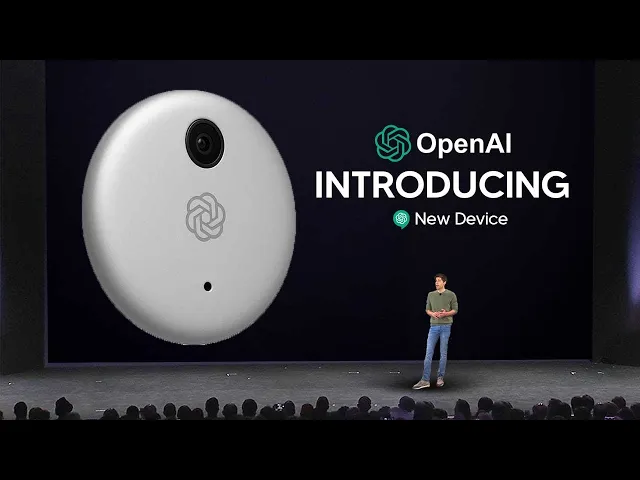
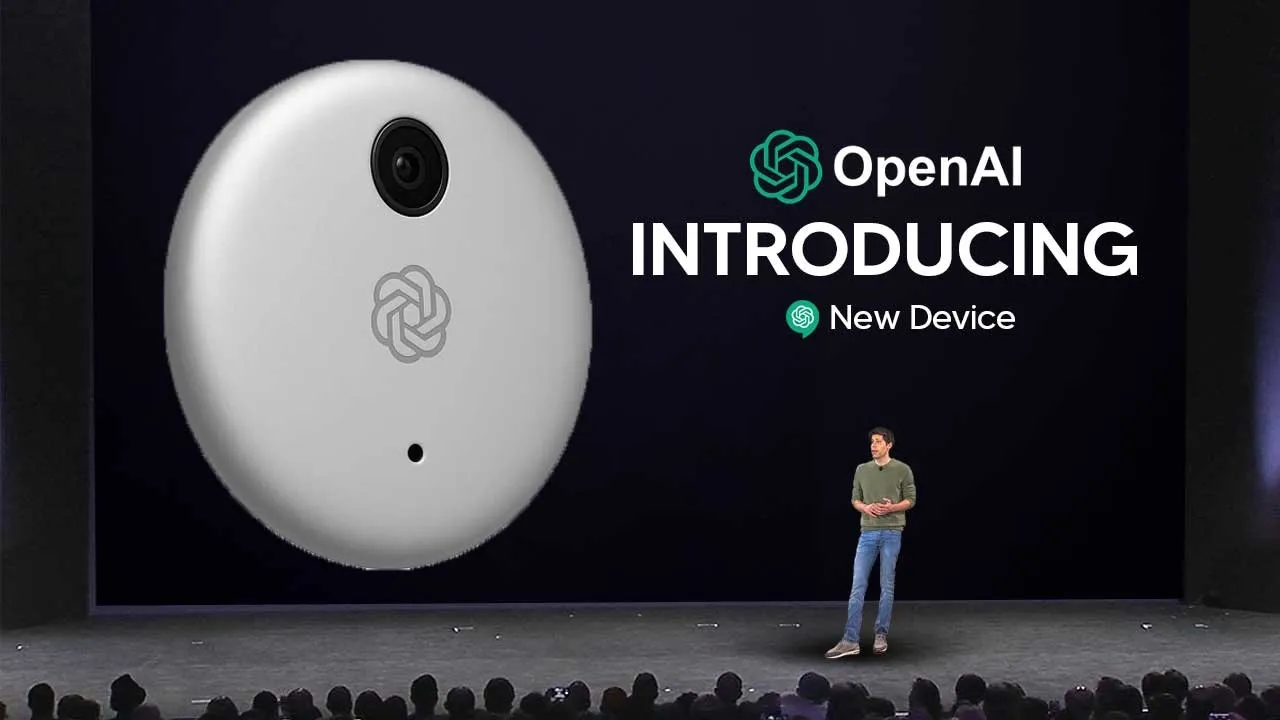
OpenAI dropped what might just be the biggest bombshell in consumer technology since the iPhone itself. We are talking guys about a $6. 5 billion acquisition of Joanie IV startup and plans for a completely screenfree AI device and ambitions to ship $100 million units right out of the gate.
Now, this actually caught my attention on Twitter because this wasn't just another, you know, tech gadget announcement. This could actually fundamentally change how we interact with AI in our daily lives. The collaboration between Sam Alman and the legendary designer behind the iPhone, the iPad, every single iconic Apple eye product you've ever loved, represents a seismic shift towards what they're calling AI native devices.
But here's where things get interesting. This device won't have a screen and it's not wearable like glasses. It's actually designed to make us use our phone less, not more.
So, let me start by walking you through exactly how this even came to be. Because when I was, you know, reading through some of the numbers, I had to actually doublech checkck these figures. OpenAI made their largest acquisition ever by buying Joanie Ives hardware startup called IO for a staggering 6.
5 billion in an all stock deal. Now, this isn't just about money, though. This is about bringing together two of the most influential minds in technology today.
Now, what blew my mind about this entire story is that two years ago, Sam Alman and Joanie IV started having conversations about what the future of AI and computers would look like. And at the time, Sam Alman was running OpenAI and pushing the boundaries of what AI could do. While I've had actually just left Apple and started his own design firm, Love from, which people are calling the densest collection of talent that ever existed in the world.
Now, I came across this article that also mentioned how their collaboration built upon friendship, curiosity, and shared values, quickly grew in ambition. But here's where things get super interesting. They quickly realized that to make their vision happen, they needed something completely new.
And it wasn't just software, it wasn't just design, but an entirely new company. So, exactly one year ago, I've founded IO with some absolutely legendary former Apple employees. Scott Cannon, Evans Hanky, Tang Tan, and if those names don't ring a bell, these are the people who designed some of the most iconic products in tech history.
Now, what really caught my attention was how I've described this project. During a recent call with OpenAI staff, he called it a new design movement and said that working with Samman has been profound for him. Coming from someone who worked closely with Steve Jobs until 2011 and designed everything from the iPod to the iPhone to the iPad, that's actually saying something massive.
And now, let's get into the juicy details about what this device actually is. Because I was honestly surprised by how they're tackling new AI devices. According to some leaked information from an internal OpenAI staff meeting, this thing is going to be completely screenfree, pocket-sized, and contextually aware of everything around you.
Sam Alman described it to his team as an AI companion that will be aware of its surroundings and can either fit in your pocket or sit on your desk. Now, here's what really got people on social media wondering what this is. Sam Alman told his staff that this device is designed to be a third core device alongside your MacBook Pro and iPhone.
Think about that for a second. We are talking about creating an entirely new category of essential technology that sits right next to two of the most important computing devices nearly everyone owns. Now, I was also surprised to find out what this device specifically won't be.
During the meeting, Alman made it crystal clear that this is not a smartphone replacement. It's not a pair of glasses, and it's definitely not going to be a wearable. Apparently, IV wasn't interested in creating something that people would have to wear, especially after the recent criticism of devices like the Humane AI pin.
The goal here is absolutely fascinating when you think about it. Both Alman and IV want to wean users from screens and create smoother interactions without having to reach for your phone or open your laptop every time you want to interact with AI. I've even said in their announcement video that the tools we are currently using to connect us to the incredible technology are outdated.
The products that we're using to deliver and connect us to unimaginable technology, they're decades old. Yeah. And so it's just common sense to at least think surely there's something beyond these legacy products.
The ambitious product timeline and market goals. Now, here's where things get absolutely wild. Sam Alman is not just thinking small here.
He's targeting shipping 100 million of these devices, faster than any company has delivered 100 million of something before. To put that into perspective, it took the iPhone about two and a half years to hit 100 million units sold. And Samman is essentially saying they want to break every record in consumer electronics history.
Now, the timeline they're working with is pretty aggressive, too. Mass production is expected to start in 2027 with the device potentially launching by late 2026. That gives them about 2 years to go from concept to shipping millions of units worldwide.
And I came across this quote from Sam Alman during the staff meeting where he told OpenAI employees that this project represents the chance to do the biggest thing we've ever done as a company. Now, what also really caught my attention was how seriously they're taking the secrecy around this project. Information about the device has been kept extremely confidential because they're actually worried competitors might try to copy it before its public release.
That level of paranoia usually means that they think they're sitting on something truly revolutionary. So, since we've actually taken a look at what the AI device could be, why don't we take a look at the AI device market right now? So, we really need to understand the mountain that they have to climb.
We need to look at what's already out there in the AI device market. And let me tell you guys, if you've been here for a while, you'll know that it's been a bit of a roller coaster. There's been a lot of hype.
There's been a lot of money spent, but there's not been a lot of runaway success just yet. So, we're going to start with the face plants. And these are gadgets that got a lot of attention, a lot of buzz as well, and then they just kind of fell off a cliff.
So, the first one that everyone can remember is the humane pin. And oh boy, I remember the humane pin. I was surprised to find out just how quickly this one went from hero to zero.
People were so excited about this little pin you wear on your clothes with its laser display on your hand. It was supposed to be the future, a screenfree way to interact with the eye. But the reality was that it was being returned faster than it was being sold.
Users complained it was overheating like crazy. The connectivity was really spotty, which is of course a big problem for an AI device that needs the internet. And it came with a hefty $699 price tag plus a monthly subscription.
And as Technica had some brutal reviews and so did Marcus Brownley. You can see that Marcus Brownley, one of the most influential tech reviewers, said that this is the worst tech product he's ever reviewed. And he literally said that the Humane AI pin is so bad almost no one should buy it.
That's great. And I think number one on top of all of this is if you ask me like who should buy this device right now? I mean, nobody should buy this device right now.
But then speaking of battery life, really bad a and inconsistent, which is annoying. So, it's already kind of bad enough that you have another device that you also have to charge every single day. But with this, it's actually more than that.
You have to constantly babysit the battery and swap out boosters and charge this thing and keep it charged multiple times per day. So, like I said before, you get two of these things that come with it. And I've had a pin nuke through the entire booster battery in 2 hours.
Now, if you also looked on Reddit, some users were not happy, and it got so bad that the company had to shut down its hardware efforts and offload all of those assets to HP. That is a pretty dramatic flame out. And it really shows just how hard it is to get this stuff right, which means that if OpenAI doesn't, things could go downhill pretty fast.
And then there was the Rabbit R1. Now, this one was a little bit different because there was a lot of optimism around this product. It was this cute, bright orange pocket-siz device, and it definitely proved the hype for a Pocket AI companion is real.
Now, their first batch sold out in hours. People were clearly hungry for something new, but when the reviews started coming in, people couldn't really understand what the product was. The Verge called its software barely reviewable and said it felt halfbaked.
TechCrunch and others pointed out a lot of what it did or tried to do could probably just be an app on your phone. And it wasn't quite the revolutionary experience that people were hoping for from a dedicated device. So, there was actually a lot of initial excitement, but the follow-through just wasn't quite there.
And it shows that having an AI just isn't enough. The experience has to actually be amazing. And I know this isn't an AI device, but we have to understand that Apple has made a recent blunder.
Everyone is actually starting to talk about the Apple Vision Pro. And on paper, if you've seen the demos, the technology in the Vision Pro is absolutely mind-blowing. The display quality is apparently insane, like nothing else out there.
And Joanie IV of course wasn't directly involved in this one as he'd already left Apple at this time. But you can see Apple's design DNA in it. But the big big butt from this one was that the hefty price tag was $35,000.
That's insane. And that made it a toy for developers and super rich tech enthusiasts. Not really something your average person could afford.
and Wired and other critics even called it one of 2024's biggest hardware flops in terms of actual sales and mainstream impact despite how cool the tech is. Now, Apple basically says that it's the start of a new computing platform and they're probably right in the long run, but it shows that even the best tech needs the right price and the right use case to really take off. Now, I've already spoken about the several failures that are currently in the mix, but those are just bumps in the road.
It just sounds like this is just set to fail, like OpenAI are never going to get this products right. But it's not all bad news. While some of these big flashy AI gadgets have struggled, there have actually been some quieter wins happening.
These are often cases where AI is being added to things we already use, making them better rather than trying to reinvent the wheel completely. So, one of the key examples of this is the Meta Ray-B band smart glasses. I came across this article also on the verge talking about how these things are getting pretty good.
Now, these things have been around for a little while now, but they have the meta AI builtin and it's multimodal, meaning it can understand both what you say and what it sees through the camera on the glasses. So, you can ask it questions about what you're looking at compared to something like the Vision Pro. And they're way cheaper.
And a big plus is that they actually look like normal fashionable sunglasses. The tech is completely hidden. And of course, Facebook or Meta, I should say, is pushing these quite hard.
And it seems to be a much smoother way to get AI into people's lives. It's not this big new scary thing. It's just your glasses, but smarter.
Now, it wasn't just Meta who made AI glasses. If you remember recently, we had Google reveal a bunch of new tech at Google's IO conference. And one of the things they showed us was their new update to their Android XR platform, which is these really cool glasses that are probably going to be competing with Metas in the near future.
And I've actually used Meta's glasses before, and I can honestly say it's the kind of technology that just works and I can definitely see doing well in the future. Now, here's where we get into some strange AI devices. Because whilst yes, there are some screenless devices coming in the future from OpenAI, there is a strange whole world of AIP PCs or what they're calling Copilot Plus PCs.
You may have actually seen some of these ads from Dell and some of these big computer brands. But what really caught my attention was a statistic from Ghana, a big tech company. And they think, okay, and this is crazy because I'm not sure if I agree with this, but that nearly half of all PCs shipped next year will have these special chips inside called NPUs.
Now, these MPUs are designed to specifically run AI tasks right there on your laptop without always needing to connect to the internet. And now, Techraar and a site called AI Advantage for Business and a full of articles about this. Apparently, it's going to be a huge shift, which means that AI is becoming a standard feature in computers, basically like Wi-Fi or a webcam.
Now, it's making AI tools like Microsoft's Copilot faster and more private because if your data wasn't always going up to the cloud, that's a massive win for quiet AI integration. So, I want to show you guys just exactly why this kind of thing matters. Because when we do a quick checkpoint back to this idea of the OpenAI device, we sort of realize a pattern here.
success or at least more positive movement seems to flow to devices that feel more normal. Glasses that look like glasses and laptops that are basically just better laptops. The big failures actually tend to happen when the hardware overpromises with some radical new form factor but then just underdelivers on basic everyday usefulness or it's just too clunky or it's just too expensive.
And Joanie Ives's mission and open AIS has to be hitting that sweet spot of being genuinely useful and delightful to use right from day one. It can't just be a cool tech demo. It needs to solve real problems for real people without being that much of a hassle.
So what is the 5-year outlook for this product? Well, we've already seen the grand plan from OpenAI and Joanie IV, and we've looked at the messy, complicated world of AI gadgets today. Now, let's try and gaze into the crystal ball a little bit.
What could the AI device landscape look in, let's say, the next 5 years? And that's where things get really exciting, I personally think. First off, the idea is going to be AI first, screen optional.
So, let's actually think about that. We're already seeing it with those AI PCs. And I mentioned that Gartner statistic earlier where analysts see a 43% AI market share by next year.
And that's incredibly fast. And other firms are seeing some similar trends, too. All of these MPUs are probably going to be inside laptops, which means that people are going to get used to having a co-pilot level AI magic available instantly, even when they're offline, which means that this is now going to become an expectation.
But the next jump beyond our laptops and our phones is that a lot of people are talking about this new trend, which is called ambient AI, which is kind of like what Openai and Jon IV might be building. Imagine tiny AI helpers scattered around your home, in your car, in your pocket, maybe even your clothes or jewelry. They wouldn't be full-blown computers, but dedicated nodes or devices, each running a trimmed down special AI model locally.
They'd all work together, maybe talking to a more powerful AI in the cloud when needed, basically to make your life easier in the background. And it's less about, you know, you actively using a device and more about intelligence just being around you, just there helping you out. And this OpenAI device is one of those steps in that entire direction.
Now, to make this dream a reality, you actually need a smart approach to how the AI actually works. This brings us to the Edge Plus cloud hybrid model. We actually spoke about this earlier.
Your local device, whether it's a tiny pendant or smart glasses, it needs to be able to do a lot of thinking on its own. And that's the edge part. I was also surprised to find out just how powerful these chips are getting.
Qualcomm has the new chip called the Snapdragon XLite that can do over 40 tops. And top stands for trillions of operations per second. It's basically a measure of AI processing power.
Intel's new Luna Lake NPUs are claiming to do 48 tops, which is tons of horsepower. And that means with all of these things being developed, we can get instant responses for many common tasks. And of course, for the complex questions, the device would whisper to a giant model like GPT5 in the cloud.
And this hybrid approach would give you the speed for everyday things and super intelligence whenever you would need it. And that's basically what OpenAI and IV are aiming for. Now, next up, some things are hugely important that I know most people won't even want to talk about.
This is privacy and regulation. And this is a big one because it's only going to get bigger. People are rightly getting more concerned about what happens to their data, especially when AI is involved.
The European Union has already passed its AI act which has a lot of rules about how AI can be developed and used. The United States is already looking at its own rules too. And what this means is that for AI gadgets having strong ondevice processing that edge computing we just talked about.
It isn't just some fancy feature. It's actually probably going to become a very legal and competitive advantage. It's kind of like building a moat around your users's privacy.
products that have to send every single voice command or every bit of information to the cloud for processing is like the early versions you know of rabbit and the humane pin which is what they seem to do they're going to face a lot more scrutiny from regulators and from users so expect new devices especially from names like openai and any other company to emphasize that ondevice AI for privacy now of course there is going to be the fun part the design wars as AI gets embedded into more and more things We're going to see a real convergence of what we think of as jewelry, clothing, and gadgets become devices. If opening eyes ends up being something like a pendant or a small pin or even something woven into fabric, you can bet other companies are going to follow suit. And Apple is a master at this.
They could counter with updated AirPods that are much smarter, maybe with more sensors and direct to GPT style AI. But what about the rumored Apple ring? a small discrete ring that could be your AI interface.
You know, the goal could be to make these AI interaction points so seamless and so stylish that you barely notice you're wearing a piece of advanced technology. It will basically be less about a tech look and more about a personal style that just happens to be intelligent. Jon IV is obviously a key player here.
His designs always aimed at that blend of high-tech and anti fashion. And finally, how will these companies make money? Now, this is where we need to get ready for a big business model shift.
Subscription is already king in software, and it's going to be huge for AI hardware, too. Think about it. The Humane AI pin, for all its faults, charged $24 a month on top of the device cost, and the Rabbit R1 initially offered a free trial for its services and then was expected to move to a premium tier.
OpenAI already has its chatbt plus subscription. So it's very likely that new hardware including whatever Joan Eye of Designs might come with a certain amount of AI usage bundled in. Maybe a number of token or queries per month.
And then they'll probably try to upsell you to Pro Tiers for more power, more features, or maybe even unlimited access. The device itself might even be sold at a lower profit margin or even at a loss to get you into their entire subscription ecosystem. Now, that's a model that's worked for game consoles for years.
So, if we do another checkpoint on what the future outlook for AI devices is, we know that there are three things you need. Number one is the local speed. They need to be fast for common tasks, running AI on device for itself.
They of course need clouds scale IQ. They need to be able to tap into the massive intelligence of cloud-based AI for the complex tasks. And they need fashion grade wearability.
They need to look good, feel good, and fit into people's lives without being awkward or intrusive. And when you think about it, these three pillars align perfectly with what Sam Alman brings from OpenAI. The model knowhow, the cloud infrastructure, and then Jooni Iive brings his design, the aesthetic, the skills, the focus on user experience.
And it's like they've identified the target, and now they're building the arrow. Now, I do think that OpenAI and IV could rewrite the entire playbook. You know, we've covered a lot of ground in this video, but why could this partnership be one that actually rewrites the playbook for AI devices?
We of course need to talk about the lessons from the flops. We've already talked about the Humane Pin and the Rabbit R1. And apparently, Joanie IV has already pointed out those products for all their ambitions and really proved that you can't just slap a GPT like interface onto a cool looking badge on a quirky box and call it a day.
You need world-class user experience. It has to be intuitive, reliable, genuinely useful, and you need a rock solid infrastructure behind it. So, the fact that I've publicly called out these early attempts is pretty significant because it means the expectations for whatever he and OpenAI are going to build are going to be sky-high.
They basically told the world, look, we already know what bad looks like, and we're going to deliver something truly good. That's a lot of pressure, but it shows that they're aware of the pitfalls that they might fall into. So, what unique advantages does OpenAI bring to the table that other companies might not have?
Well, one of them is super clear. They have model supremacy. Now, let's be honest.
Open EI's models like GT40 and whatever they're cooking up next are widely considered the best inclass. The brain inside the device is already going to be smarter and more capable than most, if not all, competitors right out of the gate. That's a massive head start.
They've also got the data mode. OpenAI has a massive incredible amount of data. They they've said that over a billion queries are processed by the systems weekly.
Every single one of those interactions help to fine-tune and improve their AI models. And this basically creates a feedback loop that makes the AI better and better. And it's very hard for newcomers to catch up to that scale of data.
Now, there's also the API ecosystem. OpenAI already has a thriving ecosystem of developers who use their APIs to build AI features into their own apps and services. And this is a big one.
It means that when the new device launches, there's a potential army of developers who could quickly create new skills, new integrations, and apps for it. And this was a major weakness for devices like the Rabbit R1, which had very limited third party integrations at launch. OpenAI could open the doors on day one.
And let's have a little dream about potential killer features. What could this device do that would make people say, "Wow, I actually need that. " So, imagine you've got like a, you know, a multimodal grocery assistant.
You point at the device and your fridge, and it sees what's inside, and instantly it generates a meal plan for the week, plus a shopping list for what you're missing. That would be pretty cool, right? Or how about real-time personal memory?
If you're in a meeting, you bump into someone, and you just can't remember their name or that key detail from your last conversation. the device that you've been discreetly listening with, of course, with your permission. The device that you have could quickly remind you or without you needing to pull out your phone in a really awkward moment.
Now, of course, there could be this seamless transition. Imagine traveling and having conversations in a foreign language as if there's no language barrier at all or without fumbling with an app and definitely without those crazy roaming fees for all of the data. So, of course, these are just like crazy ideas, but it does show that there is a lot of potential in an AI assistant that's able to solve these real world annoyances.
Now, of course, it's not all guaranteed success. There are definitely some risks and unknowns. We have the battery life and heat, which is still the Achilles heel of many small powerful devices.
If they try to pack too much processing power into a tiny form factor, and can they keep it running all day without it becoming a pocket warmer? That's going to be a huge engineering challenge. of the things that I saw as a consistent issue when watching Marcus Brownley's review was that the thing was a literal hot device on his shirt all day and just felt rather uncomfortable.
And it's also just like constantly warm the whole time, just all the time, which is a little bit concerning. I'll also say multiple times in various situations, I've had it just overheat for seemingly no reason and tell me to wait a while for it to cool down. I think the heat problem is also amplified because of the gap created by whatever fabric is between the booster and the product that it is actively inductively charging.
You know, it is a lot of very impressive engineering, but wireless charging is notoriously inefficient and loses energy via heat and that's what's happening in here all the time. So, just the fact that it's warm, just this warm puck on my chest all day was just enough to never quite forget that I'm wearing it. And pricing is going to be another major hurdle.
We already saw that the Apple Vision Pro is struggling because of its $3,500 price tag. And if this OpenAI device costs as much as that, and let's say for example, it costs like what, $400, $500, it actually risks falling into the cool but why do I really need it category for most people? It needs to be accessible to the everyday user.
And of course, privacy alarms. We spoke about my previous idea, but what about a device that is always potentially listening? Even if it is to be helpful, it's going to raise a lot of red flags for a lot of people.
OpenAI and IV will need to be incredibly transparent and give users ironclad control over their data and the device it senses. If they mess this up, they could kill the product before it even gets going. Now, of course, remember how they spoke about that this could be some pivoting moment?
I really do think that that is not an exaggeration. When we think about the market timing of this, thanks to Chat GPT and other AI tools, consumers are finally getting comfortable with talking to AI. It's actually not weird anymore.
And at the same time, a lot of people are experiencing what you might call phone fatigue. We are glued to these glass slabs. Many people are looking for a less intrusive way to stay connected and get information.
And the timing might just be perfect for a new kind of interface. I don't know about you guys, but I do catch myself doom scrolling every now and again and have to slap myself on the wrist because I've wasted a bit of time. Now, there's also the design story arc.
Think about this guy's career. This guy is one of the last truly massive hits for Apple and the iPhone. This was an entire paradigm that replaced the old one.
Could this be his next big creation? This device with open eye that, you know, demotes the smartphone to being the center of our digital lives as more of like a legacy device. It's kind of a bold thought, but that could potentially happen.
Now, think about it like this as well. Most people don't realize that if Open AI and IV manage to land this device, companies are going to freak out. This is going to force everyone else to react and fast.
Apple would almost certainly have to accelerate its overhaul of Siri and probably release its own competing hardware much quicker. And we know that Apple are, you know, notoriously slow due to their perfectionism. And of course, Google, which is already working on things like Project Astro, which is their vision for a future AI assistant, would have to push its hardware plans into Overdrive.
And then, of course, you've got Meta. They would have to double down even harder on their smart glasses and wearables. This could, you know, just like the AI race, set off an entirely new race.
So, you know, when I was, you know, digging into all of this, I was surprised to find out just how incredibly fast the AI scene is maturing. the Gartner forecast we talked about with 40% of AI PCs being powered next year that stat blew my mind and all of the various things when we look at you know the devices that have failed and after looking at all of these pieces the secret meetings the design philosophy the market stumbles the quiet winds the real headline here seems to be pretty simple openai plus jive could genuinely be the partnership that finally delivers the first AI gadget that actually sticks one that doesn't feel like a gimmick or tech demo but something essential something that seamlessly blends into our lives and makes them so much better.