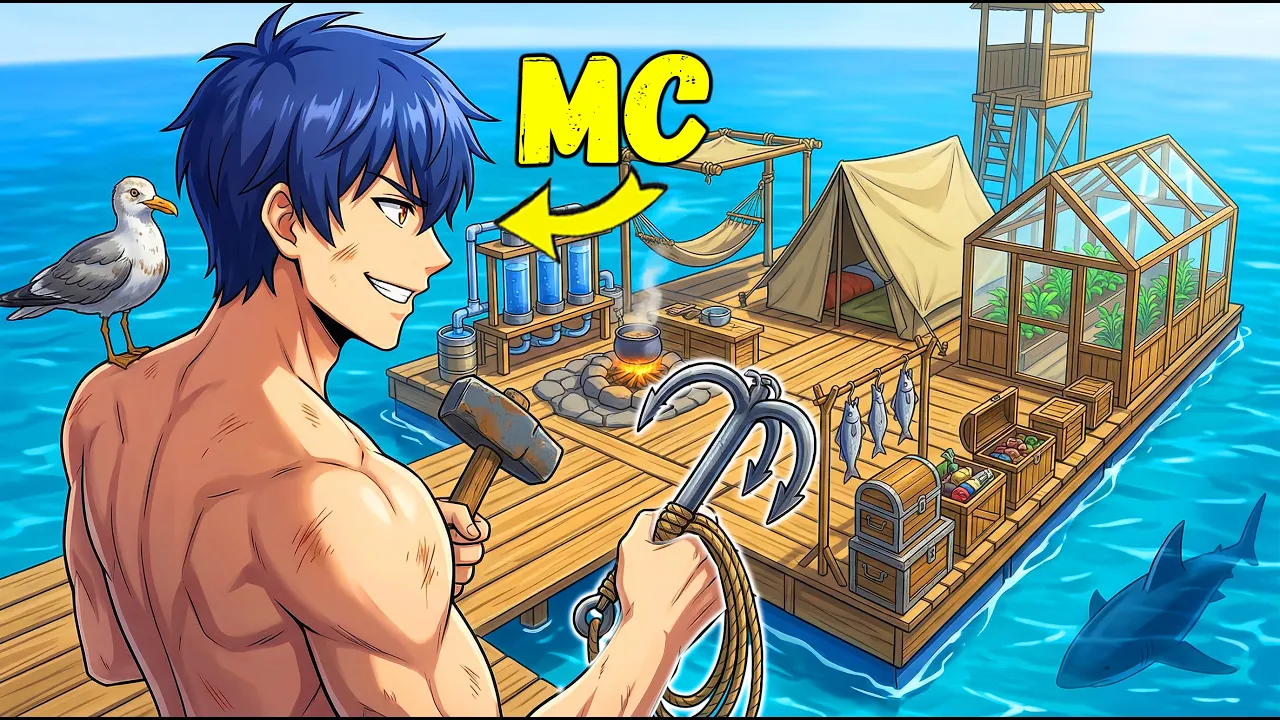
My name is Hiroto. Two days ago, a truck killed me on a Tokyo crosswalk. Now I'm dying again, slower this time on a 4x4 wooden raft in the middle of an ocean that doesn't exist on any map I know. The system screen still hovers in front of me, pale blue against the morning sky. Use the hook and hammer to gather materials and craft. I read it for the 10th time. My tongue is so dry, it feels like a piece of leather glued to the Roof of my mouth. My lips have split in three places and
the cracks taste like copper. But now I see what I didn't see yesterday. The ocean around me isn't empty. It's a graveyard of garbage. Old planks drifting past in lazy circles. A wooden barrel bobbing 20 m out, pieces of rope, scraps of canvas, a broken crate, a plastic buoy yellow with age. The sea has gathered all of it around me like an offering or a test. I grab the hook. The rope is rough in my hands, my Palms already raw from yesterday's panic. I pick the closest target, a long plank floating maybe 5 m away.
First throw, short. The hook splashes into water and I drag it back, heart hammering. Second throw. Better arc. The hook clips the edge of the plank and slides off. The plank turns lazily and drifts further away. I curse out loud. My voice is a croak. Calm down, Hiroto. You used to be good at fishing games at the arcade. Same Principle. Aim past the target. Let it sink in. Third throw. The hook arcs over the plank, drops and I pull. The metal bites into the wood. I haul it in hand over hand, the plank scraping against
the side of the raft. Plus one plank. I let myself feel 1 second of victory, then I scan again. The barrel is next. It's heavier. I can tell from the way it sits in the water. Three throws to land the hook properly into one of its iron rings. Pulling it in nearly tips me Forward. I brace my feet against the raft's edge and lean back, dragging it centimeter by centimeter until it bumps against the planks. The barrel is empty. Of course it's empty. For a second I want to scream, then I remember. It's not the
contents that matter. It's the barrel itself. I take the hammer. The wood is old and rotted in places. I split the first stave with one hit. The next ones come apart easier. Plus six Planks, plus four iron rings, a scatter of rusted nails I sweep into a pile with my hand. The system screen flickers. A new line of text glows into existence. Recipe unlocked. Solar desalinator. Requires one container, one fabric, transparent or thin. One secondary container, sunlight. I stare at the words. Solar desalinator. A piece of memory drifts up from middle school science class. Mr.
Tanaka, the physics teacher, in front of a poster of the Water cycle. Sun heats salt water. Water evaporates, leaves the salt behind. Vapor cools, becomes droplets. Droplets are pure water. He'd shown us a picture of survivors using a piece of plastic over a hole in the desert. The same principle works on a raft. I know what to do. But I need fabric. Thin fabric. Something the sun can warm through. I throw the hook again. Three throws to drag in a tangled scrap of old sail, gray, sun bleached, but Intact. Two more throws and I've got
the broken plastic crate I saw earlier. The yellow plastic is cracked along one side, but the bottom still holds. Now I have everything. I work fast. My hands are shaking, partly from dehydration, partly from focus. I split one of the barrel staves down the middle to make a half bowl shape. I scoop seawater into it with my hands until it's half full. The water sloshes, brown, green and stinking of salt. Above The bowl I build a frame from two planks, leaning toward each other like a tent. I drape the canvas over them, pulled tight, sloping
down to one edge. Under that edge I wedge the plastic crate. The principal sun hits the canvas, heats the salt water below. The water evaporates upward, hits the underside of the cloth, condenses into droplets. The droplets slide down the slope of the canvas and drip, drop by drop, into the Plastic crate. I check it three times. The cloth is taut. The slope is steep enough. The crate is positioned right. Then I look up. The sun is brutal. It's the same sun that's been killing me for 2 days. Now it has a job, but it's also
still killing me. I can feel my shoulders blistering even now, the back of my neck on fire. If I sit here in the open while the desalinator works, I'll be Unconscious before the first drop falls. I drag myself to the other side of the raft. There's a second scrap of canvas I pulled in earlier, too small for the desalinator, but big enough for me. I wedge it between the mast stub and a rising plank, making a low ragged piece of shade. I crawl underneath it and lie flat on the wood. The boards are hot against
my back, but the canvas blocks the direct sun and That alone feels like mercy. I lie there and watch my desalinator work for me. Time passes strange. I drift in and out. The sun crawls. My mouth is so dry I can't swallow anymore. At one point I think I see my mother across the raft and I almost call out before I remember she's still alive in a world I'll never see again. After what feels like hours, maybe four, maybe five, I crawl out from my shade and Check the crate. Water. Real water. Clear, clean water.
Maybe 150 ml pooled in the bottom of the cracked plastic. It looks like the most beautiful thing I've ever seen. I lift the crate carefully, hands trembling so badly I almost spill it. I tilt it to my mouth. The first sip is cool, slightly warm from the heat, but pure. No salt, no bitter aftertaste, just water. The way water is supposed to taste when you've forgotten what water tastes like. I Drink it all in three swallows. I want to cry, but I don't have the moisture for tears. The system pings. Achievement, first drop. Plus five
survival points. I don't even know what survival points do. I don't care. I refill the bowl with seawater immediately, reset the canvas, reposition the crate. The sun has hours of work left in it. By the time the sun starts dropping toward the horizon, the crate has another 200 ml in it. I drink Half. I save half. I find a small wooden cup from one of the broken bottles in my mess of materials and pour the water into it carefully. Set it under the shade. 350 ml for the day. Not enough to live well, enough to
live. I sit at the edge of the raft as the sun goes down. For the first time in 2 days my head is clear. My hands have stopped shaking. The cracks in my lips still hurt, but they don't bleed anymore. I do the math In my head. Materials, six planks left over. Four iron rings. 15 rusted nails. One working desalinator producing maybe 350 ml a day. Food, zero. Health, critical but stable. It's not much. Two days ago it was nothing. Two days ago I was a corpse on a Tokyo street. Now I'm a man with
a roof of canvas and a bowl of water and a hammer. I'll take it. Then I see something move in the water under the raft. I freeze. My hand finds the hammer without my thinking about it. A shape, small, maybe the length of my forearm, silver. It darts between the planks underneath me and disappears. A fish. I almost laugh. My next problem just announced itself and it's a problem I can eat. Then I see the second shape, behind the fish, bigger, much bigger, long and gray and moving slow, the way something moves when it isn't
worried about being seen. It glides under the raft and keeps going, vanishing into the dark blue. It was at least 2 m long. I Sit very still with the hammer in my hand and I don't move for a long time after it's gone. I didn't sleep that night. Every time I closed my eyes, I saw the gray shape sliding under the raft, slow, patient, big. I lay on my back with the hammer on my chest and watch the stars. Wrong stars, foreign constellations I couldn't name until the eastern sky started turning pale. When the sun
came up, I checked the desalinator first. 200 ml Waiting in the crate from the night's slow condensation. I drank half, saved the rest, refilled the bowl with seawater and reset the canvas. Then my stomach reminded me it had been 3 days. Not a hunger pang, a real deep animal demand. The kind that makes your hands shake and your vision narrow. Water keeps you alive, but it doesn't feed you. I needed calories right now. I opened the system screen. Recipe unlocked. Primitive fishing rod requires One long pole, one length of rope, one hook. Bait. I almost
laughed. Bait, of course. The system tells you what you need, but not where to get it. Pole, that I could solve. I dragged one of the longer planks toward me and started working on it with the hammer, splitting off the rough edges. Not pretty, not straight, but about a meter and a half long and light enough to swing. Rope, also solvable. Yesterday I dragged in a length of rotted hemp rope. Most of it was useless, falling apart in my hands like wet paper, but the inner strands were still strong. I sat cross-legged and unwound the
rope carefully, separating the good fibers from the dead ones. After 20 minutes of patient work, I had maybe 2 m of usable line, thin but tough. Hook. That was the problem. I picked up one of the four iron rings from the broken barrel. Heavy, curved already in a way, but a full circle, not A hook. I needed to bend a piece of it into shape, sharpen one end, leave a small barb if I could manage it. I had no forge, no fire, no anvil, just a hammer and a wooden raft. Think, Hiroto. Same principle as
the desalinator. Use what you have. I laid the iron ring across the corner of the raft where two heavy planks met, the hardest, flattest surface I had. I held the ring down with my left hand. With my right I brought the hammer down on one section of it, Hard. The ring rang. The plank under it shuddered. I hit it again, again, again. After about 30 strikes, the iron started to deform. Not much. A slight flattening on one side. I kept hitting the same spot. My shoulder started to burn. Sweat ran into my eyes and I
blinked it away. After what felt like an hour, I'd managed to break the ring open at one Point, turning the closed circle into a curved C-shape. Now I had something I could shape. I worked the open ends, hammered one straight. Heat did nothing, just brute force and repetition. The other end I left curved, hammering it slowly into a sharper hook shape. To put a point on it, I dragged the metal back and forth across one of the rusted nails I'd salvaged, like a knife across a sharpening stone. It took forever. My fingers cramped. The metal
squeaked against the nail. But after maybe 2 hours of work, I had something that could be called a hook. Crude, lopsided. The point was duller than I wanted, but the shape was right, curved enough to hold a fish, sharp enough to pierce skin. I tied the rope to the straight end with a knot I half remembered from a fishing trip with my uncle when I was 12. Tied The other end to the pole. Now I needed bait. I sat at the edge of the raft and looked into the water. Small silver shapes flickered between the
planks underneath me. The same kind of fish I'd seen yesterday. They were curious about the shadow of my raft, about the cool darkness it offered in the bright morning sun. There were maybe a dozen of them, maybe more. But fish don't bite a bare hook. They Need something on it, something that smells like food. I had no food. I tried the obvious thing first. I tore a strip of fabric from my shorts, small, just a thumb-sized piece, and tied it to the hook. Lowered it into the water. Nothing. The fish swam past it, completely uninterested.
One of them bumped against it once and turned away. I pulled the line back up. Sat there thinking, "What does a fish want? Movement? Smell? Blood? Blood." I looked at my hands. They were already a mess from yesterday, raw from the rope, scraped from the wood. I picked at a small scab on my knuckle and pulled it open. A bead of red welled up. I smeared it onto the hook. Lowered the line back in. The change was instant. Three of the silver fish started toward the hook within seconds. I felt the line jerk, a Tiny
pull, almost not there. Then a sharper one. I yanked the pole A fish came flying out of the water, twisting in the air, the hook through its lip. About the size of my hand. Maybe 200 g. It landed on the deck and started thrashing. I stared at it. For a second, I just stared. The fish flopped against the planks, its silver scales catching the sun, its small eye looking at nothing. Then I dropped to my knees and grabbed it before it could flop back into the water. It was slippery, slippery in a way I wasn't
ready for, and it almost squirted out of my hands twice before I got a real grip on it. I pinned it against the deck and brought the hammer down on its head. It went still. Plus one fish, plus 200 g raw protein. I sat back on my heels, breathing hard. Three days of starvation and I'd just Caught a fish with a piece of bent iron and a drop of my own blood. I worked the hook out of its mouth carefully, because I needed the hook intact for the next one, and reset the line. This time
I used the fish's own intestine as bait. I'd read once that fish guts were better than almost anything else. I slit the belly open with the sharp edge of a broken nail, scraped out a small piece of gut, threaded it onto the hook. Lowered the line back in. Hit within 30 seconds. By mid-morning, I had four fish on the deck. By noon, I had six. I stopped because my hands were cramping and because six fish was more than I could eat in one sitting, and I had no way to preserve them. They'd start rotting in
this heat within hours. I ate the first one raw. There's no good way to describe this. I'm not going to pretend it was anything But disgusting. The flesh was cold and slimy, and the small bones got stuck in my teeth, and the smell made me want to gag. But the calories were real. After the first bite, I forced myself to chew slowly, methodically, swallowing the meat in small pieces. By the time I finished the first fish, I could feel something I hadn't felt in 3 days, a base of warmth in my stomach. A small core
of energy returning to my arms. I Ate a second fish, then I stopped, because I could feel my body wanting to reject any more. And because I'd learned in survival videos a long time ago that a starving person who eats too much too fast can actually kill themselves. I sat with my back against the broken mast stub and let the food settle. For the first time since I'd opened my eyes on this raft, I felt like a living thing instead of a dying one. I went back to fishing in the early afternoon. I wanted at
least two more for the rest of the day, and I wanted to figure out how long the gut bait would keep working before I needed fresh. I lowered the line, waited. A bite. Sharp, harder than the others. I yanked up and the rod almost ripped out of my hands. Whatever was on the other end was big. The pole bent dangerously. The line was So tight I could hear it humming. I braced my feet against the raft's edge and pulled, and for 1 second I thought I had something amazing, a really big fish, maybe a meal
for 2 days. Then I saw the gray shape rising up from below. It came up fast, faster than anything that big should move, a long, I gathered the four fish and put them in the center of the raft, in the small patch of shade under my canvas. I rinsed my hands in seawater carefully, making sure not to lean over the edge any further than I had to. I checked the desalinator. Another 100 ml waiting. I drank it. Then I picked up the hammer and the hook and started looking at the water for the next piece
of garbage to drag in. The sun was halfway down the sky. I had hours of daylight left. And the small thing in my chest that had been despair for 2 days had turned into Something else, something harder, more useful. I was going to build a fortress on this raft, plank by plank, whatever it took. Because the alternative was waiting for the moment I lost my balance. The next 4 days became a routine. I woke at sunrise, checked the desalinator, drank what had collected overnight, reset the bowl, reset the canvas, caught fish in the morning before
the sun got too high. Through the hook in every direction I Could reach, dragging in whatever the ocean had pushed close to me during the night. By midday, I was breaking down whatever I'd salvaged with the hammer. By afternoon, I was crafting. By evening, I was too tired to think. I made a new fishing rod on day four, better than the first one. Thicker pole, doubled rope, a safety line tying the rod to a peg I'd hammered into the raft. So even if a shark hit again, I wouldn't lose the Whole setup. The shark came
back twice. Both times I let go of the pole and let the safety line do its job. Both times I lost the bait and the small fish I'd hooked, but I kept the rod. Lessons cost something, as long as you only pay them once. By the end of the fourth day, my haul was real. I counted it out on the deck like a merchant doing inventory. Two more barrels, one of them with the lid Still sealed, which I cracked open to find nothing but stale air. But the wood was good. Eight more planks of various
lengths, a coil of decent rope half rotten on the outside but solid in the middle, a torn piece of sail almost 2 m across, a plastic buoy yellow and cracked. A short length of metal grating, the kind you might see in a ship's engine room. And the prize of the week, a wooden chest sealed shut with rust and salt, Dragged in from a long throw on the third afternoon. I left the chest for last. I knew what it might mean, and I didn't want to be disappointed too fast. I worked on it with a hammer
for 20 minutes before the lid finally cracked open. Inside, wrapped in oiled cloth that had mostly held, a flint and steel striker, a rusted knife with a wooden handle, the blade pitted but still sharp, two short Candles, a coil of fishing line, real fishing line, thin and strong, a small box of nails, properly made, not the rusted scrap I'd been collecting. And at the bottom, almost hidden, a sealed glass bottle full of clear liquid. I uncapped it carefully, sniffed, fresh water, a whole bottle, maybe 700 ml of it. I sat on the deck holding the
bottle in both hands, and for a long minute, I didn't move. 700 Ml, 2 days of drinking, easy a week if I was disciplined. But the real treasure wasn't the water. It was the flint and steel. Fire was now possible. I set the bottle down carefully and turned the striker over in my hands. A piece of curved steel designed to be held in the fingers, a nub of dark flint. I'd never used one in my life. I'd only seen them in movies and on YouTube, but The principle was simple. Strike the steel against the flint
at an angle, catch the spark, feed it tinder. I could have fire tonight. But I couldn't have fire on a wooden raft. Fire on dry pine planks in the middle of an ocean would kill me faster than the shark. One spark in the wrong place, one ember rolling into a crack between boards, and the entire raft would be a torch within minutes. I'd jump into the water to escape the Flames, and the shark would have me before I'd taken three breaths. Fire needed a safe place, a place with no wood under it, a place I
could control. So before I could have fire, I needed to expand and zone the raft. I had been thinking about this for 2 days already, while I caught fish, while I dragged in materials, while I watched the shark cruise lazily under my feet at dusk. I had a plan. I just needed to start. I started the next morning. The expansion came first. I lashed two of the new heavy planks to the eastern edge of the raft, extending it outward by about a meter. Then two more planks running perpendicular, tying the whole thing into a rough
frame. Then planking across the top, boards laid tight, hammered down with the proper nails from the chest. The new section creaked when I stood on it. I didn't trust it yet, but It held my weight. I did the same on the western side. By the end of the first day of expansion, I had pushed the raft from 4 m by 4 m out to about 6 by 5. Not much, but the extra surface area was already enough to start dividing the space into zones. I spent the second day on the southern side. By evening, the
raft was approximately 8 m by 6. It looked completely different now. It looked like something somebody had built On purpose, instead of something somebody had been dropped onto. Then I started zoning. Zone A, the kitchen. I picked the corner farthest from where I slept, the southwest corner, where the prevailing wind would carry smoke away from the rest of the raft. I built up a thick base of doubled planks. Then on top of that, I laid the metal grating I'd salvaged. Below the grating, I packed in a layer of wet sand, sand I'd shaken out of
one of the Empty barrels, where it had been used as ballast. The sand was the key. It would absorb heat and protect the wood underneath from any embers that fell through the grating. On top of the grating, I built a small ring of stones, chunks of a broken ceramic crock from the chest, plus a few flat pieces of metal hammered into shape, a primitive hearth. Crude, ugly, dangerous if I wasn't careful, But functional. I tested it that evening. I took a small handful of dry shredded fabric, the inside of the rotted rope I'd been unwinding,
fluffed up into a nest of tinder. I struck the flint against the steel. The first three strikes did nothing. The fourth produced a single bright spark that died before it touched the tinder. The fifth, the sixth, the seventh, Sparks but no catch. On the eighth strike, a spark landed in the rope fluff and held. I bent down close and blew on it, gentle, the way I'd seen people do in videos. The spark crawled. Then it caught. A tiny orange flame bloomed in the rope fluff, no bigger than my thumb. I added a sliver of dry
plank, then another, then a small piece of broken barrel stave. The flame grew. Within 5 minutes, I had a real fire going on the metal grating, the smoke rising up and being pulled away by the evening wind toward the empty horizon. I cooked a fish. I gutted it with a rusted knife, skewered it on a thin sharpened stick, held it over the fire for about 4 minutes, turning it slowly, watching the white flesh go from translucent to opaque. The skin blackened on one side. Some of the meat dripped fat into the Flames, and the fat
hissed, and the smell of cooking fish hit me like a hammer to the chest. I sat down on the planks beside my fire and ate it with my hands. I'm not going to be poetic about this. It was a small fish, badly cooked, eaten with my fingers on a wooden raft in the middle of nowhere. But it was hot. It was the first hot food I'd had since dying. And the difference between raw fish and cooked fish, the difference between cold Dead meat and a meal, is the difference between an animal and a person. I
sat by the fire until it died down. And then I banked the coals carefully under a layer of sand to keep them alive for the morning. Zone B, the desalinator station. I spent half a day rebuilding the desalinator on a raised platform on the eastern edge, two of them now parallel, twice the surface area, twice the output, about 700 ml per day if the sun Was full. I built a small wooden frame to hold the collection crates so they wouldn't tip in the swell. I built a canvas roof over the whole station to keep rain,
when it eventually came, from contaminating the system, with a separate channel to direct rainwater into a third container. Every drop counts. Zone C, the sleeping area. This one I cared about. I picked the spot near the center of the raft, where the boards Were thickest and most stable. I built up a low platform, just two layers of planks above the main deck, maybe 10 cm of clearance, so I wouldn't be sleeping directly on cold wet wood. On top of the platform, I laid a stretched out piece of canvas, doubled over. It was a bed in
the same way that a stone is a chair, but it was off the deck. It was mine. It had a place. Above it, I Rigged a low canvas roof, slanted so any water would run off to the side, secured at four corners, a roof. After a week of nothing, that night I lay down on the canvas and pulled a second piece of cloth over me as a blanket, and looked up at the underside of my new shelter, and felt something I had not felt since the truck. I felt like I had a place to sleep
instead of a place to die. Zone D, the workshop. The fourth corner I made into a workspace. I dragged my pile of materials there and organized it for the first time. Planks in one stack, sorted by length, iron pieces in a small pile, nails in an empty cup from the chest, rope coiled, cloth folded. The hammer hung from a nail driven into the mast stub. The knife I kept on me at all times now, tucked into the waistband of my shorts. By the end of the third day of work, the Raft was something else entirely.
It had zones. It had purpose. It had a kitchen, a water station, a place to sleep, a place to work. It had a fire that I could rebuild every morning from the banked coals. It had a roof over my head and a meal in my stomach and a routine. That night, I sat by the dying fire with a piece of cooked fish in my hand, and looked out across my 8 by 6 m kingdom, and I thought for the first time, not How do I survive tomorrow, but how do I make tomorrow easier? It was
a small thought, but it was a different kind of thought. The thought of someone who wasn't just running from death anymore, the thought of someone building a life. I went to sleep on my canvas bed under my canvas roof. In the middle of the night, I woke up. Something had touched the raft. Not hit it, touched it. A long slow scrape along one of the side Planks, the kind of scrape something makes when it's running its body along an edge to feel for what's there. The sound was unmistakable in the silence. Long, deliberate. Then a
pause. Then again, on a different plank. The shark was checking my walls. I lay very still on my canvas bed and listened. The scrape came one more time, then nothing. The water lapped against the planks the Way it always lapped. The wind moved across the canvas above my head. The fire crackled faintly under its sand cover. I didn't sleep again that night. In the morning, when the sun was up, I went to the side of the raft where I'd heard the scraping. Two of the planks had fresh marks on them, long parallel grooves where something
with rough skin had rubbed against the wood. I traced one of the grooves with my Finger. It was deep enough that I could feel the splintered edge. The shark was bigger than I'd thought. The marks were spaced far apart. Whatever had brushed against my raft last night was longer than the meter and a half I'd seen on day three. I stood up and looked out at the water. It was calm in the morning light, empty, innocent. I looked up at the sky. A black dot was Moving against the blue, very far away, circling, slowly coming
closer. A bird. The first living thing I had seen in this world that wasn't a fish or a shark. I shaded my eyes with my hand and watched it come. The bird circled for almost 2 hours. I sat on the edge of the kitchen platform with my hands shading my eyes and watched it. At first, it was just a black dot against the pale Morning sky, drifting in lazy arcs maybe a kilometer up. Then the arcs got tighter. The dot got bigger. By the time the sun was high, I could see what it was. A
large albatross, white-bodied with dark wings. The kind of seabird that lives its whole life over the ocean and only touches land to breed. But this one was wrong. It was flying badly. One wing wasn't moving the way the other Was. Every time it banked, I could see the right wing trailing slightly, hitching at the top of the stroke. It kept losing altitude and then catching the wind to climb back up. And each climb cost it more than the last. By noon, it was barely 50 m above the water. By the time the sun started bending
toward afternoon, it was so low that I could see the dark feathers on its underside. The long curved beak, the Black eye scanning the surface for anything to land on. It saw the raft. It made one final circle, wide, exhausted, and then came in. The landing was bad. It tried to slow itself with its wings, and one of them folded the wrong way, and it half fell, half glided onto the eastern edge of the raft, hit the planks hard, and tumbled across the wood until it stopped against the base of the desalinator station. Feathers everywhere.
One leg sticking out at an Angle. The right wing completely splayed out, twisted near the shoulder. I didn't move. For a long moment, the bird didn't move, either. I thought it was dead. Then its chest heaved once, twice. The black eye opened and found me. We looked at each other. The bird was big, bigger than I'd thought from a distance. Wingspan probably more than 2 m when it had been spread. Body the size of a small dog. The kind of animal that on land would Have weighed maybe 4 kilos, maybe 5, maybe 3 kilos of
meat under those feathers. The thought arrived in my head before I could stop it. 3 kilos of meat. Real protein. After a week of eating small fish two at a time, 3 kilos of bird meat would be a feast. I could smoke half of it, eat half tonight, and not have to fish for 2 days. I had the rusted knife at my waist. I could be on top of the bird in three steps. It was injured. It Couldn't fly. It probably couldn't even fight. The whole thing would take 10 seconds. I didn't move. Not because
of any noble feeling, just calculation. I sat on the platform with my hand still up to shade my eyes, and I did the math the way I'd been doing every other piece of math on this raft for a week. Option one, kill it now. 2 to 3 kilos of meat. Saves me 2 days of fishing. After that, it's gone. Option two, try to keep it alive. Cost, maybe one fish per day, Possibly two while it's recovering. Risk, it dies anyway and I get nothing, or it recovers and flies away and I get nothing. Reward if
it works, a bird that can fly, a bird that can see from the air, a bird that can scout for floating debris I can't see from the deck. A bird that can find things kilometers away that I would never find on my own. The first option was guaranteed. The second was a gamble. But the second one paid in something I couldn't get from any number of fish. I needed eyes. I lowered my hand slowly. I stood up, slow, careful, the way you move around a frightened animal. The bird's eye tracked me. It tried to scrabble
backward with its one good leg and got nowhere. It's beak opened and a horse, exhausted sound came out. Not really a cry, more like a warning rasp. Stay away. I stayed where I was. I went to my Workshop corner instead and picked up one of the small fish from this morning's catch. I'd been planning to cook it for lunch. I cut it in half with the knife. Clean strokes, slow, so the bird could see what I was doing. And then I crouched down and slid one half across the planks toward it. Stopped about a meter
away. The bird watched the fish. Then it watched me. Then the fish again. It didn't move. I backed away to the Kitchen platform and sat down where I'd been before. I didn't look at the bird directly. I knew enough about animals to know that staring at one is a threat. Half an hour passed. The bird hadn't touched the fish. The sun was starting to go down. I tried a different approach. I picked up the second half of the fish and chewed it in my own mouth for a while, until the flesh was broken down into
a Soft pulp. Disgusting. But I'd seen mother birds feed their chicks like this in nature documentaries. Maybe this was something it would recognize. I spat the pulp into my palm and crawled forward on my hands and knees, slowly, until I was about a body's length from the bird. I set the pulp down in front of it. Then I backed away. This time, the bird stretched its neck out, sniffed at the pulp, pecked at it once, hesitantly. Then again, and the Second peck was real. It ate the whole pulp in three jerky motions, and then looked
back up at me with that black eye like it was demanding more. I made another pulp. Brought it closer this time. The bird ate it from a half meter away. By sunset, it had eaten an entire small fish in mashed form from my hand. I named it that evening, while I sat by the fire and watched it from across the deck. I wanted to call it something simple, something I could shout if I needed to. The Japanese word for albatross is ahodori, which literally means fool bird, because they're so easy to catch on land. That
was too long and too rude. So, I just looked at it sitting there with its lopsided wing and its scowling face, and I said the first short name that came into my head, Kame. The bird turned its head at the sound. "Yeah, I know." I said out loud. "Kame means Turtle. You're not a turtle. I don't care." The bird made a low rasping noise that might have been agreement or might have been a curse. I decided it was agreement. The next 4 days I learned a lot about Kame. Kame was not grateful. That was the
first thing I had expected, stupidly, that an animal whose life I was saving would show some kind of trust, some kind of softening. Kame did not soften. Kame ate the fish I Gave it, and then, the moment I turned my back, hopped over to my fish storage corner and tried to steal another one. When I caught it in the act and shouted, it gave me a look that I can only describe as outraged, as if I were the one in the wrong for keeping food away from it. Kame was loud. Whenever I did something it
didn't like, moved a piece of canvas, repositioned a plank, banked the fire wrong, it would let out a horse complaining cry from wherever it was Sitting. The cry sounded exactly like an old man complaining about young people. I started talking back to it. "Yes, Kame. I'm moving the canvas. The canvas needed to move." Horse rasp. "No, Kame. I'm not interested in your opinion." Louder rasp. Kame was afraid of water. This was the strangest thing about it, given that it was a seabird. It refused to go anywhere near the edges of the raft. Whenever I worked
at the Borders, fishing, throwing the hook, Kame would retreat to the dead center of the deck and watch me with what I now recognized as nervous suspicion. I think it had nearly drowned at some point. Maybe whatever broke its wing also dropped it in the water, and it had only barely made it out. Whatever happened, Kame did not trust the sea. Kame slept by the fire. The first night it tried to sleep on the desalinator station and shivered all Night in the wind. The second night, after I'd gone to bed, I heard its claws on
the planks. Hop, hop, hop, and then a soft rustling as it settled itself near the kitchen, where the banked coals were still warm under their sand cover. Every night after that, it slept there. Head tucked under its good wing, body angled toward the warmth. By day four, the wing was healing. Not straight. It would never be straight, but the joint had set into something that worked. Kame Started testing it. Short hops at first, just stretching. Then a few hard flaps that lifted it off the deck for a second before it dropped back down. By day
five, it could glide a couple of meters. By day six, it made its first real flight, a clumsy, wobbling launch from the kitchen platform that took it in a low arc out over the water and back to the western edge of the raft. It landed badly and looked at me like I had personally embarrassed it. "You did fine." I told it. "Try again." It tried again. By day seven, Kame could fly properly. The right wing still hitched at the top of every stroke, and its turns were lopsided, but it could climb. It could glide. It
could circle. It could go up. That was the morning I started getting paid back for the fish. Kame took off from the kitchen platform at sunrise, climbed in a slow spiral until it was maybe 100 m above the raft, And then drifted west on the wind. It was gone for almost an hour. I started to wonder if it was ever coming back, if the deal was off, if it had decided that freedom was better than my hand-fed fish pulp and my warm sand. Then I saw it coming back, coming back with purpose. It was flying
in a straight line, fast, and when it reached the raft, it didn't land. It circled overhead and made a series of harsh, urgent calls, then peeled off and flew West again, maybe 30 m out. Then it banked and flew back, calling. It wanted me to follow. I climbed onto the raised sleeping platform, the highest point on the raft, and looked west. In the distance, maybe half a kilometer out, there was something dark on the water, a patch of debris, bigger than anything I had near me. A real cluster, something the size of a small car
drifting on the surface. I would not have seen it from deck level. The horizon would have hidden it. From the platform with the sun behind me, I could just barely make out the shape. Kame had flown up. Kame had had seen what I couldn't see. Kame had come back to tell me. The deal was working. I spent the next 2 hours rigging a paddle. I hadn't built one yet, because the raft was too heavy to row in any meaningful way, and I had nowhere to go. But now I had somewhere to go, half a kilometer
west, before the current pulled the debris field away. I lashed a flat plank to a long pole, made a clumsy oar, and then I worked the raft slowly across the open water with Kame circling overhead and screeching what I'm pretty sure were instructions. It took me almost 3 hours to reach the debris field. By the time I got there, my arms were shaking and my palms were bleeding Through new blisters. But the field was real and it was full. Half-broken planks, a long piece of mast, two more barrels, a tangle of rope, a torn fishing
net bigger than anything I had, and in the middle of it all, half submerged but riding the swell, a large wooden barrel, sealed, heavy, big as a man's chest. I hooked it and dragged it toward the raft with everything I had left. It bumped against my boards and I Stopped, panting, holding the rope, looking down at my prize. I had no idea what was inside it. I could already feel that it was full of something, dense, packed, not liquid. It could be anything, garbage, dead meat, stones, or something I needed. Above me, came circled once
and then settled on the kitchen platform with a satisfied rasp. "All right." I said to the barrel, "Let's see what you've got." I picked up the hammer. The barrel was heavier than anything I'd dragged onto the raft so far. I worked the lid for almost 20 minutes. Salt had glued it shut, and the wood around the seal was swollen tight. I hammered, I pried, I cursed. Came watched from the kitchen platform with a bored expression of an old man watching a child fail at a simple task. The lid finally cracked. I pulled it back and
looked inside. Packets. Dozens of them. Small paper packets sealed in waxed cloth, stacked in layers, packed tight against the inside of the barrel. Most of the top layer was ruined, soaked through. The paper turned to pulp, the contents inside reduced to a black mush. But the second layer down had held. The waxed cloth had done its job. The packets in the middle of the barrel were dry. I picked one up with shaking fingers. The paper was brittle but intact. I tore one corner. Small dark Seeds spilled into my palm. I stared at them for a
long time. I knew what they were before my brain caught up to my eyes. Tomato seeds. The kind I had seen my grandmother shake out of a paper envelope into a clay pot every spring on her balcony in Yokohama, 30 years ago and a lifetime away. I went through the rest of the barrel. Tomatoes, cucumbers, beans of three different kinds, daikon, spinach, some Kind of leafy green I didn't recognize, a small packet of peppers, onions, and at the bottom, wrapped separately in oiled cloth, six dried potatoes with the eyes still intact, the kind you save
through winter for replanting in spring. I sat down on the deck with the open barrel in front of me, and I didn't move for a long time. This wasn't food, not directly. You can't eat a seed and live, but seeds are the thing food comes from. Seeds are the thing that gives you food forever. Instead of food today, every fish I caught was a one-time meal. Every seed in this barrel, if I could grow it, was a meal that produced more meals after itself, season after season. The whole rest of my time on this raft
just changed. I thought it through carefully before I touched anything else. There were three problems and I needed to solve all of them, or none of this Was going to work. Problem one, soil. There was no soil on this raft. There was no soil within a thousand kilometers, probably. Plants need something to root into, and they need that something to hold water, and they need that something to feed them. I worked on this all afternoon. I gathered everything I had that might break down into something soil-like, strips of seaweed I'd collected from Earlier debris hauls
and let dry in the sun, fish guts and heads I'd been throwing overboard. I started keeping them instead in a wooden box, letting them rot down, ash from the fire pit, which I'd been sweeping out and dumping until now. Rotted scraps of fabric and rope, dust and grit from the bottoms of the empty barrels, sand from the kitchen platform. I mixed all of it in a large box I built from spare planks, crude, ugly, smelling Of rotten fish and ash, but it was dark. It was heavy. It held water when I poured a little in
to test it. It was the closest thing to soil I could make in the middle of the ocean. It would have to be enough. Problem two, water. This was the hardest part. The desalinator made about 700 ml a day. I drank most of it. There was no surplus to pour onto plants. If I tried to water a garden the normal way, I'd have to choose between drinking And growing, and that's not a choice. I'd drink. The plants would die. Game over. I needed a system that used the absolute minimum amount of water. Drop by drop,
only where it was needed, with nothing wasted to evaporation or runoff. I sat on the kitchen platform with a piece of fabric in my hand and thought about it. And then I remembered something. When I was a kid, my grandmother had been sick For a long time, and I had watched her in the hospital with one of those slow IV drips going into her arm. A bag of fluid hanging from a hook, a thin tube running down, and at the bottom of the tube, the liquid moved drop by drop into her vein. Slow, steady, almost
nothing per minute, but over hours it added up to enough to keep her alive. I needed to do the same thing for the plants. I built it like this. I took a length of cotton fabric, thin, absorbent, the kind That pulls water along itself by capillary action. I dipped one end of the cotton into the collection crate of the desalinator, where the fresh condensate pooled. I ran the other end of the cotton down to the soil box I built. The fabric soaked up water from the crate and carried it slowly along its length and released
it, drop by drop, into the soil at the other end. I tested it. I sat watching the cotton for a long Time. After about 10 minutes, the far end started to darken with moisture. After 20 minutes, a single drop fell from the fabric into the soil. Then another. Then another. It was working. The plants would get water without me losing my drinking supply. Problem three, salt air. Even if I had soil and even if I had water, the air on this raft was poison To seeds. Salt spray killed plants, wind dried them out. The sun
was too direct and too strong. If I just laid out my soil box on an open part of the deck and planted seeds, every shoot would be dead within a day. I needed a greenhouse. I spent two full days building it. I built the frame from the thinnest, lightest planks I had, a square base about 2 m by 2 m, with four corner posts standing about a meter and A half tall. I lashed the joints with rope and reinforced them with nails from the chest. Then I stretched the largest piece of canvas I had over
the top, and on the sides I used pieces of the cracked yellow plastic from the buoy, cut into flat panels, translucent enough to let some light through, solid enough to block the wind and the spray. It was ugly, lopsided. The canvas roof sagged in the middle, and the plastic walls didn't quite meet at the corners. I had to stuff the gaps with strips of cloth and old rope. But when I crawled inside it, on the third afternoon, and sat there in the muted, warm, salt-free air, it felt like I had built a small cathedral. I
planted the next morning. I made small holes in the soil with my finger. I dropped two tomato seeds into the First hole, two cucumber seeds into the second, beans into the third row, spinach, daikon, the leafy green I didn't know. I covered each hole gently with my fingertips. I positioned the cotton drip line so water would reach every section of the box. I cut the potatoes carefully with the rusted knife, keeping each eye intact, and pressed them into a separate corner Of the soil. Then I closed the canvas flap of the greenhouse and walked away,
because I knew if I sat there staring at the soil, it wasn't going to make anything grow faster. While the seeds did their slow work, I built other things. The shower. I made it on the back of the greenhouse. On the canvas roof, I built a second, smaller solar desalinator, a flat tray of seawater under a sloped canvas, And I rigged it so the condensate flowed down a wooden channel into a sealed plastic crate suspended above head height. The crate had a small hole drilled in the bottom and a wooden peg jammed into the hole
as a stopper. The first time I used it, I stood under the crate, naked except for my shorts, and pulled the peg. Water poured down through the perforated underside of the lid, fresh water, slow Trickle, not a real flow, but real, clean, sun-warmed water running over my head and shoulders and down my back for the first time in over two weeks. I closed my eyes and stood there until the crate was empty. I'm not going to try to describe it. I'll just say that there are things you take for granted in your old life, and
when you get them back after losing them, they stop being small. A shower stops being a shower. It becomes a kind of return, a small piece Of being a person again. I dried off in the sun, put my shorts back on, and felt like a different man for the rest of the day. The bed. This took me an evening and a morning. I rebuilt the sleeping platform properly, a real frame this time. Four heavy posts, planks across the top, joints reinforced. On the platform, I built a kind of mattress, a long sack made from two
pieces of canvas sewn together with Fishing line, stuffed with handfuls of dried seaweed I'd been collecting and letting bake in the sun. The seaweed was springy and held its shape. The mattress wasn't soft, the way a real mattress is soft, but it wasn't a wooden plank, either. It had give. It had warmth. I made a pillow the same way, a smaller canvas sack stuffed with folded cloth. That night, I lay down on a real bed in a real shelter on a raft I had built With my own hands, and I cried, just a little, into
the canvas pillow. Not from sadness, from something else, something I didn't have a word for. The kitchen upgraded. I built a small table next to the hearth, a flat plank on four short legs, and a stool, a single block of wood from a half barrel I'd cut down. I started eating my meals sitting at the table instead of crouching by the fire. Came would hop up onto the opposite end Of the table while I ate and watch me with that scowling face, demanding her share. I always gave her a piece. We ate together, an old
man and his bird, on a raft in the middle of nowhere. The days passed in a strange new rhythm. Fish in the morning, salvage and craft in the afternoon, tend the greenhouse before sunset, eat with Came, sleep on a real bed. On the morning of the fourth day after planting, I opened the Greenhouse to check the drip line, and I saw the first green. A tiny shoot, no bigger than my smallest fingernail. A pale, almost translucent green pushing up out of the dark soil in the bean row. I crouched in front of it and stared
at it for a long time. A plant. A living plant. On a raft in the middle of the ocean. By the end of the week, there were nine of them. Beans mostly and two tomato shoots and a thin curl of something that might have been daikon. The potatoes hadn't shown anything above the soil yet. But when I gently pressed my finger into the dirt near one of them, I could feel the roots forming underneath. It was working. Came had become the greenhouse's unofficial guardian. She'd taken to perching on the corner of the canvas Roof every
morning, scanning the inside of the greenhouse with one suspicious eye, daring any insect that didn't exist out here to come close to her plants. She had decided the greenhouse was hers. I didn't argue. Two more weeks went by like this. The garden grew. The raft grew with it. I added another small expansion to the south side, building out about another meter in each direction just for the storage I now needed. I built a second smoking rack near the kitchen and started smoking fish properly, hanging them in long rows above the slow heat. Real food storage,
a buffer against bad days. I had it all. Fire, fresh water, a shower, a bed, a garden, a companion, smoked fish hanging in the kitchen, a roof over my head, a routine. For a few days, I let myself believe that this was sustainable, that if nothing changed, I Could live like this quietly, carefully, fishing and gardening and tending my little floating home for a long time. Maybe forever. Then one morning, just after sunrise, the raft tilted. Not much, just a sudden lurch, maybe 10 cm of rise on one side. The kind of motion you'd get
if something very large had passed under the boards from below, close enough to push water out of the way. I dropped the fishing line I was holding and ran to the western edge. I got there just in time to see it. A back. A gray back breaking the surface for one slow second before it slid under again. A fin standing up out of the water. Not the small triangular fin of the meter and a half shark from week one. A tall fin, a wide fin. The base of it as thick as my arm. The body
that the fin was attached to passed under the raft slowly. It took Almost 3 seconds for it to go from the western edge to the eastern edge. The raft was 8 m long. The thing under me was at least 5 m. It surfaced once more on the far side, blew a slow exhale of air through whatever it had for a blowhole. No, sharks don't blow air. That was just water displacement. And then it sank into the dark blue and was gone. I stood at the edge of my raft and I did not move. Came came
down from the Greenhouse roof and landed on the planks beside me. She made a low sound. Not a rasp this time, a different sound, a worried sound. "Yes," I said quietly. "I saw it." I stood there for a long time after the water had gone calm again. The shark from week one had been a juvenile, a test, a scout. This This was the real population of these waters. This was what my raft had been hiding from. The thing that had Brushed against my boards in the night. The thing that had left grooves on my planking
that hadn't been my one little juvenile shark. That had been this. And it knew where I was now. I looked back across my raft. My beautiful, fragile, growing raft. The greenhouse, the shower, the kitchen, the bed, [clears throat] everything I'd built in these last weeks. All of it suspended on a few centimeters Of wooden plank above a mouth that was 10 times bigger than me. One bite from that thing in the wrong place and the entire western side of my home would be gone. The greenhouse would tilt into the sea. The garden would drown in
seconds. The seeds I'd grown, every one of them would be lost. I didn't sleep well that night or the night after or the night after that. I started building the defensive stakes the next morning, But I already knew in some part of myself that had learned to trust bad feelings, that I was not going to finish in time. For 3 days, I lived in the shadow of that fin. I worked from sunrise to sunset on the defensive stakes. The plan was simple. Take the longest, heaviest planks I had, sharpen one end of each into a
point with a rusted knife, and lash them to the underside of The raft so the points stuck outward and downward into the water. Anything that came at the boards from below would meet the points first. The work was slow. Each stake took me almost an hour to shape. The knife was dull and the wood was hard and my hands were already raw from the last 2 weeks of building. I could only attach the stakes from a sitting position at the edge of the raft, leaning out over the water to lash Them into place. And every
time I leaned out, I felt the back of my neck prickle with the certainty that something was about to come up out of the dark and take my arm off at the elbow. By the end of 3 days, I had finished 16 stakes, six on the western side where I'd seen the back, four on the south, three each on the north and east. It wasn't a complete perimeter. The corners were still bare. The underside of the raft was still Mostly exposed, but it was something. It wasn't enough. I knew it wasn't enough on the third
evening when I sat down by the kitchen fire to eat and Came wouldn't come to the table. She stayed on the greenhouse roof with her head turned toward the western horizon, not eating, not making her usual rasping complaints, just watching. Once, she let out a low sound I'd never heard from her before. Somewhere between a moan and a whistle. The sound an animal makes when it knows. I didn't sleep at the bed that night. I lay down on the kitchen platform instead, near the banked coals, with a hammer in one hand and the rusted knife
in the other and the gutting knife from the chest within reach. I told myself it was just a precaution. I told myself I'd sleep better near the fire. I lied to myself in a lot of small ways that night. I drifted off somewhere After midnight. The crash woke me. It wasn't a thud. It wasn't a bump. It was a crash, a wet, splintering, breaking apart sound that I felt through the planks before I heard it through my ears. The whole raft jerked sideways. I rolled off the kitchen platform and hit the deck on my shoulder.
Came was screaming. I had never heard her make a sound like that. It wasn't her usual horse rasp. It was a High, ragged, panicked shriek over and over coming from somewhere above me in the dark. I scrambled to my hands and knees and tried to get my bearings. The eastern side of the raft was tilted up. The western side was tilted down. Water was sloshing over the edge of the planks where the greenhouse was had been and I could hear, even over Came's screaming, the sound of wood breaking somewhere underneath me. Another crash. The raft
jerked again. The tilt got worse. I slid across the wet deck and slammed into the side of the kitchen platform. I forced myself to look toward the western edge. In the moonlight, I saw the greenhouse. It was breaking. The whole western corner of the raft, the corner I had worked so hard on, the corner with the greenhouse and the garden and 3 weeks of planted seeds was tearing free of the rest. The stakes I'd put on that side Were splintered and dangling. The planks I'd lashed together were popping their ropes one by one. As I
watched, the canvas roof of the greenhouse collapsed inward and a black mass of soil and broken pots slid out into the water. 3 weeks of growing. Every shoot, every bean, every tomato. The potatoes I had buried with my own fingers, all of it sliding into the dark water in the space of a single breath. I think I yelled something. I don't remember what. I crawled toward the breaking edge, crawled on my hands and knees because the deck was too steep to walk on now. I had some half-formed idea of saving something. Anything. A handful of
soil, a single shoot, something. That was the mistake. The third hit came as I reached the edge. Bigger than the first two. The whole raft heaved up and twisted and the deck under me, the wet, tilted, broken Deck, went sideways out from under my hands and knees in a single second. I slid. I slid across the planks toward the open water like I was on a slide of ice. I scrabbled for something to grab. My fingers caught the edge of a broken plank for half a second and tore loose. My elbow hit the side of
the broken stake and pain went up my whole arm and I lost any grip I had left. Then I was in the water. I went under immediately. The cold hit me like a hand around my chest, much colder than I had expected after weeks of feeling My mouth filled with salt. My eyes burned. My ears went under and the world became muffled and slow and impossibly large. I kicked and got my head above the surface. I gasped a breath. The raft was right there. Right there. Less than a meter away. The broken edge of it
bobbing in the moonlight. I reached for it. A shadow moved underneath me. I felt it before I saw it. A shift in the water against my legs. The sense of something enormous passing close. I looked down. I shouldn't have looked down. And through the dark water, I saw it. It was rising toward me, slow. The way something rises when it doesn't have to hurry because it knows the prey can't go anywhere. A long, pale shape coming up out of the Deeper dark. The mouth was open. I could see the rows of teeth, white in the
moonlight, angled inward in two staggered lines. I tried to swim. I tried to swim up, away, sideways, toward the raft, toward anything. My arms moved in slow water that felt like syrup. I made no progress. The shadow kept rising. I had time to think one full thought. This is how I die for the second time. Then the impact came from the side. It wasn't the shark. It hit the shark, not me. Something fast and gray and heavy came in from my left and slammed into the side of the rising mouth. The shark's head jerked sideways.
The rows of teeth snapped shut on nothing. The whole long body of the shark was knocked off course, drifting away from me in the dark water with a kind of stunned sluggishness. I saw the thing That had hit it. It was a dolphin. Not a small one, a big animal, maybe 2 and 1/2 m long with an old curved scar running down one side of its body. It wheeled in the water and came back at the shark and hit it again, head-down, full speed, ramming the shark in the gills. The shark twisted and tried to
bite back. The dolphin was faster. It darted up and out of the way, came around in a tight curve, and hit the shark a third time, this time in the side of the head. The Shark gave up. It turned its long body and slid down into the deeper dark and was gone. I was still in the water. I had stopped moving. I think I was in shock. The dolphin came toward me. I want to say I felt no fear. That's not true. I had just watched a 5-m shark try to eat me, and now an
animal almost as long as the shark was swimming directly at my face. And every part of my body that had survived the last few minutes Was telling me to swim away as fast as I could. I didn't move. The dolphin slowed. It came up under me very gently, and I felt its back press against my chest and shoulders. Smooth, rubbery skin, warm, somehow warmer than the water. It lifted me without effort. Just lifted me, raising my head and shoulders out of the water on its back, the way a parent picks up a child. It carried
me toward the raft. It moved slowly, deliberately, The way you move when you're afraid of dropping something you're holding. It brought me to the broken edge of the raft and pressed itself up against the planks so I could grab on. I caught the splintered edge of a board with both hands and pulled. The dolphin pushed against my legs from below, nudging me upward. I scraped my chest on the broken wood and got my torso onto the deck. My legs followed. I rolled onto my back on the wet planks And lay there gasping and coughing up
salt water and shaking so hard I couldn't make my hands close. The dolphin stayed in the water beside the raft. I rolled my head sideways to look at it. It was watching me. One dark eye, intelligent and steady, set into the side of that smooth gray head. It made a sound, a series of clicks and a soft high whistle. And then it nudged the side of the raft once with its nose, like it was checking on me. Like it was saying, "Are you all right?" I sat up slowly. I'm not sure I could have stood.
I crawled to the edge, the sane edge, the unbroken edge, and reached out one shaking hand toward the dolphin's head. It didn't move away. My fingers touched the smooth skin of its nose. The dolphin made another soft click. I stroked it once, gently. It pushed its head a little harder against my palm. "Thank you," I said. My voice was a wreck. It came out as a kind of whisper cough. "Thank you. Thank you." The dolphin made the clicking sound again. I was already beginning to think of the clicks as words, even though I knew that
was probably just my exhausted brain trying to make sense of an animal. I sat at the edge of the raft with my hands still on its nose for I don't know how long. Maybe a minute. Maybe 10. The night was very quiet. Kame had stopped screaming somewhere up above me. I could hear her now, making small worried noises from the top of what was left of the greenhouse frame, but she wasn't shrieking anymore. I looked at the dolphin's face in the moonlight, and I tried to think of a name for it. It seemed important. Suddenly,
the bird had a name. The bird had become Kame the moment I'd Named her. Names mattered. Names made things real. The dolphin had blue-gray skin, bluer than I would have expected for a sea mammal, almost a soft slate color in the moonlight. The Japanese word for the color blue is ao. The suffix shi is in a lot of male names from old stories. "Aoshi," I said. The dolphin clicked. I decided it was agreement. The sun started coming up about an hour later. By the time it was fully light, I had managed to stand up And
take stock of what had happened. It was bad. The greenhouse was gone. Not damaged, gone. The western corner of the raft had been sheared off cleanly by the shark's bites, and everything that had been on that corner, the greenhouse, the soil box, the plants, the second desalinator I had built into the greenhouse roof, the entire shower assembly, was either at the bottom of the ocean or floating in pieces on the surface around the broken edge. I could See some of the wreckage, a piece of the canvas roof drifting 20 m out, a flat plank from
the soil box, half submerged, with a single bean shoot still clinging to it by its tiny pale roots. The yellow plastic from the buoy walls was scattered across the water in fragments. I would not be getting any of it back. The current was pulling it away already. And even if I had wanted to risk going after it, I had no paddle anymore. The paddle had been on the western corner. I forced myself to count the rest. The kitchen platform was intact. The fire was out, drowned by the splash, but the coals could be relit from
the flint and steel. The bed was intact, on its raised platform near the center. The remaining desalinator on the eastern side was still standing. Though water had splashed into the bowls and contaminated the night's collection, I'd have to drain it and start over. I had lost about half of my fresh water reserve. The smoking rack was tilted but standing. About two-thirds of the smoked fish had survived. The rest were in the water somewhere. The hammer was still in my hand from when I dropped onto the deck. I hadn't even realized I was holding it. Kame
was alive. She came down from the broken greenhouse frame and hopped over to me on the deck and made a long, Hoarse, complaining rasp directly at my face from about 30 cm away. I have no idea what she was telling me. I think she was telling me I had been an idiot for falling in. I told her she was right. Aoshi was still in the water beside the raft. He had not left. He was circling slowly, maybe 10 m out, watching. Every few minutes he came back to the broken edge and touched it with his
nose, as if checking to see whether I was still Upright. I sat down on the kitchen platform with Kame on one side of me and Aoshi in the water on the other side, and I put my face in my hands, and I tried very hard not to cry, because crying would be a waste of water I couldn't afford to lose. When I took my hands away from my face, I looked across the broken deck at the empty space where the greenhouse had been. Three weeks of growing, every seed I had planted, the drip irrigation system,
the shower I had Stood under and felt human again, all gone in less than a minute. But I was alive. Two animals had decided, for reasons I could not understand, that I was worth keeping alive. The bird had warned me. The dolphin had pulled me out. I was not alone anymore. I stood up. My legs were still shaking, but they held me. I walked to the eastern edge of the raft, the safe edge, the edge where the water was empty, and I looked out at the Rising sun. One thing was certain. The next time the
shark came back, and it would come back, either my raft was going to be a fortress or my raft was going to be splinters. There was no third option. I picked up the hammer. I didn't sleep for the next 3 days. I mean that almost literally. I lay down twice, once for an hour at midday on the second day, once for maybe 2 hours on the third night when my hands Stopped working from exhaustion. The rest of the time I worked. I worked the way you work when you have understood that the next mistake is
the last mistake. The first morning after the attack, I made a list in my head and held to it like a prayer. One, rebuild the broken corner so the raft is structurally whole again. Two, build a real perimeter defense that goes all the way around, no gaps. Three, make A weapon I can use against something big. Four, rebuild the greenhouse on a different side with what seeds I have left. Five, rebuild the desalinator so I have water again. Six, do not stop until all of this is done. I started with the broken corner because everything
else depended on it. I dragged in every piece of debris within crook and rope range. Most of what I needed was already nearby. The attack had shaken loose a lot of floating wood, and the current Had pushed some of it toward the raft instead of away. Within the first morning, I had pulled in 11 new planks, three more pieces of broken sail, a long section of mast from somewhere, and two more iron rings from a half-rotted barrel. I lashed and nailed the new planks across the broken edge in a rough patch, then doubled the layer
with a second course of planks running perpendicular to the first. I'd learned the lesson From before. A single layer of boards is fast to build and fast to break. Two layers with the grain running in different directions take much longer to bite through. By the end of the first day, the western side of the raft was whole again, ugly as a bruise, patched in mismatched colors of weather-beaten wood, but whole. I started the perimeter defense on the second day. This was the part I had been thinking about while my hands worked on the patches. The
Defensive stakes I had built before the attack had been a half measure. Six on one side, four on another, big gaps in between, all of them just lashed to the underside in places I could reach without tipping into the water. What I needed now was a complete ring. Every side, every corner, no openings. I started by sharpening planks. I had eight of the new planks shaped into stakes by the end of the first morning. One end pointed, the other end flat for Lashing. I added them to the bare corners first, where the sharks would naturally
probe for weakness. Then I went back and doubled the existing stake density on the western and southern sides, where I'd seen activity. By the end of the second day, there were 31 stakes around the perimeter of the raft, spaced no more than half a meter apart. All of them angled outward and slightly downward into the water. Then I built the net shield. This was Aoshi's contribution, in a way. While I worked, he was always nearby, circling slowly, surfacing every few minutes to make a soft click in my direction, then disappearing back under to do whatever
a dolphin does in the deep. Twice on that second day, he came back to the raft pushing something with his nose. The first time it was a long piece of fishing net, balled up and trailing Weeds that had been drifting somewhere out of my sight. The second time, it was a shorter piece of the same net cleaner, with most of the mesh intact. I knelt at the edge of the raft and pulled the net out of the water with my hook. Aoshi watched me do it. I said, "Thank you," out loud, the way you do
when you mean it, and Aoshi clicked once and went back down. I Untangled the net for the rest of that afternoon. There were holes in it and rotten patches I had to cut out with the rusted knife, but most of the mesh was good. By evening, I had a single long piece of net, about 6 m long and 2 m deep. I rigged it under the raft. I lashed the top edge of the net to the perimeter stakes all the way around the side where the attack had happened. So, the mesh hung straight down into
the Water like a curtain. I weighted the bottom edge with the iron rings and the heaviest bits of metal I could find. The net dropped about a meter and a half below the raft and then trailed slightly outward in the current. The point was simple. A shark coming up from below would not be able to hit the boards directly. It would meet the net first. The net would not stop a 5-m shark. Nothing I could build would stop a 5-m shark in a straight charge, but it would Tangle, slow, and confuse anything that hit it.
It would take away the shark's number one weapon, which was the speed and surprise of an attack from below. I extended the net around to the southern side on the third day. By the morning of the fourth day, it covered every side of the raft except the small section at the eastern stern where I left a gap for fishing. I built the doubled hull on the third day in between net sections. The principle was the same As the perimeter defense. Instead of one layer of boards making up the side of the raft, I added a
second layer on the outside, lashed and nailed flush against the first. The two layers together made the side of the raft almost twice as thick. A bite that would have shattered single planks would only crack the outer layer of doubled ones. I did the doubled hull all the way around. By the end of the third day, the raft Was visibly different, squatter, heavier, sitting lower in the water by a few centimeters from the added weight, but solid in a way it had never been before. I started on the harpoon on the fourth morning. I had
been planning it from the beginning. The fishing rod was for fish. The hammer was for crafting. The knife was for small work. None of these were weapons against something the size of a man, let alone something the size of a Small whale. I needed reach. I needed a point that could pierce. I needed a way to retrieve whatever I threw. I picked the longest, straightest pole I had, a piece of mast about 2 and 1/2 m long, smooth and dense from years in the salt. I sharpened one end of the mast to a rough point
with a knife. Then I lashed an iron stake to the pointed end, so the metal extended the reach by another 20 cm. The stake was the sharpest piece of metal I had, a piece I'd hammered into a Long needle shape across two evenings of patient work, and it sat seated in a notch I'd cut into the mast, bound tight with three turns of doubled rope, and then sealed with a smear of fish oil soaked cloth that I let dry hard. I tied a length of the strongest rope I had to the back end of the
mast. The other end of the rope I anchored to the base of the kitchen platform, the most solid structure on the raft. The idea was, throw the harpoon, hold the line, never Lose the harpoon. Let the raft itself be the anchor. I made a second harpoon by the end of that day. Shorter, lighter, but with the same principle, a backup. I would not be making the same mistake I had made with the fishing rod on day three, losing my only weapon to a single bad moment. I rebuilt the greenhouse on the fifth day. I built
it on the southern side this time, away from the corner that had been broken, and I built it smaller, a meter and a half by a Meter lower, sturdier, lashed directly into the doubled hull instead of standing free on the deck. I had only a few seed packets left. Most of what I'd planted before was gone with the original greenhouse, but I still had cucumbers and beans and one packet of spinach and three of the dried potatoes that had survived because I'd stored them separately near the kitchen. I planted them carefully. I rebuilt the drip
irrigation. I added a Second small desalinator to feed the new greenhouse and a third one beside it to replace the water capacity I had lost. By the time I was done, the raft had three desalinators running in parallel, about a liter and a half of fresh water per day, more than I needed to drink, enough to grow things on the side. I rebuilt the smoking rack and reorganized what was left of my smoked fish. I rebuilt the kitchen properly. I built A low railing along the inside edge of the raft, the side facing the deck,
not the side facing the water, so that if I slipped on a wet plank, I would have something to grab before I went over. A small thing, the kind of thing I should have built weeks ago. It would have saved me on the night of the attack. By the morning of the sixth day, the raft was finished, or as finished as it was going to get. I stood at the kitchen platform and looked at it. It was not the fragile floating home I had built before. It was a fortress, a small, ugly wooden fortress with
a doubled hull and a perimeter of stakes and a curtain of net hanging into the water all around it. It had a rebuilt greenhouse on the south side, three desalinators on the east, a smoking rack heavy with fish, a real bed under a real shelter, two harpoons leaning against the mast, and a fire burning low in the hearth. It was the home of someone who had decided not to die. The companions had been working with me the whole time. A Oshi had not left the raft once in those six days, not for any length of
time, anyway. He surfaced every few minutes during the day, checking on me, sometimes nudging the hull with his nose as if to test the new construction. I started to read his sounds. One short click meant I'm here. A series of three or four clicks meant Come and look. A long, low whistle meant something is nearby. A sharper whistle, higher pitched, meant something is nearby and you should pay attention. Twice during those six days, he made the sharper whistle, and both times when I looked into the water, I could see a small shark, one of the
meter and a half kind from the first week, turning away from the raft and heading back into deeper water. A Oshi was driving them off. I was not sure how. I think his presence alone was enough for the smaller ones. Dolphins are predators, too, in their way, and a healthy adult bottlenose with a body full of muscle is not something a juvenile shark wants to fight over a piece of debris. He started bringing me fish, not many. Two on the third day, one on the fourth, three on the fifth, but they were big fish, bigger
than anything I could catch with my line. He would surface near the raft with a fish in his mouth, drop it onto the boards from a few centimeters above the water, and then back away and watch me retrieve it. The first time he did it, I just stood there staring. I had no idea why he was doing it. Then I picked up the fish, said thank you, and gutted it for dinner. After that, he kept doing it. I did not understand it. I still don't understand it. Maybe he was hunting for Himself and bringing me
the surplus. Maybe he had decided I was a member of his pod and members of a pod share food. Maybe he was just lonely. I don't know. I know that on the fourth night, I cooked the fish he had brought me and I ate half and gave the other half back to him over the side of the raft, and he took it from my hand without hesitation. Caim was the air. She left at sunrise every morning and was gone for two or three hours. She came back with Information. I learned to read her, too, the
way she circled when she'd found something worth showing me, the way she stayed low when something dangerous was nearby, the way she perched on the greenhouse roof and rasped a particular long complaint when she'd seen no debris worth chasing. On the fourth morning, she came back from the south excited. She circled the raft three times and then flew off again, slowly enough that I could see what Direction she was going, south-southwest. I climbed onto the raised sleeping platform and looked. Half a kilometer away, there was a clear patch of debris on the water. I could
just see it as a darker line against the morning swell. I rigged the new paddle. I had built one on the third day, sturdier than the first, and worked the raft slowly toward the patch with Caim circling overhead. It took most of The day. The raft moved like a wet log now, much heavier than before, and I had to row in shifts because my arms gave out every 20 minutes. A Oshi swam alongside the whole way, sometimes pushing the back of the raft with his nose to help. I could feel him doing it. The raft
moved a little faster when he was pushing. We reached the debris field by late afternoon. I dragged in everything I could, more planks, a chunk of metal grating larger than the first One, two more barrels, a coil of thicker rope than anything I had, a long section of canvas in surprisingly good condition, several smaller bits of wood and rope and broken plastic, and then, on one of the last hauls, A Oshi came up beside the raft pushing something with his nose. It wasn't food. It wasn't a piece of debris I could use for building. It
was small, small enough that he had it balanced carefully against the side Of his face, and when he nudged it up against the boards and let it go, I had to lean down with my hand to pick it up before it sank. It was a piece of metal, about the size of my palm, roughly rectangular but slightly curved, as if it had been part of something larger. The metal was a strange grayish color, smoother than steel, lighter than I expected when I lifted it. It was not rusted. It had been in the salt water for
who knows how Long, and it was not rusted. I turned it over in my hands. There was an engraving on one side. I held it up to catch the late afternoon sun and looked at it carefully. The engraving was a series of marks, lines and curves arranged in a pattern that was clearly deliberate, not random scratches, not damage, but a script, symbols, writing. I looked at it for a long time. It wasn't Japanese. I would have recognized any kanji or any kana Instantly, even worn ones. It wasn't English. The letters of the Latin alphabet were
not there. It wasn't Chinese. It wasn't Korean. It wasn't any system I had ever seen on a sign or in a book or on a website in 28 years of being a literate person on the planet Earth. But it was writing. I knew it was writing because of the way the marks were grouped, short clusters separated by tiny spaces, the way words separate In a sentence. There was rhythm. There was structure. There was meaning, if you knew how to read it. I had never seen this language before in my life. I sat down on the
kitchen platform with the metal piece in my hand, and I stared at it as the sun went down over the water. A Oshi was clicking softly in the water beside the raft. Caim was on the greenhouse roof, watching me with one tilted eye like she was waiting for me to understand something. I understood it Slowly. Someone had made this metal piece, someone with hands, someone who knew how to refine metal into something better than rust and shape it into something smooth and engrave a written language on its surface. Someone who had made this object and
then either lost it or thrown it away, or died holding it. And the ocean had carried it through who knows how many days or weeks or years until a dolphin had brought it to me. I was not the first person here. I had Been so deep in the work of staying alive, so completely consumed by water and food and shelter and sharks, that I had stopped asking the obvious question. Not how do I survive, but who else has survived? I had been thinking of this world as empty, as a vast ocean with only me and
my raft and the things that wanted to eat me. But the world was not empty. The world had people in it, people who made things, people who wrote, people who Lived somewhere. And if they lived somewhere, somewhere out there beyond the horizon, then somewhere was a place I could go with my raft, with my paddle, with my dolphin and my bird and my harpoons and my smoked fish and my water. I closed my fingers around the metal piece and held it tight in my fist. For the first time since I had opened my eyes on
a 4x4 square of wood with no water and no food and no hope, I had a Goal that was bigger than the next sunrise. I had a direction. I just didn't know which way. I stayed up that night long after the fire had burned down, sitting on the kitchen platform with the metal in my hand and the engraving turned toward the moonlight. Aoshi surfaced once, made a long low sound. Not a warning, just a presence, and went back under. Kame slept with her head tucked under Her wing. Somewhere out there in the dark, a long
way off, something was about to come for me. I felt it. Not the way you feel a guess, the way you feel a fact. The smaller sharks had been driven off. The juvenile from week one had not been seen. Aoshi had been calmer for 2 days in a row. That was wrong. That was the wrong kind of calm. The way the sea gets quiet before a big storm comes through it. Something was clearing the way for itself. I tucked the metal piece into a small cloth pouch I had made for the flint and steel and
tied the pouch to the inside of my waistband where I would not lose it. Then I checked both harpoons. I checked the lashing on the rope. I checked the perimeter stakes one more time, Walking the entire edge of the raft slowly in the moonlight, running my hands along each stake to feel for any that were loose. They were all tight. The raft was as ready as it would ever be. I lay down on the bed under the canvas roof and I closed my eyes and I waited for whatever was coming. I woke up to silence.
That was the first wrong thing. Mornings on the raft had a sound. Water lapping against the hull, Kame rustling On the greenhouse roof, the small slap of a fish breaking the surface somewhere nearby, sometimes the soft click of Aoshi surfacing for a breath. There were always sounds. The ocean was never quiet. This morning the ocean was quiet. I opened my eyes and lay on the bed under the canvas roof and listened. Nothing. No fish, no birds, no clicks from the water. The wind was moving across the Sail of the desalinator the way it always did.
But underneath the wind, there was nothing else. I sat up slowly. Aoshi was at the eastern edge of the raft, motionless in the water. He was not swimming. He was not circling. He was just hanging there, holding his position with small flicks of his tail, with his head turned toward the western horizon and his whole body still in a way I had never seen him Still before. Kame was on the highest point of the kitchen platform with her wings half spread, like she was about to take off but had stopped at the last second. Her
head was turned the same direction as Aoshi's. Her eye was fixed on the same point in the distance. I followed their line of sight. The horizon looked empty at first. Pale gray sky meeting darker gray water in a flat line, lit from behind by a sun that Hadn't fully cleared the eastern horizon yet. I scanned slowly, west to north, north to south. Nothing. Then I saw it, a fin, just the tip of it at first, a dark triangle barely above the water, so far away that I could only see it because I was looking for
it. It was moving, coming toward me, slowly. The way something moves when it knows the prey can't run, when it has all the time in the world. I watched it for a full minute before I moved. I needed to Be sure. I needed to see how big it was before I started preparing for the wrong size of enemy. The fin got closer. After a minute, I could see that it was not a normal fin. It was tall, taller than a man's height above the water, and it was wide at the base, the kind of base
that meant something massive underneath. The water around it didn't behave the way water behaves around a normal Swimming animal. It bulged. The back of the thing under the fin was breaking the surface in long slow swells that went on for meters before the fin even passed. I had been telling myself for days that the shark from the night attack had been 5 m, maybe 6. This thing was longer than my raft. I stood up. The system pinged in front of my eyes, calmly, the way it always did, as if it were reporting the weather. Threat
detected, level five. Survival Probability unknown. I almost laughed. Survival probability unknown. That was the system's polite way of saying, "We don't know how to calculate this." I called the thing Oni in my head before I had even finished standing up. Oni, demon, the old word for the things that come out of the dark in the old stories. The things that are too big for the ordinary rules. The thing in front of me was an Oni, and naming it gave me something to focus on, a target for my fear. Oni was old. I could see that
even from a kilometer away. The fin was not smooth. The fin was scarred along its top edge, notched in three places, ragged. Whatever this animal was, it had survived a long lifetime of fights with other things its own size. It had been winning fights for years. I had 30 seconds to get ready. I moved. I Grabbed both harpoons from where they leaned against the mast and checked the lines one more time, both anchored to the kitchen platform, both coiled flat on the deck so they wouldn't tangle. I grabbed the hammer and tucked it through my
waistband. I grabbed the rusted knife and tucked it through the other side. I made sure the cloth pouch with the metal piece and the flint and steel was still tied tight against my hip. I took a position at the western edge of The raft where Aoshi was watching from. I crouched low. The doubled hull came up to about my knees from this position. Below the hull, the perimeter stakes pointed outward and downward into the water. Below the stakes, the net curtain hung like a fringe. I waited. Oni took a long time to arrive. The slow
part was almost worse than the attack. I knelt on the wet planks at the western edge for what felt like an hour, watching the fin grow Larger by tiny increments, while Aoshi stayed perfectly still in the water beside me and Kame stayed perfectly still on the platform behind me. The three of us all looking at the same point on the horizon, all waiting for the moment when the world was going to start moving very fast. I had time to think. I didn't want time to think, but I had it. I thought about the truck in
Tokyo, About the way the dark had come down on me with no warning, about how in some sense every second of life I'd had since opening my eyes on this raft was borrowed time, time I should not have had at all. About the fact that if I died here this morning, I would die having built something with my own hands for the first time in my life, a home, a system, a small partnership with two animals who had decided I was worth keeping alive. And that was more than I'd had in 28 years of being
a salary man in an office in Shinjuku. I thought, "I'm not going to die here." Then I thought, "Yes, you might." Then I thought, "I'm still not going to die here." The fin reached the edge of the closer water, maybe 200 m out. Aoshi clicked once, sharp, short, the warning click, and dove. Oni's first pass was a circle. It came around the raft at a distance of maybe 50 m, slow, the great body cruising just below the surface. I could see its outline now. The head was wider than any shark I had ever seen in
a documentary. The eye on the side of the head was the size of my fist, dark and wet and old. There was a long pale scar down the side of its body from somewhere near the gills to the base of the tail, a scar from another fight, a fight Oni had survived. Both flanks were marked in Ways that I now understood were trophy marks. Generations of fights. Generations of winning. It circled twice. It was studying me. It was studying the raft. Then it stopped circling and turned and came at me. The first attack was straight
in from the west. It moved fast, much faster than something that big should be able To move. The water in front of it bulged into a wave as it accelerated. I could feel the vibration of its body through the planks under my knees before it hit. I planted my feet, tightened my grip on the first harpoon, and waited. It hit the perimeter stakes. Three of the stakes on the western side took the full force of the charge. I heard wood crack. I felt the entire raft jerk back from The impact, sliding maybe 2 m across
the surface. I lost my footing for a second and caught myself with one hand on the deck. Above me, Kame screamed, but the stakes held barely. Two of them snapped at the lashing. The third one, the central one, drove into Oni's side just behind the gills and stuck. I saw it happen. I saw the wood disappear into the great gray flank and dark fluid bloom into the water around The wound. Oni twisted away, the stake stayed in. Oni made a sound, not a roar. Sharks can't roar, but a low rumbling thump that I felt through
the water and the planks. The sound of an animal in pain, made by a body big enough to broadcast pain physically. It pulled back maybe 20 m, circled. The stake was still in its side, dark fluid trailing behind it now in the water. Then it dove. I knew what it was going to do. I had been afraid of this from the moment I'd seen its size. It was going to come up from below. I scrambled to the center of the raft and braced. I gripped the harpoon in both hands and held it ready. Aoshi was
somewhere down there, too. I knew he had dived the moment Oni had charged, and I hadn't seen him since. I had to trust him. There was nothing else to do. The hit Came up under the southern edge. It was massive. The whole raft heaved up and twisted. The southern side rose almost a meter out of the water and slammed back down. I went sprawling. The harpoon flew out of my hand and clattered across the deck. The smoking rack tipped and came apart. Kame screamed again somewhere and took off into the air, beating her wings hard.
I rolled to my hands and knees and looked over the southern edge. The net. Oni had hit the net. The mesh had wrapped around its head and one of its front fins. And now Oni was thrashing in the water with the net dragging at it. Not enough to stop it, not nearly, but enough to confuse it, enough to make its movements clumsy. The dark fluid from the stake wound was clouding the water around it. Its body was so long that I could see most of it from above, gray and Pale-bellied and twisting. Aushi came in
from the side. He came in fast, full speed, head down. And he hit Oni in the same place the stake was already buried. He drove it deeper. The stake went all the way in and Oni made the rumbling pain sound again, louder this time, and the water around them turned dark. I grabbed the harpoon off the deck. I had one chance to do this right. The harpoon line was anchored to the Kitchen platform. I had maybe 10 m of slack. Oni was about 8 m away, half tangled in the net, half on its side from
Aushi's hit. The eye was facing up. The eye was fist-sized and dark and looking at nothing right now because of the pain. I planted my feet on the doubled hull and threw. I had never thrown a spear in my life. I had no technique. I had only the certainty that this was the only chance I was going to get. I put every gram of strength I had into the throw and watched the harpoon sail in a flat arc across the water and come down on Oni's body just behind the eye, in the side of its
head. The iron point sank in. It did not bounce. It did not slide. The angle was right and the bone was thin in that spot and the harpoon went in and the line went taut and the kitchen platform behind me shuddered as the rope took the strain of all that Weight. Oni convulsed. It thrashed sideways with a force that nearly tore the kitchen platform out of the raft. The rope sang. The platform creaked. I grabbed the rope with both hands to take some of the strain off the anchor and the rope burned through my palms
in a single second, leaving two red lines across both hands. I let go and grabbed the second harpoon instead. Above me, Kame came down out of the sky like a thrown rock. She hit Oni's good Eye. She had been waiting for it. She had been circling above us the whole time with that one ruined wing flapping faster than I had ever seen it flap. And she had been watching and she had seen the moment Oni's head turned upward and she had come down on it from the air. She hit the eye with her beak, the
shark's other eye. Oni went blind. I want to be careful here because I was watching this happen and I'm still not completely sure what I saw. The eye was very large. Kame's beak was very sharp. There was a sudden cloud in the water around Oni's head, not the dark wound fluid this time, but something cloudier, paler. And Oni's body started moving in a different way after that. Not toward the raft anymore, not toward Aushi, not toward anything specific. It was thrashing in all directions at once, sweeping with its great tail at empty water, snapping its
jaws at nothing. It Was blind. Aushi understood before I did. He came up on the western side of the thrashing Oni and he made a series of clicks and whistles that I had never heard him make before, fast, urgent, almost like commands. And then he started pushing. He pushed Oni toward the southern stakes. He used his head and his whole body and the natural drift of the current and he steered the blind shark toward the side Of the raft where the perimeter defense was thickest. Oni did not know what was happening. Oni was thrashing and
snapping and the pain was overwhelming all of its other senses and it followed the only solid thing it could feel against its body, which was Aushi pushing from the side. I saw what was happening and I scrambled for the second harpoon and ran across the deck to the southern edge. Oni hit the southern stakes with most of Its body length. Six stakes drove into its flank. Some of them broke. Three of them held. The body twisted against the doubled hull and the raft tipped sideways from the force and water came over the southern edge in
a wash that drenched me to the chest. I leaned out over the edge with the second harpoon in both hands and I looked down at the great gray head twisting in the foam below me and I picked the spot where I thought the Brain was. Guessing. Just guessing. Working from the half-remembered diagrams of shark anatomy I had seen on the internet years ago and I drove the second harpoon down with everything I had left. The point went in behind the head where the spine would be in any creature with a spine. Oni went still. Not
all at once. There was a long shudder that ran the Entire length of its body. From the head where my second harpoon was buried to the tip of the great tail. The thrashing slowed. The jaws kept moving but slower. The body sagged in the water against the southern stakes. Then it stopped. The whole ocean was quiet. I was breathing very hard and I could hear it. I could hear Aushi clicking softly in the water. I could hear Kame's wings as she landed Back on the kitchen platform with a small clumsy thump. I could hear the
water lapping against the raft, normal water sounds, regular water sounds, the kind of sounds you hear when nothing is trying to kill you anymore. I sat down on the wet deck. I sat there for a long time. When I looked up again, the sun was higher than it had been when this started. Maybe an hour had passed. Maybe two. I had no real sense of how long the fight had taken. The body of Oni was still pinned against the southern side of the raft, lashed there now by my own harpoon ropes and by the perimeter
stakes that had not broken and by the net that was still wrapped around its head and front fins. It was longer than the raft. I checked. I walked the length of it along the southern edge and Oni's body extended past the western corner of my raft by Almost 2 m. A creature longer than my home. Dead. Killed by a man and a bird and a dolphin working together. I sat down on the kitchen platform with my hands in my lap and I started to shake. Not from cold, from everything else. The shaking went on for
a long time and I let it. I had earned it. Aushi came up against the side of the raft and clicked. I reached out and put my hand on the top of his head and held it there. I didn't Speak. He didn't need me to. He stayed at the edge of the raft for a long time, breathing slowly through the blowhole I could see clearly now in the morning light, the side of his body rising and falling against the doubled hull. Kame hopped over to me and made a soft rasp that I had never heard
before. Not the complaining rasp, a different one, a quieter one. She bumped her head against my leg. I stroked her good wing. She let Me. The three of us stayed like that in silence for a long time. Then I got up to deal with Oni's body because that body was now the largest single piece of resource I had ever seen in this world and I was not going to waste any of it. I started cutting that afternoon. The skin came off in strips with the rusted knife. The skin was tough, much tougher than fish skin
and thicker and patterned with small abrasive scales that made it Feel like sandpaper under my hand. I cut a strip almost 2 m long off one flank and laid it out on the deck to dry. It would make sail material, better sail material than anything I had. Strong, salt-resistant, tear-resistant. The system pinged. Recipe unlocked. Reinforced sail. Recipe unlocked. Toe clothing. The meat came out in dark red slabs, so much of it that I had no way to process it all in one day. I cut the best of it, the meat from the back near the
spine into long thin strips and started laying them out on the rebuilt smoking rack. I salted some of it with a salt scraped from the inside of the desalinator bowls. The rest of the meat I cut into chunks and packed a barrel I had cleaned out for storage. There was enough meat in Oni's body to feed me for months. The teeth I pulled with the rusted knife and the hammer, prying them out of the great jaw One at a time. Each one was as long as my thumb. Sharper than anything I owned. I lined them
up on the kitchen table and counted 43 of them before I stopped counting. Recipe unlocked. Sharp points. The bones I would deal with later. They were going to be tools and structural elements and weapons and frames for things I had not even thought of yet. The liver was the prize. I found it when I cut deeper into the Body cavity in the late afternoon. The liver of a shark this size was enormous, bigger than my torso, dark and dense and dripping with oil. I cut it out in pieces and rendered it down in a pot
over the fire that evening. Pure shark liver oil came out of the rendering, a slow trickle of dark golden fluid that I caught in a clean container. Recipe unlocked. Oil lamp. Recipe unlocked. Soap. I would have light at night now. I would be able to wash properly. Two more pieces of being a person. I worked until the sun went down. Then I lit a small piece of cloth in a clay dish I'd made from broken pottery, soaked with the new oil, and I had a working oil lamp by full dark. The lamp lit up the
kitchen platform and the table and Kame's sleeping spot in the edge of the bed in the next zone over. Soft, warm light. The first artificial light I had had on this raft since the day I died. I sat by the lamp and ate a strip of the smoked meat from the smoking rack, already half-cured by the slow heat, and watched Kame settle down for the night. Aushi was somewhere in the water beside the raft, resting. I could hear his breath every few minutes through the planks. I went back to Oni's body one more time before
I slept. I had been putting off the last part because I wasn't sure what I was going to find. The stomach. I cut into the stomach with the rusted knife and the contents spilled out onto the deck in a slick of half-digested matter and I held the lamp closer and started sorting through it. Bones. The first thing I found was bones. Animal bones. Fish bones. The long curved rib of something that had been the size of a Dog. The small skull of a seabird like Kame. Then human bones. I found a human jawbone first. It
was unmistakable, the shape of it, the small flat teeth still set in the curve of the bone. Then a piece of skull, broken. Then a femur, snapped near the middle. Not from one body, from several. There were more femurs than would fit one person. There were two skull fragments that did not match each other. Oni had eaten people. Multiple people. Over how long I could not tell. Years, probably. Maybe decades. This was an old shark. It had been hunting these waters for a long time. And when it had found human survivors on rafts like mine,
it had eaten them. The note in the bottle from the dead man Aushi had brought me weeks ago. "Beware the big shadows. They come on the third week." That had been from one of these people. He had been one of the survivors Before me. He had warned me. He had also been wrong about my third week because I was past my third week and Oni had only just arrived now. Or maybe he had been right and I was just luckier than he was. I kept sorting. Among the bones I found something else. It was made
by hands. A piece of metal, oval, a little larger than the first metal token Aushi had brought me. The same strange grayish color, the same unrusted surface. Engraved on one side with the same kind of unknown writing, but different markings, different words, a different message. And tangled around the metal, stuck to it by digestive matter, there was a strip of cloth. Cloth. Not fabric from a sail. Not canvas. Not the scrap of someone's clothes from a dead man's raft. Woven cloth. The kind of cloth that is made by people Who have looms and dye and
patterns. The strip was small, maybe the size of my hand. And the pattern on it was a series of red and dark blue stripes alternating in regular bands. Decorative. Made with intention. Made by someone who cared what cloth looked like. Made by hands. Worn by a person. A person who had been alive recently enough that the cloth was still cloth and not pulp. I held the metal piece in one hand and The strip of cloth in the other. And I stood very still on the deck of my raft in the soft yellow light of the
oil lamp. Someone who could weave patterned cloth had been eaten by Oni. Recently, that meant the person had been in these waters. Alive. With clothes. With a written language and the ability to refine metal. And then sometime in the last weeks or months, they had ended up in the same Patch of ocean as a giant shark. And the giant shark had won. I closed my fingers around both objects. There were people here. Real people. People who lived somewhere with cloth and metal and writing. People who until very recently were alive until they had crossed paths
with something they couldn't fight. I had just killed that something. I sat down on the kitchen platform with the lamp burning in front of me and the two Artifacts in my hands. And I looked out into the dark water past the edge of my raft. Aushi surfaced once somewhere in the dark and made a soft contented click before going under again. Kami was already asleep with her head under her wing. Tomorrow I was going to have a lot of decisions to make. Tonight I just sat with the lamp and the bones and the cloth and
the metal and I tried to understand the size of the world that Had just opened up in front of me. I woke up the next morning to a different world. I knew it before I opened my eyes. I could feel it in the way my body lay on the bed. Not braced, not curled, just lying. The constant low hum of fear that had been running under everything for weeks was gone. I could feel its absence the way you feel the absence of a noise you'd stopped hearing because it was Always there. I sat up slowly.
Every muscle in my body hurt. My palms were two raw red lines from where the rope had burned them yesterday. My right shoulder had a deep ache from the harpoon throw. I had a cut on my forehead I didn't remember getting. I didn't care about any of it. Oni's body was still lashed to the southern side of the raft. In the Morning light it looked smaller than it had yesterday. Not because it had shrunk, but because yesterday it had been a god of the deep coming for me. And now it was meat and bone and
material and a story I could tell. The dead are always smaller than the living. I went to the shower first. I had rebuilt the shower on the southern corner during the rebuilding week. The tank above was almost full from the new desalinator. I stood under it and pulled the peg and let the warm water come down on my head and shoulders and back. And I scrubbed at my arms and chest with my hands until the dried blood and the salt and the slick of Oni's stomach contents from last night came off in the runoff. I
held my face up into the trickle and let it run down my closed eyelids and into my mouth. I had soap now. I made the first piece that morning before anything else. While the water in the tank was still warming up, I rendered a small handful of Oni's liver oil with ash from the fire in a wooden bowl, the way I half remembered from a documentary I had watched a long time ago. And I worked the mixture with my fingers until it became a thick gray paste that didn't quite hold its shape, but would lather
when I rubbed it on my skin. Crude. Smelled like fish. But it Was soap. Real soap. The kind that made the dirt come off properly instead of just rinsing it. I washed my whole body with it under the slow trickle from the shower tank. When I stepped out from under the shower, I was cleaner than I had been since the truck. My skin was still raw and weather-beaten and my hair was a mess and I was thinner than I had been in my old life. I had lost weight on this raft. Fish and bean sprouts
not being the diet I had grown up on, but I was clean. Kami was sunning herself on the greenhouse roof. She had spread her wings out wide to catch the light, the way seabirds do when they need to dry the salt out of their feathers. And she looked, for the first time since I had met her, like a healthy bird. The crooked wing was still crooked, but the feathers were full and oiled and she Was holding the bad wing as wide as the good one. And the difference in the morning light was almost invisible. Aushi
was beside the raft. He had been beside the raft all night, I think. He surfaced when he saw me and made a long contented click and rolled onto his side so one eye was looking up at me. I went over and crouched at the edge and put my hand on the side of his head. He pushed up against my palm. We stayed like that for a while. I made breakfast at the kitchen table. Smoked Oni meat. The strips from yesterday were properly cured now after a night on the rack. And a small bowl of beans
from the new greenhouse. The first beans I had managed to grow to harvest since the seed barrel. I ate sitting on my stool at the table with Kami on the other end of the table eating her share of the meat and Aushi clicking softly in the water below me. It was the best meal of my life. I am not exaggerating. There has never been a meal in my life, including any of the meals I ever ate in my old life with my mother and father in Yokohama, or any of the dinners I had with friends
in Shinjuku after work, or any of the rare times I had gone to a real restaurant for something special, that came close to that simple breakfast on the deck of my raft on the morning after I killed the demon of the deep. I sat at the table for a long time after I Had finished eating. I was thinking about something the way you think about something when you have not yet decided to admit you were thinking about it. I was thinking about the metal piece and the strip of cloth. I had laid them both out
on the kitchen table beside my food. The two metal tokens, the one Aushi had brought me and the one from Oni's stomach, were sitting side by side. The strip of woven cloth with its red and dark blue stripes was folded next to them. I was thinking about what the day looked like from here. I had a fortress. I had food that would last me for months. I had three working desalinators making more water than I needed. I had a bird who could fly and a dolphin who could swim. And a relationship with both of them
that had now been tested by combat and hell. I had a small new garden that Was producing actual food. I had soap. I had a lamp that would burn through the night. I had two harpoons and a hammer and a knife and 43 teeth from the largest predator in these waters ready to be turned into points and tools. I could stay here. I could stay here on this raft for a long time. Maybe forever. Fish in the morning, garden in the Afternoon, sleep with the lamp burning low. Aushi would keep the smaller sharks away. Kami
would scout for debris. The desalinators would keep making water as long as the sun kept rising. I had built a life that was sustainable in a way my old salaryman life had never been sustainable. I had built something that worked. I could stay. But I knew I wasn't going to. I had known I wasn't going to from The moment I had picked up the metal token from Oni's stomach last night. Maybe even from the moment Aushi had brought me the first one. The decision had been made days ago in some quiet part of me that
I hadn't yet talked to. The world had people in it. People who made things. People who wove cloth in patterns. People who had a written language I had never seen. And I was a man. A man. Not a survivor. Not just a body that had figured out how to stay alive. And a man cannot live next to the proof of a civilization and never go and see it. I picked up the strip of cloth and held it up in the morning light. The red and the blue stripes alternated in a pattern that was completely unfamiliar
to me. Not Japanese. Not Chinese. Not anything. But the care of it. Someone had chosen those colors. Someone had set up a loom and woven Those bands deliberately because they thought stripes were better than a plain weave. That care was the most human thing I had touched in this world. More human than my own face in the reflection of the desalinator water. I had to go find them. Even if they were dangerous. Even if they spoke a language I could not learn. Even if they were nothing like me. I had to go and see. I
stood up from the Table. Kami was looking at me. I think she knew. Animals know things in a way that has nothing to do with language. She tilted her head at me and made a small inquiring rasp. "We're going." I said to her. I went to work right away. I spent most of the morning finishing the things that needed finishing before the raft could move. I cured the strip Of skin from Oni's flank that I had laid out yesterday. It was almost dry now. Much tougher than canvas. Sandy and ridged on one side and smoother
on the other. And I cut it into the shape of a real sail. I rigged it to the mast. The mast was the same broken stub I had been working around since day one. But I added a long pole lashed to it as an extension, doubling the height. The new sail caught the wind the moment I unfurled it. And the raft jerked forward by half a meter before I caught the rope and held it. The reinforced sail of Oni's skin was three times stronger than the canvas sail I had made before. It was going to
hold up to real wind. I built a real rudder on the back of the raft. I had been steering with a paddle until now, which worked for short trips, but would be useless on a long voyage. The rudder was a flat plank lashed to a Vertical pole, set into a wooden bracket on the rear edge so I could turn it from a position by the mast. Crude, but it would let me hold a course. I packed everything that needed to be packed. The smoked meat went into two barrels with sealed lids. The dried beans went
into a cloth pouch. The water went into the largest sealed containers I had. Three of them, almost full, enough for 10 days, even if the desalinators failed completely. The metal pieces and the strip of cloth went into the pouch at my waistband, beside the flint and steel. The harpoon stayed by the mast, the knife on my belt, the hammer in the waistband, the lamp and the oil for it in the kitchen. I left some things behind. I left the smoking rack. I would build another one. I left the bigger of the Two desalinators, the one
that was lashed solidly to the deck and would be hard to rebuild if I broke it taking it apart. I left some of the heaviest building material I had been hoarding, the iron rings and the bigger metal pieces, because I needed the raft to be lighter for travel. It was strange to leave things behind. They had cost me weeks of work each, but the raft was the home, not the things in it, and the raft was coming with me. By mid-morning, Everything was ready. Then I waited for Kame. I sent her up. It wasn't a
complicated thing. I just stood on the kitchen platform and looked at her and pointed at the sky and made the small gesture I had been making for the last week when I wanted her to scout. She rasped at me once, the I'm tired and I just woke up rasp. And then she launched herself into the air with a hard double flap of her wings And climbed. She climbed higher than I had ever seen her climb. I think she understood the importance. I think she had been watching me pack and she knew this morning was different
from the other mornings. She went up and up until she was a small dark mark against the pale blue and then she leveled out and started flying in a wide slow circle around the raft. Bigger than her usual scouting circle, much bigger. She was looking far. She circled For almost an hour. I sat on the kitchen platform with my hands shading my eyes and I watched her and Aushi watched her, too. He was floating beside the raft on his side with one eye out of the water, tracking her against the sky. Neither of us moved
much. We were both waiting on her. She came back finally in a long slow descending arc from the northwest. She landed on the kitchen platform with A small thump and folded her wings and looked at me and made a long complicated series of rasps that I could not parse into anything specific. But she had something in her beak. She dropped it onto the table in front of me. A leaf. A fresh green leaf, oval with serrated edges and a stem still attached, glossy on one side and matte on the other. It was not seaweed. It
was not anything that lives in the ocean. It was the leaf of a real tree. The kind of tree that grows in soil, with roots and a trunk and branches. The kind of tree that exists on land. It was bright green. It was fresh. It had been alive on the tree probably an hour ago. I picked it up with my fingers. The leaf was warm from being in Kame's beak. There was a single drop of moisture clinging to the underside near the stem. I touched the drop with the tip of my finger and brought my
finger to my tongue. Freshwater. Plant water. There was land out there. There was land out there and Kame had flown to it and back inside an hour, which meant it could not be more than 15 km away, maybe 20. Within a day's journey under sail. Within reach of one good day of travel for a raft like mine. I sat on the kitchen platform with the leaf in my hand and Kame standing on the table in front of me with her one good wing tucked against her side and her one bad wing held a little crooked
and I started to laugh. Quietly at first, then a little louder. The kind of laugh that comes out of you when something has become too much to hold inside. Aushi clicked from the water beside the raft, long and contented. I laid out the four artifacts on the kitchen table in front of me, side by side in the order I had received them. The first metal token, the one Aushi had brought me. Smooth gray metal, palm-sized, engraved with the writing I could not read. The strip of patterned cloth from Oni's stomach. Red and dark blue stripes
woven by hands. The second metal token, the larger one, also from Oni's stomach. Engraved with different words but the same script. The fresh green leaf from Kame with its drop of plant water. I looked at them in their row. Each one had come from a different direction and a different source. The dolphin from the depths, the shark's belly from the past, the bird from the air. And every one of them pointed the same way. Every one of them said there is more Than this raft. Every one of them was a piece of the same answer.
I stood up. I went to the mast and took hold of the rope that controlled the new reinforced sail. I went to the rudder and put my hand on the steering pole. I looked west, the direction Kame had come back from, and I unfurled the sail. The wind was good that morning. It was a steady wind blowing from the east, the Way it had been blowing for most of the days I had been on this raft. The sail filled. The reinforced shark skin caught the wind in a way the old canvas never had. It bellied
out solid and tight and the rope I was holding in my burned hand went taut all the way to the mast and the raft moved. It moved the way it had never moved before. Not the slow drift of the current, not the sluggish push of my paddle. Sailing. Real sailing. The whole structure under My feet picked up speed in a smooth steady acceleration and the water started to whisper against the doubled hull and the broken corner I had patched and the perimeter stakes that had held against Oni's charge. The raft was moving west under its
own power. Aushi stayed alongside the raft on the southern side. He had positioned himself to swim with us, not pushing this time, just keeping pace. And after a few minutes, he sped up slightly and slid Out in front of the raft taking the lead. He was leading me. He knew where we were going. Maybe he had always known. Maybe he had been waiting for me to be ready. Kame was already in the air. She had launched the moment the sail had filled and she was now flying in a long slow line ahead of us, climbing
and gliding in a pattern that I now understood as a scouting course. She Would fly out a few hundred meters, circle, come back and then go out again drawing a path I was meant to follow. I held the rudder with one hand and the sail rope with the other and I set my course on her. The system pinged in the air in front of me. I had been almost expecting it. The system always knew when the world had changed. Approaching inhabited zone, threat level unknown, new section unlocked, reputation. I read it twice, Then a third
time. Reputation. That was a word that meant other people. Reputation was a thing you had with someone who could remember you. The system was telling me in its calm flat way that I was about to enter a place where I would be seen by other beings who would form opinions of me and remember those opinions over time. The system was telling me that the part of my life that had been pure survival was over and a new part, a much more Complicated part with politics and language and trust and betrayal and everything else that comes
with humans was beginning. I closed the system screen. I looked west at the empty horizon and at Kame's small dark shape against the sky and at Aushi's gray back rising and falling in the swell ahead of me and I said the thing out loud that I had been thinking about all morning. A month ago, I didn't know how to catch a fish. Today, I Killed the king of these waters, but somebody made this token. Somebody wove this cloth. Somebody is alive out there with hands that build and a mouth that speaks a language I have
never heard. And if they're still alive, that means they know how to kill, too. I learned how to survive against the ocean. Now I have to learn how to survive against people. The wind moved across the sail and I don't even know if they speak my Language. I stood at the rudder of my raft as the sun climbed higher with my bird scouting the sky in front of me and my dolphin leading me through the water and I sailed west toward the place where the leaf had grown and the place where the cloth had been
woven and the place where somewhere a person was waking up this morning who did not yet know that I existed. I would meet them soon.