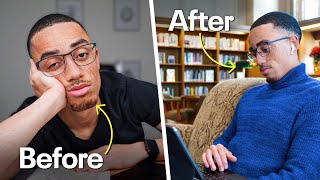
I spent over 1,000 days in a row doing the exact same thing every morning. Not because I'm special or particularly disciplined, but just because I finally found something that changed everything about how I study. And if you're someone who's ever felt overwhelmed by the amount that you need to learn or frustrated that you forget things that you studied just weeks ago, then this video is for you.
For most of my life, I was a chronic procrastinator. I'd wait until the last possible moment, cram everything in, and somehow I made it work. Well, that was until medical school hit me like a brick wall.
Suddenly, cramming was not an option anymore. The volume of information just was impossible. And more importantly, I needed to actually remember things long-term, not just for the next test.
What I discovered, first through trial and error, and eventually through diving deep into learning science, is that doctors don't study differently because we're smarter. We study differently because we have to. The techniques I'm about to share come from reviewing over 100 peer-reviewed studies on how to learn.
These are the same ones that helped me go from struggling on the MCAT as a premed to scoring in the 99th percentile on step two, the standardized test that medical students take. My success is not because I'm naturally gifted. It's because I finally learned how I can work with my brain instead of against it.
If you're new here, my name is J. R. Smith and I'm an orthopedic surgery resident at the Mayo Clinic.
As a recovering procrastinator, I resonate with a lot of you watching this video. In high school and college, I would wait until the pressure of an exam forced me to cram. And honestly, a lot of the times it worked.
You can pull allnighters, memorize enough of the material temporarily, and then dump it on the test and move on. But we all know the truth about cramming. It's not just ineffective, it's actually harmful for our learning.
When I took the MCAT the first time, which is the test that you have to take to get into medical school, I studied the only way I knew how, cramming. I only scored a 506, and it wasn't terrible, but it wasn't what I needed either. I wasn't comfortable applying to medical school with that score, so I had to retake it.
And even after trying some new test taking strategies the second time, I only improved to a 5'11. I was still using the same broken approach, just with minor tweaks. But at least at this point, it was enough for me to get into medical school.
The real change didn't happen until medical school though when I discovered AI and more importantly the idea of treating studying like a habit rather than a stressful task. I remember a senior medical student showed me something that absolutely blew my mind. They put up their ANI statistics over 800 days straight of space repetition and almost equally impressive was the fact that they weren't stressed about their board exams.
They weren't pulling all-nighters. They were just consistent and their scores reflected it. That conversation changed my entire approach to learning.
I realized that studying isn't something that you do before a test. It's something that you do every day, like brushing your teeth. And when you approach it that way, something magical happens.
The stress just somehow disappears and the information somehow sticks and you actually enjoy the process of learning. The first principle of studying like a doctor is simple. Consistency beats intensity every time.
2006 meta analysis found that space repetition produces 100 to 200% better long-term retention compared to what they call mass practice. In practical terms, this just means studying a little bit every day is literally twice as effective as cramming or concentrated and intense study sessions with little to no rest in between. So, I started to experiment.
Every morning from 5 to 6:00 a. m. , I reviewed my Ani cards.
Not sometimes, not when I felt motivated. every day for over 1,000 days straight. My birthday, my wife's birthday, Jesus's birthday, every day.
That 1 hour every morning compounded over 3 years, completely transforming my medical school experience. The change wasn't immediate, but it was profound. My stress levels dropped because I actually stayed ahead, and I'd hear some of my peers talking about pulling allnighters before exams.
And meanwhile, I was getting a full night's rest. But more importantly, when I started my clinical rotations, I could actually remember the anatomy or microbiology that I learned from years prior. The information had become part of my long-term memory, not just something I memorized briefly for a test.
Now, let's talk about the neuroscience that actually makes this work. Your brain has two types of memory storage, short-term and long-term. When you cram, you're filling up the short-term memory, like pouring water into a bucket with holes.
It might hold for a little bit, but eventually it's gone. Space repetition though works differently. It builds permanent neural highways.
Every time you successfully recall information, your brain strengthens those neural connections and the timing matters tremendously here. The Ebing house forgetting curve shows that we lose 50% of new information within an hour if we don't review it. However, if you review at specific intervals, you can flatten that curve almost immediately.
For example, an optimal review pattern may be reviewing after one day, then 3 days, then 7 days, then 21 days, then 3 months, etc. And every successful recall makes the memory more permanent. And that is why ANI's algorithm is so powerful.
It automatically calculates these intervals for you based on how well you remember each card. The other half of the equation is active recall, which just means testing yourself. Research has shown that testing yourself, even when you don't know the answer, improves retention by 150% compared to passive review.
Think about that for a second. Just by trying to recall information, even if you get it wrong, you're learning more effectively than by reading over your notes over and over and over again. This is so important.
The testing effect works because retrieval is harder than recognition. When you force your brain to pull information from memory without any cues, you're strengthening those neural pathways far more than when you're just recognizing information that you're reading. This is why flash cards are so powerful.
They force active retrieval. What's really fascinating is that the harder the retrieval, the stronger the memory becomes. This is called the desirable difficulty.
So, when you're struggling to remember something, that's not failure. That's actually your brain building stronger connections. The struggle is actually helping you learn.
Practice questions are another amazing way to implement active recall into your studying. Which brings me to an incredible resource that I want to tell you guys about and the kind sponsor of this video, Medzy. Medzy has a USMLE app that has revolutionized how medical students prepare for boards by combining evidence-based learning techniques with an intuitive and beautiful interface.
What makes Metezy special is that they understand the science we're discussing. Their question banks are designed specifically for space repetition and active recall. They've analyzed thousands of board questions to identify the highest yield topics and present them in a way that maximizes retention.
And what's best about all of this is that it's literally an app that you can use on your phone because sometimes we're not able to get that dedicated hour of studying in. But being able to crank out high yield practice questions intermittently throughout the day can be a huge game changer. If you're preparing for any medical exam, check out their USML app using the link in the description below.
Thank you so much to Medzy for sponsoring this video. All right, let's get back to it. Now, I want to talk about the third principle, which is environmental design.
Your study space isn't just where you work. It's a cognitive trigger that can enhance or destroy your focus. Research shows that temperature, lighting, and even noise levels have massive impacts on learning.
The optimal temperature for cognitive performance is between 69 and 77° F. And studies actually show that being too warm impairs your thinking more than being too cold. Now, I know I'm a little bit lucky because I live in Minnesota where it's cold basically 75% of the year.
But make sure that your space is keeping you alert, not making you want to curl up and take a nap. And lighting here is equally critical. You want bright white light, not the warm yellow stuff.
Too dim or too warm and you'll get sleepy. I actually have massive lights in my room that allow me to control the temperature and make it so it mimics natural daylight. And one factor that may surprise you is noise.
Complete silence isn't actually optimal for a lot of people. Some white noise or soft instrumentals in the background can actually improve focus, especially if you have attention difficulties, but if you're naturally laser focused, silence may be better. I actually personally like listening to low-fi hip-hop beats when I'm working.
But this is something that you should experiment with to see what works best for you. Now, let's dive into the fourth principle, which is sleep optimization. This isn't just about getting enough sleep.
It's about understanding how sleep consolidates memories. When you learn something new, it's initially stored in your hippocampus, a part in your brain. But during sleep, specifically during slowwave and rim sleep, these memories get transferred to your cortex for long-term storage.
This is why pulling allnighters is so counterproductive. You might pass the test, but you're literally preventing your brain from consolidating those memories. Studies show that even one night of sleep deprivation can reduce memory formation by up to 40%.
And as a resident, sometimes I can't control my sleep schedule, but I have to recognize just how important it is for my performance. Which brings me to an important point. You have to be intentional about tracking your cognitive performance.
There are going to be days where you're crushing your practice questions or feeling super energized during your flashcard sessions. And it's important to keep track of what contributed to your success. Was it a workout beforehand, some coffee, or just a good night's rest?
I personally use this ultrahuman ring to basically track everything automatically, especially my sleep, so that I can reference it later. I even recently got my wife Madison one, and it's kind of funny how a mom with a newborn and an orthopedic surgery residents are tracking their sleep, but here we are. If you want one, big discount in the description.
But if you don't know what's contributing to your success or to your failures, then you'll end up leaving it to chance, which is not the approach that a doctor would take. The fifth principle is exercise timing. A 2021 meta analysis found that moderate exercise before studying improves memory performance.
But here's what's fascinating. Exercise after studying within 4 hours provides even bigger benefits for memory consolidation. So think about combining your study habit with your exercise one for a truly powerful combo.
The sixth principle is deep work and flow states. Cal Newport's research on deep work completely changed how I approach studying. The key insight is that attention residue from task switching can last up to 30 minutes.
So every time you check your phone or switch tasks, you're operating at a reduced capacity for half an hour. That is not how you get anything done. Here's my deep work protocol.
I use time blocks of 45 to 90 minutes with zero interruptions, phone out of sight, and notifications off. During these blocks, I'm so much more productive than during regular study time. Deep work puts you in a flow state, and studies have shown that executives in flow states show up to 500% increases in their productivity.
To trigger a flow state, you need three things: clear goals, immediate feedback, and a challenge level about 4% above your current skills. too easy and you're bored and too hard and you're anxious. That sweet spot of slight stretch is where the flow happens.
And you know one way of studying that accomplishes these three things, practice questions and flashcards. You know a study strategy is good when it's supported by basically all of the research. The seventh principle is strategic break management.
The desk time study of highly productive people looked to identify a specific work rest cycle that could boost output. They found that the most productive people worked for 52 minutes, then took a break for 17 minutes. But since I'm not that neurotic, I just do 45 minutes of work and 15 minutes of break most of the time.
And I actually do this live on YouTube once a week if you ever want to study with me. But here's the key. What you do during breaks matter.
Scrolling social media is not a break. It's actually an attention drain. Effective breaks involve movements or just letting the brain rest and work on those neural pathways we talked about.
Do some push-ups, walk outside, or just take some deep breaths. These activities actually restore cognitive resources rather than depleting them further, getting you ready for that next work session. Now, let's move on to the eighth principle, note-taking methods that actually work.
Studies show significantly better retention with the use of mind mapping at one week compared to linear notes. The visual spatial organization matches how your brain naturally stores information. You can create mind maps for complex topics starting with the core concept and then branching out to details using colors and images to enhance encoding.
I'm actually personally not the best note taker, but I know a lot of people like to take notes, so I had to at least mention it briefly so that at least you can do it in a way that actually works. Okay, the ninth principle is strategic supplementation. First, proper hygiene is crucial.
Even 2% of dehydration significantly impairs cognitive function. Try to drink half of your body weight in ounces of water every day. And caffeine can help a ton too.
And there is a lot of data on caffeine use and cognitive performance. But timing matters here. It's important to limit it to the morning only so that you can protect your sleep quality.
We don't want to improve one part of your study strategy by hurting another. And two other supplements that have been studied extensively and have been shown to relate to cognitive performance are creatine and ketones. Studies show that creatine isn't just helpful for your muscles, but it's helpful for your brain.
It's been linked to improvements in working memory and processing speed. My favorite is gains. I just throw five grams in some water every day.
And even though I still need to work on my biceps, I at least feel like my brain is benefiting. And the other molecule is ketones. Ketones are these macronutrients that cross the bloodb brain barrier and provide energy to the brain.
They are fantastic, particularly if you're not a caffeine drinker or need an energy boost in the evening without ruining your sleep. And my favorite here is definitely Ketone IQ. It's just a shot of pure brain fuel.
And honestly, I usually feel more locked in after that than I do after drinking caffeine. Links with some discounts in the description if you want to try any of these out. Now, the 10th principle brings everything together, and that's implementation science.
Knowledge without action is useless. The fog behavior model shows that behavior happens when motivation, ability, and prompt come together. Most people fail because they try to change too much too fast.
Start with tiny habits. Instead of I'll study 3 hours daily, start with I'll review five flashcards after my morning coffee. Once that's automatic, expand it to 10 and then 20.
The consistency matters more than the volume initially. Your brain needs to wire the habit circuit before you can increase the intensity. And it can take a while.
At first, only using evidence-based study strategies was tough. My brain resisted the structure. I wanted to go back to cramming because it felt familiar and honestly a little bit easier.
But after a few weeks, something clicked. The daily review started to become automatic. I started remembering things much more effortlessly.
And I always thought that I had a terrible memory. And eventually, I went from stressing out about the MCAD and having to take it twice to scoring in the 99th percentile on my US medical licensing exam with relatively minimal stress. And of course, some days will be better than others.
But using proving techniques to study efficiently and effectively is how doctors do it. And it's how you should do it, too. Because if you take this approach, you will be so far ahead of your peers and you'll notice that the effects will compound.
And over time, not only will you be acing every exam you take, but you'll be a real expert in whatever it is that you're studying. And this is exactly what I teach in my evolving student challenge. We take all of these evidence-based techniques and create a personalized system that fits your life.
It's not about copying a standard routine. It's about understanding the principles and then adapting them to your unique situation. This course was designed to help you build habits for learning that the best students and doctors are using.
You'll get a notion workspace template that I personally use and that you'll customize through a 30-day challenge period where you also get one short video every day on topics ranging from test taking strategies to your mindset. And in my opinion, it is the most value I have ever p on the internet. So check it out in the link in the description if you're interested.
But the transformation isn't just academic. When you realize that you can master any subject through systematic effort, your entire perspective shifts. You stop seeing intelligence as fixed, you stop fearing complex topics, and you develop a genuine confidence because you have a proven system that works.
Looking back, the biggest insight isn't about any specific technique. It's about working with how your brain actually functions versus fighting against it. We're not computers that can download information.
We are biological systems with specific requirements for optimal function. When you align your study methods with your brain's natural processes, learning becomes not just easier, but honestly a little bit enjoyable. But that's it for this one.
Thanks so much for watching. And if you found any of this helpful, I'm sure you would love this video here where I talk about 22 AI tips that you can use to become a better student. And as always, keep evolving and I'll see you guys in the next one.