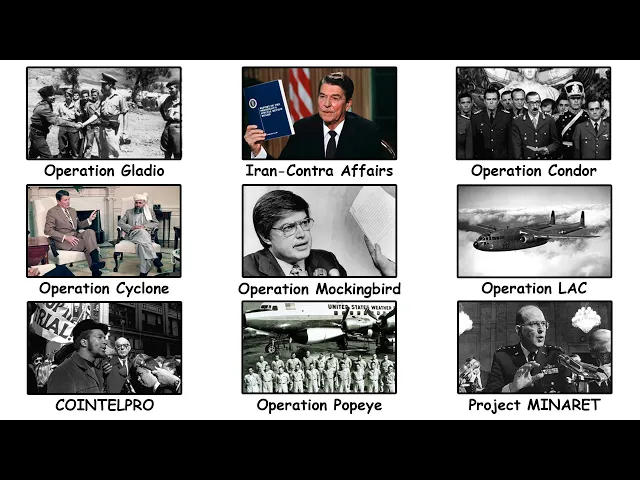
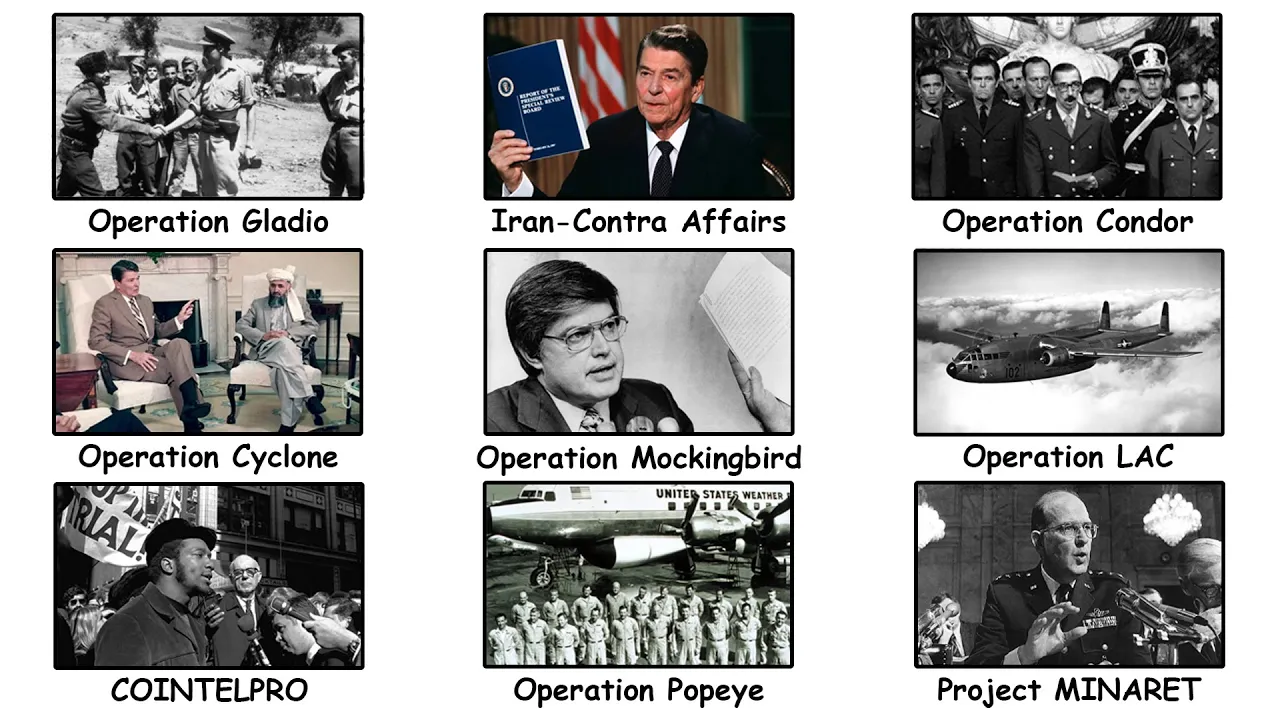
Operation Gladadio. After World War II, the US and the UK set up secret paramilitary groups in Western Europe called staybehind organizations. A staybehind operation is one where a country places secret operatives or organizations in its own territory for use in case of a later enemy occupation.
Operation Gladadio was the code name for these covert operations. The official purpose was to prepare for a possible Soviet invasion by using sabotage and guerilla warfare behind enemy lines. However, in reality, these groups also carried out assassinations, psychological warfare, and false flag operations to undermine left-wing parties in Western Europe.
They even supported anti-communist militias and right-wing terrorism with reports suggesting they were involved in the torture and killing of communists. For example, the 1969 assassination of Eduardo Mandlane by the Portuguese Secret Service. These operations were initially organized by the Western Union founded in 1948 and later by NATO formed in 1949 and the CIA established in 1947 working closely with various European intelligence agencies.
On the 24th of October 1990, Italian Prime Minister Julio Andreotti publicly confirmed Gladio's existence. He described it as a structure of information response and safeguard that included hidden gun stashes and reserve officers. He also released a list of 622 civilians he claimed were part of Gladadio.
Following this revelation, the European Union Parliament drafted a resolution strongly condemning the operation. However, only Italy, Belgium, and Switzerland launched parliamentary investigations while the administration of US President George HW Bush refused to comment. Later, the United States Department of State rejected the view that it supported terrorists and maintained that the operation served only to resist a potential invasion of Western European countries by the Soviet Union.
Iran Contra affairs. The Iran Contra affair was a major political scandal in the United States that took place between 1981 and 1986. Senior officials in the Ronald Reagan administration secretly arranged to sell arms to Iran.
This was especially controversial because after the Iran hostage crisis in November 1979, when Iranian students seized 53 American hostages from the US embassy in Thran, including diplomats and civilians, the US government under President Jimmy Carter, had imposed an arms embargo on Iran, making it illegal to sell weapons to the country. The Reagan administration argued that the armed shipments were part of a plan to free seven US hostages held in Lebanon by Hezbollah, an Islamist paramilitary group with close ties to Iran and connections to the Islamic Revolutionary Guard Corp. The proposal to exchange arms for hostages was put forward by Manusher Gorbanar, an Iranian arms dealer in exile, and some officials believe that these sales would pressure Iran to compel Hezbollah to release the hostages.
The administration also hoped to use money from the arm sales to fund the Contras, an anti-sandinista rebel group in Nicaragua. They were worried about the spread of communism in Central America, especially since the Sandinistas had the support of Fidel Castro. Although the Reagan administration had previously funded the Contras, the Boland agreement later banned such support due to concerns about human rights abuses and drug trafficking by the guerilla group.
However, the administration later found a loophole and secretly used non-appropriated funds which were not controlled by Congress to continue supporting them. After a leak by Medi Hashimi, a senior official in the Islamic Revolutionary Guard Corps, the Lebanese magazine Ash Shira exposed the arrangement on November 3rd, 1986. The Iranian government confirmed the Ash Shira story and within 10 days it became international news.
In response, President Reagan appeared on national television and acknowledged that the weapons transfers had indeed occurred. but he insisted that the US had not traded arms for hostages. This was the first public report of the weapons for hostages deal.
According to journalist Seymour Hirs, an unnamed former military officer claimed that a covert team led by Arthur S. Maro Jr. , assistant to the chair of the US Joint Chiefs of Staff, may have arranged the leak.
They were reportedly worried that the scheme was spiraling out of control. The operation was fully uncovered only after an airlift of guns. Corporate Air Services HPF821 was downed over Nicaragua by the Sandinistas.
Eugene Henfouse, who was captured by Nicaraguan authorities after surviving the crash, initially claimed during a press conference that two of his co-workers, Max Gomez and Ramon Medina, worked for the CIA. The investigation was slowed down when large amounts of documents related to the affair were either destroyed or kept from investigators by officials in the Reagan administration. In March 1987, President Reagan made another nationally televised address, taking full responsibility for the affair and saying, "What began as a strategic opening to Iran deteriorated in its implementation into trading arms for hostages.
" Operation Condor. Operation Condor was a secret campaign of political repression run by right-wing dictatorships in South America's southern cone from 1975 to 1983. It involved intelligence operations, coups, and assassinations targeting left-wing sympathizers.
The operation was supported and financed by the United States, and although France denies any involvement, there are claims that it was involved as well. Venezuela and Colombia are also said to have collaborated in these covert activities. Condor was formally created in November 1975 when Chilean dictator Austo Pino's spy chief, Manuel Contreras, invited 50 intelligence officers from these countries to the Army War Academy in Santiago, Chile.
These countries became the founding members of the operation, but Ecuador and Peru later joined, taking a more peripheral role. Operation Condor continued until it ended with the fall of the Argentine Juna in 1983. Condor operatives used brutal tactics such as death flights, a method of extrajudicial killing, where victims were dropped from airplanes or helicopters into oceans, large rivers, or mountains.
Due to its secretive nature, the exact number of deaths directly linked to Operation Condor remains highly disputed. Some estimates suggest that at least 60,000 people were killed with up to 30,000 of those fatalities occurring in Argentina alone. The victims included dissident, leftists, union and peasant leaders, religious figures such as priests, monks, and nuns, as well as students, teachers, intellectuals, and suspected gerillas.
Although the CIA described Operation Condor as a cooperative effort by the intelligence and security services of several South American countries to combat terrorism and subversion, the fight against guerillas was merely a pretext. In reality, guerrilla groups were never strong enough to control territory, secure significant foreign support, or seriously threaten national security. Based on formerly secret CIA documents from 1976, American historian J.
Patrice McSherry claims that in the 1960s and early 1970s, international security officials at the US Army School of the Americas and the Conference of American Armies developed plans to counter what they saw as threats from political dissident in South America. In June 1999, under President Bill Clinton's order, the State Department released thousands of declassified documents that revealed for the first time that the CIA as well as the State and Defense Departments were fully aware of Operation Condor. The report described Condor's joint counterinsurgency operations aimed at eliminating Marxist terrorist activities and mentioned that Argentina had set up a special Condor team that was organized much like a US special forces unit.
Operation Cyclone. After the communists took power in Afghanistan in 1978, the CIA began arming and financing the Afghan mujahedin from 1979 to 1992, both before and during the Soviet military intervention in support of the Democratic Republic of Afghanistan. This operation, cenamed Operation Cyclone, leaned heavily towards supporting militant Islamic groups, including those with jihadist ties.
Operation Cyclone was one of the longest and most expensive secret CIA operations ever. It started with $695,000 in mid1 1979, then grew to between 20 and $30 million per year in 1980, and by 1987, funding had jumped to $630 million per year, making it the largest support ever given to a third world insurgency. To hide US involvement at first, they supplied the rebels only with Soviet-made weapons.
This was made possible with quiet support from Israel, which had captured large amounts of Soviet arms during the Yam Kapour War and secretly sold them to the CIA, and Egypt, which had modernized its army with Western weapons while passing on older Soviet-made arms to the Mujahedin. The first non-S Soviet weapons were old British Lee Enfield rifles shipped in December 1979. By September 1986, the program had grown to include modern US weapons like the FIM92 Stinger surfaceto-air missiles, about 2,300 of which were sent to Afghanistan.
Funding continued at reduced levels after the Soviet withdrawal in 1989 as the Mujaheden kept fighting the armed forces of the Democratic Republic of Afghanistan during the first Afghan civil war. Key figures behind the program included Texas Congressman Charlie Wilson, young CIA paramilitary officer Michael G. Vickers and CIA regional head Gust Avricoto who formed a close bond with Wilson.
The distribution of the weapons depended largely on Pakistani President Muhammad Ziah Hak who had a personal relationship with Congressman Wilson. Pakistan's interervices intelligence ISI acted as the middleman handling funds, transferring weapons, arranging military training, and providing financial support to the Afghan resistance groups. After 1985, when the Reagan administration openly supported antis-siet resistance movements worldwide, an approach now known as the Reagan doctrine, there was no longer any need to hide the source of the weapons.
Operation Mockingbird. During the early Cold War, the US government through the CIA launched an alleged large-scale program called Operation Mockingbird. Its goal was to manipulate domestic American news media for propaganda purposes.
According to author Deborah Davis, the operation recruited prominent American journalists into a propaganda network and even influenced various front groups. Operation Mockingbird wasn't limited to influencing domestic public opinion. It also aimed to shape views internationally.
The Church Committee's report issued in 1976 by a Senate Select Committee led by Senator Frank Church confirmed earlier claims that the CIA had secret ties with private institutions, including the press. Although the report didn't name names, it mentioned finding 50 journalists with covert relationships with the CIA. In a 1977 Rolling Stone article titled The CIA and the Media, reporter Carl Bernstein expanded on these findings.
He claimed that over 400 US Press members secretly carried out assignments for the CIA. Among those mentioned were New York Times publisher Arthur Hayes Solsberger, columnist Stuart Alop, and staff from Time magazine. Bernstein noted that the overseas branches of major US news agencies had long served as the eyes and ears of Operation Mockingbird, spreading CIA propaganda through domestic media.
To this day, the government has neither confirmed nor denied the operation. Many site operations like these as the reason for the modern distrust of traditional media. But luckily, today we have alternative ways of finding news that are as objective as possible.
Take Ground News, today's sponsor, for example. They don't come at you with a single version of events. They gather news from around the world on one platform so you can come to your own independent decisions.
For example, look at this article about the items that might see the most fluctuations after the new tariffs from Trump. We can see that 27 sources reported on this, but only two of them were right-leaning. This is what ground news calls a blind spot for people who consume right-leaning sources only.
It's for this reason that they also have a blind spot feed, which shows you stories under reportported by one side of the political spectrum. We can also see how differently right-leaning and left-leaning sources frame these stories. This right-leaning sources headline says pain now, prosperity later, while this left-leaning one says that Trump is scrambling to defend the chaos.
You can finally start trusting the news again by going over to ground. news/tpe or by scanning my QR code and you'll get 40% off the same top tier Vantage plan I use for unlimited access to all their features. Thanks again to Ground News who help us make videos like these possible.
Operation LAC. During the early 1950s, amid fears of biological warfare, the US government decided to test the spread of chemical and biological agents on its own citizens. Operation LAC, large area coverage, was carried out by the US Army Chemical Corps in 1957 and 1958.
The project involved dispersing tiny fluorescent zinc cadmium sulfide particles over large parts of the United States and Canada to study how far these particles could travel, simulating the spread of harmful agents. To conduct the tests, the US Air Force loaned the Army a C119 flying box car airplane. This aircraft was used to release massive quantities of the material into the atmosphere.
Ground stations then tracked the fluorescent particles. In the initial test and subsequent ones, much of the material was carried by winds into Canada with particles being detected up to 1,200 miles from their drop point. A typical flight along a 400m route would disperse about 5,000 lb of zinc cadmium sulfide.
In fiscal year 1958 alone, approximately 100 hours of flight time were dedicated to Operation LAC, including four runs of varying lengths, one of which extended for 1,400 m. In December 1957, a test from South Dakota to International Falls lost particles to a Canadian cold front, though some reached New York 1,200 m away. In February 1958, another front at Dougway proving ground carried particles into the Gulf of Mexico.
Subsequent tests from Toledo to Abalene and from Detroit to Springfield and Goodland showed aerial dispersal could reach both sides of the flight paths. Some anecdotal reports suggested that exposure to zinc cadmium sulfide during Operation LAC may have caused health issues. However, a US government study by the National Research Council stated, "After an exhaustive independent review requested by Congress, we found no evidence that exposure to zinc cadmium sulfide at those levels could cause people to become sick.
Despite this, the use of ZNCDS remained controversial. One critic even accused the Army of literally using the country as an experimental laboratory. Additionally, the National Library of Medicine's TOXNet database shows that the EPA classified cadmium sulfide as a probable human carcinogen.
The US government has never apologized for these tests. Co-intelpro. CO-Iintelpro, short for the counter intelligence program, was a series of secret and illegal projects run by the FBI from 1956 to 1971.
The goal was to monitor, infiltrate, discredit, and disrupt American political groups that the FBI believed were subversive. The FBI targeted a wide range of groups and individuals through co-intel pro. These included feminist organizations, the Communist Party USA, antivietnam war organizers, and civil rights and black power activists such as Martin Luther King Jr.
, the Nation of Islam, and the Black Panther Party. The FBI also targeted independence movements, including Puerto Rican groups like the Young Lords, and the Puerto Rican Socialist Party. Although the main focus was on groups associated with the New Left, even white supremacist organizations like the Ku Klux Clan and the National States Rights Party were not spared.
FBI Director J. Edgar Hoover personally issued orders for Cointelpro instructing agents to expose, disrupt, misdirect, discredit, or otherwise neutralize these groups, especially their leaders. Additionally, Attorney General Robert F.
Kennedy gave written approval for limited wiretapping of Martin Luther King Jr. 's phones on a trial basis for about a month. Hoover later extended that approval, effectively giving his agents free reign to search for evidence in any area of King's life they found relevant.
The program remained secret until March 8th, 1971 when the Citizens Commission to investigate the FBI broke into an FBI field office in Media, Pennsylvania. They seized several dossas and exposed the program by turning the material over to news agencies. The timing coincided with the fight of the century boxing match between Muhammad Ali and Joe Frasier in March 1971, which provided cover for the activists burglary.
Muhammad Ali was a co-intel protarget due to his involvement with the Nation of Islam and his participation in the anti-war movement. Many news outlets initially refused to publish the documents except for the Washington Post which broke the story. After checking that the material was reliable, the Post ran the documents on its front page despite a request from the attorney general not to do so.
This led other news organizations to publish the documents as well. Within a year, director J. Edgar Hoover announced that centralized co-intelp pro operations were over and that future counter intelligence activities would be managed on a case-byase basis.
Operation Popey Operation Popeye was a secret US Air Force program during the Vietnam War. Running from 1967 to 1972, its goal was to use cloud seeding to induce extra rainfall during the rainy season from March to November and extend the monsoon over parts of the Ho Chi Min Trail by an additional 30 to 45 days. This trail, a network of roads and paths used by the Vietkong and North Vietnamese army to transport supplies between North and South Vietnam through Laos and Cambodia, was vital for enemy logistics.
By increasing rainfall, Operation Papey aimed to soften road surfaces, trigger landslides, and wash out river crossings, thereby disrupting the movement of military supply trucks and hindering enemy supply lines. The chemical weather modification program was conducted from Thailand over Cambodia, Laos, and Vietnam. It was allegedly sponsored by Secretary of State Henry Kissinger and the CIA without the approval of then Secretary of Defense Melvin Leair under President Nixon.
Leair had categorically denied to Congress that any such tactical weather modification program existed. Reporter Jack Anderson first published a story about Operation Popey in March 1971. The name Operation Popey entered public discourse through a brief mention in the Pentagon Papers, a top secret Pentagon study of US government decision-making related to the Vietnam War that was leaked by Daniel Ellburg, a United States military analyst to the New York Times, the Washington Post, and other newspapers.
Project Minouret. Project Minouret was a domestic espionage operation run by the NSA. It intercepted electronic communications that mentioned specific US citizens and then passed those messages on to other government agencies.
The intercepted communications were shared with the FBI, CIA, Secret Service, Bureau of Narcotics, and Dangerous Drgs, and the Department of Defense. Starting in 1962, the NSA kept a watch list of Americans traveling to Cuba. Over time, the list expanded to include narcotics traffickers.
From 1967 onward, President Lyndon B. Johnson added the names of anti-war activists, and President Richard Nixon further broadened the list to include civil rights leaders, journalists, and even two senators. Between 1967 and 1973, Project Minouret's watch lists targeted over 5,925 foreigners, 1,690 organizations, and 1,650 US citizens, including these guys.
In 1975, NSA Director Lou Allen testified before the Senate Intelligence Committee that the NSA had issued more than 3,900 reports on these watch listed Americans. There was no judge overseeing the project, and it operated without legal permission to listen in. The NSA helped the FBI and CIA when they asked for international communications about certain people, but only if those agencies didn't involve the NSA further.
Under this system, the FBI and CIA had to either give the reports back to the NSA or destroy them after 2 weeks, mark them as top secret, and keep them separate from other NSA records. A 1977 Department of Justice review found that wiretap laws had been violated. The review argued that if intelligence agencies had too much discretionary power with too little accountability, it wasn't just a flaw within the agencies.
It was a 35-year failure of oversight by presidents in Congress. One result of these investigations was the creation of the Foreign Intelligence Surveillance Act, FISA, in 1978. FISA limited what the NSA could do by setting up a legal process for getting warrants and having judges review its actions.
In addition, the US Signal Intelligence Directive 18, first introduced in 1980 and updated in 1993, was established as an internal rule to protect the NSA and the entire intelligence community. If you want to discuss this video or suggest an idea for the next one, join my Discord link in the description.