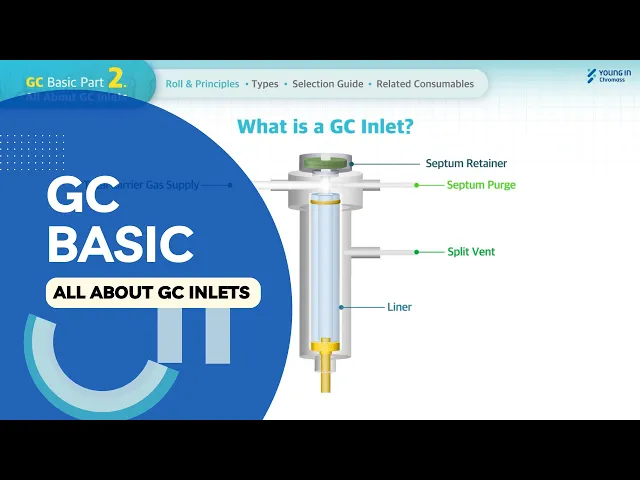
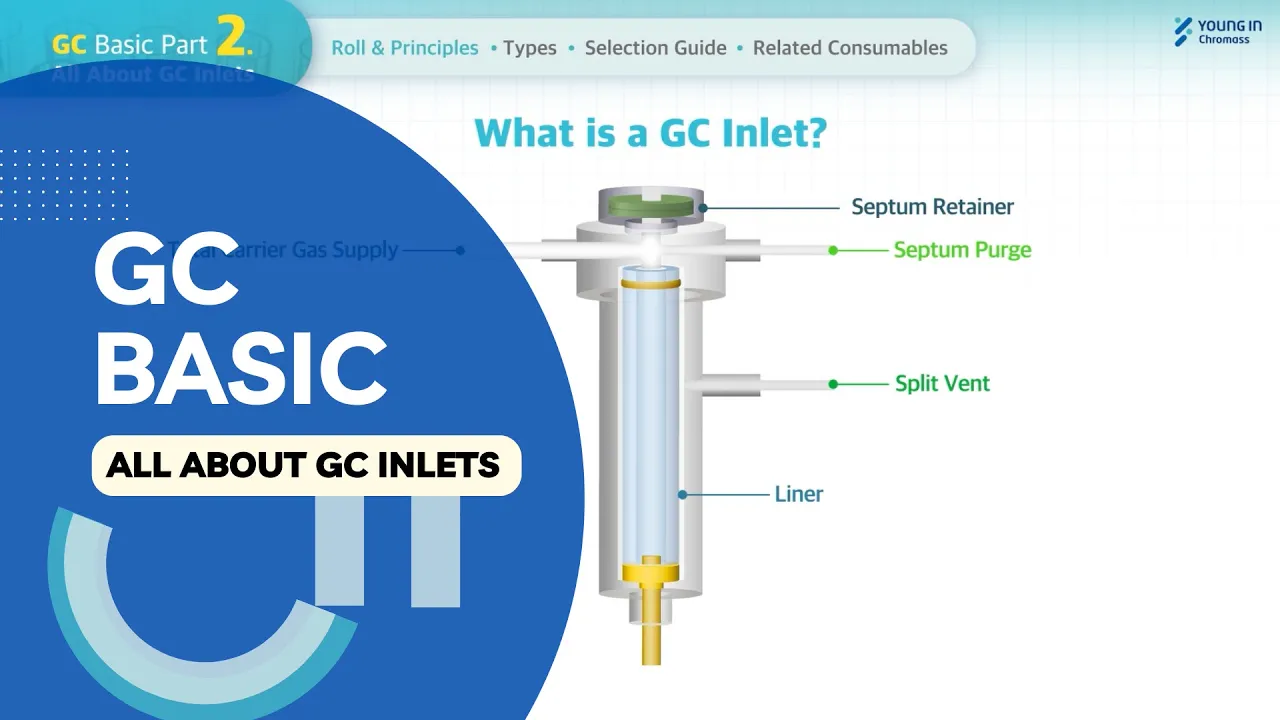
yay [Music] a comprehensive guide to GC warning this video includes everything you need to know about GC once you watch this video you'll be dying to know the next series as a series of comprehensive guides to GC we're going to take GC basic part 2 to know all about GC inlets what is a GC Inlet the main role of the GC Inlet is to deliver an accurate and reproducible Sample introduction into an analytical column a GC Inlet is commonly configured with a scepter retainer where the injection Port is a total carrier gas supply line and
a liner where the liquid samples get vaporized and the septum Purge line split vent line or other consumables might be added depending on manufacturers or Inlet types inlets are commonly categorized into two types which are capillary column inlets and packed column inlets capillary column inlets utilize a capillary column with the following properties and inner diameter ranges and fact column inlets can utilize a packed column with the following properties and are preferably indicated with these outer diameter ranges the mostly used Inlet and capillary column inlets is a split splitless Inlet we will talk about more details
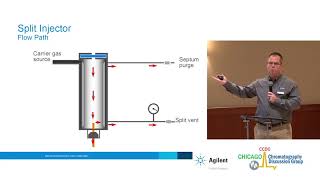
of schematic gas flow by Inlet types let's start with the flow path of the split splitless Inlet total carrier gas will flow into an inlet and this passes through into the septum Purge line and an inlet liner in the liner the set column flow goes into the column while the rest of them will be vented out through the split vent line the column flow is considered depending on the type of carrier gas column length and column ID [Music] split vent flow is calculated from column flow and split ratio the split ratio varies depending on the
sample concentration and the column ID [Music] the septum Purge is to sweep the septum scraps to remove potential contaminants and is usually set as three milliliters per minute in the split splitless Inlet you can operate with two injection modes with the split injection mode the total gas flow can be set as follows for example if you set the column flow at one milliliter per minute and the split ratio is 1 to 50. the split vent flow will be calculated at 49 milliliters per minute and the total gas flow will be set as well after the
gas flow gets stabilized this sample will be injected [Music] with the splitless injection mode the total gas flow will flow to the septum perch and the column flow at first let's say we set the column flow to one milliliter per minute and the split ratio to 1 to 50 the split ratio needs to be set as well to be applied at split on time then the total gas flow would be four milliliters per minute after sample injection this sample will remain for a while in the liner and then enter the column before the split on
time the split vent line is closed once the time reaches the split on time the split vent line will be open and the total gas flow rate will be changed and split accordingly [Music] let's learn about the packed column Inlet packed column Inlet design is simple because the entire carrier gas will enter the column after subtracting the septum purge flow for example if the column flow is set to 20 milliliters per minute the total will be 23 milliliters per minute after gas flow stabilization the sample will be introduced to the inlet liner and the entire
sample will be loaded into the column depending on the GC manufacturers the usage of the septum Purge line could be no available [Music] then how can we select the right Inlet for sample analysis there are several GC inlets in the market but still split splitless inlets and packed column inlets are the most commonly used Inlet on GC so this made GC Inlet selection simple and you may consider more for the method development including column and detector selection there are two injection modes in Split splitless Inlet while packed Inlet has no selection of injection mode a
major consideration of GC Inlet selection would be the column type whether you utilize a capillary column or a packed column depending on what to analyze depending on the sample concentration Purity and boiling point range of aniline you can choose the right Inlet which can optimize your analysis results also there are certain consumables related to GC inlets that can affect the GC results and we'll talk about more details of each part a septum is a thin piece of silicone rubber or similar material located at the top of the GC Inlet a septum provides a complete sealing
between the sample injection and carrier gas flow and prevents contamination of the inlet from outside there are various types of Inlet septum depending on the inlet and several parameters which are the maximum GC Inlet temperature septum material cost bleed temperature optimization long life and the septum diameter it is recommended to replace a GC Inlet SEPTA every 100 to 200 injections to ensure accurate and precise results prevent sample contamination and maintain the Integrity of the GC column an inlet o-ring is the seal between the liner and the injection port at the GC which prevents gas leaks
to maintain consistent gas flow this needs to be replaced periodically before it gets damaged or worn out a GC Inlet liner is located at the entrance of the GC column inside the GC Inlet this is a place where the liquid samples get volatilized and plays a role in the transfer of the injected sample into the GC column while preventing the GC column from sampler residue and non-volatile contaminants and selecting Inlet liners has a direct effect on analysis results there are various types of Inlet Liners in geometric design volume [Music] inner diameter deactivation and the presence
or absence of packing [Music] the inlet liner is recommended to inspect daily and replaced every month or when any related symptoms occur [Music] the last part we're going through is a gold seal located between the GC Inlet and the inlet liner this prevents sample contact with hot and active metal surfaces and is mostly used in Split splitless inlets this needs to be replaced every six months want to learn more about chromatography please stay tuned on Young and chromast channel [Music]