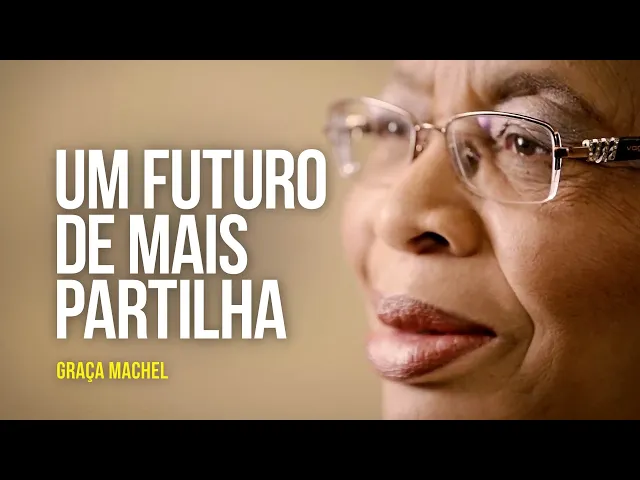
I always imagine the future in a most optimistic way. Because I am an optimist by nature. Sometimes my sons criticize me harshly because, when things seem too difficult, too complex… I always find a way of… That will take us… That it will… Things may be solved.
They have to be solved. And sometimes that is not because I can say exactly. .
. It is more like a conviction. It is inside me.
That things have to change. I'm a great believer in human nature and in our capacity as humans. We have transformed realities that might have seemed disastrous at first, but I say it is possible to turn such disasters into an opportunity to build something better.
Therefore, I believe that the future depends a lot on how we collaborate with the new generations, enabling them to grow up with a more supportive mind. In the environments in which they communicate, truly communicate with one another, and build and enlarge spaces of support and understanding, reducing little by little spaces of divergence and disagreement, so to say. In the other hand, I believe that… Young people’s natural impulse, if you think, the natural impulse of young people is not to beat one another.
As they grow up, we influence them so that they build psychological walls. But the younger portions of society are much more open to embrace others. Nowadays, we have a historical human family structure in which there are more youngsters than grown ups, than elderly people even globally.
This is why I trust that, if we do our work well, if we listen to others and encourage them to define themselves, they will surely create a much more human and supportive world. And it won’t happen on its own, but as I see it… If a young person in Brazil is able to communicate with a Japanese youngster in a fraction of seconds through communicational tools, it provides them with a kind of power, it is a very powerful tool for surpassing the limits we were talking about. If through that process, instead of just communicating, spreading a message, they promote some sort of constructive debate, then we must understand that a youngster in Japan is able to communicate with a youngster in Guatemala, and they will find out they have a lot in common, that they have much more things in common than differences.
And this is the world we want, isn’t it? The world we would like our children to live in. Not my children, but my grandchildren now, because my children have already grown.
But my grandchildren. Truth is, those things won’t happen on its own. We have to invest on it, we must support young people so that they accept themselves mutually, instead of being influenced by the walls that we, the grown-ups, have already built with our fears.
And here we are, back to fear again. The fear of others, right? Fear of what we don’t know.
They know a lot more, and the more knowledge they have, the less fearful they will be. That is why I believe that future is going to be good. There is one more thing I would like to mention, which worries me a lot.
It is that the new generations must build a world without inequality. This is one of the great challenges of our times. Something we created.
But they can build a future without inequality. They have all the means to end inequality. They are able to grow food for everyone.
I mean, there is no reason why some people should eat while others shouldn’t. The scientific knowledge we already developed, that the human family developed, is now accessible to all people, and it may be accessible even through technological tools that already exist. Therefore, they have all the means to create a world in which people are much closer to each other.
Where people respect, I mean, where everyone have dignity. Where everything that can be shared is shared.