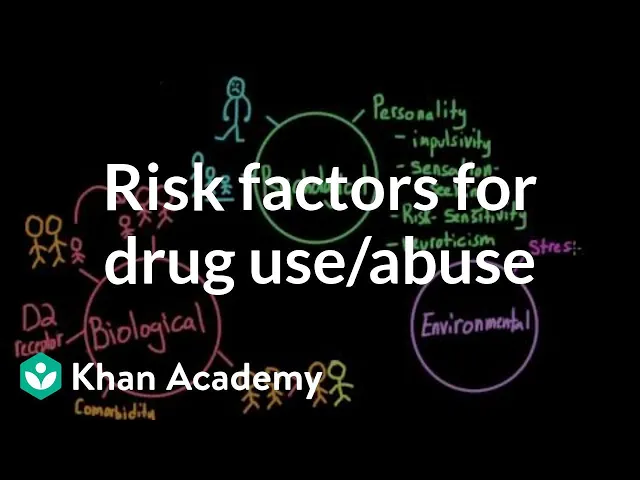
I think that talking about risk factors for drug abuse can be really difficult and that's just because there are so many different factors that feed into it and also I don't want to put too much emphasis on any one cause I don't want to demonize any one thing so I want to say right off the bat that there is no one thing that can lead to drug abuse or addiction instead there are numerous factors that relate to each other in complicated ways and I also want to mention that the presence of any or even all
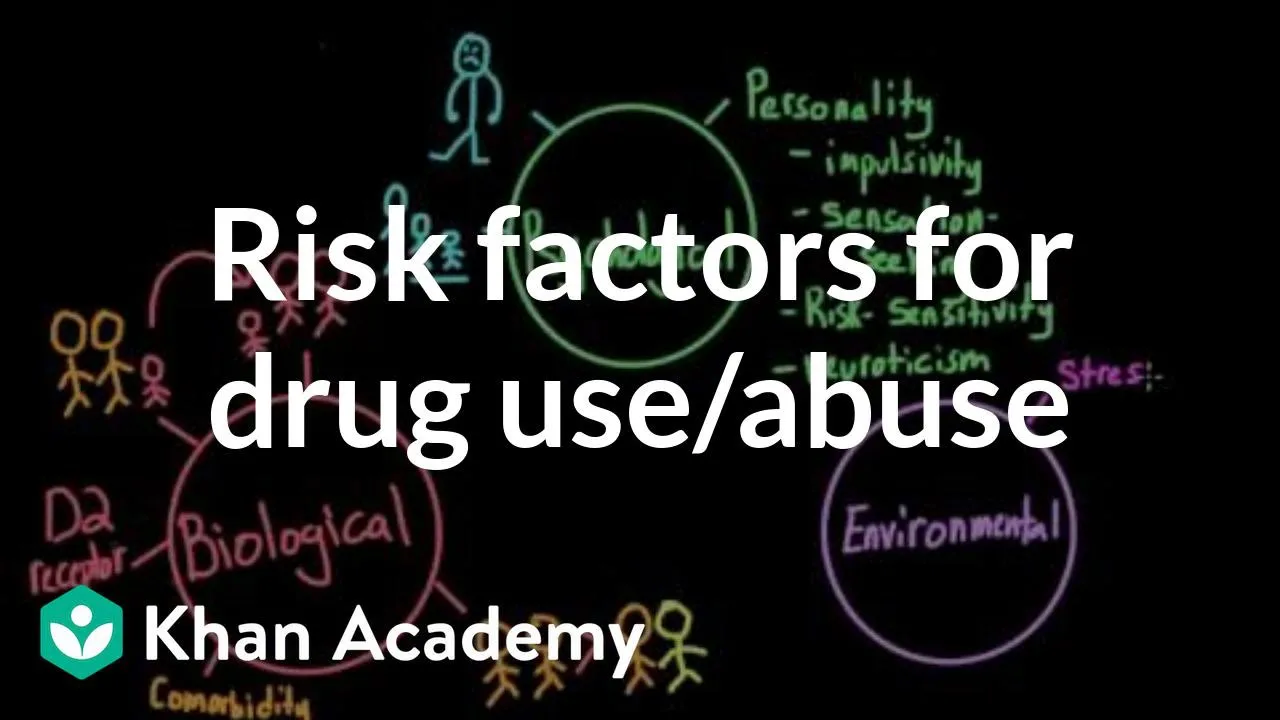
of these risk factors does not actually guarantee that an individual will become addicted to any substance or will even use it all all right well with all of that said now I am going to talk about some risk factors for substance abuse so things that seem to correlate with substance abuse later in life and we're going to talk about biological risk factors psychological risk factors and sociocultural and environmental risk factors and let's start off with the biolog iCal factors we know that if a child has a parent who abuses substances they are more likely to
abuse them as well and this in combination with the fact that identical twins have more similar rates of addiction than fraternal twins seems to imply that there could be a genetic component to addiction this is also supported by the fact that adopted children tend to resemble their biological parents more than their adopted parents in terms of addiction rates but even if genetics are involved even if someone can have a genetic predisposition to substance abuse this does not guarantee that a person will develop a substance abuse problem instead it might make them more vulnerable to having
one another biological risk factor has to do with the D2 receptor which is a type of dopamine receptor in the reward circuitry of the brain some studies suggest that individuals with fewer D2 receptors might have a higher risk of addiction than those with a typical amount of receptors we know that many substances are associated with an increase in dopamine Within the reward circuits in the brain and we also know that the body tries to counteract the effects of drugs through down regulation so over time the body will take away dopamine receptors if too much dopamine
is present and this would stop an individual from feeling pleasurable experiences both when they take the drug meaning that they'll have to take more to get the same high but also in basically everything else in their life and you can see how all of this would be particularly bad for individuals who had fewer D2 receptors to begin with having fewer receptors might also explain why individuals seek out drugs in the first place because it takes more stimulation for them to naturally get a reward signal another biological risk factor for addiction has to do with comorbidity
meaning that individuals with certain psychiatric disorders might be more likely to have substance abuse problems as well one of these disorders is attention deficit hyperactivity disorder ADHD and this actually makes a lot of sense to me because indiv idual with ADHD tend to be impulsive and as we will talk about later when we talk about psychological risk factors impulsivity in general seems to be a risk factor for addiction other disorders that can sometimes go hand inand with addiction are anxiety disorders and depression and we're not entirely sure why this is the case but some researchers
have suggested that it might be because these individuals are trying to self-medicate for their conditions however we should also remember that this is a correlation and even though we might be tempted to conclude that mental disorders lead to substance abuse that might not be the case it could be that substance abuse leads to mental disorders or perhaps could trigger mental disorders in those who have a genetic predisposition or maybe both mental illness and substance abuse problems could be generated by a third factor maybe some genetic vulnerability for both either way it's important to keep in
mind when we discuss all of these risk factors that correlation does not imply causation now let's move on to psychological risk factors one thing that tends to get asked a lot is if there is such a thing as an addictive personality and the answer is kind of while there is no one single personality trait that causes a person to become addicted researchers have identified a number of personality traits that seem to be present in many individuals with substance abuse problems one of these is impulsivity and I don't mean that in a fun let's drop everything
and go to the beach kind of way when we talk about impulsivity here we mean an inability to control on the inability to inhibit one's actions even when faced with negative consequences this is also sometimes referred to as behavioral disinhibition another component is sensation seeking the need to seek out high levels of external stimulation and new experiences so a constant need for new more thrilling things in life things like skyd diving or extreme sports or trying knuffel Foods risk sensitivity also plays a role so individuals who Focus solely on the benefits of the experiences without
thinking about the risks or maybe failing to see how the risks might apply to them the last personality factor that I want to talk about is neuroticism or being abnormally tense and anxious and sensitive to stress and these individuals might be at risk because they might attempt to minimize their stress reactions through self-medication there are other psychological factors that can play a role that aren't personality traits for example we also know that individuals who tend to score high on aggression tests so individuals who have feelings of aggression and aggressive behaviors who also tend to act
out at school or at home they also seem to be at a higher risk of developing addiction later in life age can also play an important role people who begin using substances as adolescents have a much greater chance of having a substance abuse disorder later in life let's move on to environmental risk factors and here especially it is important to keep in mind that the presence of any one of these factors does not guarantee that a person is going to use or abuse substances instead we are looking at a pattern of environmental factors that might
make an individual more vulnerable to addiction and one of the most important environmental factors seems to be the presence of stress in an individual's life both childhood stress as well as current stress and we know this both from examining the lives of those individuals who have substance abuse problems as well as from a number of animal studies animals who are placed in stressful environments tend to self- administer more substances than animals who are not exposed to stressors and when we talk about stressors we mean a lot of different things some of them might be family
related children in families with marital instability tend to have a higher risk as our individuals who suffer abuse whether that be physical or sexual or psychological and before we talked about how evidence from family twin and adoption studies all seem to show that genes play a role in developing addiction but it is also possible that there might be an added environmental effect as well in the form of modeling and imitation so if a child watches a parent drink or use other substances as a coping mechanism they might be more likely to model this behavior for
themselves when they face stressors in adulthood lack of family involvement and family supervision also seems to increase the risk for substance abuse as does not having a close family bond between an individual and their parents and their siblings the friends an individual has can also play a role if a friend group approves of substances and uses them an individual is more likely to start and this might be true for a number of reasons one is that we make friends with people because of shared interests and so we might hold things that our friends believe in
high esteem another reason is social facilitation substances are often consumed in a group setting and so they can serve to enhance social bonds we have not mentioned it yet but of course pure pressure can also play a role individuals might be pressured into using substances by their peers either directly by them saying that the individual should use those substances or indirectly by giving the impression that it is or will be an important part of pure bonding the community and individual is in can also play a role there is a higher concentration of substance abuse within
low sces communities and communities that are faced with poverty those who lack education and don't really have an employment history seem to be at the greatest risk but I want to point out something important which is that while there might be more substance abuse Within These Lowes communities there isn't necessarily more substance use it could be that those in impoverished communities lack the safety net things like education and strong support networks and financial stability that keep those in higher sces communities from moving from use to abuse the availability of substances can also make a big
difference when substances are available people are more likely to use and the type of drug can also make a difference those with a fast rate of administration so those that are injected or snorted or smoked are more likely to be abused than those that are ingested orally because they take effect faster because they produce a faster High a faster reward and this causes the brain to form a stronger Association which might make it more likely that they will crave the drug again in the future these substances also fade faster which also makes users more likely
to use again to continue the high and you might think that all of these environmental factors are less important than some of the biological and psychological factors that we talked about before but I want you to know that this just isn't the case and so I want to take a minute to talk about a study that highlights how important they are you might be familiar with studies that show that a rat alone in a cage with access to drugs will basically use continuously sometimes neglecting food and water but I want to point out that these
rats are left alone in a cage with literally nothing else to do and so they're in an environment without a lot of other options except for using the substance and to figure out what effect this might be having on the studies some researchers built what was called the rat Park which was a large cage filled with lots of engaging toys and fun things to play with things like balls and tunnels and it also had the best rat food that they could get and it had lots of rats all living together all with access to the
enriching food and activities basically it was rat paradise and wouldn't you know it even though the researchers made drugs available in Rat Park the same way that they were made available in experiments with a solid AR rat in an unstimulating cage the rats in Rat Park didn't abuse substances and for those few rats who did use it was in much smaller amounts and this is absolutely incredible to me and I still remember how shocked I was when I first learned it and even though it's really hard to compare animal models to human models I think
it's important to consider what this might have to say about human substance abuse so we've talked about biological risk factors psychological risk factors and EnV enironmental risk factors but I want to note that even though I've discussed them separately these three things are actually interconnected certain environmental factors might put an individual at a greater risk for drug abuse but it is only when those things are combined with biological and psychological predispositions that they would start to take effect or saying that a different way individuals with a biological predisposition and certain psychological traits might only be
at risk if they're placed within certain environmental situations is









![DEEP THETA HEALING SESSION [Listen it for At least 3 minutes]](https://img.youtube.com/vi/Yy_zwF05Zfg/maxresdefault.jpg)