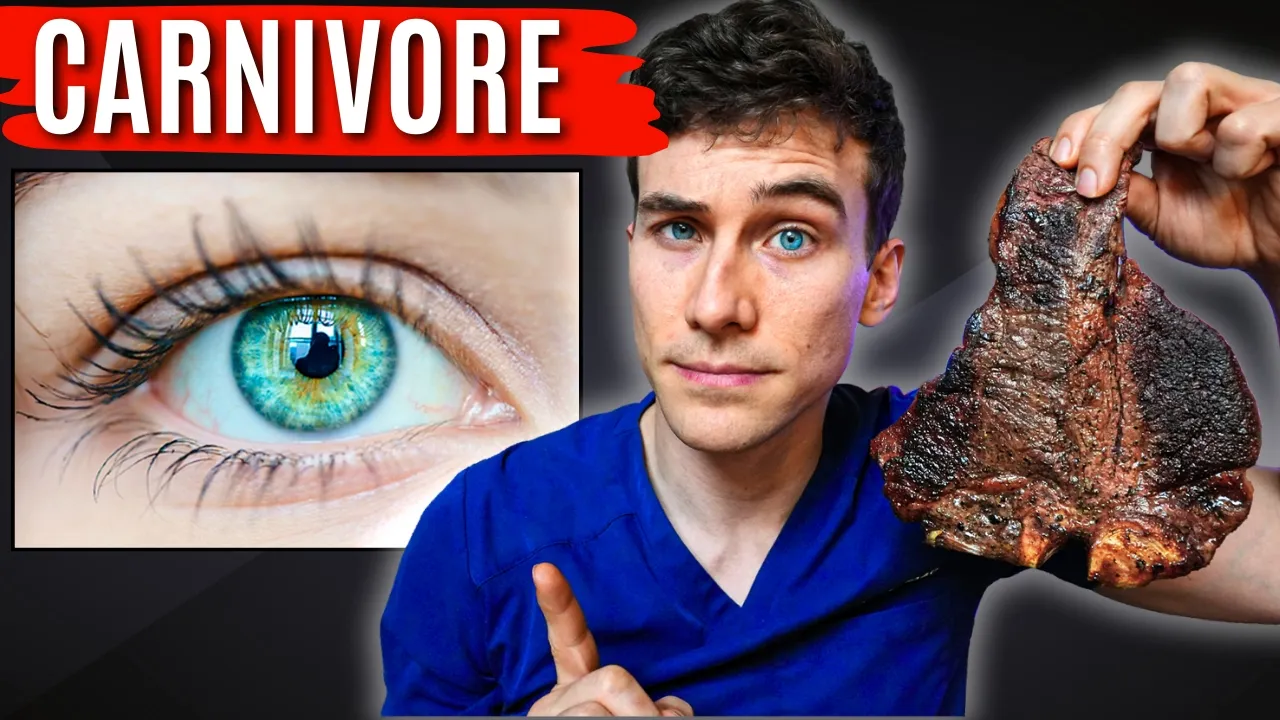
All right, so the carnivore diet has become quite popular over the last few years, and I've seen a lot of social media posts, as well as comments here in the channel, of people claiming that their eyesight has improved while on this diet, with claims saying that it has helped their cataracts, it's helped with their eye floaters, their dry eye, macular degeneration, everything. And if you follow the channel for any length of time, then you know that I have a pretty keen interest in both diet and nutrition, especially as it pertains to eyesight, both in terms of how diet can improve our eyesight but also prevent eye disease and blindness. So I've been very interested in this topic, and I've been digging pretty deep into the research on it.
But first, what is the carnivore diet? If this is the first time you've heard of the carnivore diet, this is an extreme zero-carbohydrate diet. Basically, people are eating only animal products, mainly that of meat, but absolutely zero foods derived from a plant source.
This means no fruits, no vegetables, no grains, no legumes, no nuts or seeds. You had me at meat tornado. And if this sounds extreme to you, or risky, or kind of backwards because you've always been told to eat your fruits and vegetables, then I wouldn't be surprised.
It's definitely sort of against the grain. And I'll be honest, as a healthcare professional, when I first heard about the carnivore diet, I was a bit of a naysayer. But I figured, for this diving deep into the research, let's pull a Ted Lasso and be curious, not judgmental.
Be curious, not judgmental. So in general, let's first review the possible benefits of a carnivore diet. First, a carnivore diet is in many ways an elimination diet.
This means people are not eating a lot of different types of foodstuffs, some of which people may be allergic to and not even realize it or sensitive to. Things like gluten sensitivity, maybe a sensitivity to a preservative, or even pesticides or unknown chemicals that could be in foodstuffs. Eliminating these foods may help remove some distress in their gut or remove immune reactions or systemic inflammation, which may leave some people feeling better with more energy, less fatigue, fewer headaches, etc.
Another way this diet may help people is that the carnivore diet is essentially an animal-based ketogenic diet, where the body is forced to burn fat as fuel, even turning fat into ketones in the liver, which then the brain can use for energy. Ketogenic diets, whether they are animal-based or plant-based ketogenic diets, have been associated with weight loss for some people and shown significant improvements in both blood sugar and insulin levels. And this, alongside increased levels of ketones, may have some health benefits, as ketone bodies produce more ATP per unit of oxygen versus glucose.
This means that the cells, or your mitochondria within your cells, can work more efficiently, producing less harmful byproducts and protecting themselves from damage. And this protection seems to even slow down some of the decline that we see in neurodegenerative diseases such as Alzheimer's and Parkinson's. Ketones have even been postulated to help suppress inflammation, help boost the production of brain chemicals like dopamine, and even alter how genetics work.
And not too surprising, but similar diets that have reduced refined carbohydrates in them, such as less cookies, less sodas, less kind of baked goods and things, have improved findings with our gut microbiome health, which a lot of research is finding that it affects so many things in our body and can even directly affect our eye health. But more info on the gut microbiome and the eyes in a future video. And finally, another possible benefit of this diet is that it may trigger a process called autophagy, which is a way your body can naturally recycle old content and even may influence your immune cells.
And if you recall from a previous video, we talked about fasting diets and eye health. Autophagy was mentioned there too. So just knowing all of this, all these different possible ways it may be beneficial, it's not surprising to me that some people have noticed benefits of this diet, at least in the short term.
Right? If somebody is eliminating foods they might be sensitive to, they're also eliminating highly processed grains or high-sugar sodas, all these refined cakes and cookies and things. They're also maybe losing weight.
They're going to be feeling good about themselves losing the weight, even if it's water weight. They can even have some positive benefits to hormonal changes from weight loss. So it makes sense to me why, again, in the short term, people can be having this excitement and just feeling better on this type of a diet because they're removing so much, such a big change from their diet.
Plus, I think some people just love the idea of eating a delicious, juicy steak multiple times a day. But now, how does a carnivore diet affect the eyes? Like, what is really going on here?
Now, the challenge with answering this question lies with the fact that the carnivore diet is still very new, and there's very little, if any, published research to support this type of diet. So going forward here, most of what I'm going to be saying is either going to be what I could find in the literature or what I could theorize to potentially cause this benefit or change to someone's vision if they are going to be going on this diet. First, carnivore diet and having better eyesight.
Now, I've seen several people claim that their vision improved with a carnivore diet. It's hard to assess how their vision improved. A lot of people describe their vision just being sharper, better, or at least less dependent on glasses.
"I stopped wearing my readers. I used to wear readers all the time. " One theory that could explain this is that people's blood sugars are actually coming down and stabilizing.
Elevated blood sugars can cause the lens inside the eye to swell, and so going on this type of diet and stabilizing the blood sugar, the lens may lose some of that swelling, and their vision could improve or maybe reduce or change the refractive error. This is actually something we see happen quite frequently in people who are diabetic and get put on medication, and then we see this shift in the refractive error. Two other possible theories I could come up with include improved mental clarity or focus.
This is something that is reported often for people who are either in ketogenic diets or even in fasting diets, as perhaps using more ketone bodies in the brain can improve this mental sharpness or clarity. And so people's perception of their eyesight is that everything is getting a little bit clearer and more in focus. Otherwise, perhaps this type of diet could also be changing their autonomic nervous system, which does have an influence on your pupil size.
And if your pupils get a bit smaller, then your depth of focus is enhanced, and people can see a little bit better up close without having to rely on things like reading glasses. This last theory is a little bit of a stretch, but again, I'm trying to reason why some people could be reporting these. Now, what about carnivore diets and dry eye disease?
Again, there are no published research studies on the carnivore diet or even ketogenic diets that support that it could help with dry eyes. But if I was to have a theory of how this could affect dry eye, it would have to do with reducing systemic inflammation. We know that inflammatory proteins play a major role in destabilizing the tear film and what dry eye disease truly is.
And if you have reduced systemic inflammation, that would potentially reduce inflammatory proteins in the tear film, helping reduce inflammation in the lacrimal gland, where tears are produced, as well as reducing inflammation even in your skin. A huge part of dry eye is inflammation in the meibomian glands of your eyelids that produce the oil that helps protect the tear film and stabilize it. And there are some small studies that at least support that ketogenic diets may help with acne in some cases.
However, I will add here, you can find similar support for acne and other skin conditions with more plant-based diets, not just ketogenic or carnivore diets. In fact, this reduction in inflammation theory is the exact same reasoning why vegan or more plant-based diets have been theorized to help with dry eye disease as well. One case where a carnivore diet could make your dry eye worse, or really any diet for that matter, has to do with water or electrolyte imbalance.
So I think no matter what you're eating, just be mindful of how much water you are taking in and your electrolytes, especially if you're somebody who exercises a lot or sweats a lot. All right, what about the carnivore diet and other major eye diseases? Things like cataracts, macular degeneration, and glaucoma?
Again, I could not find any publications looking at the carnivore diet and these major eye diseases specifically. However, there are some mechanisms that may be supportive for cataracts, the condition where the lens inside the eye becomes cloudy and opaque, usually just due to oxidative stress and age. One possible mechanism could be autophagy.
Again, this is where your body naturally starts to clean house to remove cellular waste. Your body is technically always going through this. However, diets such as being in the ketogenic diet or even in a fasting state are known to perhaps enhance this autophagy effect.
And a recent publication in just 2023 did find that errors or mutations in the autophagy proteins inside the lens play a role in human cataract formation. In addition to this, perhaps improved glucose levels may help reduce any blood sugar problems that may have an effect on cataract formation, as this is something that we frequently do see in poorly controlled diabetics. Now, glaucoma and the carnivore diet are also on a similar page.
Again, glaucoma is where the nerve that connects the eye to the brain slowly dies over time. But the only real theory I could come up with is, again, this autophagy theory, but more for its neuroprotective effects. But even a study did urge caution about applying autophagy to glaucoma because it still is a bit controversial right now.
And while again, there's no studies specifically on the carnivore diet, there are some publications showing support that maybe ketogenic diets may be beneficial for glaucoma prevention. One interesting note I will add here is that in one large study that followed low-carbohydrate diets, it was found that there was no reduction in risk for glaucoma for people who followed this diet. However, the people who did follow the low-carb diets but happened to have more of their protein and even more of their fat from vegetable sources had about a 20% reduction in papillomacular vision loss, which sort of supports the opposite direction—that vegetable sources are, in fact, maybe healthier.
Again, not a direct comparison, but this is something I thought I would add. Now, as far as carnivore diets and age-related macular degeneration, or AMD, I think similar things could be said about autophagy and AMD. Because we know that dysfunctions in autophagy, as well as inflammation, oxidative stress, and even mitochondrial dysfunction, all play a role in the pathogenesis of AMD.
Now, if you continue to dig into carnivore diets, or you already have, then there's a good chance you're going to get introduced to this very robust narrative around the dangers of toxic seed oils. This is often preached by strong carnivore advocates and other health gurus as the cause of modern disease, weight gain, cancer—just about everything, it seems like. And a benefit of the carnivore diet, as many people will preach, is that not only are you removing these toxic seed oils, but you are replacing them with the healthy fats of butter and animal lard.
And the reason I bring this up is because, interestingly, one of the more prominent faces in the carnivore community that talks about this narrative is Dr Chris Knobbe, who is a no longer practicing ophthalmologist, but he adamantly believes that the ingestion of these toxic seed oils happens to be the primary and proximate cause of macular degeneration, primarily that of ingestion of omega-6 linoleic acid. I have seen his lectures many times over the last six years or so, and while he does give an excellent presentation, and I can independently find some smaller, not necessarily robust studies, but I can find some studies that do support his narrative in that linoleic acid is associated with a risk of AMD, I can't help but find holes in many of his arguments. For one example, the largest studies on macular degeneration include the AREDS 1 and AREDS 2 studies, with over 8,000 participants.
And they found that there was only a nominal association with linoleic acid intake and the progression to more advanced stages of macular degeneration. Whereas people who ingested higher quartiles of saturated fat intake, which goes in line with his recommendation of eating more butter and lard, happened to have an even greater risk of having an association with advancement of macular degeneration, which sort of goes against his theory. It doesn't mean he's wrong, but this large of a study does cast some shade on his theory.
Now, I don't have the time to break down all of Dr Knobbe's arguments, nor do I think we should try to boil down macular degeneration to just one mechanism. We know the disease is a lot more complicated than that. But if you are interested in learning what science truly says about the effect of seed oils on our health, then I'd love to refer you to Dr Gil over at Nutrition Made Simple.
He makes really amazing educational content all about nutrition and even covers this topic. Plus, I'll put some other links to trusted resources in the description below so you can find that as well. Because this narrative on the toxicity of seed oils is kind of everywhere across the internet, and I want you to have access to more trusted resources.
Now, probably the biggest challenge that I've had in doing this research on the carnivore diet related to eye health is the fact that there is a plethora of research, and in fact, most of the research out there about diets and related to eye health shows almost the opposite. That eating less meat, especially less red meat, and eating more plant-derived foods like green leafy vegetables and some oily fish is more protective in reducing your risk of not only macular degeneration but other age-related eye diseases, primarily from the high quantities of antioxidants and other phytonutrients in those foods. However, we'll save more of that research for future videos.
Now, after hearing all of this, if you're somebody who's already following a carnivore diet, or if you are just interested in starting it, just keep in mind that, again, right now, there are no published studies to validate its benefits nor its safety. And that's exactly why a lot of healthcare professionals have concerns about it, primarily for the following reasons. Number one is that eating a carnivore diet usually has higher levels of saturated fat and cholesterol in it.
And eating higher levels of saturated fat may increase your LDL, or bad cholesterol, as well as your ApoB levels, which may have a higher risk of cardiac issues. Also, as illustrated in a recent video from Dr Dr, where a person who had a carnivore diet had elevated levels of cholesterol so high that they developed xanthelasma on their skin, which also does appear on the thin skin of the eyelids for some people. Two is that eating a lot of meat can also come with higher levels of sodium intake, which is also associated with not only high blood pressure but kidney disease and other negative health outcomes.
Three is that the consumption of red meat and processed meat is associated with higher risks of certain types of cancer, such as colon cancer and rectal cancer. Four is that, in addition to all of this, elimination of many other foods that may provide micronutrients may end up in deficiencies. Things like vitamin C deficiency or scurvy, for example, can also be of concern, especially if things go unchecked.
Five is that the carnivore diet has almost no fiber in it, which may lead to not only constipation, but fiber is known to be vital for the gut microbiome. And diets with more fiber have been associated with not only less risk of cardiac disease but less risk of cancer and other ailments. And then finally, six, people who are at risk of kidney or liver disease may also not fare well on this diet, as higher protein levels may put them at risk of kidney and liver failure.
Now, if you've made it this far into the video, and I think this video is going to be one of my longer ones, I just want to say thank you so much for sticking around. But I also do encourage you to leave your comments in the comment section below. Let me know your thoughts about the carnivore diet, ketogenic diets, if you've tried those.
If you are a strong supporter of the carnivore diet and you have published research, anything to support the methods or a mechanism or anything, leave that in the comment section below because I want to read that. Otherwise, if you want to learn more about things like the gut microbiome—because I mentioned that a few times—there's a lot of interesting research on the gut microbiome and how it affects the eyes, and we'll be covering that in this next video here. Thank you so much for watching.
Keep an eye on it and stay curious. We'll see you in that next one.