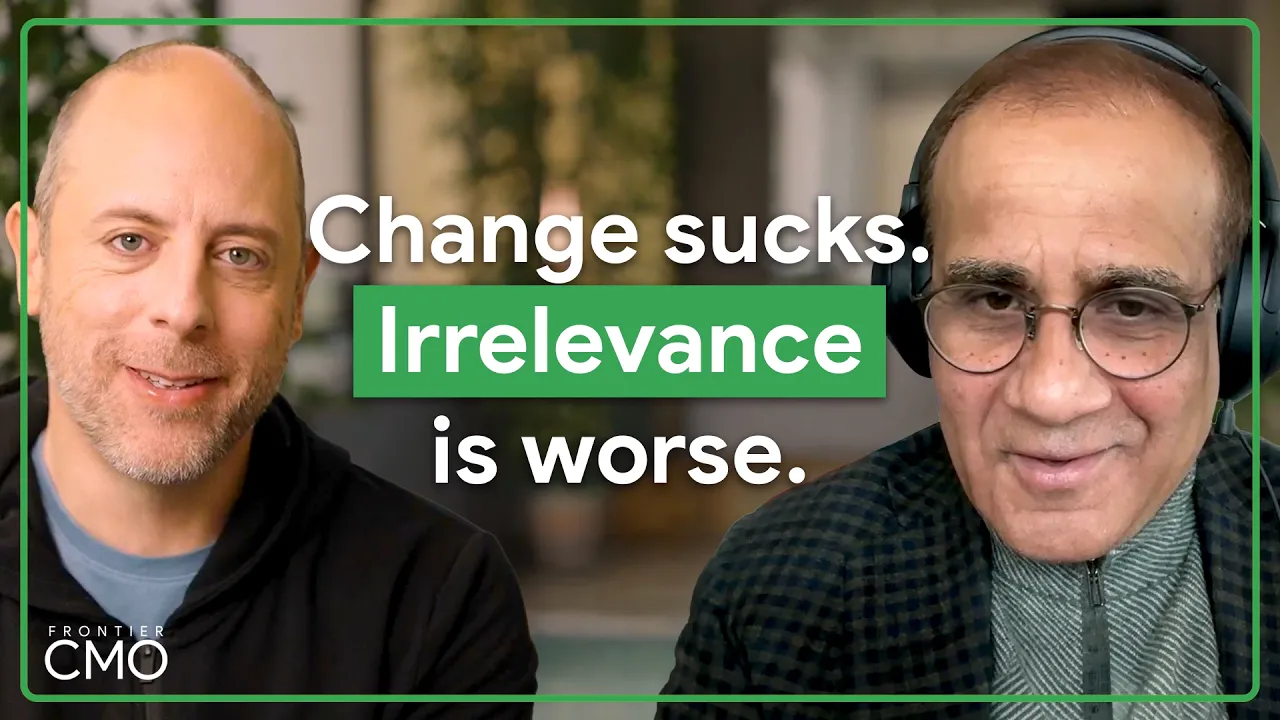
So what I basically began to realize, and I've written about this, that change sucks. We kept saying change is good, but when you change, it's really difficult. And the more senior you are, the harder it is.
So I eventually basically decided this change sucks, but irrelevance is even worse. Say that again. Change sucks, but irrelevance is even worse.
I can go along with that. Yep yeah. Business is all about reinvention.
We are constantly adapting to New things. The invention of the internet, the explosion of the mobile phone, and now AI are just the most obvious catalysts of change. My guest today has a front row seat to that change across technology, culture and marketing.
And just as interesting is his own personal reinvention in recent years. Richard tobaccowala is the former chief growth and strategy officer at Publicis, and one of marketing's most influential minds. For 40 years, he's helped businesses, large and small navigate transformation.
In recent years, Richard has personally reinvented himself, becoming a consultant, author, and advisor to CEOs on the future of work. In this episode, Richard shares his spicy yet practical ideas on the evolving role of CMOs and one of the sharpest observations I've heard all year. Change sucks, but irrelevance is even worse.
Whether you're leading a global organization or navigating your own reinvention, this episode is for you. Here's Richard. Richard, welcome to frontier CMO.
I'm thrilled that you could be here today to talk with us about all things work, all things AI and all things creativity as this world changes around us. Learning from your 37 years of publicists and seven years beyond, let's have a conversation. Thank you very much.
I'm so glad to be here. Let me ask you this. Let me put you on the spot.
What is your spicy thinking about the marketing industry today. So my spicy thinking about the marketing industry today, they've lost the plot. Marketing has lost the plot.
There's a longer timeline for this. And you, in your long career, you're 37 years at a publicist. You've lived through these eras of transformation and change.
This didn't just happen in this moment. At what point did you come to this realization of the ecosystem, the bubble that all US marketers are in. Did that take you leaving the industry and doing your next thing, or did you see it while you were inside publicists?
So we saw it inside publicists. We saw it in around 2010, 2011. And what we began to realize was, shit, the world is changing, and our marketers are going to actually require something more than what we currently have.
And so we wrote a strategy and that ended up us going buying things like SAPIEN and epsilon and things like that. I wanted to ask you about the publicist is currently having a generational, of generational successful run in the marketing services industry. That all happened off the back of you being the chief growth officer and chief strategy officer.
So, and you're saying it was as early as 2010 that you started sowing the seeds for this. We helped set up the strategy and we were involved in purchasing some of the key acquisitions. And so what can we learn from how you did this to make this generational run for publicists now.
So first of all, obviously, I remind people it's weird. There are lots of people. So I'm just going to claim that I was involved in it.
But one of the things that I think it's important this is around 2000, when we began to see mobile technology and social media begin to happen, it became clear to us that this was enabling people to have incredible power and that our clients would require additional skills, both not only in reaching these people, but in rethinking their organizations. That was one. And the other it became very clear to us that we needed a differentiated data strategy versus the Google's, and at that time, Facebook and Snap's cetera of the world.
And so there were two things that were done to a great extent of the future does not fit in the containers of the past, which is one of my lines, and that's my Substack. Then it could be that our clients organizational design needs to change. For that, we're going to basically need to help them not just in marketing transformation, but in business transformation.
Those two things led to SAPIEN and epsilon. How much work. How many months years strategy sessions did it take to get to that sort of crystalline distillation of this is what's actually going to be happening.
Here's what we now need to do to response. I would say that would probably was about four or five years of work on figuring out exactly what needed to be done, 3, 4 years in acquiring these companies. What went wrong.
Just give me one or two examples of stuff which was incredibly hard that you hadn't accounted for. So I think the New team has done everything really well. So I don't think they made any mistakes.
But I'll tell you about the mistakes I made. I don't know if anybody else made these mistakes, but at least I made for sure. So one was we underestimated the willingness of people to change.
So what I basically began to realize and I've written about this, that change sucks. We kept saying change is good, but when you change, it's really difficult. And the more senior you are, the harder it is.
So I eventually basically decided this change sucks, but irrelevance is even worse. Say that again. Change sucks, but irrelevance is even worse.
I can go along with that. Yep right. And so what basically began to happen is we underestimated what I call the fourth, fifth and sixth keys to change.
So I'll tell you what the six keys to change are. And we were so good at the first three that we didn't get four or five. Six right.
I'm going to hold these up. I'm going to run through these rapid fire. So the first one is have a strategy a strategy.
I believe we were the only company in our space that actually had a strategy. An actual strategy and a strategy is called the way we defined it was future competitive advantage. Understand where your customers or your clients are going to want in the future.
Understand who you're going to compete with in the future. Understand what their customers people are going to want in the future, and figure out how to basically against future client needs and future competitors. You get an edge.
That's one. Have a strategy. You were the head of strategy and you had a brilliant strategy.
And it's the founding thing. I love it. Number two was once you have it, you begin to realize that you don't have all the skills you need.
So you start investing in either upgrading your skills or you buy companies, which is M&A. That's what we did. Epsilon SAPIEN before that.
We're done. Digitas Razorfish. All of that.
Third is you reorganize. So strategy, M&A reorganization. Now at this particular stage, you tend to put out press releases and balloons and coffee cups and things are done.
But the big thing we realized later is everything is easy till people get in the way. Because 4, 5, 6 is you have to explain to the teams why this strategy and M&A and organization is good for them. So we didn't have the story as to why it's good for the people.
And then the last thing was we needed to invest in training. So the idea basically is having a strategy, having M&A and having reorganization all are very hard to do. We did those.
But even harder is why is it good for the people. How are people incented correctly to do the right behavior. And where is the training for the new skills.
And what I'm scared about is many companies are going to be repeating our mistake in this AI age. Because they're all fixated on AI, AI, AI. I actually believe that every advance in technology puts a premium on talent that this is the time that for every dollar you invest in technology, you need to invest $2 in talent.
Not basically take out talent to buy technology. I believe AI is going to be like electricity. Everybody's going to need it, but it ain't going to be a differentiator.
So for instance, if people say, let's write an AI strategy, I say, do you write an electric strategy. Does PNG say they're better than Unilever because of electricity. Are you competing with people using candlelight.
Tell me, who isn't using AI. Those six things. Brilliant I made notes, which I don't normally do, but one of the things that I'm seeing, and I've been saying for a little while and writing about, is this notion that we're end of the first era of AI transformation, where it's all been about efficiency, and we need to stop thinking about just making the ways humans have worked 10% 20% 30% 40% more efficient and actually start thinking about what more we can do with AI enabling all sorts of whatever.
So this is my basic belief is so the AI right now we're basically focusing on efficiency and effectiveness. So give you an idea I'm going to tell you a story which is now 20 years old. When I was at Publicis, sometimes companies would call publicists and they asked if I would spend some time with them.
So one of them was a newspaper company called the New York Times. And right. And so I would go around there and talk about the internet to them.
And all the competitor newspapers were thinking about how do they use digital to more efficiently get subscribers, how to route their trucks better, how to buy paper cheaper. What the New York Times did is they did the following. What if the future of newspapers is not newspapers.
What if the future is not print but it's multimedia? What if it is not New York City. It's the globe.
What if it's not printing what time of day, but 24 hours a day. So today they used to have two million subscribers then in print. I think they have less than a million subscribers today in print, and they have about 12 million online paid subscribers.
Their stock price is at an all time high. 30% of their revenue comes from non-us sources like Wordle and menus and recipes. So to a great extent, the New York Times is a multimedia lifestyle company with the name of a newspaper on it.
This is the AI equivalent of what The New York Times did, is what people have to think about versus how do we do what we currently do cheaper and faster and better. Because my basic belief is doing pathetic things faster and more pathetically still keeps you pathetic. So that's the first thing I would do.
And we're going to get to the second and third and fourth because you said there were four. But I just want to ask in some ways, what you're talking about is CEO c-suite to the n-th degree, right. The fundamentals.
So what could a CMO. What is it. So there's ways of working in marketing.
And I guess marketers can influence the c-suite and should be at the high table. But just bring it down to what marketers need to do versus what maybe the CEO has to be thinking about. The single biggest thing the CMO should basically do is be the voice of the three voices.
They need to sing in three voices. They have to be the voice of the future people. People is better than customer.
Consumer what will people want. They need to bring the people's perspective in, because there isn't anybody on the board that represents the people's perspective. So that's always meant to be doing that.
They're supposed to be representing the people. That's number one. The second thing the CMO should do is be the voice of the outsider and the future.
So not only of the people, but the future. So one of the things that I did is I would take our board for what was called learning tours. OK And we would go and we would spend time in weird places.
So I took people to AOL before people knew there was AOL, I took them to Broderbund and Arthur's teacher trouble. Before people knew CDs. So the whole idea is they have to see it.
They got to see this shit. So my old stuff is take them to the future. And the third thing that you want to basically do is identify world class companies to partner with or purchase.
That will actually help. And these three things are not what CMOs should are doing enough of. Because my whole stuff is have the rest of your team do all this other optimization of this and going to this conference and that conference.
You should be the voice of the person, people future customer, the voice of the future and identify partnering because we're living in a connected world. And who are we going to partner with. Those are the three things I would do as a CMO.
What I love about all this, Richard, is it's so logical and obvious, and yet we somehow don't see the wood from the trees and get on and do it. On that second one, though, the voice of the future. Can I just ask you as an individual, as a thought leader, as a strategist, where do you turn to.
Where do you get your stimulus. How do you see the voice of the future today. Now I keep a list and I have 66 different resources I use on a weekly basis.
I have a list of I'm not talking about streaming services. But 66. So I'll give you some of that.
Is that the perfect number like 64 is to not enough and 67 is too much. It's just 66 OK. But the 66 that I do have is I use things like the traditional ones.
So I use the New York Times the Financial times the Wall Street Journal, because I consider them to be really good. But I also use people like om Malik. I obviously use Ben Thompson strategy.
I use the information, and what I do is I invest significant amounts of money in learning because the other thing is what a marketer has to do is they got to connect dots, OK. The other thing that I do is I surround myself with people who remind me continuously, which is very easy for them to remind me that I have lost the plot. OK, I go to people and say, can you explain to me why my thinking is wrong.
But the whole idea is do you have people who actually ask you to think differently. The other thing I would ask every CMO to do is once in a while, not all the time. Build a case for the exact opposite of what you believe.
And if you're a very successful company CMO, you may not know this, but you're constantly in defense mode. Go into attack mode. Think about how you would destroy your company if you had all the assets of your company.
You had no constraints, excepting what you do has to be legal, technologically possible, and will break even in 18 months. Because what I'm finding in most cases is marketers talk big, but they imagine small. Is there a company who you think has thought big enough.
Is there someone who really admire and actually has transformed. So there's a lot of that. But I would say someone who did a lot of inventive things, whereas a DoorDash for instance, they've done a lot of interesting things.
And what I'm particularly interesting is for the way like a PG or a Unilever are reinventing themselves are very, very interesting. And so my basic belief is everyone talks about Liquid Death, but most companies are much bigger, much broader, much deeper. And I think there's extraordinary medium to large companies that are doing stuff that are very, very big.
You all are one P&G's, one, Unilever is one. DoorDash is one. There are several of them.
But what they're also doing, and this is one of the things that I'm fixating a lot on is this, which is we are truly in what I call now tectonic times. I don't even call it transformational times. So I call it tectonic times.
And my basic belief is in tectonic times, companies don't change. People do. So I always ask people, tell me your people strategy.
I'm not really interested in your AI strategy. They don't have a people's strategy. They have an AI strategy.
They should recognize this. The biggest marketing capacity in a company is its existing employees. Many of these companies have so many employees.
100,000, 50,000, 200,000. Each one of those are media companies. Each individual is a media company.
They may have a reach of one, but it may be a very influential reach, or they may reach of a lot of other people in the course of a week. Between everything that I do as a self-employed author. I think I reach more CMOs and CEOs than most people who read our age.
How did I do that. By publishing every Sunday, by having three different podcasts, all by myself. And my whole stuff is imagine you've got 100,000 of me who actually better than me.
Why don't you use them to unleash your company. Why are you only thinking about outside influencers. I've been talking about how.
And this is typecasting me, Tony Stark. The Marvel character, genius, entrepreneur, businessman. Put him in an Iron Man suit.
He becomes a superhero. And that's the mindset shift that we have to take that. Take your employees, give them the Iron Man suit, and they will become superheroes in your behalf.
They will become superheroes in your behalf. So I've written about the future is about work and not jobs. And jobs are a silly phrase that work is going through.
So my whole stuff is like, jobs are like yesterday's news. You have to learn how to operate like a company of one. And in order to learn to operate like a company of one, you need three things.
And you can do it today. At any time in your career. You're five years out of school, you've just become a CMO.
You're a senior CMO. Here's what you should do. Number one, build massive skill sets and craft.
Be good at something besides ordering, allocating, delegating, and giving people budgets. Be good at a craft. It's one clarify.
So use craft and then skill. They're different. Build massive skills.
Yeah build massive skills while also building craft, which are the two things. So yes, what basically happens is my craft is writing OK. My skill is thinking about and simplifying the future.
I wonder how many people listening to this right now could articulate succinctly what their skill is and what their craft is. The second is be very generous. Help people like crazy when people are unemployed.
Take calls. In fact, go make calls to people who get unemployed and just be very nice to people all the time as much as you can. Generosity is a strategy.
It feels good. It's a nice thing to do. It's good karma.
Doing the right thing is doing the right thing. Build skill and craft. Do the right thing.
And the third one is this. Look at your calendar for the last two weeks, and put all the stuff you've done into two different columns. Column number one is the time you were spending, allocating, delegating, measuring, monitoring and checking in.
How much of your time as you did that, and then how much of your time did you build, sell, mentor, create or make or guide. Look at those two. If one of them this left one is more than 50% Reduce it.
That's going to be done by machines. That's not real added value. And part of this whole idea is also learning.
If you are spending an hour a day learning, you're falling behind. You're faking it. What are you learning about today for your two hours today in your schedule, and you're giving up time for it to do this, so maybe you don't have as much.
I make sure that I spend one of my two hours on learning. Very old fashioned. I read a physical book.
If you basically spend time learning, you become very curious and you're more likely to ask stupid questions because you don't feel stupid asking stupid questions. And when you ask stupid questions, people help you. They don't actually think you're stupid.
They think you're curious. So I go around and I take things and I keep asking people, what does that mean. Or what does this mean.
And then they tell me it's so beneficial because I truly believe that we're living in a world of abundance where people want to help, but you have to also want to help them. There's such an unbelievable opportunity of amazing things in the world and amazing resources. I mean, I mentioned YouTube countless hours you can spend learning from the most incredible minds.
All right, there, I'll give you one very weird way to learn. On Dolan, what are the ways of learning. AI is pay for x.
I've created a list called so I have 50 people I follow on I. You don't have to follow me. You can follow my list.
So I basically go through the list every day and all of them are talking about the latest things and what they're doing. And I bookmark all their latest stuff, and then I go and replicate exactly what they're doing to see what's actually happening. So they basically say, here's 12 ways to replace Goldman Sachs with Claude.
So I go and say, OK, let me try that or put in this thing and do that. And I put it. So what I do is I on I spend like time looking at these people and seeing what they're doing.
And it's all easy. It's all available. The world's greatest teachers are available.
I do something similar. I generally find the hit rate is about 60% but people are overclaim. But what's really interesting is it may be 60% right now, but is this going to be at 90% and 100% in two years.
And you can really make it opens your eyes. My whole thing is you don't need power and wealth to succeed in the future. You need curiosity, humanity and hunger.
And I will leave you with this. I'll give you a story. So I spoke at an event where it was about marketing and advertising technology investors.
So were like private equity people, hedge funds, VCs. And it was the New York Times center. And they'd asked me to be the opening and closing talk.
OK, so I did an opening, and then I had to listen to everybody all day long and then summarize at the very end, which is great for me because I got to learn from a whole bunch of people. And I said, here are some of the learnings that we've had, and I would now like to leave you with a mindset. So I said what's happening is we are all moving into an undiscovered country called the Future.
So therefore, to be successful, we need to think immigrants. And what do immigrants think immigrants think Outsiders. Remember I told you the CMO has to go outside.
Immigrants think underdogs. Who's going to come and get me. Not my existing competitors.
Where's the Uber and Teslas of my category or the Dollar Shave clubs and immigrants are willing to take short term pain for long term gain. So whether you invest in education or invest in growth or invest in products or invest in service, that's what's going to happen. So if you want to succeed, think an immigrant.
That could be a good t-shirt. Yes so, Richard, just for a bit of fun, if I could wave my magic wand and make you a CMO right now. And you wanted to be a CMO.
Which company would you choose to be the CMO of and what would be the first three things you would do as the new CMO of this company. So the CMO of a company that I want to be of I would not name because I'm not sure I know the name of it, but it would be a company that has got a small group of very talented people with talent everywhere, leveraging AI first to focus on real human needs, either in the area of connection or health, which I think are big needs. So with that being said, what I would do is a CMO, I would first make sure that I free up 20% of my calendar one day every five to travel outside to see things not in my category, to free up time, one hour a day on the other days to learn new things.
And the other is to go out of my way to make sure that at least once every quarter, if not once every month, I go to a conference that has nothing to do with my industry, go to a concrete conference, go to a radiology conference. Because in connecting dots between categories is where the ideas are. Great answer.
Rishaad this has been wonderful. Thank you so much for your time. I want to ask you a couple of rapid fire questions.
You call this the signal and noise section. OK, so rishaad signal or noise books are immediately outdated in the age of AI noise I would agree. Signal or noise.
Remote work hurts culture noise, signal or noise. If you're not freelancing right now, you will be soon signal. If you don't have a side hustle or side gig, you will soon have to have one.
I have two more signal noise. Spending 30 years at one company is obsolete that I believe is noise though reality is, it's unfortunately soon going to be a signal. But I think it's noise.
It's what you do during those 30 years, rather than you could be spending 30 years in 30 different companies doing the same thing, or you could be spending 30 years in one company doing 10 different things. Signal or noise. Jobs are dead.
Work isn't that signal. Jobs are not dead. Jobs are dying.
But work is growing. I found that all super interesting. Richard, thank you so much for the time.
This has been wonderful. I've really enjoyed and you nailed all those incredibly insightful lessons around what marketers need to hear right now. Really great.
Thank you very much. This was great. Thank you so much.
Before we wrap, I want to leave you with three takeaways to carry into your week. Think of these as your field notes from the frontier. First, stay curious.
Richard spends countless hours reading, learning, researching, and exploring new ideas. Curiosity is about survival, but it's also a strategy. Use it.
Second, build and hone your skill sets. Identify your craft and learn how to articulate it. It could be storytelling, leadership, anticipating the future.
Whatever it is, use it, hone it, and lead with it. Because in a world that is being automated, that will be your differentiator. Third, reinvent before you're forced to.
The future doesn't care how successful your old playbook was. The leaders of the next era will be the ones willing to rethink, relearn, and reinvent themselves before they absolutely have to. So if you keep just one thing from today, change is hard and usually sucks.
But staying still is riskier. Be sure to follow, rate and review frontier CMO on YouTube or wherever you get your shows. For research, case studies, and tools to help you lead through this next platform shift, visit google.
com, where we track the signals and share what leaders are actually testing in real time. We'll be back with another leader operating at the frontier. Until then, keep moving, stay sharp and stay out front.