welcome once again everyone we are still on 3.2 examination phase of the qms 3 path of workflow management uh we do have covered already the three activities and we are actually in the fourth so we have covered overview of examination phase using standard operating procedures and we have answered the question is that is qy that important and we are on 3.2.4 is there more to C than just platting data H so is there more to QC than just platting data so first of all um this question or this sentence has a an assumption first that
we are already performing or running quality control and second we are planning uh plotting the quality control on a chart therefore we have applied the principle that we have learned in creating a maintenance and QC log that we have created now is log to record to capture that um Act of uh performing the QC and we also have applied the and been convinced that quality control is really important all right so this is an example of an LJ chart now it's already a record because it's already populated all right so here you have the result
of your QC which is at 50 59 and 59 is where by the way this is your mean that's 60 the units is in micro per liter and this is 58 so 59 should be here and you see that plot this one is 61 so 61 this is 60 that should be here all right and this one is 57 somewhere here so basically as an LJ chart is where you plot your QC results your QC data so is there more to QC than just plotting it on an LJ chart let's find out but let's first
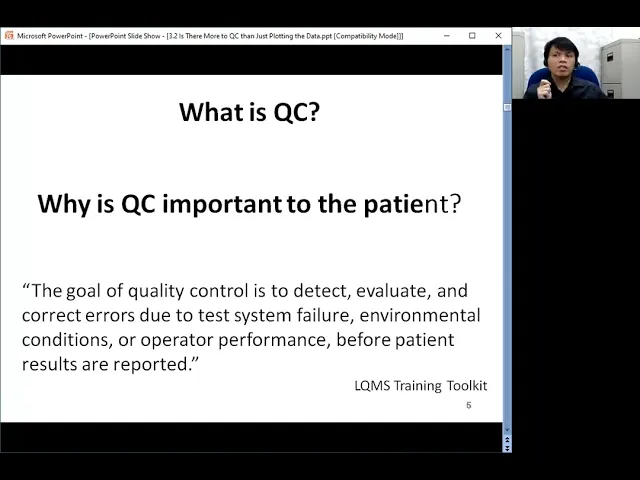
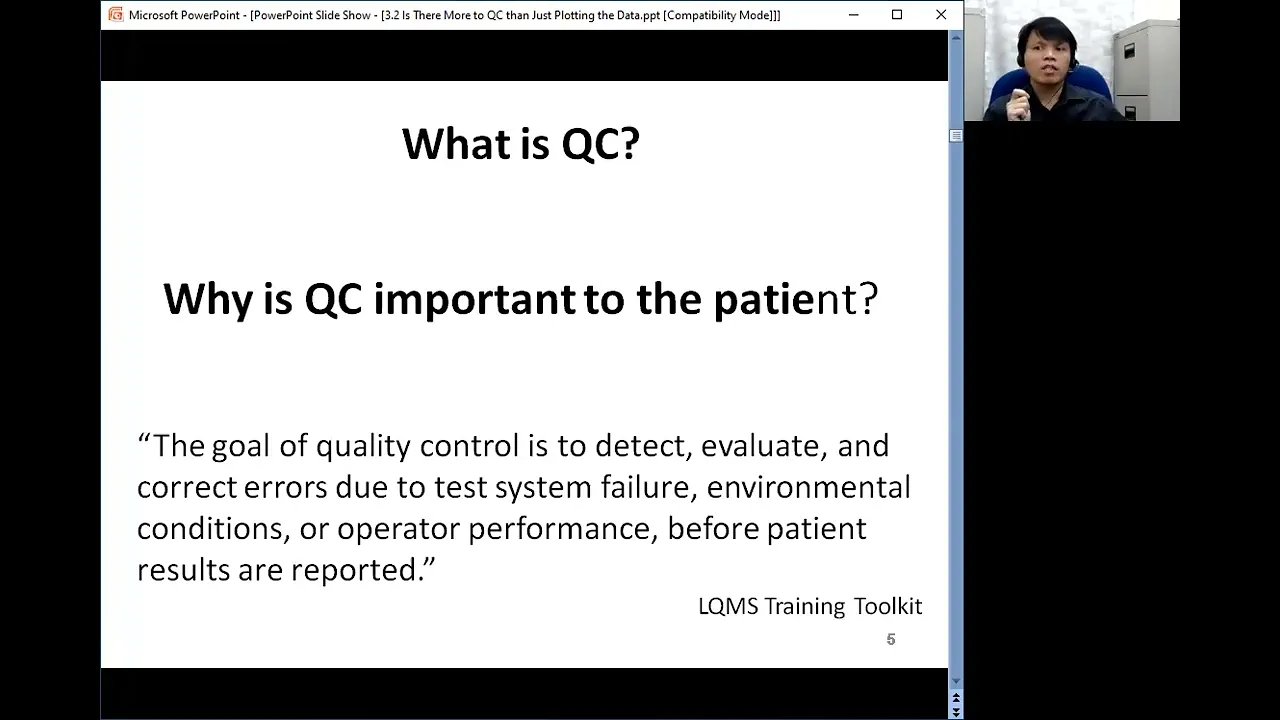
review the purpose the right quality control approach so if there's a right quality control approach there must be a what a left no there must be a wrong so the right quality control approach can detect and prevent errors in this activity participants learn the importance of establishing acceptable ranges for control material and the importance of control rule selection in interpreting changes in the analytical system what is quality control why is quality control important to the patient so let me quote coming from lqms training tool toolkit this one is powerful the goal of quality control is
to detect evaluate and correct errors due to what test system failure environmental condition or even operator performance before what the patient results are reported so Q is very important because it will verify if we are releasing um patient results that are accurate reliable timely and interpretable so is it essential oh yeah definitely very essential because wrong patient results can endanger patient lives prolonged suffering both physically and financially because it can add significant cost both money and time wise to the patient treatment the right QC approach will detect and prevent errors now the categories of QC
or quality control based on AET type are quantitative semi-quantitative and qualitative so quantitative is measures the quantity of an analyte and basically it's numeric and normally you see a result with a figure a number and a unit in this case for example 5.2 milles per liter let's say this is glucose um semi-quantitative it also measures the quantity of the light but this is more of an estimate and we report it as Stace moderate plus one plus two + three and of course we have qualitative to answer the question the presence or absence of an analyte
so the reporting will be either positive negative growth or New Growth reactive or non-reactive our discussion as far as this activity is concerned is focused on the quantitative quality control